
대부분의 사람들이 자체 보관—자신의 암호화폐 자산을 보유하고 제어하는 행위—여행을 시작할 때 표준 단일 키 하드웨어 지갑으로 시작합니다. 단일 개인 키 또는 시드 구문이 모든 자금에 대한 액세스를 제어하는 이 설정은 자산을 중앙화된 거래소에 맡기는 것에 비해 보안에서 엄청난 도약을 나타냅니다. 당신만 키를 보유하기 때문에 진정한 재정적 주권을 달성합니다.
그러나 자산이 증가하거나 조직의 요구 사항이 더 복잡해짐에 따라 단일 키 모델은 치명적인 약점을 드러냅니다: 단일 실패 지점입니다. 그 하나의 장치가 파괴되거나 그 하나의 시드 구문이 발견되거나 유일한 키 보유자가 무능력 상태가 되면 자금은 잠재적으로 영원히 손실되거나 액세스 불가능해집니다.
여기서 점진적 보안 개념이 등장합니다. 은행 금고가 여러 보호 장치를 사용하는 것처럼 고급 사용자와 기관은 암호화학적 중복 레이어를 필요로 합니다. 이 기사는 표준 콜드 스토리지를 넘어 multi-signature(Multi-Sig) 및 Multi-Party Computation(MPC) 지갑을 탐구합니다—신뢰를 분산하고 인간 오류를 완화하며 진정한 자체 주권에 헌신하는 누구나 접근할 수 있는 기관급 보안을 만드는 두 가지 주요 솔루션입니다.
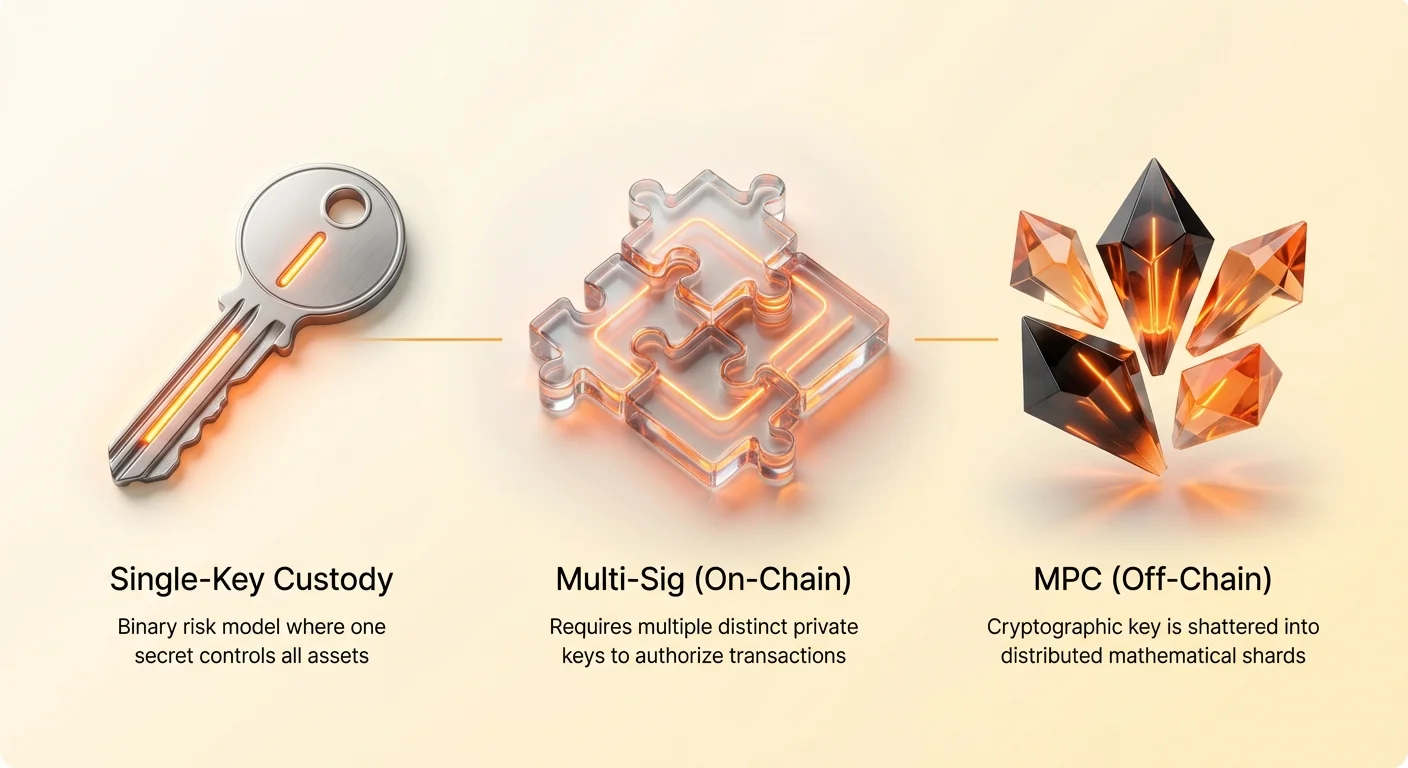
단일 실패 지점: 표준 자체 보관 검토
고급 분산 방식에 뛰어들기 전에 우리가 극복하려는 표준 설정의 한계를 명확히 이해하는 것이 중요합니다.
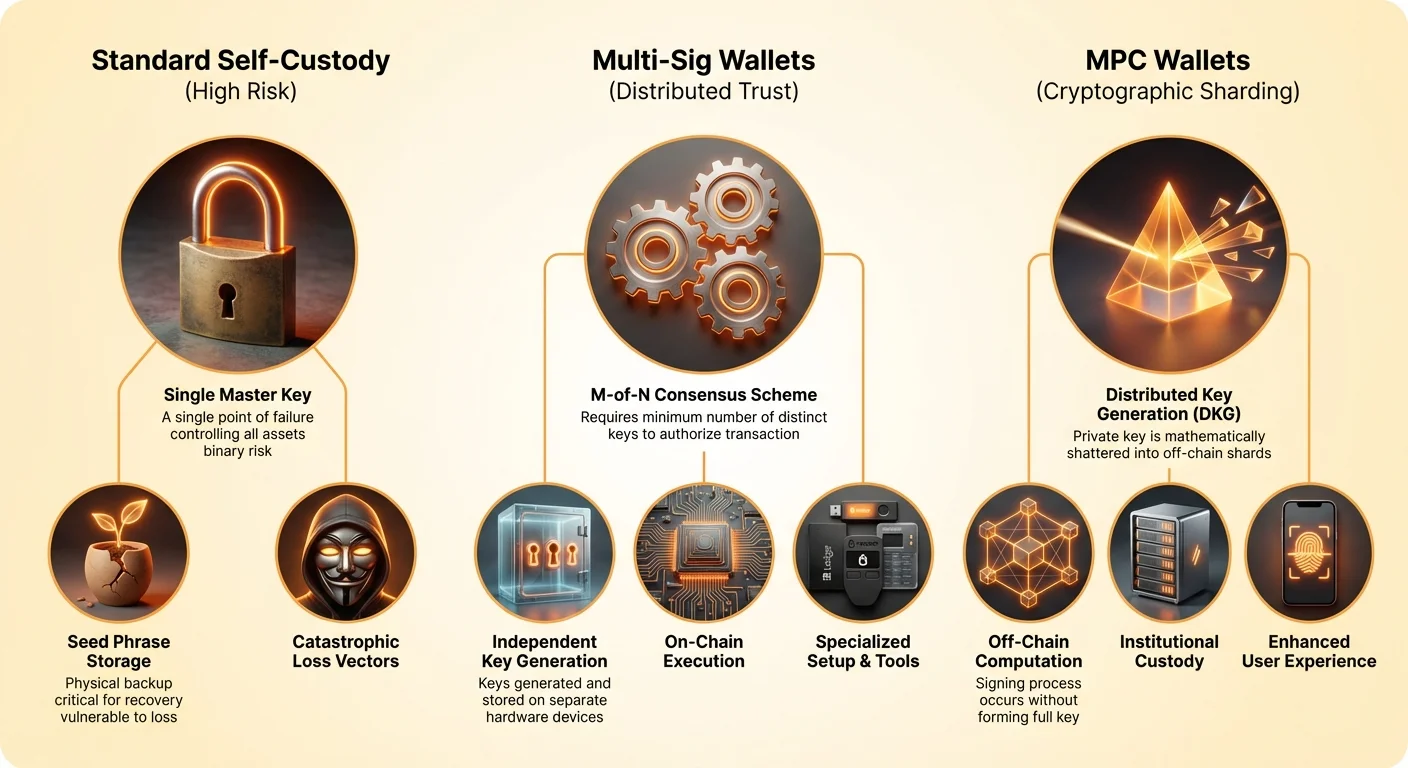
전형적인 자체 보관 지갑에서 모든 암호화학적 액세스는 일반적으로 12단어 또는 24단어 시드 구문(또는 복구 구문)으로 표현되는 단일 마스터 키에서 파생됩니다. 이 시드 구문은 해당 지갑 내 모든 자산에 대한 거래 서명을 위해 필요한 모든 개인 키를 생성합니다.
이진 위험의 문제
단일 키 시스템의 가장 큰 장점인 단순성은 동시에 가장 큰 취약점입니다. 전체 보유 자산의 보안은 이진적입니다: 시드 구문이 완벽하게 안전하거나 전체가 손상됩니다.
단일 키 보관과 관련된 위험 요인은 일반적으로 두 가지 범주로 나뉩니다:
- 치명적 손실: 유일한 물리적 저장 위치(예: 구문을 포함한 금속 플레이트를 파괴하는 화재)의 손실, 파괴 또는 복구 불가능한 손상.
- 도난 또는 강제: 저장된 구문에 액세스하는 해커 또는 키 보유자가 강제되거나 키를 공개하도록 강요당하는 경우.
상당한 양의 자산을 보유한 사용자에게 하나의 키의 완벽하고 영구적인 보안에 의존하는 것은 종종 받아들일 수 없습니다. 이 위험 평가가 여러 개체 또는 위치에 제어를 분산하는 암호화학적 솔루션의 필요성을 촉진합니다. 단일 실수나 공격이 전체 손실로 이어지지 않도록 보장합니다.
The Cornerstone of Distributed Trust: Multi-Signature (Multi-Sig) Wallets
Multi-Signature (often shortened to Multi-Sig) wallets solve the single point of failure problem by requiring more than one private key to approve a transaction. Introduced early in Bitcoin's history, Multi-Sig is a powerful, transparent, and proven security primitive built directly into the core protocols of many major blockchains.
How M-of-N Addresses Function
Multi-Sig works based on an $M$-of-$N$ scheme.
- N represents the total number of private keys (signers) that are designated to control the funds.
- M represents the minimum number of keys required to collectively sign and authorize any transaction.
For example, a 2-of-3 Multi-Sig wallet requires two out of the three available keys to agree before any funds can move. If one key is lost or stolen, the remaining two keys can still work together to recover the funds or sign new transactions, effectively mitigating the threat of a single key failure.
Critically, Multi-Sig addresses are established on-chain. This means the blockchain itself is aware that the address requires multiple, distinct signatures to validate the spending conditions.
Setting Up and Implementing Multi-Sig
Implementing Multi-Sig requires specialized software and hardware planning, as each of the $N$ keys must be generated and stored independently, ideally using separate hardware devices.
1. Independent Key Generation
Each participant (or each storage location) must generate its own unique seed phrase and private key. These keys should be generated on separate hardware wallets (e.g., a Ledger, a Trezor, and a Coldcard) to prevent any single device vulnerability from compromising all keys simultaneously.
2. Specialized Wallet Software
Standard single-key wallet apps do not support Multi-Sig configuration. Users must rely on dedicated client software that supports the process of coordination and construction of the required complex transactions. Popular examples include Bitcoin-focused tools like Sparrow Wallet or Caravan, or enterprise solutions that manage the signing workflow.
3. Creating the Shared Wallet
The $N$ public keys derived from the $N$ private keys are collectively used to create the final Multi-Sig wallet address. This address is then used to receive funds. When a user wants to spend the funds, they initiate a transaction request, and the $M$ required keyholders must individually sign the transaction using their respective hardware devices before the final, authorized transaction is broadcast to the network.
Practical Use Cases for Multi-Sig
Multi-Sig is not just a high-security measure; it is a vital tool for organizational governance and risk management.
Corporate Treasury Management (2-of-3 or 3-of-5)
A business holding cryptocurrency as assets often cannot risk allowing a single CEO or CFO to have unilateral control.
- Setup: Key 1 held by the CEO, Key 2 held by the CTO, Key 3 held by the Legal Counsel.
- Benefit: Requires consensus among leadership. If the CEO is compromised or goes rogue, the CTO and Legal Counsel can block unauthorized spending or move funds to a safe location.
Digital Inheritance and Estate Planning (3-of-5)
This is a robust solution for ensuring funds can be accessed after the primary owner passes away, without sacrificing security during their lifetime.
- Setup: Key 1 (Primary owner), Key 2 (Spouse/Family Member A), Key 3 (Family Member B), Key 4 (Trust/Legal Counsel), Key 5 (A highly secure cold storage location, e.g., a bank vault).
- Benefit (3-of-5): While the owner is alive, they only need two other keys (e.g., Key 1 + Key 5 + one family member) to move funds. After the owner’s death, the family (Keys 2, 3, 4, 5) can collaborate to reach the 3 required signatures without needing Key 1.
Escrow and Mediation Services (1-of-2 or 2-of-3)
Multi-Sig is the foundational tool for creating trustless escrow.
- Setup (2-of-3): Key A (Buyer), Key B (Seller), Key C (Trusted Arbitrator).
- Process: If the transaction is successful, A and B sign, and the funds release instantly (2 signatures). If there is a dispute, A and B block the funds. The Arbitrator (C) reviews the evidence and sides with either A (A+C sign) or B (B+C sign) to release the funds.
Navigating the Complexity of Multi-Sig Implementation
While Multi-Sig offers unparalleled resilience, its complexity means it introduces unique administrative and operational risks that must be carefully managed. This security layer trades simplicity for redundancy.
The Administrative Overhead
Managing a single seed phrase is difficult enough; managing $N$ independent seed phrases is exponentially harder.
- Storage Segregation: Each of the $N$ keys must be stored in geographically separate, secured locations. Storing all three keys in the same safe defeats the purpose of distributed trust, as a single event (e.g., a home invasion or fire) could compromise the entire setup.
- Key Tracking: The user must accurately track which specific keys belong to which $M$-of-$N$ configuration. As advanced users implement multiple Multi-Sig schemes (e.g., a 2-of-3 for daily operating funds and a 3-of-5 for legacy savings), the potential for confusion and error increases significantly.
- Setup Failure: A common pitfall is failing to thoroughly test the recovery process immediately after setup. If one key is incorrectly generated or the setup file is corrupted, the funds deposited into the address may be permanently locked.
The Critical Challenge of Recovery Thresholds
The beauty of Multi-Sig is its protection against the loss of a single key. However, losing too many keys results in an absolute loss of funds.
Consider a 2-of-3 setup:
- Scenario 1 (Successful): Key 1 is lost. Keys 2 and 3 can still sign transactions and move funds to a new 2-of-3 address.
- Scenario 2 (Fatal): Key 1 and Key 2 are lost. Only Key 3 remains. Since the threshold ($M=2$) cannot be met, the funds are permanently inaccessible, regardless of how perfectly preserved the remaining Key 3 is.
Advanced users must carefully calculate the $M/N$ ratio to balance resilience against administrative burden. Higher $N$ (more keys) increases resilience but exponentially increases the required coordination and management overhead.
Technical Limitations and Blockchain Footprint
Because Multi-Sig is an on-chain requirement, it has technical implications for transaction cost and privacy:
- Transaction Size and Fees: A transaction that requires three distinct signatures is significantly larger than a standard single-signature transaction. This larger data footprint means higher network transaction fees (gas fees) must be paid.
- Software Dependency: If the specialized wallet software used to create the Multi-Sig setup goes out of business or stops supporting the specific configuration, the user must rely on complex open-source tools to manually reconstruct and sign the transactions, which is often beyond the capability of even technically proficient users.
다음 진화: Multi-Party Computation(MPC) 지갑
Multi-Party Computation(MPC)은 분산 보관을 위한 더 새롭고 강력한 암호화학적 기술을 나타냅니다. Multi-Sig이 여러 독립적 개인 키가 온체인에서 서명을 조정하는 데 의존하는 반면 MPC는 완전히 형성되기 전에 단일 개인 키를 오프체인에서 수학적으로 분해하는 데 중점을 둡니다.
MPC는 Multi-Sig과 관련된 관리 복잡성과 높은 거래 비용을 해결하면서 분산 보안의 이점을 제공하는 것을 목표로 합니다.
키 샤딩 및 분산 키 생성(DKG)
MPC와 Multi-Sig의 근본적 차이는 키 생성에 있습니다.
- MPC 생성: 하나의 마스터 시드 구문을 생성하는 대신 MPC 프로토콜은 분산 키 생성(DKG)이라는 프로세스를 사용합니다. DKG 중 최종 개인 키는 단일 조각으로 계산되지 않습니다. 대신 즉시 암호화학적 조각 또는 샤드로 분해되어 다른 당사자 또는 장치에 분산됩니다.
- 전체 키가 절대 존재하지 않음: 결정적으로 단일 샤드 보유자는 전체 개인 키를 독립적으로 재구성할 수 있는 충분한 정보를 절대 가지지 않습니다. 전체 키는 이론적 구성물입니다—RAM, 하드 드라이브 또는 종이에 완전히 존재하지 않습니다.
MPC에서의 서명 프로세스
MPC 지갑이 거래를 서명해야 할 때 프로세스는 분산적이고 비동기적입니다:
- 요청: 사용자가 거래 요청을 시작합니다(예: "1 BTC 전송").
- 계산: 필요한 키 샤드 수(Multi-Sig의 $M$ 임계값과 유사)가 각 장치에서 로컬에서 복잡한 수학적 계산을 수행합니다.
- 서명 출력: 이러한 로컬 계산은 샤드 보유자 간에 통신됩니다. 이 통신은 키 샤드 전송이 아닙니다; 오히려 결합 시 유효한 단일 거래 서명을 생성하는 수학적 입력의 교환입니다.
- 온체인 결과: 결과 거래 서명은 블록체인에서 표준 단일 서명 거래와 동일하게 보입니다. 체인은 분산 서명 메커니즘을 알지 못합니다.
MPC 대 Multi-Sig: 기술 비교
MPC는 여러 레거시 도전을 해결하면서 특히 기관을 위해 독특한 이점을 제공하므로 종종 "Multi-Sig 2.0"으로 간주됩니다.
| 기능 | Multi-Signature (Multi-Sig) | Multi-Party Computation (MPC) |
|---|---|---|
| 키 상태 | 여러 독립적 개인 키. | 하나의 이론적 개인 키가 샤드로 분해됨. |
| 키 조립 | 각 서명 장치에 전체 개인 키가 존재(서명 중 일시적). | 전체 개인 키가 한 곳에 절대 존재하지 않음. |
| 온체인 발자국 | 블록체인에서 명시적으로 보임(필수 다중 서명). | 블록체인에서 보이지 않음(표준 단일 서명으로 보임). |
| 거래 수수료 | 더 큰 거래 데이터로 인한 높은 수수료. | 단일 서명 지갑과 동일한 표준 수수료. |
| 유연성 | Multi-Sig 표준을 지원하는 체인으로 제한(예: Bitcoin, Ethereum 등). | 높은 유연성; 기본 블록체인 프로토콜에 관계없이 오프체인 보안 적용. |
| 복구 | 시드 구문 저장 위치 기반 복잡한 수동 복구. | MPC 공급자가 제공하는 표준화된 키 로테이션 및 복구 서비스에 의존. |
MPC 지갑 사용 사례
MPC는 보안, 속도, 유연성으로 인해 기관 보관 및 중앙화 거래소의 표준이 빠르게 되고 있습니다.
기관 보관 및 거래소
거래소는 사용자 자금을 대량 보유하면서 공격 벡터를 최소화해야 합니다. 해커가 중앙 서버를 뚫으면 하나의 암호화학적 샤드에 액세스하지만 다른 샤드 없이 무용지물입니다. MPC는 거래소가 샤드 A를 보유하고 규제된 제3자 보관인이 샤드 B를 보유하도록 하여 자금 이동에 두 개의 별개 규제 개체 간 조정이 필요합니다.
사용자 경험 향상
많은 MPC 공급자는 키 관리 복잡성을 사용자에게 완전히 추상화합니다. 예를 들어 사용자가 모바일 장치(샤드 A)와 클라우드 백업(샤드 B)을 사용하여 2-of-2 설정을 만들 수 있습니다. 휴대폰을 잃으면 공급자가 인증 자격 증명을 사용하여 샤드 B를 재생성하여 12단어 시드 구문을 관리하거나 만지지 않고 자금을 복구할 수 있게 합니다—대중 채택에 큰 촉진제입니다.
점진적 보안 적용: 레이어 선택
단일 하드웨어 지갑에서 Multi-Sig 또는 MPC와 같은 분산 보관 솔루션으로 이동하는 것은 중요한 결정입니다. 선택은 특정 위협 모델, 자산 가치 및 관리 복잡성 허용 범위에 전적으로 달려 있습니다. 이것이 점진적 보안의 본질입니다—위험 프로필에 맞는 보안 메커니즘을 일치시키는 것입니다.
탈중앙화 대 편의성 스펙트럼
고급 보관 방법을 선택할 때 핵심 트레이드오프는 진정한 탈중앙화와 사용자 편의성 간 균형입니다.
Multi-Sig: 탈중앙화 최대화
주요 목표가 절대적 자체 주권—단일 제3자, 서비스 제공자 또는 기업이 자금에 간섭하거나 키 구성 요소를 보유할 수 없도록 하는 것—이라면 Multi-Sig이 이상적 선택입니다. 모든 $N$ 키를 사용자(또는 신뢰하는 동료/가족)가 순수하게 보유할 수 있어 완전하고 필터링되지 않은 통제를 부여합니다.
- 트레이드오프: 높은 기술 문해력, 세심한 기록 유지, 높은 관리 부담 및 높은 거래 비용이 필요.
MPC: 편의성 및 추상화 최대화
많은 상업적 MPC 솔루션은 암호화학적 샤드 중 하나를 신뢰할 수 있는 서비스 제공자가 보유하는 것을 포함합니다(예: 사용자가 샤드 1과 2를 보유하고 공급자가 샤드 3을 보유하는 2-of-3 설정). 공급자의 샤드는 주로 사용자가 로컬 샤드 중 하나를 잃을 경우 신속한 키 로테이션, 중복 및 간소화된 복구에 사용됩니다.
- 트레이드오프: 단일 로컬 샤드 보유자와 공모하여 자금을 훔칠 수 없는 공급자에 대한 약간의 제3자 신뢰를 도입하지만 사용성, 수수료 구조 및 표준화된 복구 프로세스에서 막대한 이점을 얻습니다.
자산 분리를 위한 점진적 위험 모델링
단일 지갑 설정이 모든 자산에 적합하지 않습니다. 고급 사용자는 자금의 가치와 액세스 빈도에 따라 보안 레이어를 적용해야 합니다.
| 자산 계층 | 자산 가치 | 필요 액세스 | 권장 보안 솔루션 |
|---|---|---|---|
| Tier 1 (운영 자금) | 작음 (일상 지출) | 높음/빈번 | 핫 지갑 (모바일 또는 데스크톱 앱) |
| Tier 2 (핵심 저축) | 중간 (중기 투자) | 중간/주기적 | 단일 키 하드웨어 지갑 (에어갭) |
| Tier 3 (유산 재산) | 높음 (장기 저축, 상속) | 낮음/드묾 | 자체 관리 Multi-Sig (2-of-3 또는 3-of-5) |
| Tier 4 (기관/기업) | 매우 높음 (재무, 보관) | 중간/높음 | 상업 MPC 솔루션 |
이 점진적 접근 방식을 채택하면 가장 중요한 자산(Tier 3 및 4)에 대한 노출을 최소화하면서 낮은 가치 Tier 1 자산에 필요한 유동성과 편의성을 유지합니다.
분산 보안 구현 모범 사례
Multi-Sig 또는 MPC를 선택하든 간에 자금의 치명적 손실을 피하기 위해 모범 사례를 준수하는 것이 필수입니다.
1. 키뿐만 아니라 절차 문서화
시드 구문이나 키 샤드를 단순히 저장하지 마십시오. 전체 복구 절차를 문서화해야 합니다. Multi-Sig 설정의 경우 $M/N$ 비율, 사용된 특정 파생 경로, 주소 구성을 위한 소프트웨어 및 각 키의 정확한 물리적 위치를 기록해야 합니다. 무능력 상태가 되면 나머지 서명자들이 자금 액세스를 위한 명확한 단계별 로드맵을 가져야 합니다.
2. 복구 훈련 실시
새로운 Multi-Sig 또는 MPC 주소로 상당한 자금을 보내기 전에 실패를 시뮬레이션하십시오. Multi-Sig의 경우 하나의 키($N-1$) 분실을 테스트하고 나머지 $M$ 키가 새로운 주소로 거래를 성공적으로 서명할 수 있는지 확인하십시오. 이는 설정과 문서화를 검증합니다.
3. 키 관리 도구 분리
Multi-Sig의 경우 $N$ 키에 사용된 하드웨어 지갑이 서로 다른 회사에서 제작되고 다른 운영 체제를 실행하도록 하십시오. 이 다양화는 특정 하드웨어 지갑 모델에서 발견된 취약점이 전체 $N$ 키 세트를 손상시킬 위험을 최소화합니다.
4. 신뢰 모델 이해
상업 MPC 솔루션을 사용하는 경우 공급자의 보안 모델을 완전히 이해하십시오. 그들이 보유한 샤드 수는? 복구는 어떻게 수행하나요? 규제받나요? 공급자에 대한 신뢰는 검증 가능한 보안 프로토콜에 기반해야 하며 마케팅 카피가 아닙니다.
결론
표준 단일 키 보관에서 Multi-Sig 및 MPC와 같은 분산 솔루션으로의 진화는 자체 보관 운동의 성숙을 표시합니다. 이러한 도구는 숨겨진 종이 지갑에 단순히 의존하는 구식이고 취약한 개념을 중복, 분산 신뢰 및 암호화학적 복잡성에 중점을 둔 현대적 기관급 보안 메커니즘으로 대체합니다.
진정한 재정적 주권에 헌신한 사용자에게 Multi-Sig 채택은 단일 실패에 대한 최대 탈중앙화 및 보호를 제공합니다. 기업 사용자 및 핵심 보안 원칙을 희생하지 않고 고급 편의성을 추구하는 사용자에게 MPC는 간소화되고 유연하며 수학적으로 건전한 대안을 제공합니다.
이러한 고급 하드웨어 및 암호화학적 기술의 기술적 메커니즘, 관리적 도전 및 적절한 사용 사례를 이해함으로써 기본을 넘어 디지털 경제에서 재산 관리를 위한 진정으로 탄력적인 기반을 구축하기 시작합니다.