
Ethereum is not a static piece of software that was released once and left untouched. It is a living protocol that manages billions of dollars in value and supports a vast ecosystem of decentralized applications. To fix critical bugs, scale the network, and respond to evolving market conditions, the protocol must constantly change. However, unlike a traditional company with a CEO and a board of directors, Ethereum has no central authority to unilaterally dictate these changes.
This lack of a central figurehead leads to a unique challenge. The network requires a system to propose, debate, and implement upgrades without compromising its decentralized nature. This process is generally referred to as governance. In centralized systems, decision-making is efficient but opaque. In decentralized systems like Ethereum, the process is necessarily one of deliberation, persuasion, and volition among disparate stakeholders.
The evolution of the network relies on a concept known as "rough consensus." This means that while total unanimity is rarely achieved, the community must broadly agree on a path forward before changes are made. This structure turns software development into a quasi-political process. Different groups often have competing interests, and balancing these needs determines the future of the blockchain.
The Formal Modification Process
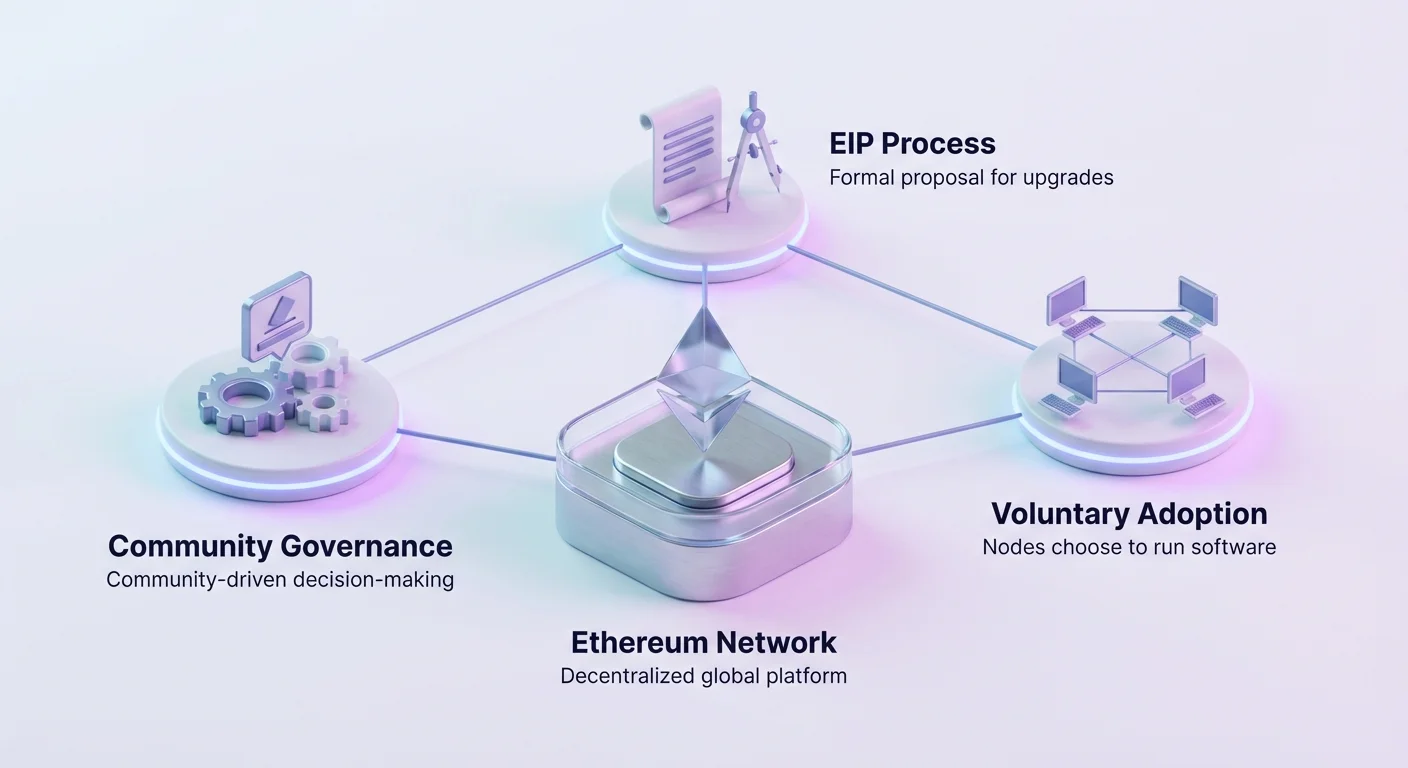
The primary vehicle for governance in Ethereum is the Ethereum Improvement Proposal, or EIP. This is a formal document that outlines proposed changes to the protocol. The process begins when an individual or a team of developers drafts a proposal. This can be anyone in the community, though it is often core developers or researchers who have the technical expertise to specify complex upgrades.
Once an EIP is submitted, it undergoes a rigorous period of debate. The wider community, including developers and researchers, scrutinizes the technical merits and potential security risks of the proposal. Suggestions are made, and the proposal is often amended and resubmitted multiple times. This phase is crucial for filtering out bad ideas and refining good ones before any code is finalized.
After the code is written, it does not immediately go live on the main network. It is first audited and tested on a "testnet." This allows developers to see how the upgrade behaves in a simulated environment without putting real funds at risk. Only after extensive testing and broad community agreement is the upgrade scheduled for the main network.
The Role of Voluntary Adoption
A critical aspect of Ethereum governance is that it relies on voluntary adoption. Even after an EIP is finalized and the code is released, the network does not upgrade automatically. The "Ethereum network" is essentially thousands of independent computers, known as nodes, running the Ethereum client software. For an upgrade to take effect, the operators of these nodes must choose to download and install the new version of the software.
This mechanism acts as the ultimate check on power. If the core developers were to release an update that the community fundamentally disagreed with, node operators could simply refuse to update. This would result in a failed upgrade or a network split. Therefore, the power does not reside solely with those who write the code, but also with those who run the infrastructure that executes it.
Vjerodostojna neutralnost kao Sjeverna zvijezda
Ethereum zajednica vodi se specifičnim vrijednostima koje utječu na donošenje odluka. Dok Bitcoin kultura snažno naglašava samodovoljnost i ekstremni konzervativizam glede promjena, Ethereum nastoji biti platforma za globalne decentralizirane aplikacije. Kako bi služio ovoj širokoj svrsi, mreža teži principu koji suosnivač Vitalik Buterin naziva „credible neutrality“.
Vjerodostojna neutralnost u suštini znači da dizajn mehanizma protokola ne smije diskriminirati za ili protiv bilo kojih specifičnih osoba. Treba tretirati sve pošteno u mogućoj mjeri. Kada se gleda dizajn sustava, trebalo bi biti očito da nije namješten u korist specifičnih dionika ili specijalnih interesa.
Izazov implementacije
Postizanje ove neutralnosti u praksi je teško. Svijet je inherentno nejednak, a sudionici dolaze s različitim mogućnostima i potrebama. Mehanizam koji tretira sve točno isto ipak može favorizirati one s više resursa. Na primjer, ako pokretanje čvora zahtijeva skupu hardveru, sustav efektivno diskriminira one s manje kapitala, čak i ako je softver otvoren za sve.
Sam proces upravljanja također mora ostati neutralan. Ne smije ga preuzeti jedna grupa utjecajnih osoba ili velike korporacije. Ako proces donošenja odluka postane dominiran od strane nekoliko moćnih entiteta, mreža gubi svoj zahtjev za decentralizacijom. Osiguravanje da se protokol razvija na način koji održava ovu neutralnost predstavlja stalnu borbu za zajednicu.
Progresivizam nasuprot konzervativizmu
Zalaganje za neutralnost često se testira kada stvari krenu po zlu. Najpoznatiji primjer bio je DAO hack 2016. godine. Značajan iznos Ethera ukraden je zbog greške u pametnom ugovoru. Zajednica se suočila s teškim izborom: intervenirati i poništiti krađu ili se pridržavati principa da je „kod zakon“ i pustiti hakera zadržati sredstva.
Većina zajednice odabrala je intervenciju, stvarajući „hard fork“ koji je poništio transakciju. Ova odluka efektivno je podijelila mrežu na dvije. Nova veriga zadržala je ime Ethereum (ETH), dok je originalna veriga, koju su podržali oni koji favoriziraju konzervativni, neintervencionistički pristup, postala Ethereum Classic (ETC). Ovaj događaj istaknuo je da upravljanje Ethereumom teži progresivizmu, favorizirajući pragmatična rješenja i aktivni razvoj umjesto krute pridržavanosti utvrđenim pravilima.
The Shift to Proof of Stake
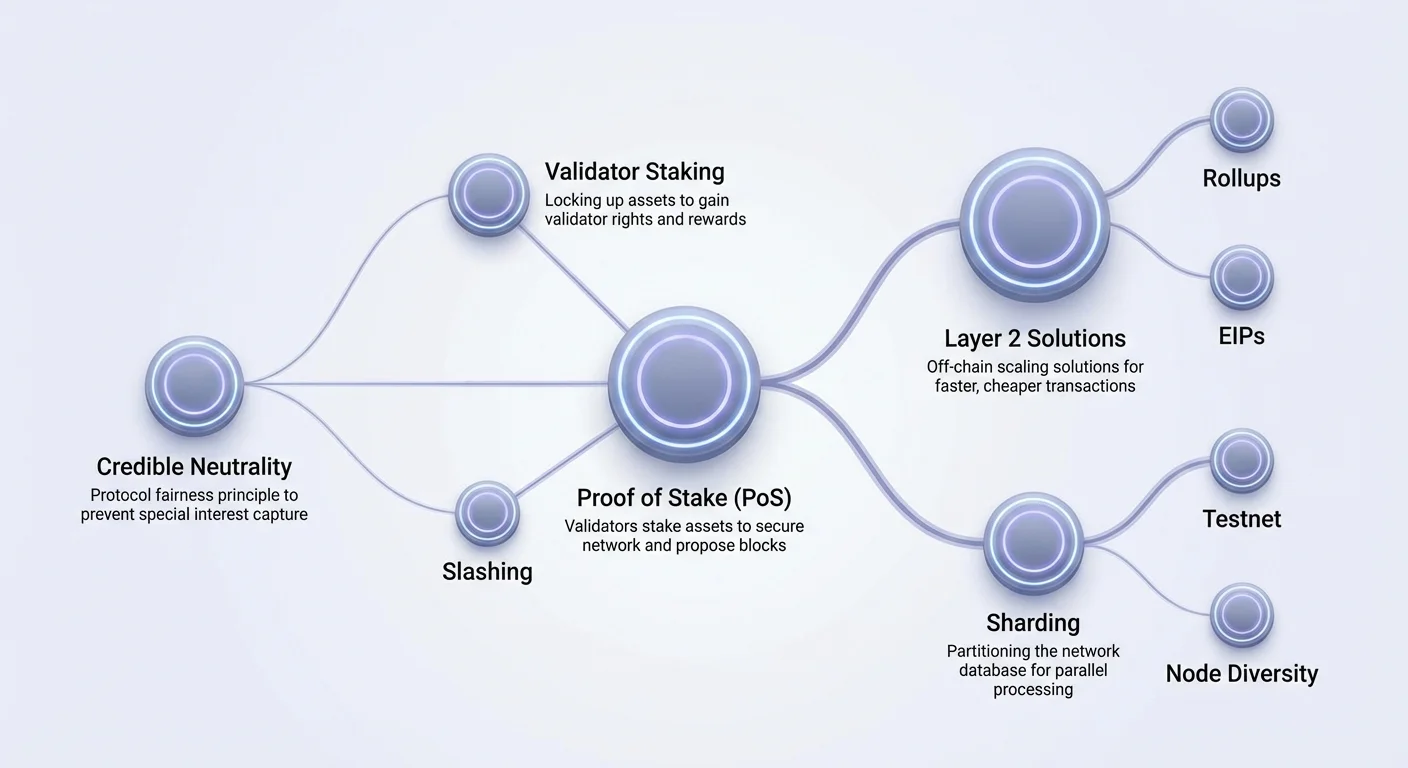
One of the most significant governance decisions in Ethereum's history was the transition from Proof of Work (PoW) to Proof of Stake (PoS). This upgrade, known as "The Merge," fundamentally changed how the network is secured and who gets to participate in consensus. It was a move designed to solve the "blockchain trilemma" by improving security and scalability while drastically reducing energy consumption.
In the old PoW system, miners used energy-intensive hardware to solve puzzles and validate blocks. In the new PoS system, validators replace miners. Validators lock up, or "stake," crypto assets in a smart contract to gain the right to propose new blocks. This shift eliminated the need for massive mining farms, reducing energy consumption by over 99%.
New Incentives and Risks
The move to PoS introduced a "carrot and stick" approach to security. Validators earn rewards for processing transactions correctly (the carrot). However, if they violate protocol rules or attempt to attack the network, they face "slashing," where a portion or all of their staked assets are forfeited (the stick). This economic model is designed to align the incentives of validators with the health of the network.
However, this transition also brought new governance concerns. Critics argue that PoS can lead to a "rich get richer" scenario. In PoW, mining is competitive and has thin profit margins, forcing miners to sell coins to cover costs. In PoS, operating costs are low, allowing large stakeholders to compound their wealth simply by staking. This could potentially concentrate influence among wealthy validators over time.
Validator Centralization Concerns
To become a validator on your own, you generally need 32 ETH. This is a high financial barrier for many individuals. As a result, many users stake their ETH through intermediaries or pooled services. If a handful of these services control the majority of the staked ETH, they could theoretically exert outsized influence on the network.
Governance discussions now frequently revolve around how to mitigate these centralization risks. The community actively monitors the distribution of stake and encourages the use of decentralized staking solutions. The goal is to ensure that the validator set remains large and diverse, preventing any single group from dominating the consensus process.
Scalability and the Blockchain Trilemma
The governance of Ethereum is heavily influenced by the technical constraints known as the blockchain trilemma. This concept posits that a blockchain can only optimize for two of three features at once: decentralization, security, and scalability. Ethereum's roadmap has consistently prioritized decentralization and security, often at the expense of raw speed and low fees on the main layer.
This prioritization has consequences. When demand for the network exceeds its capacity, transaction fees (gas) skyrocket. This prices out smaller users and limits the network's utility. To address this, the governance roadmap has shifted focus toward "Layer 2" solutions and a technique called sharding to handle scaling without compromising the base layer's security.
The Role of Layer 2 Solutions
Layer 2 refers to a set of technologies that operate on top of the Ethereum mainnet. These solutions, such as rollups, process transactions off-chain and then bundle the data to send back to the main Ethereum blockchain. This allows for much faster and cheaper transactions while still benefiting from Ethereum's security.
There are two main types of rollups: Optimistic rollups and Zero-Knowledge (ZK) rollups. Optimistic rollups assume transactions are valid by default and only compute validity if challenged. ZK rollups use complex cryptography to prove validity upfront. Both methods aim to increase throughput, but they introduce their own governance layers. Layer 2 networks often have their own operators and upgrade processes, creating a fragmented governance landscape where users must trust both Ethereum and the Layer 2 protocol.
| Feature | Optimistic Rollups | ZK Rollups |
|---|---|---|
| Validation Method | Assumes validity; fraud proofs used if challenged | Cryptographic validity proofs submitted on-chain |
| Withdrawal Time | Long delay (e.g., 7 days) for dispute resolution | Instant or very fast once proof is verified |
| Complexity | Lower technical complexity to implement | High computational and cryptographic complexity |
Sharding and Future Data Availability
Sharding is another major upgrade on the Ethereum timeline aimed at scalability. It involves partitioning the network's database into smaller, manageable pieces called shards. Each shard operates somewhat like a separate blockchain but communicates with the others. This allows the network to process many transactions in parallel rather than sequentially.
The implementation of sharding is complex and requires careful governance coordination. Validators are randomly assigned to different shards to ensure security, preventing any single shard from being corrupted by a specific group. This random assignment is a key defense against coordinated attacks. As sharding is rolled out, it will further test the community's ability to execute complex technical upgrades without disrupting the live network.
Cjelovitost ekosustava čvorova
Decentralizacija Ethereuma snažno se oslanja na raznovrsnost njegovih čvorova. Čvorovi su računala koja pohranjuju povijest blockchaina i verificiraju pravila. Ako pokretanje čvora postane preskupo ili tehnički preteško, manje ljudi će to raditi. To dovodi do situacije gdje samo velike institucije pokreću čvorove, čineći mrežu ranjivijom na cenzuru ili preuzimanje.
Kritičari često ističu da je Ethereum blockchain vrlo velik, mjerjen u terabajtima. To čini pokretanje „full archival node“ teškim za prosječnog korisnika u usporedbi s manjim Bitcoin blockchainom. Ako korisnici ne mogu sami verificirati lanac, moraju se oslanjati na treće strane za interakciju s mrežom.
Rizik oslanjanja na infrastrukturu
Oslanjanje na pružatelje treće strane infrastrukture predstavlja rizik za upravljanje. U studenom 2020., veliki pružatelj infrastrukture Infura doživio je tehnički kvar. Budući da su mnoge novčanice i burze oslanjale na Infuru umjesto pokretanja vlastitih čvorova, prisiljene su pauzirati transakcije. Ovaj incident istaknuo je opasnosti centralizacije u sloju infrastrukture.
Ako kritična masa ekosustava oslanja se na jednog pružatelja, taj pružatelj postaje centralna točka kvara. Rasprave o upravljanju često se fokusiraju na smanjenje barijere ulaska za operatere čvorova. Cilj je zadržati zahtjeve za hardverom i propusnošću dovoljno niskima da robustna, raznovrsna grupa sudionika može neovisno osiguravati mrežu.
Zaključak
Ethereum upravljanje je složen, evolucijski eksperiment u koordinaciji ljudi. Nedostaje mu čista učinkovitost korporativne strukture, oslanjajući se umjesto toga na neuredne debate, grubi konsenzus i dobrovoljno usvajanje. Prelazak na Proof of Stake i integracija Layer 2 rješenja za skaliranje demonstriraju sposobnost zajednice da izvrši masovne promjene u potrazi za boljim protokolom. Međutim, ove promjene donose nove izazove glede koncentracije bogatstva, tehničke složenosti i centralizacije infrastrukture.
Princip vjerodostojne neutralnosti ostaje vodeća svjetlost za budućnost mreže. Da bi Ethereum uspio kao globalna platforma, mora odoljeti preuzimanju od strane specijalnih interesa i ostati pošten u svom dizajnu. Djonici — programeri, validatori i korisnici — moraju ostati budni. Nose odgovornost osigurati da potraga za skalabilnošću ne erodira decentraliziranu osnovu koja mreži daje vrijednost.
Budućnost mreže odlučuje se ne jednim vođom, već kolektivnim izborom onih koji pokreću softver.