
Bitcoin governance is characterized by a deliberate conservatism that prioritizes security and backward compatibility over rapid innovation. While this approach ensures the stability of the protocol as a store of value, it restricts the network's ability to support complex applications natively. To address this, developers have pursued scaling solutions that operate adjacent to the main blockchain. Sidechains have emerged as a primary method for expanding Bitcoin’s functionality without altering its core consensus rules.
These secondary blockchains allow for the transfer of assets between the main Bitcoin network and an alternative environment. By moving Bitcoin to a sidechain, users can access features that are not available on the main chain. These features often include faster transaction speeds, lower fees, and advanced smart contract capabilities. However, the security models of sidechains differ significantly from Layer 2 solutions like the Lightning Network.
The primary distinction lies in how the sidechain secures the assets moved onto it. Unlike Layer 2s, which generally inherit the security of the main chain, sidechains are responsible for their own security. This independence creates a unique set of risks and trade-offs. Two of the most prominent models for managing these risks are Federated Sidechains and Drivechains. Each proposes a different mechanism for maintaining the connection, or "peg," between the sidechain and the Bitcoin mainnet.
The Mechanics of the Two-Way Peg
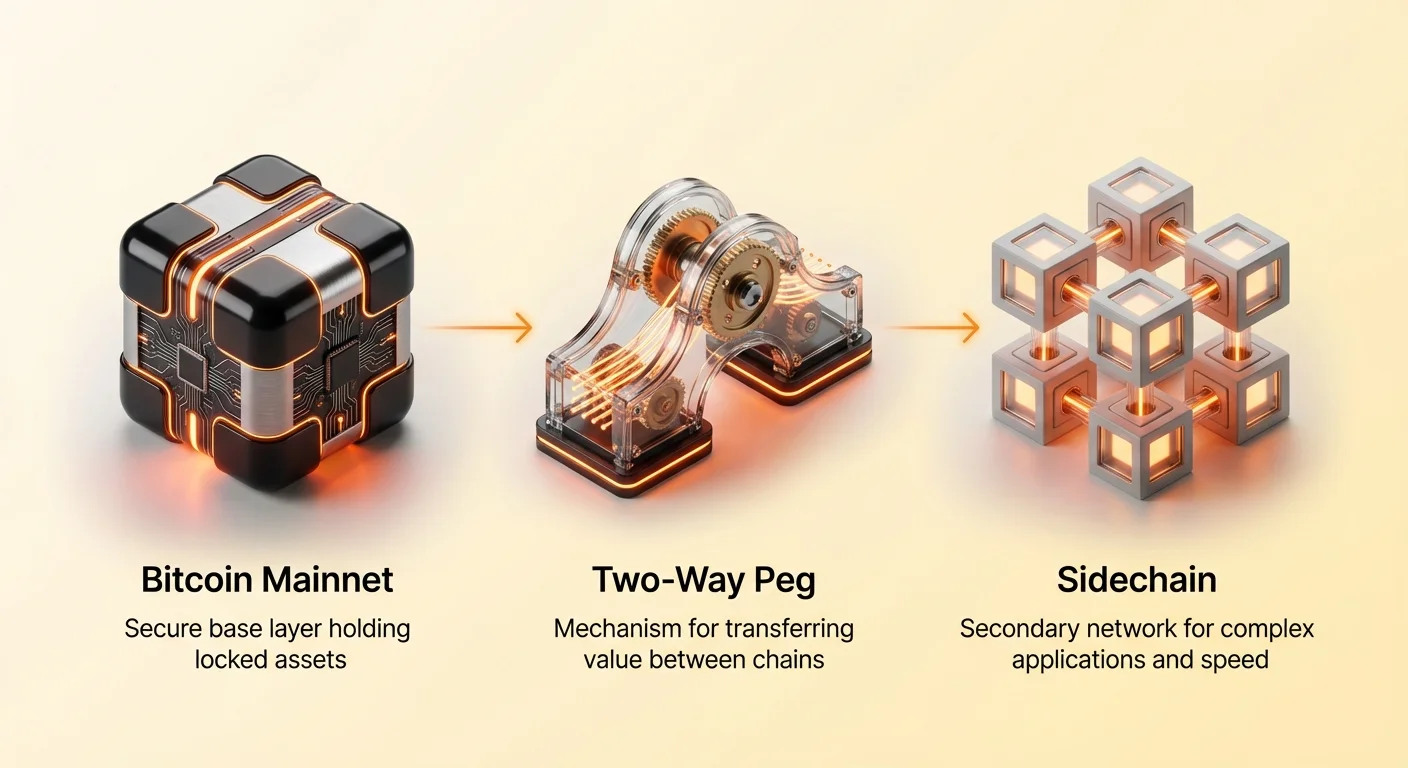
The fundamental component of any sidechain is the two-way peg. This mechanism allows assets to be transferred from the Bitcoin blockchain to the sidechain and back again. It is important to understand that the Bitcoin ledger is immutable and isolated, meaning tokens cannot leave the network.
Instead, the transfer process involves locking the original Bitcoin in a specific address on the main network. Once the protocol confirms that the funds are secured, a corresponding amount of tokens is minted on the sidechain. These new tokens act as a claim on the locked Bitcoin. When a user wishes to return to the main chain, the sidechain tokens are destroyed, or "burned."
Following this destruction, the smart contract or governing mechanism on the main chain releases the original Bitcoin back to the user. This locking and unlocking process is the most critical security vector in the sidechain ecosystem. If the mechanism controlling the locked Bitcoin is compromised, the backing for the sidechain tokens disappears, rendering them worthless.
Security Models and Asset Custody
The method used to secure the locked Bitcoin defines the type of sidechain. Different architectures rely on different groups of participants to validate transfers and ensure that the peg remains solvent. The choice of security model determines the level of decentralization and the potential attack vectors.
In some designs, a fixed group of entities controls the keys to the lockbox. In others, the security relies on the collective hash power of Bitcoin miners. There are also hybrid approaches that attempt to balance these methods. The debate between Federated models and Drivechain models centers on who should be trusted with the custody of the funds.
| Security Model | Custody Mechanism | Primary Risk |
|---|---|---|
| Federated | Selected Consortium | Collusion among signers |
| Drivechain | Miner Consensus | 51% Hashrate Attack |
| Hybrid | Dynamic Membership | Complexity of coordination |
Understanding Federated Sidechains
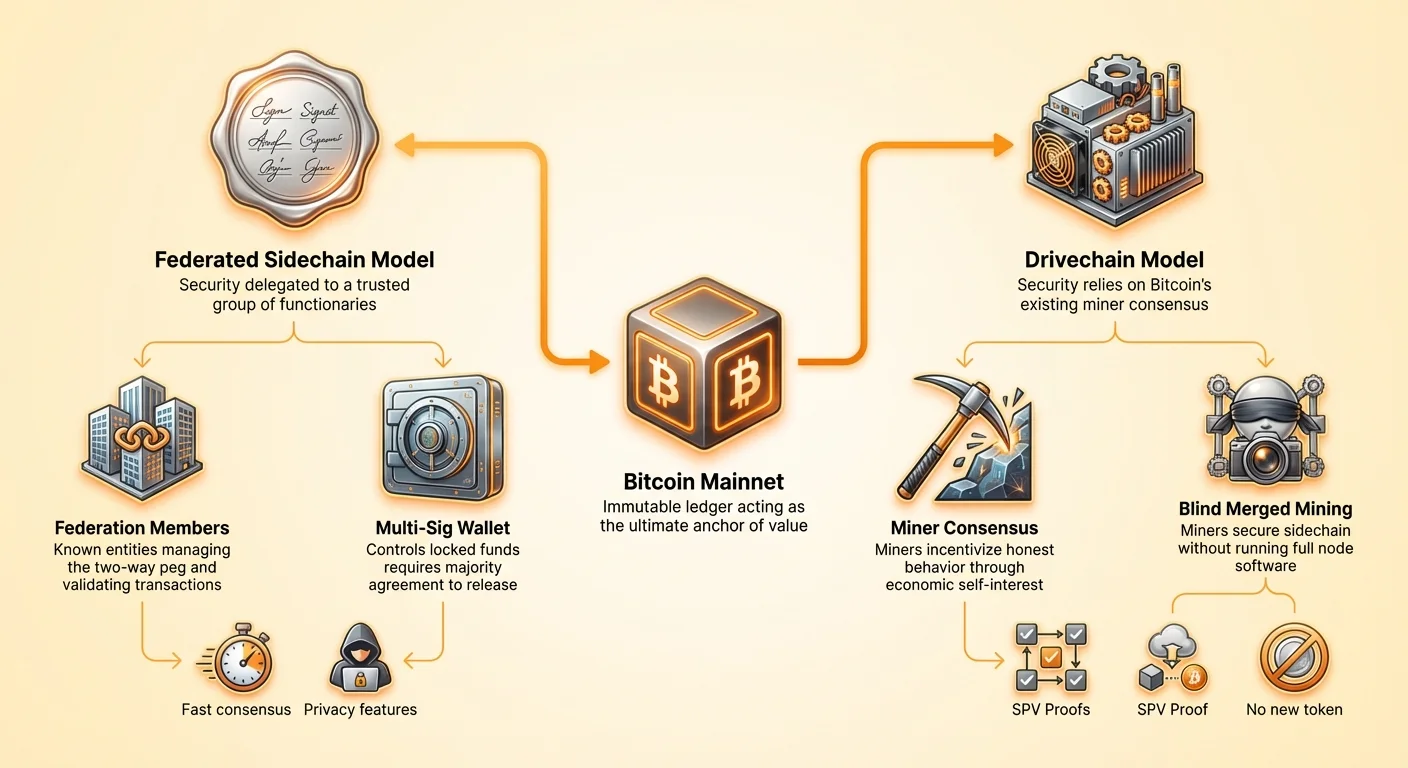
Federated sidechains operate on a model where a defined group of functionaries manages the two-way peg. This group is known as a federation. When a user sends Bitcoin to the sidechain, they are essentially sending it to a multi-signature address controlled by this federation. The members of the federation effectively act as gatekeepers.
These members are often well-known entities within the cryptocurrency ecosystem, such as exchanges, wallet providers, or infrastructure companies. They run the software that powers the sidechain and are responsible for validating transactions and signing off on withdrawals. This approach offers several advantages in terms of performance and feature implementation.
Because the number of validators is small compared to a global network of miners, federated chains can achieve consensus very quickly. This allows for block times that are significantly faster than Bitcoin’s ten-minute average. Additionally, federations can implement features like confidential transactions, which hide transaction amounts and asset types for greater privacy.
The Trust Trade-Off in Federations
The primary criticism of federated sidechains is the reintroduction of centralized trust. Users must trust that the majority of the federation members will act honestly. If a sufficient number of federation members conspire to steal the locked funds, there is no cryptographic barrier on the Bitcoin network to stop them. This reliance on reputation and legal agreements stands in contrast to Bitcoin’s trustless ethos.
To mitigate this, federations are often composed of geographically and legally diverse members. The logic is that it would be difficult to coerce or bribe a majority of members who operate in different jurisdictions. However, regulatory pressure remains a concern. If governments forced federation members to censor transactions or freeze funds, the permissionless nature of the sidechain would be compromised.
Furthermore, the security of a federated chain does not scale with the value it secures. Whether the sidechain holds one million dollars or one billion dollars, the difficulty of compromising the federation remains roughly the same. This creates a "honeypot" effect where the incentive to attack the federation increases as the sidechain grows in popularity.
Operational Efficiency and Privacy
Despite the centralization risks, federated sidechains provide a practical solution for specific use cases. For traders and institutions, the ability to move assets rapidly between exchanges without waiting for Bitcoin confirmations is valuable. The Liquid Network is a prime example of this utility, facilitating faster settlement between trading venues.
Privacy is another significant benefit. Because the federation manages the ledger, they can deploy advanced cryptographic techniques that might be too heavy for the main chain. This allows for obscured transaction details, protecting distinct commercial strategies from being monitored on a public ledger. For businesses, this privacy is often a requirement rather than a luxury.
However, this efficiency comes at the cost of transparency. While the federation members can verify the state of the chain, external observers often have less visibility than they would on a fully public blockchain. This opacity can make it harder for the broader community to audit the system in real-time.
The Drivechain Proposal
Drivechain represents an alternative approach that seeks to align sidechain security with Bitcoin’s existing miner consensus. Described technically as a "parent-child" relationship, the Bitcoin network acts as the parent while the Drivechain operates as the child. This model removes the need for a specific federation of companies to hold the keys.
In a Drivechain, the custody of the locked Bitcoin is determined by miners. The concept relies on the idea that miners, who have invested heavily in hardware and energy, have a vested interest in the health of the Bitcoin ecosystem. Therefore, they are incentivized to process sidechain transactions honestly to earn additional fees.
This model utilizes Simplified Payment Verification (SPV) proofs to facilitate the transfer of assets. To withdraw funds from the Drivechain back to Bitcoin, a user submits a request that miners must acknowledge. Over a period of time, if the majority of miners agree that the withdrawal is valid, the funds are released.
Blind Merged Mining Explained
A key innovation within the Drivechain proposal is Blind Merged Mining (BMM). This technique allows Bitcoin miners to secure the Drivechain without running a full node for that sidechain. In traditional merged mining, a miner must process all data for both chains, which increases their computational load and bandwidth requirements.
With BMM, a separate entity runs the sidechain node and constructs the block. They then pay the Bitcoin miner a fee to include a hash of that block header in the Bitcoin blockchain. This means miners can earn revenue from the sidechain without needing to understand its rules or store its data.
This separation of duties is designed to prevent sidechains from bloating the main network. It allows for infinite experimentation with different block sizes, privacy features, or smart contract languages on sidechains without imposing those technical debts on the main Bitcoin protocol.
The Miner centralization Risk
The most significant risk associated with Drivechains is the potential for a 51% attack. If a coalition of miners controlling more than half of the hash rate decides to steal the funds locked in the sidechain, they can do so. They could theoretically approve a fraudulent withdrawal transaction that sends all the sidechain’s Bitcoin to themselves.
Proponents argue that game theory prevents this. They suggest that stealing funds would destroy confidence in Bitcoin, crashing the price and rendering the miners' expensive hardware investment worthless. This is known as "mutually assured destruction." The argument is that the immediate gain from theft would be outweighed by the long-term loss of mining revenue.
Critics, however, are skeptical of relying on economic incentives alone for security. They argue that if the value stored in a Drivechain becomes large enough, the temptation to steal could overwhelm the long-term incentives. Additionally, there is a concern that large mining pools could exert undue influence, forcing smaller miners to follow their lead or risk having their blocks orphaned.
Interoperability and Bridge Risks
Regardless of whether a sidechain is federated or miner-controlled, the bridge remains the most vulnerable component. History has shown that cross-chain bridges are frequent targets for hackers. Vulnerabilities in the smart contracts that govern the locking and unlocking mechanism can lead to catastrophic losses.
Unlike Layer 2 solutions, where the user can unilaterally exit to the main chain if the second layer fails, sidechains do not offer this guarantee. If the peg breaks or the bridge is drained, the tokens on the sidechain become unbacked. Users holding these tokens would lose their claims to the underlying Bitcoin.
This risk is inherent to the architecture of sidechains. Security is not inherited; it is constructed separately. This means that users must carefully evaluate the code quality and the operational security of the specific sidechain they are using. There is no universal safety net provided by the Bitcoin protocol itself.
The Impact of Smart Contract Bugs
Smart contracts introduce complexity, and complexity increases the surface area for attacks. Both federated and Drivechain models rely on code to manage the flow of assets. A simple coding error in the withdrawal logic could allow an attacker to bypass the security checks.
In a federated model, the human element can sometimes act as a fail-safe. If a bug is discovered, the federation might be able to pause withdrawals or upgrade the software to fix the issue. While this ability to intervene prevents theft, it also highlights the centralized control the federation possesses.
In a decentralized Drivechain model, fixing a critical bug is more difficult. It requires coordination among miners and potentially a software update that must be widely adopted. If an exploit is discovered and executed quickly, the funds could be drained before the network can react.
Complexity of User Experience
Interoperability also presents challenges for the end user. Moving assets between chains often requires specialized wallets and a deeper understanding of blockchain mechanics. Users must understand that an asset on a sidechain is not the same as the asset on the main chain, even if it shares the same name and value.
This distinction is crucial during times of high volatility or network congestion. If the sidechain network stalls or the bridge becomes congested, users may find themselves unable to arbitrage or exit their positions. The friction of moving between layers can limit the practical utility of sidechains for everyday payments.
Furthermore, different sidechains may not be compatible with each other. An asset minted on a federated sidechain cannot easily be moved to a Drivechain without going back to the main Bitcoin network first. This fragmentation forces users to choose ecosystems carefully and can fracture liquidity across multiple isolated environments.
Technological Enablers: Taproot and SegWit
Advancements in the Bitcoin protocol have played a significant role in making sidechains more viable. The activation of Segregated Witness (SegWit) addressed transaction malleability, a technical issue that previously made the design of secure bridges more difficult. By separating signature data, SegWit ensured that transaction IDs remained constant, simplifying the logic required for sidechain pegs.
More recently, the Taproot upgrade has introduced Schnorr signatures. This technology is particularly beneficial for federated sidechains. In a traditional multi-signature setup, every signer’s signature must be included in the transaction data, which consumes space and reveals the size of the federation.
With Schnorr signatures, multiple signatures can be aggregated into a single signature. This makes complex multi-signature transactions look identical to standard transactions on the blockchain. For a federation, this means they can increase the number of signers without increasing the transaction cost or revealing the internal structure of their security model.
Improving Privacy and Efficiency
Taproot also enables Merkelized Abstract Syntax Trees (MAST). This feature allows for complex smart contracts where only the executed condition is revealed on-chain. For sidechains, this means the logic governing the peg can be much more sophisticated while maintaining privacy and efficiency.
These upgrades demonstrate how the main Bitcoin layer is evolving to support second-layer protocols. While Bitcoin Core development focuses on stability, these changes provide the primitives that sidechain developers need to build more robust and secure systems. The synergy between the base layer and these external layers is essential for the long-term scaling roadmap.
However, these technological improvements do not solve the fundamental governance issues. Better cryptography can make a federation more efficient, but it cannot prevent collusion. It can make a Drivechain more capable, but it cannot guarantee miner honesty. The core debate remains centered on the human and economic incentives rather than just the code.
Governance and the Path Forward
The implementation of Drivechains requires a soft fork of the Bitcoin protocol, specifically BIP 300 and BIP 301. A soft fork is a backward-compatible upgrade, but it still requires broad consensus from the community and miners. Achieving this consensus is notoriously difficult in the Bitcoin ecosystem, which favors the status quo.
Opponents of Drivechains argue that adding this functionality changes the incentives for miners in dangerous ways. They fear that it could lead to mining centralization, as large pools might dominate the revenues from profitable sidechains. There is also a philosophical objection to altering Bitcoin to support features that were intentionally excluded from the base layer.
Federated sidechains, on the other hand, do not typically require permission from the Bitcoin network to operate. Anyone can form a federation and create a multi-signature address. This permissionless innovation allows federated chains to launch and iterate quickly. However, their adoption is limited by the willingness of users to trust the federation.
The Role of Layer 2 Alternatives
The conversation around sidechains is complicated by the rise of other scaling solutions. The Lightning Network offers fast, cheap payments with a trust model that arguably aligns closer to Bitcoin’s decentralized nature. While Lightning does not offer the full smart contract capabilities of a sidechain, it solves the payment scalability issue without introducing a federation or new miner incentives.
Additionally, projects like RGB and Taro are exploring ways to issue assets and run smart contracts directly on top of the Lightning Network or through client-side validation. These technologies attempt to offer the benefits of sidechains without the need for a separate blockchain or a trusted bridge.
As these technologies mature, the specific niche for sidechains may shift. They may become specialized environments for specific institutional or experimental use cases, rather than general-purpose scaling layers. The competition between these different approaches drives innovation and forces developers to constantly improve the security and usability of their systems.
Conclusion
The debate between Federated sidechains and Drivechains represents a fundamental question about the nature of trust in the Bitcoin ecosystem. Federated models prioritize efficiency and functionality by delegating security to a known group of entities. This approach works well for institutional use cases where legal recourse and reputation provide sufficient guarantees. However, it introduces centralized points of failure that contradict the censorship-resistant goals of cryptocurrency.
Drivechains attempt to solve this by relying on the decentralized hash power of miners. This aligns the security of the sidechain with the security of Bitcoin itself, theoretically removing the need for trusted third parties. Yet, this model introduces new risks regarding miner behavior and requires consensus for protocol changes that the community may be hesitant to adopt. Both models offer valid paths for scaling, but neither is without significant trade-offs.
Ultimately, the success of either approach will depend on user preference. Some users will value the speed and privacy of a federated chain enough to accept the trust assumptions. Others will prefer the miner-aligned security of a Drivechain or the stricter decentralization of the Lightning Network. As Bitcoin continues to evolve, it is likely that a diverse ecosystem of interoperable solutions will emerge to serve these varying needs.
Sidechains expand Bitcoin’s capabilities, but users must choose between trusting a federation of companies or the collective honesty of miners.