
Tijekom više od desetljeća, Bitcoin je služio kao temelj digitalne rijetkosti i samovlasništva, prvenstveno funkcionirajući kao čvrst, nepomjenjivi dnevnik za prijenos vrijednosti. Međutim, arhitektura koju je dizajnirao Satoshi Nakamoto—iako revolucionarna—dolazila je s inherentnim ograničenjima, osobito u pogledu fleksibilnosti skriptiranja, privatnosti i transakcijske učinkovitosti.
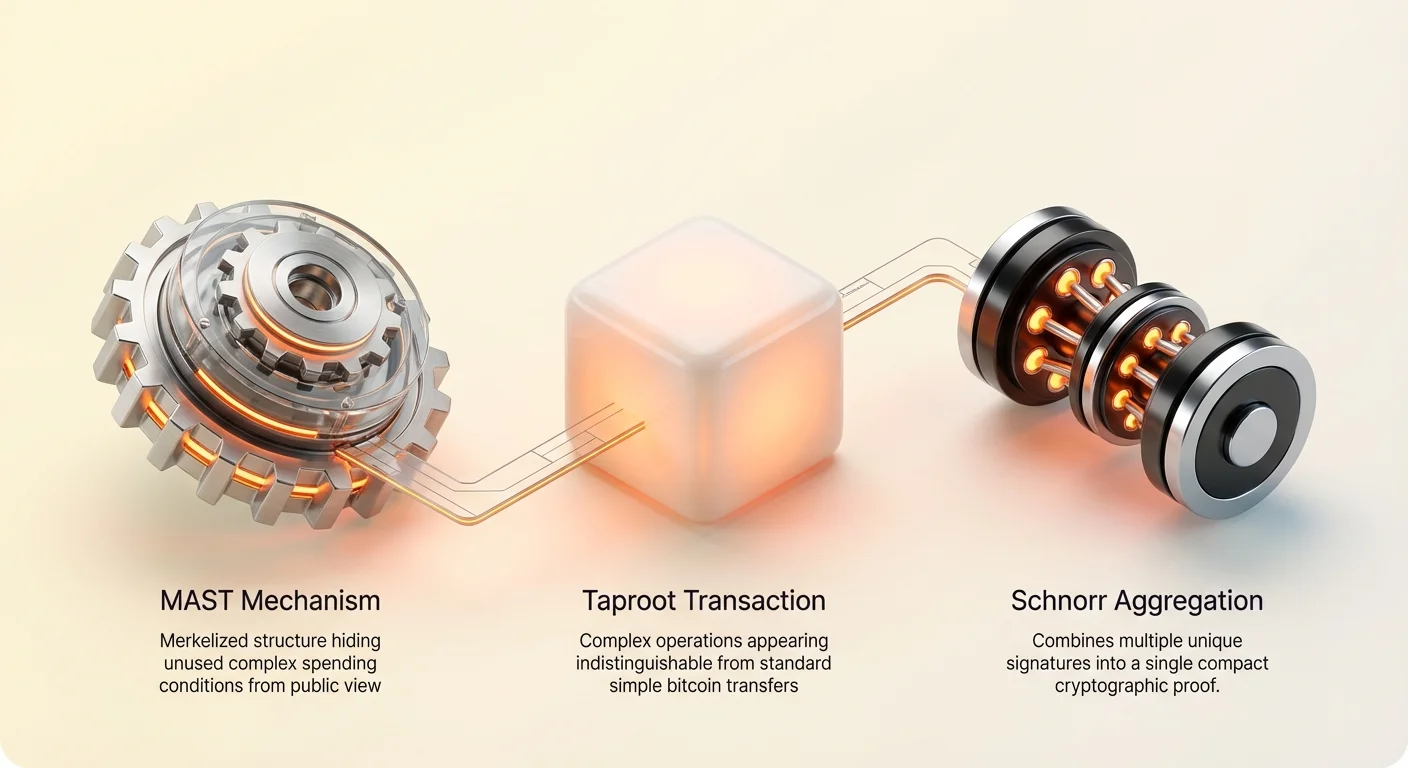
Nadogradnja Taproot, aktivirana krajem 2021., predstavlja najznačajnije poboljšanje Bitcoinovog baznog sloja (sloj 1) od SegWita 2017. Taproot nije jedna značajka; već je sofisticirani paket tri međusobno povezane tehnologije: MAST (Merkelized Abstract Syntax Trees), Schnorr potpisi i Pay-to-Taproot (P2TR) adrese.
Ova nadogradnja fundamentalno mijenja način na koji se složene transakcije izvršavaju na mreži. Dok starije transakcije emituju svaku potencijalnu uvjetu potrošnje cijelom svijetu—trošeći dragocjeni prostor bloka i otkrivajući osjetljive podatke—Taproot omogućuje složenim skriptama da izgledaju neprimjetno od jednostavnih plaćanja s jednim potpisom. Taj arhitektonski pomak dramatično poboljšava privatnost, smanjuje troškove i, ključno, postavlja čvrstu infrastrukturnu podlogu potrebnu Bitcoinu da podrži napredne pametne ugovore i skalirana rješenja sloja 2 (L2) poput Lightning Networka. Naš fokus ovdje nije samo što je Taproot, već kako on osnažuje developere da izgrade sljedeću generaciju decentraliziranih financija i alata za samokustodiju na najsigurnijem blockchainu na svijetu.
The Problem Taproot Solves: Bitcoin's Original Scripting Limitations
To understand the genius of Taproot, we must first recognize the constraints of Bitcoin’s original scripting language. Bitcoin uses a simple, stack-based language (often called Script) to define the rules for spending funds.
Anatomy of a Simple Bitcoin Transaction
Before Taproot, most Bitcoin transactions utilized either Pay-to-Public-Key-Hash (P2PKH), which is the standard single-signature payment, or Pay-to-Script-Hash (P2SH), which allowed for more complex rules like multi-signature requirements or time-locks.
When you spend funds using P2SH, the network must verify that the conditions you set (the script) are met. Crucially, when a transaction is spent, the entire script is published on the blockchain, along with the proof (the signature) that satisfies it.
For instance, if you set up a multi-signature transaction requiring 2 out of 3 keys to agree (a 2-of-3 multisig), the public record would show all three potential keys, the requirement (2-of-3), and the two required signatures, regardless of how simple the actual execution was.
The Cost of Complex Transactions
This requirement to publish the entire, potentially complex spending script had significant drawbacks:
- Reduced Privacy (Information Leakage): Revealing the entire script exposes all possible ways the funds could have been spent, even if only one path was ultimately chosen. In the 2-of-3 example, the identities of all three key holders are exposed, even if they were dormant.
- Increased Transaction Size and Fees: Complex scripts, especially those involving many participants or conditional time-locks, take up much more block space. Since fees are primarily determined by transaction size, this made sophisticated custody solutions (like corporate treasury multi-sig or intricate inheritance plans) very expensive and inefficient.
- Lack of Fungibility: Fungibility means that one unit of a currency is interchangeable with any other. When a complex script is clearly visible on the blockchain, it makes that specific transaction output look different from a standard, simple transaction output. This visual distinction can make it easier for external parties to track certain types of funds, harming the overall fungibility of Bitcoin.
MAST: Čineći složene skripte jednostavnima na izgled
Merkelized Abstract Syntax Trees (MAST) je ključni kriptografski koncept koji omogućuje Taprootu rješavanje problema transparentnosti i učinkovitosti inherentnih u P2SH.
Shvaćanje Merkleovih stabala
Kako bismo shvatili MAST, prvo moramo razumjeti Merkleovo stablo (također poznato kao Hash Tree). Ova struktura podataka temelj je samog Bitcoina, jer svaki blok koristi Merkleovo stablo za učinkovito sažimanje svih transakcija unutar tog bloka.
Merkleovo stablo funkcionira poput digitalnog sustava za arhiviranje:
- Svaki dio podataka (u slučaju MAST-a, to je potencijalni uvjet potrošnje ili „script path“) individualno se hashira.
- Ovi pojedinačni hashovi se spajaju u parove i hashiraju zajedno, krećući se prema vrhu strukture stabla.
- Taj proces se nastavlja dok se svi podaci ne sažmu u jedan sažetni hash nazvan Merkle Root.
Moćna prednost Merkle Roota je što omogućuje bilo kome da provjeri je li određeni dio podataka uključen u skup, samo pružajući mali broj među-hashova (Merkle Path) umjesto da pokaže sve podatke.
Kako MAST skriva neizvršene uvjete
MAST primjenjuje ovaj koncept Merkleovog stabla na uvjete potrošnje transakcije.
Zamislimo složeni pametni ugovor koji ima četiri moguća puta za potrošnju sredstava:
- Put A: Alice i Bob potpisuju (standardna potrošnja).
- Put B: Nakon 90 dana, samo Alice može potpisati (time-lock oporavak).
- Put C: Nakon 180 dana, samo backup ključ potpisuje (nasljeđe/sigurnost).
- Put D: Zahtijeva unos od orakula (npr. okidač podataka o vremenu).
Koristeći stari P2SH model, svi četiri puta (A, B, C i D) bili bi izloženi na blockchainu prilikom potrošnje sredstava.
Koristeći MAST:
- Svaki put (A, B, C, D) je „list“ Merkleovog stabla.
- Svi četiri puta sažmu se u jedan MAST Root.
- Kada Alice i Bob izvrše Put A, oni samo objave script za Put A i mali kriptografski dokaz (Merkle Path) potreban za dokazivanje da je Put A uključen u MAST Root.
Ključna prednost: Postojanje Putova B, C i D otkriva Merkle Root, ali njihov stvarni sadržaj skripti ostaje potpuno privatnim i neobjavljenim na lancu. Samo izvršeni put se otkriva, što dovodi do ogromnih ušteda prostora i povećane povjerljivosti.
Praktični primjer: Scenarij multi-sig potpisa
Zamislimo korporativnu blagajnu koja zahtijeva 3-od-5 multi-potpisni sporazum za rutinske troškove, ali također zahtijeva pojednostavljeni 1-od-5 put potpisa (nakon 6 mjeseci) za hitnu likvidaciju u slučaju raspada tvrtke.
- Prije MAST-a: Standardni 3-od-5 script i hitni 1-od-5 script moraju se oba emitirati na lanac, povećavajući veličinu transakcije i otkrivajući pravila hitne potrošnje svima.
- S MAST-om: Ako se koristi 3-od-5 put, emitira se samo 3-od-5 script zajedno s malim dokazom da pripada ugovoru. 1-od-5 put hitne likvidacije ostaje skriven unutar MAST Roota, otkriven samo ako se kasnije stvarno izvrši.
MAST fundamentalno transformira složene uvjete u učinkovite, kompaktne i privatne dokaze.
Schnorr Signatures: The Key to Efficiency and Privacy
While MAST addresses script complexity, the second major component of Taproot—Schnorr signatures—addresses signature efficiency, security, and anonymity. Bitcoin originally used the Elliptic Curve Digital Signature Algorithm (ECDSA). Schnorr is a mathematically superior alternative that brings two immense benefits: signature aggregation and enhanced security proofs.
The Technical Superiority of Schnorr vs. ECDSA
ECDSA signatures, while secure, are bulky and necessitate individual verification. If a transaction requires three signatures, the blockchain requires three separate blocks of signature data, and the network nodes must verify those three distinct blocks sequentially.
Schnorr signatures, based on simpler math and security assumptions, offer a significant advantage: linearity. This means that multiple public keys can be combined into a single, valid aggregated public key, and multiple signatures can be combined into a single, valid aggregated signature.
Signature Aggregation: Batch Verification and Efficiency
Signature aggregation is perhaps the most visible improvement Taproot brings to scaling:
- Multi-Party Efficiency: In a 5-of-5 multi-signature transaction using Schnorr, the five required public keys can be cryptographically merged into one new public key, and the five corresponding signatures can be merged into a single, aggregated signature.
- Blockchain Interpretation: To the rest of the Bitcoin network, this aggregated transaction looks exactly like a standard, single-signature payment (P2PKH).
- Verification Speed: Nodes verify this single aggregated signature faster than verifying five individual ECDSA signatures. This improvement saves computational power for every network participant and drastically reduces the data size of complex transactions.
This capability is revolutionary for multi-party applications like corporate custody, joint ownership wallets, and, most importantly, Layer 2 scaling solutions.
The Privacy Dividend (Key Aggregation and the P2TR Format)
The ability to aggregate keys and signatures provides a critical boost to privacy and fungibility.
If a multi-sig transaction looks identical to a standard single-signature transaction, outside observers cannot determine if the transaction was complex (requiring multiple parties, time-locks, or specialized contracts) or simple (just one person sending money).
This introduces true output uniformity to the network, meaning sophisticated smart contract outputs are functionally indistinguishable from simple peer-to-peer payments. This significantly strengthens Bitcoin's fungibility, ensuring all satoshis are treated equally by observers.
Taproot Explained: The Seamless Integration of MAST and Schnorr
Taproot is the overarching implementation that ties MAST for conditional execution and Schnorr for signature efficiency together under a new, unified address type.
Pay-to-Taproot (P2TR) Addresses
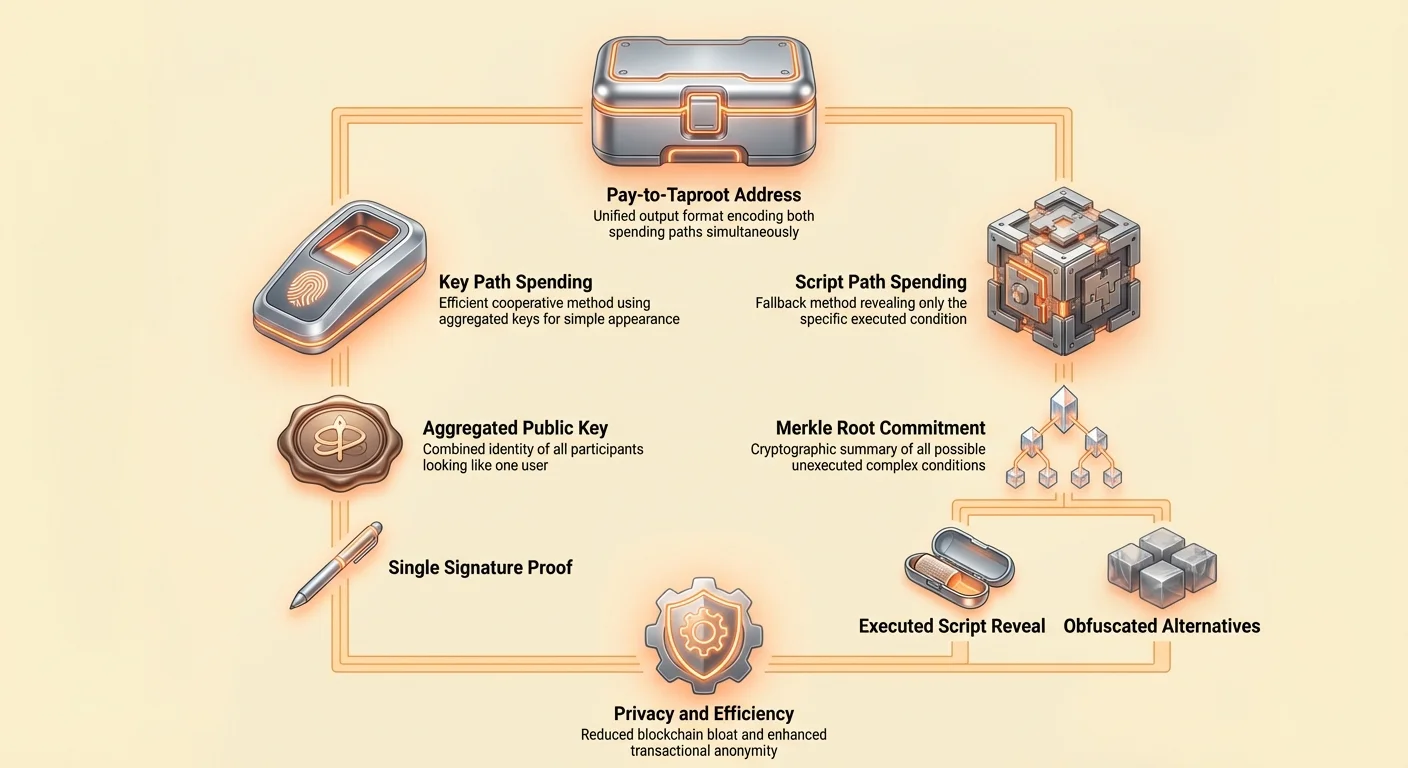
Taproot introduces a new standard output type called Pay-to-Taproot (P2TR). P2TR outputs encode not just a single public key, but a combination of a public key (for the Schnorr key aggregation path) and the Merkle Root of all potential spending scripts (for the MAST script path).
When funds are sent to a P2TR address, the transaction effectively locks the funds using two distinct methods simultaneously: the Key Path and the Script Path.
The Key Path vs. The Script Path (The Choice Mechanism)
Taproot is designed around a simple, efficient trade-off: if all parties cooperate, use the simple, cheap path; if they disagree or require complex conditions, use the slightly more expensive but robust path.
1. The Key Path (The Ideal Scenario)
The Key Path is the preferred and most efficient way to spend funds locked in a P2TR output. This path is activated when all original participants agree on the spending conditions and cooperate.
- How it works: All participants aggregate their public keys into a single Taproot key, and then aggregate their signatures into a single Schnorr signature.
- Result: The on-chain transaction looks exactly like a standard, single-signer P2PKH transfer. The entire MAST structure remains hidden, saving space and preserving privacy. This path is maximally cheap and efficient.
2. The Script Path (The Conditional Scenario)
The Script Path is activated if the participants cannot cooperate, or if the transaction requires a predetermined script condition (like a time-lock or the input of an oracle).
- How it works: The spending transaction reveals the specific script condition that was met (e.g., "Time-lock of 90 days has passed") and the small Merkle Proof required to validate that this script was indeed part of the original MAST Root.
- Result: This transaction is slightly larger than the Key Path, but still significantly smaller and more private than the old P2SH model, because it only reveals the one executed script, keeping all other potential spending conditions private.
Achieving Script Obfuscation
The combination of the Key Path and the Script Path achieves a powerful property called script obfuscation.
From the perspective of an outside observer analyzing the blockchain:
- If the Key Path is used (which is anticipated to be the most common usage for cooperative parties, especially in L2 solutions), the transaction is completely opaque and private. It looks like simple spending.
- Even if the Script Path is used, the observer only learns about the specific condition that was met, not the details of all the alternative conditions that were also possible.
This seamless integration ensures that simple, cooperative uses are highly efficient, while complex, conditional uses remain highly private—a massive leap forward for Layer 1 flexibility.
Taproot’s Impact on Modern Bitcoin Development
Taproot is not just a cosmetic upgrade; it is the most critical infrastructure update enabling Bitcoin to move beyond basic value transfer and into a realm of sophisticated decentralized applications.
Scaling Layer 2 Solutions (Lightning Network Efficiency)
The Lightning Network, Bitcoin’s primary L2 scaling solution, relies heavily on multi-signature channels and time-locks for security. Taproot directly addresses the pain points of opening and closing these channels.
Before Taproot, opening and closing a Lightning channel required visible multi-signature transactions (typically 2-of-2), which were bulky, expensive, and easily identifiable as L2 activity.
With Taproot and Schnorr Signatures:
- Channel Opening: Opening a Lightning channel can utilize the Key Path. The funding transaction now looks like a simple 1-of-1 transaction on the chain, drastically reducing block footprint and increasing privacy.
- Cooperative Closing: If the channel is closed cooperatively (the most common scenario), the Key Path is used again, minimizing fees and remaining indistinguishable from standard payments.
- Non-Cooperative Closing: If a non-cooperative closure is necessary, the Script Path (which includes the time-lock conditions) is used, but thanks to MAST, only the necessary, relevant conditions are published, still saving space compared to the old model.
This efficiency gain significantly lowers the cost of participation in the Lightning Network, encouraging wider adoption and improving the speed and reliability of instant Bitcoin payments.
Enabling Complex Smart Contracts
While Ethereum was purpose-built for Turing-complete smart contracts, Bitcoin’s design prioritizes security and immutability, making its scripting language intentionally restrictive. Taproot doesn't change this fundamental focus, but it makes the execution of sophisticated Bitcoin smart contracts far more practical and affordable.
Key areas benefiting from Taproot:
- Discreet Log Contracts (DLCs): DLCs allow parties to execute contracts based on the input of an external data source (an oracle), such as sports scores or stock prices, without revealing the contract details to the network. Taproot’s MAST capability is perfect for this, hiding the numerous potential outcomes and only revealing the single result chosen by the oracle.
- Covenants: Covenants (the ability to restrict how a UTXO can be spent in the future) are powerful tools for creating complex, self-enforcing financial products. Taproot provides the necessary flexibility within the L1 scripting environment to make covenants (often combined with other proposed opcodes) viable and efficient.
- Advanced Treasury Management: Corporations can now design highly complex, nested multi-sig scenarios with specialized recovery keys, time-locks, and emergency liquidation paths, without incurring massive fees or revealing their proprietary key management scheme to the public.
Reducing On-Chain Footprint and Transaction Fees
The net result of Schnorr aggregation and MAST efficiency is a reduction in the overall data required to execute complex transactions.
By shrinking the average transaction size for multi-sig and L2 applications, Taproot reduces overall network congestion. This translates directly into:
- Lower Fees: Less data means less cost for the user.
- Faster Confirmations: Less data processing helps miners and nodes operate more quickly and efficiently.
- Increased Capacity: While Taproot is not a pure block size increase, its optimization of transaction data functionally increases the number of complex transactions that can fit into a single block.
Filozofski i arhitektonski implikacije
Taproot nije bio samo tehničko ažuriranje; to je bila filozofska izjava koja potvrđuje evoluciju Bitcoina uz očuvanje njegovih ključnih teneta sigurnosti. Njegova aktivacija je zahtijevala gotovo jednoglasnu podršku zajednice („Speedy Trial“ mehanizam soft forka), demonstrirajući predanost ekosustava discipliniziranom, kompatibilnom unatrag rastu.
Kompromisi: Dekentralizacija naspram moći skriptiranja
Povijesna debata u kriptu često suprotstavlja Bitcoin (prioritetizira sigurnost i decentralizaciju) platformama poput Ethereuma (prioritetizira fleksibilnost skriptiranja i bogatstvo značajki). Taproot pažljivo navigira ovim kompromisom.
Za razliku od nadogradnji koje bi mogle ugroziti operabilnost punih nodova ili uvesti visoko složena pravila konsenzusa, Taproot je ne-kontroverzna optimizacija. Koristi postojeće, dokazane kriptografske principe (Merkle stabla, eliptične krivulje) za postizanje dobitaka u učinkovitosti bez zahtjeva za moćnijim hardverom ili pomaka sigurnosnog modela.
Mogućnost uvodjenja fleksibilnosti (pametni ugovori, složena logika) preko Script Patha uz očuvanje učinkovitosti i privatnosti jednostavnih plaćanja preko Key Patha osigurava da Bitcoin može podržati napredni razvoj bez ugrožavanja svog statusa najrobusnijeg decentraliziranog ledgera.
Taproot kao omogućitelj Bitcoin DeFi-ja
Dok se termin „DeFi“ (Decentralized Finance) često povezuje s brzorastućim altcoin mrežama, robustna, sigurna forma DeFi-ja podržana Bitcoinom se pojavljuje. Taproot je ključan za ovo.
Trenutni izazov za Bitcoin DeFi je što transakcije sloja 1 mogu biti spore i skupe. Taproot ih čini mnogo jeftinijima za uspostavu L1 osnova potrebnih za L2/L3 aplikacije, mosteći jaz između Bitcoinove sigurnosti i funkcionalnih zahtjeva DeFi-ja.
Na primjer, potencijalne buduće nadogradnje—poput omogućavanja moćnog skriptnog opkoda OP_CAT (koji omogućuje konkatenaciju podataka i dinamičku konstrukciju skriptova)—su samo zaista održive i učinkovite jer je Taproot već postavio temelje za kompaktno, privatno izvršenje skriptova preko MAST-a. Taproot se brine o kriptografskoj privatnosti i učinkovitosti, omogućujući budućim promjenama konsenzusa da se fokusiraju isključivo na proširenje logičke funkcionalnosti.
U suštini, Taproot pruža potrebnu infrastrukturu koja developerima omogućuje gradnju složenih, a ipak pristupačnih aplikacija na Bitcoinu, pomičući paradigmu od Bitcoina kao samo digitalnog zlata do Bitcoina kao infrastrukturnog sloja za globalne decentralizirane financije.
Zaključak
Nadogradnja Taproot, integrirajući MAST i Schnorr potpise u P2TR format, označava monumentalni pomak u arhitektonskom potencijalu Bitcoina. To je kruna godina suradničkog istraživanja usmjerenog na očuvanje fundamentalne sigurnosti Bitcoina uz ogromno proširenje njegove korisnosti.
Za novake i developere jednako, poruka je jasna: Taproot fundamentalno optimizira učinkovitost svake složene interakcije na Bitcoinu. Čineći višestruke transakcije potpisa, vremenske brave i uvjetne skriptove sličnima jednostavnim plaćanjima s jednim ključem, Taproot poboljšava korisničku privatnost, smanjuje naknade i osigurava veću fungibilnost na mreži.
Ključno, Taproot služi kao temelj za budućnost skaliranja Bitcoina. Čineći rješenja sloja 2 poput Lightning Networka jeftinijima i privatnijima za upotrebu, te omogućujući učinkovito izvršenje naprednih pametnih ugovora poput DLC-ova, Taproot je opremio Bitcoin da nosi složenost potrebnu sljedećoj generaciji alata za samovladavinu financija. Osigurava da je najsigurnija monetarna mreža na svijetu također spremna biti fleksibilna platforma za decentraliziranu inovaciju.