
Digitalna ekonomija brzo prelazi s pasivnog držanja imovine na aktivno sudjelovanje u mreži. Kako se kriptovalute razvijaju, vlasništvo često nosi odgovornost – i nagradu – za osiguranje osnovnog blockchaina. Ovu odgovornost uglavnom upravlja staking, temeljni sastavni dio mreža Proof-of-Stake (PoS).
Međutim, sudjelovanje u stakingu složenije je od pukog držanja kovanica; zahtijeva specifičnu vrstu novčanika koji ne samo da štiti vašu imovinu, već i sigurno omogućuje delegaciju, glasovanje za upravljanje i zahtjevanje nagrada – uz osiguranje da vaši privatni ključevi ostanu potpuno pod vašom kontrolom.
Ovaj sveobuhvatan vodič služi kao vaš okvir za procjenu sigurnosti i funkcionalnosti novčanika za staking. Prelazit ćemo izvan osnovnog koncepta pohrane kripta kako bismo pružili detaljan, izvedivi plan za implementaciju visoko sigurnog, ne-kustodijalnog postavke za staking koji maksimizira i vašu prinose i vašu samodostatnost.
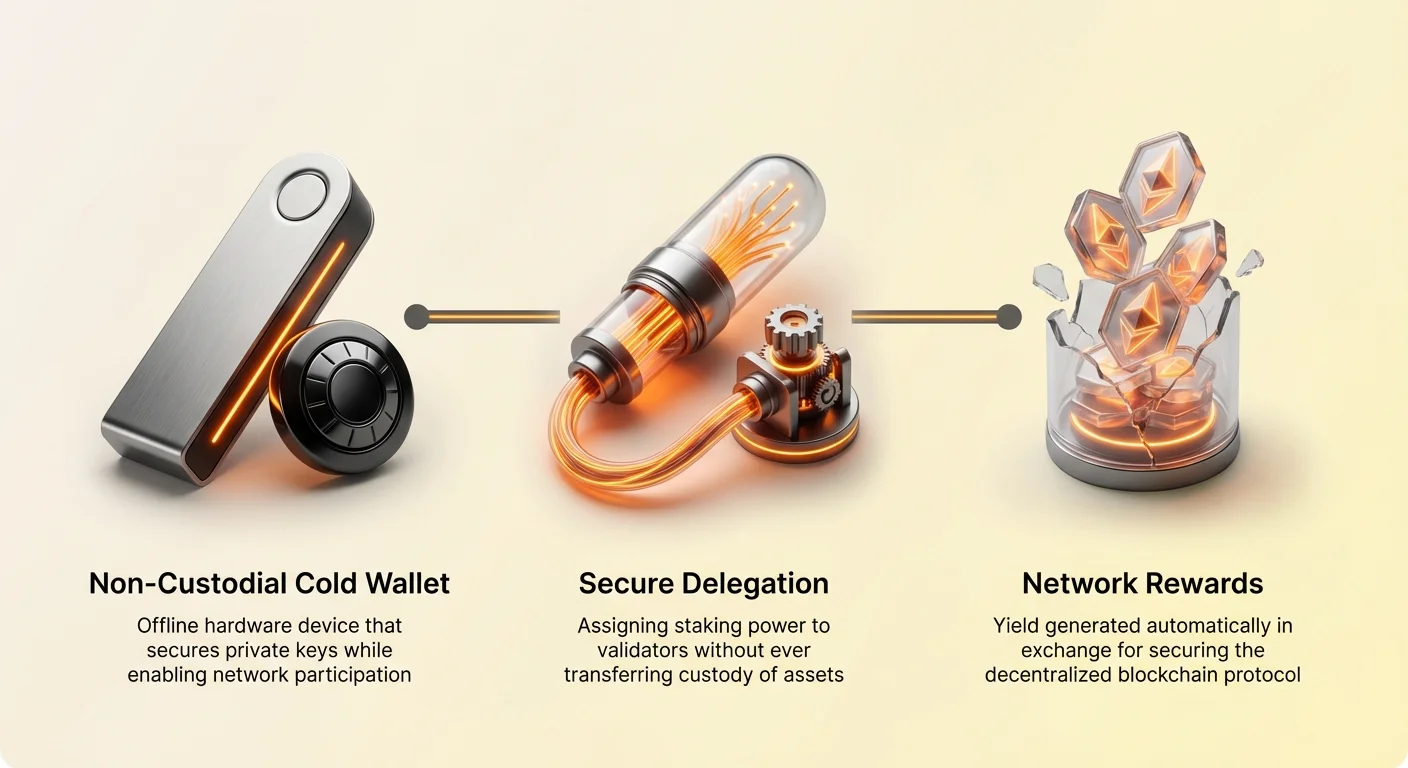
The Foundations of Staking and Delegation
Staking is the mechanism used by Proof-of-Stake (PoS) blockchains to secure the network, validate transactions, and create new blocks. In exchange for committing (locking up) your native currency, you earn rewards, similar to earning interest in a traditional bank account, but far more fundamental to the system's operation.
The wallet you choose acts as the gateway to this participatory ecosystem, defining how easily, securely, and effectively you can engage with the network’s staking mechanics.
What is Proof-of-Stake (PoS)?
Proof-of-Stake is an algorithm that determines how a decentralized network achieves consensus (agreement on the order of transactions). Unlike Bitcoin’s Proof-of-Work (PoW), which relies on energy-intensive mining hardware, PoS relies on economic incentive.
Validators (network participants who run specialized software) are selected to propose and attest to new blocks based on how much cryptocurrency they have staked. The more coins staked, the higher the chance they have of being selected, which prevents malicious actors because any attempt to cheat would result in their staked assets being penalized or “slashed.”
Staking vs. Delegation: Understanding the Roles
While the term "staking" is often used broadly, there are two distinct ways a typical user participates:
- Direct Staking (Running a Validator Node): This requires technical expertise, a dedicated server running 24/7, and significant capital (often requiring large minimum coin amounts, like 32 ETH for Ethereum). If the node goes offline or performs maliciously, the staked funds are penalized (slashed).
- Delegation (Indirect Staking): This is the method most common for individual users. You “delegate” your holding power to an existing, established validator node. Your coins remain in your wallet and under your control, but the validator uses your delegated stake to increase its probability of proposing blocks and earning rewards. You then receive a portion of those rewards, minus the validator's commission fee.
For the purpose of achieving maximum security and convenience for the average user, this guide focuses heavily on delegation facilitated by non-custodial wallets.
Why Wallet Choice Matters for Staking
A specialized staking wallet is not just a storage solution; it is an interface for network activity. The ideal staking wallet must provide three core functions:
- Security: It must protect your private keys, ensuring you alone control the funds (non-custodial).
- Functionality: It must enable the creation of delegation transactions, allow you to choose a validator, and claim rewards easily.
- Compatibility: It must seamlessly integrate with the specific blockchain’s staking protocol (e.g., Cosmos, Cardano, Solana). A wallet designed for simple Bitcoin storage won't have the features needed to interact with a PoS chain's delegation smart contracts.
Sigurnost na prvom mjestu: Vrući staking naspram hladnog stakinga
Prilikom odlučivanja kako sudjelovati u stakingu, primarna odluka vrti se oko ravnoteže između sigurnosti (štitenja privatnog ključa) i pristupačnosti (lakoće interakcije s mrežom). To dovodi do fundamentalne razlike između vrućeg i hladnog stakinga.
Definiranje vrućeg stakinga (trgovanje praktičnošću/rizikom)
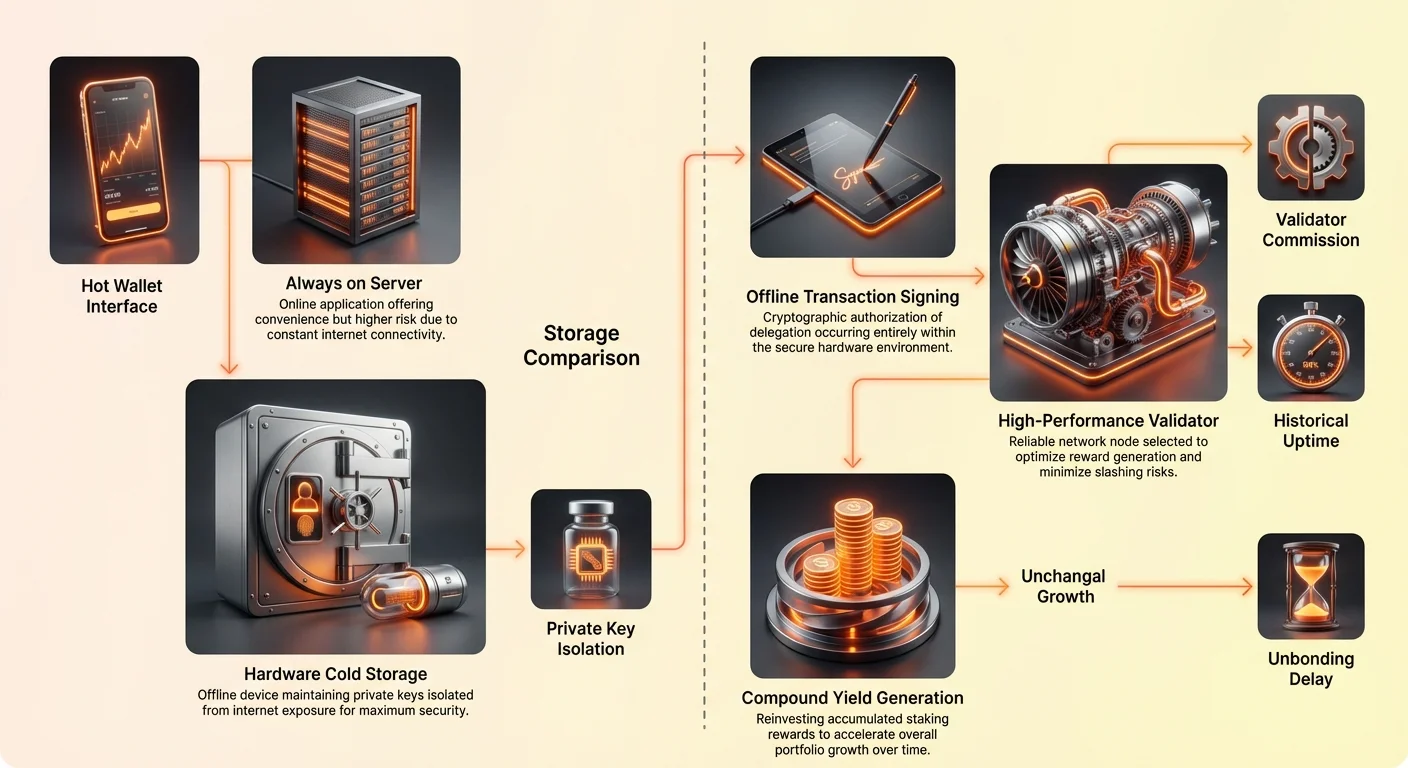
Vrući staking događa se kada se kripto imovina korištena za delegaciju drži u novčaniku koji je redovito povezan s internetom. To uključuje sredstva držana na burzama, u mobilnim aplikacijama ili u desktop novčanicima koji su stalno aktivni.
| Karakteristika | Opis | Profil rizika |
|---|---|---|
| Povezanost | Uvijek online. | Visoka izloženost udaljenim pokušajima hakiranja i malveru. |
| Praktičnost | Mjedični pristup, laka delegacija i transakcije zahtjeva nagrada. | Vrlo visok. Ako je uređaj kompromitiran, privatni ključevi su ranjivi. |
| Upotreba | Male količine, visokofrekventno trgovanje ili vrlo aktivno sudjelovanje u DeFi-ju. | Nije preporučeno za dugoročne držače ili značajni kapital. |
Dok vrući novčanici za staking nude trenutnu praktičnost, rizik od držanja velikih količina stakeabilne imovine u online okruženju krši fundamentalni princip sigurnosti samokustodije: minimiziranje izloženosti.
Razumijevanje hladnog stakinga (Zlatni standard sigurnosti)
Hladni staking označava praksu delegiranja ili zaključavanja vaših sredstava za staking dok privatni ključevi ostaju pohranjeni offline, tipično na hardverskom uređaju.
Ključna inovacija ovdje je mogućnost potpisivanja transakcije delegacije (predaje sredstava) i naknadnih transakcija zahtjeva nagrada bez ikad izlaganja privatnog ključa računalu povezanom s internetom.
Mehanizam hladnog stakinga:
- Potpis hardvera: Korisnik koristi hardverski novčanik (poput Trezor ili Ledger) za generiranje transakcije delegacije.
- Potpisivanje offline: Privatni ključ, sigurno izoliran unutar sigurnog čipa hardverskog uređaja, potpisuje transakciju.
- Emitiranje: Potpisana transakcija (koja samo upućuje mrežu, ne prenosi osnovne kovanice) emitira se u mrežu pomoću povezanog softverskog sučelja (desktop ili mobilna aplikacija).
- Nepromjenjivost: Nakon delegacije, sredstva zaključava protokol mreže za validatora, ali privatni ključevi ostaju offline i netaknuti. Sredstva se ne mogu premjestiti bez potpisa hardverskog uređaja.
Ova postavka postiže ključni cilj: sudjelujete u generiranju prinosa i sigurnosti mreže uz održavanje najviše razine kriptografske sigurnosti za vašu glavnicu.
Prepoznavanje najboljih značajki novčanika za hladni staking
Ako ste dugoročni držač, korištenje postavke hladnog stakinga je najbolja strategija hladnog staking novčanika. Primarni zahtjev je da novčanik djeluje kao osiguran uređaj za potpisivanje, a ne kao jednostavna aplikacija za pohranu.
Prilikom odabira novčanika za hladni staking, tražite ove specifične značajke:
- Integrirana nadzorna ploča za staking: Podržavajući softver (npr. Trezor Suite ili Ledger Live) treba imati izvornu integraciju s protokolom stakinga (npr. Cosmos, Polkadot), omogućujući vam pregledavanje, odabir i delegaciju validatorima izravno unutar sigurnog sučelja.
- Jasna vidljivost transakcija: Prije potpisivanja, ekran hardverskog novčanika mora jasno prikazati detalje transakcije, posebno pokazujući da je transakcija delegacija ili zahtjev nagrade, a ne transfer (trošenje).
- Ne-kustodijalni dizajn: Rješenje mora biti eksplicitno ne-kustodijalno, što znači da je hardverski novčanik izvor privatnih ključeva, a seed fraza nikad ne dodiruje online okruženje. (Pogledajte: Hijerarhija hladne pohrane: Hardver, zračnim jazom i duboka offline sigurnost za više detalja o sigurnoj pohrani.)
- Široka podrška protokolima: Tražite hardverske novčanike koji kontinuirano ažuriraju firmware za podršku novim PoS protokolima poput Solana, Polygon i novijih modela stakinga Ethereuma.
The Non-Custodial Staking Imperative
The core principle of self-custody—that you are your own bank—is fundamentally challenged when you use a centralized exchange for staking. The greatest risk in crypto is often counterparty risk, and non-custodial staking is the solution.
What is Non-Custodial Staking?
Non-custodial staking means that your private keys, which control access to your cryptocurrency, remain exclusively in your possession, typically stored and managed by a self-custody wallet (hardware, desktop, or mobile).
When you delegate non-custodially:
- You retain ownership: You sign a transaction committing the funds to delegation, but you never send the coins away.
- The network enforces the lock: The blockchain protocol, not a third-party company, locks the tokens.
- Only you can unlock/undelegate: To stop staking and move your coins, you must use your private keys to sign an unbonding transaction.
This self-sovereign approach is the cornerstone of a secure non custodial staking guide.
The Risks of Custodial Staking (Exchanges)
Custodial staking is when you deposit your coins onto a centralized exchange (CEX) and allow the exchange to handle the staking process on your behalf. While convenient, this introduces several critical risks:
1. Counterparty Risk (Not Your Keys)
The exchange holds your private keys. If the exchange is hacked, becomes insolvent, or decides to freeze your account (as seen during high-profile collapses), you lose access to your funds, regardless of whether they are staked or sitting idle.
2. Hidden Fees and Censorship
Exchanges often take a significant, non-transparent cut of staking rewards. Furthermore, by delegating massive amounts of stake through a single entity, CEXs exert disproportionate control over the network. If a government or regulator mandates that the exchange refuse to process certain transactions, they have the power to enforce censorship on the chain.
3. Slashing Risk Absorption (Without Transparency)
While exchanges often promise to cover losses from validator slashing, the specific validators they choose are opaque. You rely entirely on the exchange’s internal security practices, rather than choosing an independently verifiable validator.
How Wallets Enable Non-Custodial Delegation
A specialized non-custodial wallet provides the secure framework for delegation by facilitating complex smart contract interactions.
Consider a system like Cardano (ADA) or Polkadot (DOT):
- Wallet Selection: You open your non-custodial wallet interface (connected to your hardware device).
- Validator Browser: The wallet presents a list of active validators on the network, along with critical metrics (fees, uptime).
- Delegation Transaction: You select a validator and input the amount you wish to stake. The wallet constructs a transaction that points your assets to that validator’s staking pool address.
- Signing: The hardware device signs the transaction, confirming that you authorize the delegation commitment.
- No Transfer: Crucially, the signed transaction does not move your principal funds into the validator’s custody; it merely registers your stake with the network protocol. The coins never leave the address controlled by your offline private key.
Understanding Slashing Risks
While using a non-custodial wallet protects your private key, delegation itself does carry a risk associated with the performance of the validator you choose: Slashing.
Slashing is the penalty imposed by the PoS network if a validator breaks the network rules (e.g., double-signing blocks, going offline for extended periods). When slashing occurs, a portion of the validator’s staked funds—and the delegated funds—is confiscated by the network.
When pursuing non-custodial staking, you take on the responsibility of due diligence in selecting a high-performing validator. This transfers the risk from centralized exchange failure to validator node reliability, a risk you can mitigate through careful research, which we address in the next section.
The Art of Validator Selection
The profitability and security of your non-custodial staking portfolio hinges almost entirely on your ability to evaluate and select reliable validators. A poor choice can result in sub-optimal returns or even exposure to slashing events. This due diligence process is what distinguishes an informed staker from a passive participant.
Introduction to Validators and Network Role
Validators are the operational backbone of any Proof-of-Stake network. They are responsible for:
- Block Proposal: Creating new blocks of verified transactions.
- Attestation: Confirming the validity of other proposed blocks.
- Security: Locking up significant capital to demonstrate commitment and deter malicious behavior.
When you delegate, you are essentially lending your financial weight to increase the validator's chances of performing these tasks, thereby ensuring the health and decentralization of the network.
Critical Validator Selection Criteria
A successful staking validator selection process requires evaluating three key quantitative metrics provided within your staking wallet interface or a dedicated block explorer:
1. Commission Fee (The Cost of Service)
The commission is the percentage of the gross staking rewards that the validator keeps before distributing the remainder to their delegators.
- Low Commission (e.g., 0% to 5%): Attractive for maximizing short-term yield, but potentially risky. Validators need to charge a sustainable fee to cover operational costs (servers, bandwidth, maintenance). A 0% fee often indicates a temporary promotion, a validator using its own capital to subsidize operations, or a risk that they might suddenly raise fees dramatically.
- Stable, Medium Commission (e.g., 5% to 15%): Generally represents a healthier long-term choice. This fee range demonstrates a professional operation committed to sustainability and high uptime.
Actionable Tip: Prioritize validators with a stable, published fee structure that is above zero but reasonable for the chain’s standard. Avoid validators that have minimum commission settings (some chains enforce a minimum, like 5%).
2. Uptime and Performance (Minimizing Slashing Risk)
Uptime refers to the percentage of time the validator node has been online and performing its duties correctly. Low uptime directly translates to fewer rewards for delegators and a higher risk of being slashed for unresponsiveness.
- Look for: Near 100% uptime (e.g., 99.9% or higher) over a long history (at least six months).
- Warning Signs: Consistent dips in performance or public reports of network faults indicate poor maintenance or unreliable infrastructure. Use the staking wallet’s explorer to confirm the validator’s historical metrics.
3. Total Staked Value (TSV) and Saturation
TSV is the total amount of tokens delegated to a validator.
- Avoid Over-Concentration: While high TSV suggests popularity and trust, delegating to the single largest validator concentrates power, harming network decentralization. In some protocols (like Cardano), delegation to an "over-saturated" pool yields diminishing returns, incentivizing users to delegate to smaller pools.
- Optimal Strategy: Select mid-tier validators with strong, proven uptime and moderate TSV. This supports decentralization while still ensuring your stake is secure and productive.
Evaluating Decentralization and Community Trust
Beyond the numbers, assessing the validator’s background is crucial for the health of the broader ecosystem.
1. Validator Identity and Transparency
The best validators are transparent about who they are, where they operate, and the infrastructure they use.
- Do they have a public website?
- Do they actively participate in the community forums (e.g., Reddit, Discord)?
- Do they explicitly state their infrastructure (e.g., using geographically diverse servers, utilizing specific cloud providers)?
A reputable validator is often an established team, not an anonymous entity.
2. Geographical and Infrastructure Diversity
True network decentralization requires validators that are not all operating out of the same data center or country. By choosing validators with diverse infrastructure, you hedge against large-scale failures (e.g., a natural disaster taking out a major regional data center). While this data may require external research, some advanced staking wallets now integrate this information into their dashboards.
3. Commitment to Governance
Check if the validator actively participates in governance votes. A good validator views delegation as a holistic responsibility, not just a money-making exercise. They should vote on proposals that affect the network's future. Delegating to a validator that ignores governance means your delegated voting power is effectively wasted.
Mechanics of Earning: Rewards and Governance
Once you have securely delegated your stake using your non-custodial wallet, the final step is understanding how you earn, claim, and maximize those rewards, and how your stake contributes to the network's future direction.
Reward Claiming and Auto-Compounding Mechanics
Staking rewards are paid out periodically (e.g., every block, every epoch, or daily, depending on the protocol). Your wallet interface plays a vital role in managing this inflow.
1. Manual Claiming
In many chains (like Polkadot or Cosmos), rewards accumulate but must be manually claimed via a signed transaction.
- Gas Fee Consideration: Every claim transaction incurs a small network fee (gas). If you claim very small rewards frequently, the accumulation of gas fees can erode your profit.
- Wallet Role: Your wallet must facilitate this claim transaction securely, requiring a signature from your hardware device (in a cold staking setup).
2. Auto-Compounding (The Power of Reinvestment)
The fastest way to grow your staked holdings is through compounding—reinvesting your rewards to increase your total staked principal.
- Automatic Compounding Protocols: Some chains (like Solana) automatically add unclaimed rewards back into your staking pool, meaning you earn interest on your interest without paying extra transaction fees.
- Wallet Integration: The best cold staking wallet interfaces often offer a "Reinvest" or "Compound" button for chains that require manual action, streamlining the process of adding accumulated rewards back to your delegation pool. This is a critical feature for long-term passive growth.
Understanding Unbonding Periods and Liquidity
A necessary security feature of PoS systems is the unbonding period—the time required to wait after you initiate the process of withdrawing your stake before the tokens become spendable in your wallet.
The Purpose of Unbonding
This delay ensures that if a validator commits a slashable offense, the network has time to process the penalty before the delegated funds are removed. It is a fundamental mechanism that maintains the economic security of the chain.
| Protocol Example | Typical Unbonding Period | Implication for Liquidity |
|---|---|---|
| Cosmos (ATOM) | ~21 days | Medium liquidity constraint |
| Polkadot (DOT) | ~28 days | Significant liquidity constraint |
| Cardano (ADA) | Instant | High liquidity (funds are not locked, only the reward process is delayed) |
Wallet Management of Unbonding
A reliable staking wallet should clearly display:
- Time Remaining: The exact number of days or epochs until your staked funds are fully liquid and transferable.
- Unbonding Status: A simple, visual indicator differentiating between actively staked funds and funds currently in the unbonding process.
Actionable Tip: Never delegate funds that you anticipate needing immediate access to, as the unbonding period can lock your capital for weeks.
Participation in Governance (Voting Power)
A crucial, often overlooked, benefit of non-custodial staking is the ability to participate in network governance. When you delegate your tokens, you also delegate your voting power.
Direct vs. Inherited Governance
In most delegation models, the voting power defaults to the validator you choose. The validator then votes on proposals regarding network upgrades, treasury spending, and parameter changes.
However, advanced staking wallets for certain protocols (e.g., Tezos, Polkadot) allow you to override the validator’s vote and cast your own.
- Active Governance: Using your wallet to cast an independent vote (or changing your delegation to a validator that aligns with your view) is the ultimate expression of self-sovereignty in the digital economy.
- Wallet Features: Look for staking wallets that include a dedicated "Governance" or "Voting" tab, providing context on ongoing proposals and a simple interface for casting your vote, all secured by your private key. This feature elevates a simple storage solution to a full participatory hub.
Zaključak
Novčanici za staking su ključni alat za aktivno sudjelovanje u revoluciji Proof-of-Stake. Prioritetizacijom ne-kustodijalne postavke, posebno korištenjem hardverskih novčanika za hladni staking, osiguravate maksimalnu zaštitu za svoju glavnicu uz maksimiziranje generiranja nagrada.
Prava vrijednost samodostatnosti leži ne samo u držanju vaših ključeva, već u sigurnom i strateškom korištenju tih ključeva za interakciju i osiguranje decentraliziranih mreža na kojima se gradi buduća digitalna ekonomija. Implementacijom detaljnih kriterija za odabir validatora – fokusirajući se na radno vrijeme, održivu proviziju i predanost decentralizaciji – prelazite iz pasivnog držača kovanica u informiranog, visokoperformantnog doprinositelja mreži. Ovaj odgovoran pristup stakingu sljedeći je ključni korak na vašoj kripto putu.