
U digitalnoj ekonomiji, fraza „not your keys, not your coins“ služi kao fundamentalni maksimum sigurnosti. Ona zagovara samostalno čuvanje, praksu držanja vlastitih kriptografskih privatnih ključeva i održavanja apsolutne kontrole nad svojim imovinom.
Međutim, realnost kripto krajolika je takva da su centralizirane burze (CEX-ovi) neizbježne. One djeluju kao esencijalni portali — ulazne i izlazne rampe — omogućavajući vam pretvaranje fiat valute (kao USD ili EUR) u kripto ili brzu razmjenu između različitih digitalnih imovina. Za mnoge korisnike, burze nude likvidnost, brzinu i korisničko iskustvo potrebno za aktivno trgovanje i početne kupnje.
Stoga, za svakoga tko ozbiljno shvaća upravljanje digitalnim bogatstvom, pitanje nije jednostavno je li trebate koristiti centraliziranu burzu, već kako možete sigurno koristiti jednu. Ovaj vodič pruža pragmatičan, na sigurnost usmjeren putokaz za smanjenje rizika kada povjeravate sredstva burzi treće strane, osiguravajući da ste pripremljeni za jedinstvene ranjivosti inherentne skrbničkim uslugama. Prelazit ćemo izvan ideala 100% samodostatnosti kako bismo se usredotočili na esencijalne najbolje prakse za minimiziranje izloženosti i zaštitu vaših imovina tijekom njihovog nužnog „vremena tranzita“ na skrbničkoj platformi.
Understanding Custody and Its Risks
Before implementing security protocols, it is crucial to understand exactly what you are doing when you deposit funds into an exchange and what risks you inherit by choosing a custodial solution.
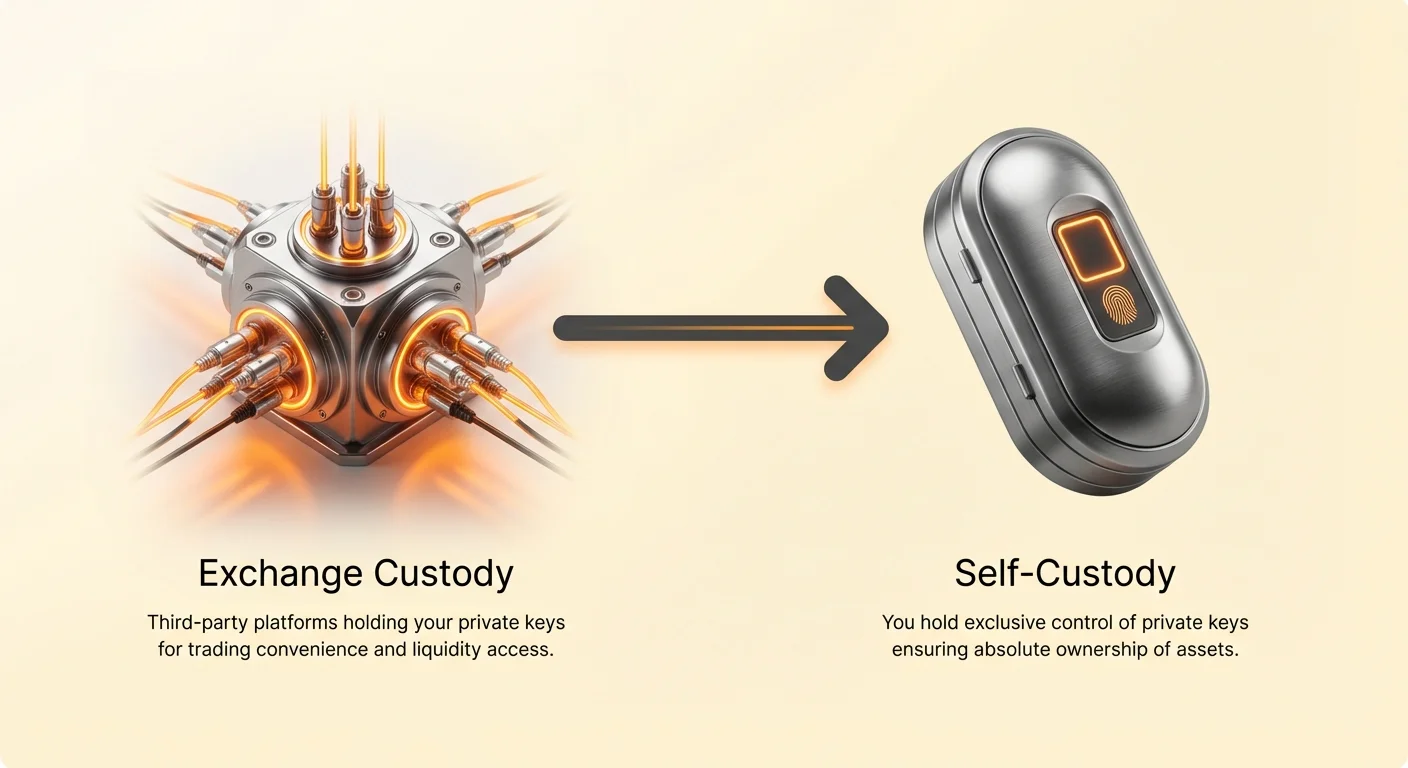
The Core Difference: Who Holds the Private Keys?
Custody refers to the safekeeping and control of your assets. In the cryptocurrency world, control is granted by the private key.
- Self-Custody (Non-Custodial): You hold the private keys. This means only you can approve transactions. If you lose your keys, your funds are gone; if you secure your keys properly, no one can take them from you, regardless of what happens to any exchange or third party. Examples include hardware wallets or desktop wallets where you control the seed phrase.
- Exchange Custody (Custodial): The exchange holds the private keys for the address where your assets reside. When you log in, the exchange authorizes transactions on your behalf, pulling funds from its vast pool of assets. You trust the exchange to manage and secure these keys, and to always honor your withdrawal request.
The fundamental risk of exchange custody is simple: you are an unsecured creditor. If the exchange fails, is hacked, or collapses, your right to withdraw your assets is dependent on the platform’s solvency and integrity.
Identifying the Primary Threats to Exchange Funds
When funds are held by a third party, the risk profile shifts away from protecting your physical key storage and toward protecting the institutional structure itself.
1. Platform Insolvency and Mismanagement
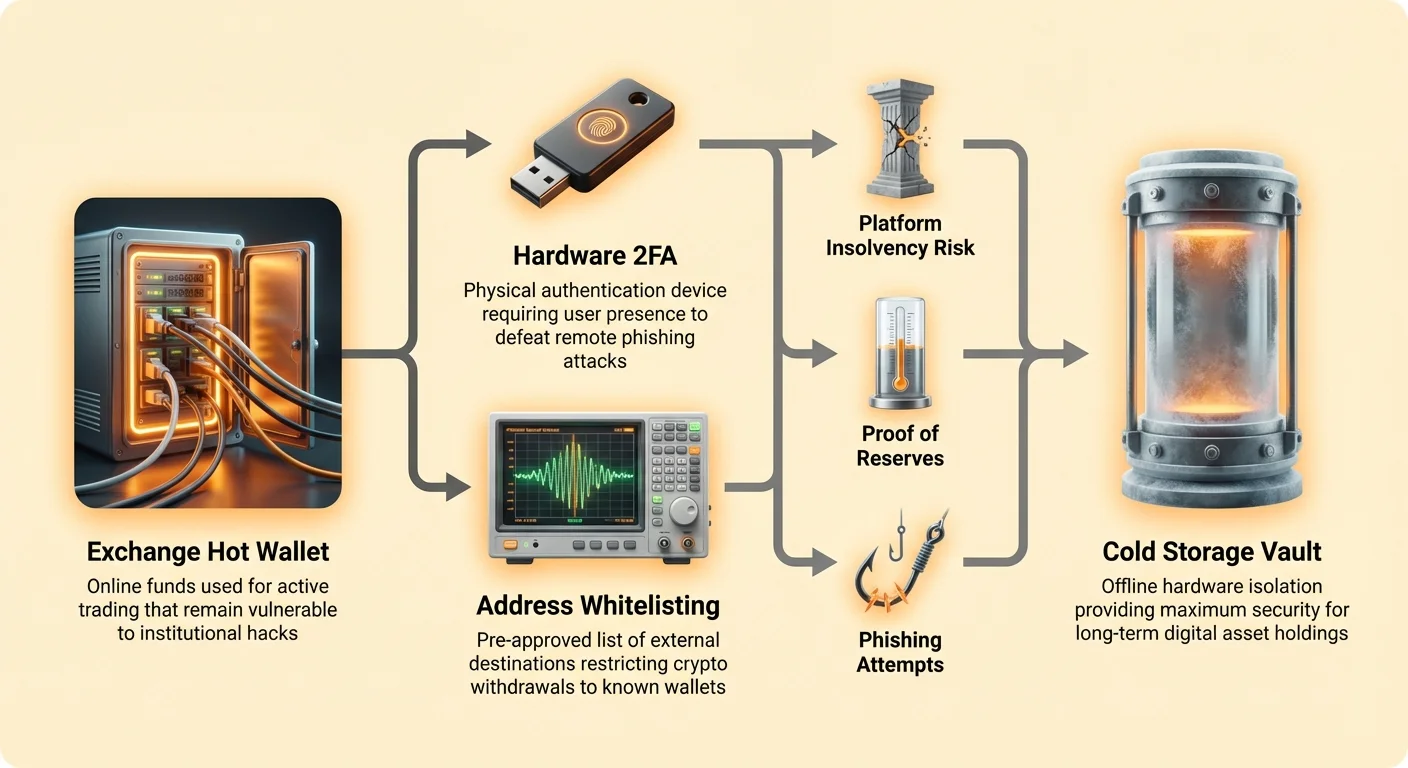
This is arguably the greatest current risk. If an exchange engages in poor financial management, takes on excessive debt, or inappropriately uses customer funds (often termed "rehypothecation"), it can become insolvent. When this happens, customers often face lengthy legal battles to recover a fraction of their deposited assets, as seen in numerous high-profile exchange failures.
2. Institutional Hacks and Exploits
While major exchanges employ sophisticated security teams, they remain massive honeypots for cybercriminals. A successful attack on an exchange’s hot wallet or centralized database can lead to the immediate and irreversible loss of billions in customer funds. Your personal account security (2FA) cannot protect you if the entire exchange infrastructure is breached.
3. Regulatory Seizure or Blacklisting
An exchange operates within a legal framework. If a government or regulator deems an exchange illegal, or requires the seizure of assets linked to specific individuals or regions, the exchange may be legally compelled to freeze or confiscate funds.
Foundational Security Measures for Custodial Accounts
While institutional hacks are outside your control, the vast majority of personal crypto theft still occurs due to user-side error: compromised credentials, weak passwords, or failure to implement proper two-factor authentication (2FA). These steps are your immediate defense against unauthorized access to your trading capital.
Implementing Robust Multi-Factor Authentication (2FA)
2FA adds a necessary layer of protection beyond a username and password. If a hacker steals your login credentials, they still cannot access your account without a second factor.
The Hierarchy of 2FA Security:
- Unacceptable (SMS/Text): Using SMS for 2FA is widely considered insecure. SIM-swap attacks allow hackers to redirect your text messages to a device they control, bypassing this security layer instantly.
- Acceptable (Authenticator Apps): Time-based One-Time Password (TOTP) apps like Google Authenticator or Authy generate codes locally on your phone. This is a significant improvement over SMS. Best Practice: Ensure you back up your TOTP seeds securely, in case you lose your phone.
- Gold Standard (Hardware Security Keys): Physical devices like YubiKey or Google Titan Keys use the FIDO standard, providing the highest level of security. They require a physical presence (touching the key) to authenticate. Hardware keys are immune to phishing attacks, as the key communicates directly with the legitimate website domain. Use hardware keys for your primary exchange accounts.
Account Whitelisting and Withdrawal Controls
Exchanges provide tools designed to slow down or block a hacker who has gained access to your account. You must activate and utilize these features immediately.
Address Whitelisting
This feature allows you to pre-approve a list of external crypto addresses (typically your own self-custody wallet addresses) to which you can send funds. If a hacker compromises your account, they cannot immediately send your crypto to their own unknown wallet because the withdrawal address has not been whitelisted.
- Actionable Tip: Enable address whitelisting immediately. Set a required security delay (e.g., 24 or 48 hours) for adding a new withdrawal address. This delay provides you with a crucial window to notice unauthorized activity and freeze the account.
Withdrawal Limits and Velocity Checks
Set limits on the maximum amount you can withdraw in a 24-hour period. While this may slightly inconvenience large traders, it drastically limits the damage a hacker can inflict before you detect the breach.
Mastering Phishing and Social Engineering Prevention
Phishing is the act of tricking you into voluntarily giving up your credentials. Exchanges are a prime target for these sophisticated attacks.
- Always Check the URL: Before entering credentials, verify that the URL is 100% correct (e.g.,
exchange.com, notexchange-login.com). Bookmark the official login page and always access it through the bookmark. - Never Click Email Links for Login: Exchanges will often send email notifications, but never click a link in an email to log in. Navigate directly to the site.
- Use a Separate Email: Use a unique, robust, dedicated email address only for your crypto exchange accounts. This reduces the surface area for data breaches from other less secure services.
Evaluating Exchange Reliability and Transparency
Since the security of your funds depends on the integrity of the institution, part of your risk mitigation strategy must involve rigorous due diligence on the platforms you choose.
Proof of Reserves and Auditing Mechanisms
Following several major exchange collapses, the demand for verifiable assurance that exchanges actually hold the assets they claim to hold has intensified.
Proof of Reserves (PoR) is a cryptographic method where an exchange proves that the crypto assets they hold in their reserve wallets match or exceed the liability owed to their customers. This is typically achieved using a Merkle Tree structure, allowing users to verify their specific balance is included in the certified total without revealing the balances of other users.
- What to Look For: Choose exchanges that regularly publish audited Proof of Reserves reports (monthly or quarterly) verified by reputable, independent third-party auditors. PoR doesn't guarantee solvency (the exchange could still have hidden fiat debts), but it provides transparency regarding the crypto assets held.
Internal Security Protocols and Cold Storage Policy
Reputable exchanges segregate customer assets into different storage types based on risk.
- Hot Storage (Online): Used for instant withdrawals and trading liquidity. This is fast but vulnerable to online hacks. Only a small percentage of total assets should be kept in hot storage.
- Cold Storage (Offline): Secured on devices completely disconnected from the internet. This is the safest way to store the vast majority of customer funds.
Due Diligence Questions: While specifics are proprietary, a secure exchange should clearly communicate the percentage of customer funds kept in cold storage (ideally 95% or higher) and detail the robust multi-signature protocols and geographically dispersed vaults they use to secure these offline keys.
Regulatory Compliance and Geographic Factors
The regulatory environment significantly impacts asset security and consumer protections.
- Jurisdiction Matters: An exchange regulated in a jurisdiction with stringent financial oversight (e.g., the US, EU, or specific Asian financial hubs) generally offers greater legal recourse and adherence to AML/KYC standards than an unregulated offshore entity.
- KYC Requirements: While some users seek "No KYC" (Know Your Customer) exchanges for privacy, regulated exchanges require KYC precisely because it provides a legal framework for accountability and fraud prevention, which ultimately adds a layer of institutional security for your deposited funds.
Razumijevanje osiguranja, uvjeta i scenarija gubitaka
Ključni korak u minimiziranju rizika burze jest razumijevanje što se događa kada se ostvari najgori scenarij (kvar platforme ili hak institucije). Uobičajena zabluda jest da su kriptovalutne burze osigurane poput tradicionalnih banaka.
Razumijevanje politika osiguranja burzi
Tradicionalne banke (fiat): U mnogim zemljama (poput SAD-a s FDIC osiguranjem), vaši fiat depoziti osigurani su do visokog limita. Ovo osiguranje pokriva gubitke ako sama banka propadne ili postane insolventna.
Kriptovalutne burze: Osiguranje burze visoko je nijansirano i često pogrešno interpretirano.
- Operativno naspram osiguranja kripto imovine: Mnoge burze imaju komercijalne police osiguranja koje pokrivaju interne operativne rizike, poput krađe zaposlenika, grubog nemara ili fizičkog gubitka hardvera za hladno skladištenje. One tipično ne osiguravaju protiv gubitka zbog insolventnosti, masovne tržišne volatilnosti ili sofisticiranih hakova na razini cijele platforme.
- Specifičnost pokrića: Ako burza oglašava osiguranje, pažljivo pročitajte sitni štamp poljice. Često osiguranje pokriva samo dio imovine držane u vrućim lisnicama, ili je riječ o općoj polici koja pokriva instituciju, što možda nije dovoljno za pokriće svih gubitaka kupaca.
- Fiat naspram kripto: Bilo koje FDIC ili ekvivalentno osiguranje koje burza može spomenuti tipično se primjenjuje samo na fiat valutu koju držite na platformi, a ne na vaše digitalne imovine.
Najbolja praksa: Djelujte pod pretpostavkom da je vaša kriptovaluta depozirana na burzi neosigurana protiv katastrofalnog kvara platforme. Ovaj stav pojačava potrebu za samostalnim čuvanjem za dugoročna zadržavanja.
Regulatorne garancije naspram garancija kripto imovine
Prilikom pregleda Uvjeta usluge (ToS), pažljivo pogledajte kako burza definira odnos vlasništva.
U tradicionalnom brokeru imovina se drži za vas. U skrbništvu kriptovalutne burze odnos može biti nejasniji. Neki uvjeti u suštini navode da čim depozirate kripto, burza drži imovinu i duguje vam dug jednak tom iznosu. Ova razlika ključna je tijekom stečajnih postupaka, gdje jednostavni vjerovnici (oni kojima se duguje dug) dobivaju naknadu tek nakon osiguranih vjerovnika, često primajući samo nekoliko centova po dolaru.
Minimiziranje izloženosti: Koncept „vremena tranzita“
S obzirom na inherentne rizike čuvanja treće strane, najefikasnija sigurnosna strategija je smanjenje vremena izloženosti. To znači tretiranje burze kao privremenog stajališta, ne stalnog sefa za uštede.
Definiranje vrućih sredstava naspram radnog toka hladnog skladištenja
Definiramo vaše imovine na temelju njihove trenutne svrhe:
- Vruća sredstva (na burzi): Minimalni iznos kripta ili fiata potreban za aktivno trgovanje, limit nalozi ili trenutne kupnje. Ova sredstva su izložena riziku platforme, ali osiguravaju nužnu likvidnost.
- Hladno skladištenje (samostalno čuvanje): Sva dugoročna ulaganja, mirovinske uštede ili imovine koje ne namjeravate prodati ili trgovati u bliskoj budućnosti. Ova sredstva su osigurana offline u hardverskom novčaniku, potpuno ih izolirajući od hakova ili propadanja burze.
Uspostavljanje rasporeda isplate
Disiplinirani raspored isplate je kamen temeljac upravljanja rizicima za korisnike burze. Ne čekajte krizu da premjestite imovine.
Strategija: Pravilo 80/20. Uobičajena profesionalna strategija je održavati samo 10-20% ukupnog kripto portfelja koji aktivno trgujete na burzi. Preostalih 80-90% treba premjestiti u novčanik samostalnog čuvanja (idealno hladno skladištenje).
- Praktičan savjet: Postavite upozorenje na burzinski račun. Ako vaš saldo premaši unaprijed definirani prag (npr. $5,000 ili ekvivalent jednog mjeseca trgovačkog kapitala), izvršite trenutnu isplatu u svoj hladni novčanik. Učinite ovo nepregovornom, rutinskom sigurnosnom praksom.
Uloga burzi samo kao ulaznih i izlaznih rampa
Gledajte burze kao transakcijske utilitete, ne banke. Njihove primarne, nužne funkcije su:
- Ulazna rampa: Pretvaranje fiat valute u kripto.
- Trgovački engine: Olakšavanje brzih, likvidnih zamjena između različitih kripto parova.
- Izlazna rampa: Pretvaranje kripta natrag u fiat kada je nužno.
Bilo koja imovina koja nije aktivno potrebna za ove funkcije treba se premjestiti s burze što je brže i rutinski moguće. Ovaj pragmatičan pristup priznaje pogodnost burzi dok prioritetizira dugoročnu sigurnost koju nudi samostalno čuvanje.
Zaključak: Uravnoteženje pogodnosti i kontrole
Korištenje centralizirane burze nužan je korak za navigaciju modernom kripto ekonomijom, ali zahtijeva prihvaćanje određenog stupnja skrbničkog rizika. Prava sigurnost se ne postiže izbjegavanjem burzi u potpunosti, već minimiziranjem ranjivosti tijekom njihove upotrebe.
Implementacijom jakih korisničkih kontrola (2FA, bijeljenje), izvođenjem rigorozne due diligence institucionalne sigurnosti (Dokaz rezervi, politike hladnog skladištenja) i, najvažnije, upravljanjem izloženosti imovine kroz disciplinirani raspored isplate, pretvarate rizičnu ponudu u upravljiv proces.
Konačno, vaš cilj treba biti korištenje pogodnosti burze za stjecanje imovina, ali iskorištavanje samostalnog čuvanja za održavanje apsolutne kontrole nad vašim bogatstvom. Najbolja obrana protiv centraliziranog rizika je dosljedna, zakazana decentralizacija vaših imovina.