
Kada novi sudionici uđu u kripto prostor, razgovor se često vrti oko povijesti cijena i volatilnosti. Međutim, da bismo integrirali digitalne imovine poput Bitcoina u sofisticiranu investicijsku strategiju, potrebna je dublja kvantitativna analiza. Moramo ići dalje od jednostavnog uspoređivanja rasta cijene Bitcoina s onim zlata ili burzovnog tržišta. Umjesto toga, moramo procijeniti njegov matematički odnos prema tradicionalnim financijama.
Ovaj kvantitativni pristup zahtijeva dvije ključne metrike: korelaciju i Beta (). Ove metrike omogućavaju investitorima da utvrde koliko se kretanje cijene Bitcoina usklađuje s S&P 500, Nasdaqom ili drugim tradicionalnim indeksima. Razumijevanje ovih odnosa ključno je za učinkovito upravljanje rizicima, konstrukciju portfelja i potvrdu uloge Bitcoina kao potencijalne makro zaštite.
Ovaj vodič pruža detaljan, metrikama vođeni okvir za izračun i interpretaciju indeksa korelacije Bitcoina i vrijednosti betea. Usvajanjem perspektive investicijskog analitičara, naučit ćete kako kvantificirati rizike i prednosti diversifikacije koje Bitcoin nudi unutar modernog portfelja.
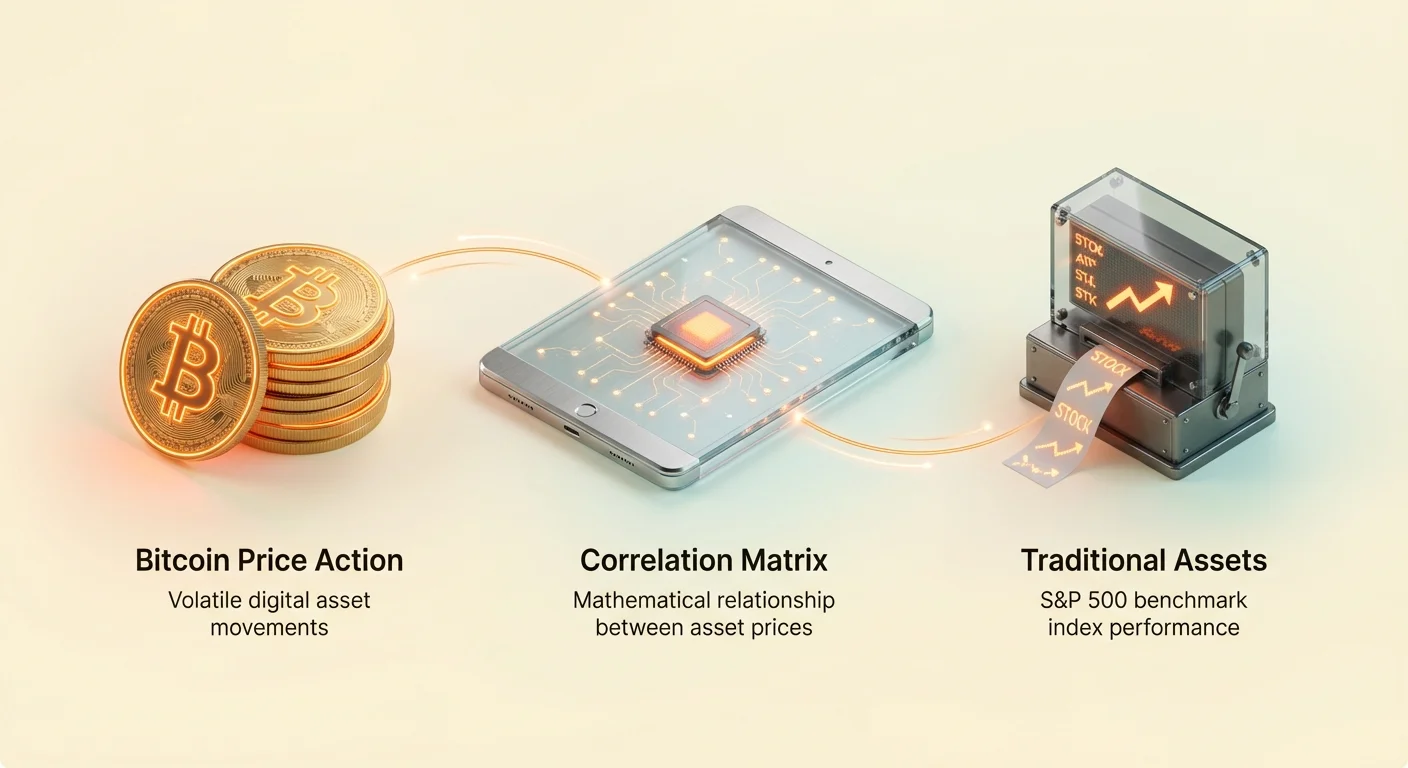
Osnove: Razumijevanje korelacije i diversifikacije
U tradicionalnim financijama, diversifikacija je ključni kamen upravljanja rizicima. Cilj diversificiranog portfelja je držati imovine koje se ne kreću istovremeno u istom smjeru. Korelacija i beta su alati koji se koriste za mjerenje ovog kretanja.
Definiranje korelacije na jednostavan način
Korelacija mjeri stupanj u kojem se dvije različite imovine kreću zajedno. Izražava se koeficijentom u rasponu od -1.0 do +1.0.
| Vrijednost korelacije | Odnos | Interpretacija |
|---|---|---|
| +1.0 (Savršena pozitivna) | Imovine se kreću savršeno sinhronizirano. | Kada imovina A poraste za 5%, imovina B poraste za 5%. |
| 0.0 (Nulta korelacija) | Imovine nemaju linearni odnos. | Imovina A se kreće neovisno o imovini B. |
| -1.0 (Savršena negativna) | Imovine se kreću savršeno suprotno. | Kada imovina A poraste za 5%, imovina B padne za 5%. |
Ako Bitcoin ima korelaciju od +1.0 s S&P 500, dodavanje Bitcoina u burzovni portfelj ne bi pružilo nikakve prednosti diversifikacije – samo bi pojačalo postojeći tržišni rizik. Investitori traže imovine s koeficijentima korelacije blizu nule ili, idealno, negativne.
Cilj diversifikacije portfelja
Kada diversificirate, ciljate snižiti ukupnu volatilnost portfelja bez žrtvovanja potencijalnih prinosa. Ako jedna klasa imovina (poput dionica) loše performira, druga klasa imovina (poput obveznica ili potencijalno Bitcoina) dobro performira ili barem ostaje stabilna.
Dugoročna investicijska teza za Bitcoin često počiva na ideji da je to nekorelirana imovina – digitalno rijetka roba koja djeluje izvan tradicionalnog fiat monetarnog sustava. Analiza indeksa korelacije omogućuje nam testiranje ove teze na stvarnim tržišnim podacima.
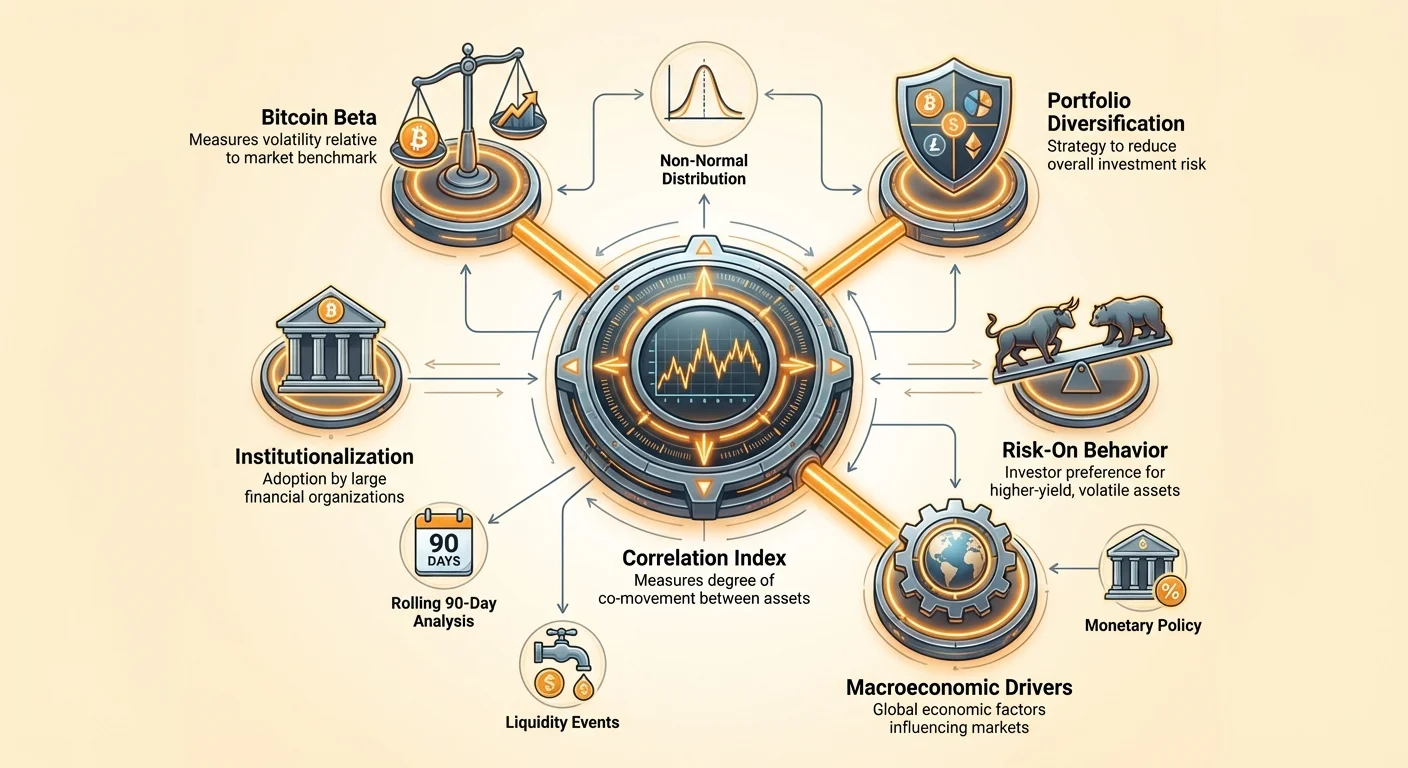
Correlation Analysis: How Bitcoin Relates to Traditional Assets
Analyzing Bitcoin’s correlation requires context. Unlike traditional asset classes where relationships might remain stable for decades (e.g., stocks vs. bonds), Bitcoin’s relationship with major market indices is highly dynamic and changes depending on market sentiment, liquidity, and macroeconomic events.
Calculating the Correlation Index (Rolling 90-Day Analysis)
A simple, static correlation calculation (e.g., BTC correlation over the last 10 years) can be misleading. Bitcoin’s maturity level and market structure have changed dramatically since its inception. Therefore, analysts rely on rolling correlation indices.
The most common method is the Rolling 90-Day Correlation. This involves:
- Calculating the daily returns for Bitcoin (BTC) and the chosen benchmark (e.g., the S&P 500, or the tech-heavy Nasdaq Composite).
- Taking the last 90 days of returns and calculating the correlation coefficient.
- Repeating this calculation every day, effectively creating a moving average of correlation.
This rolling analysis reveals crucial shifts in market structure. For example, during periods of extreme financial stress (like the COVID-19 market crash in March 2020), assets tend to move toward a correlation of +1.0 as investors panic and liquidate everything to raise cash. Analysts call this a "risk-off" environment where correlation converges.
Interpreting Correlation Values ( and $0$)
Over its history, Bitcoin has demonstrated significant shifts in its correlation profile:
- Low/Zero Correlation (Early Years & Deep Bear Markets): During periods when the institutional ownership of BTC was low, its price action was largely driven by internal crypto adoption cycles (e.g., halving events, technological upgrades). Its correlation with the Nasdaq was often close to 0. This supported the diversification thesis.
- High Positive Correlation (Periods of Institutional Integration): Following the widespread adoption of regulated financial products (like Bitcoin ETFs and futures contracts), Bitcoin began to trade alongside major technology and growth stocks. When the S&P 500 performs well, Bitcoin often amplifies that performance (correlation moves toward +0.5 to +0.8). It trades as a "risk-on" asset.
Case Study: BTC vs. S&P 500 (Historical Shifts)
To visualize this, consider the correlation between Bitcoin and the S&P 500:
- 2017 – 2020: Correlation hovered near 0.1 to 0.3. Bitcoin was viewed as an exotic, niche asset largely separate from global macro trends.
- 2021 – 2022: Correlation surged to 0.6 – 0.8 during peak liquidity. Increased institutional involvement meant BTC became subject to the same interest rate and liquidity fears that governed tech stocks. When the Federal Reserve raised rates, both the Nasdaq and Bitcoin suffered simultaneously.
- Post-2023: Correlation often recedes back toward 0.4 or 0.5. Analysts watch for these de-correlation events, as they signal a renewed acceptance of Bitcoin as a unique asset class rather than just another high-beta tech stock.
Bitcoin Beta: Measuring Volatility Relative to the Market
While correlation measures the direction of movement between two assets, Beta () measures the magnitude of that movement relative to a specific benchmark, usually the broader stock market (S&P 500).
Beta is the definitive measure of an asset’s systematic risk—the non-diversifiable market risk that affects all assets.
What is Beta ()? (The Formula Explained Simply)
Conceptually, Beta is calculated by dividing the covariance of the asset (Bitcoin) and the benchmark (S&P 500) by the variance of the benchmark.
This calculation tells us, mathematically, how sensitive Bitcoin is to broad market movements.
The Benchmark’s Beta is always 1.0. If Bitcoin has a Beta of 2.0 against the S&P 500, it means that for every 1% move in the S&P 500, Bitcoin is expected to move 2% in the same direction.
Interpreting a High Beta (\beta > 1): The Risk Amplifier
When Bitcoin’s Beta is significantly greater than 1.0, it confirms its role as a "risk-on" asset.
Key Interpretation:
- \beta > 1.0 (High Beta): Bitcoin is more volatile and sensitive than the overall market. If the stock market rallies, Bitcoin is expected to rally even harder. Conversely, if the stock market falls, Bitcoin is expected to fall further.
- Example: If Bitcoin's Beta against the S&P 500 is 2.5, and the S&P 500 rises 4% in a quarter, Bitcoin is expected to rise 10% (4% x 2.5).
Historically, Bitcoin’s Beta has often been between 1.5 and 3.0, especially when measured against indices that contain high-growth technology stocks, such as the Nasdaq Composite. This volatility premium is what attracts many investors, but it also means Bitcoin greatly increases the overall systematic risk of a portfolio.
Interpreting Negative or Zero Beta (): The Macro Hedge
The holy grail for diversification—and the strongest argument for Bitcoin as a true "digital store of value" similar to gold—is a Beta close to zero or, ideally, negative.
Key Interpretation:
- (Zero Beta): Bitcoin’s price movements are independent of the broader market. Adding zero-Beta assets reduces the overall systematic risk of the portfolio.
- \beta < 0 (Negative Beta): Bitcoin moves inversely to the market. When the market is under stress (falling), Bitcoin is expected to rise. This is the definition of a true macro hedge.
- Example: US Treasury bonds often exhibit a negative Beta relative to the stock market, rising in value when investors flee equities.
Bitcoin has rarely sustained a consistently negative Beta. The brief periods where its Beta drops toward zero often coincide with extreme monetary policy uncertainty or localized crypto events (like regulatory milestones or technological forks) that overshadow global macro trends. Sustained negative Beta remains the aspirational goal for the full validation of the store-of-value thesis.
Drivers of Correlation and De-correlation
Bitcoin's Beta and correlation are not static. They shift based on underlying market structure and macroeconomic forces. Understanding the drivers of these shifts is key to anticipating future performance.
Institutionalization and "Risk-On" Behavior
The primary driver increasing Bitcoin’s correlation with traditional markets is institutionalization.
- Regulated Products (ETFs and Futures): When Bitcoin is primarily bought through traditional vehicles like exchange-traded funds (ETFs) and futures contracts, it enters the portfolio models of massive institutions, including pension funds and corporate treasuries.
- Asset Class Classification: These institutions typically classify BTC not as a separate currency, but as a "high-growth, long-duration technology asset." This places it in the same risk bucket as the major tech stocks that dominate the Nasdaq and S&P 500.
- Liquidity Events: When fund managers need to raise cash quickly, they sell their most liquid, high-risk assets first. If Bitcoin is in the "high-risk" bucket alongside tech stocks, both will be sold simultaneously, driving correlation toward +1.0.
Macroeconomic Drivers (Inflation, Monetary Policy)
Macroeconomics play a decisive role in correlation shifts:
- Tighter Monetary Policy: When central banks raise interest rates, liquidity tightens. This universally hurts speculative, long-duration assets (like growth stocks and Bitcoin) because their future cash flows are discounted more steeply. This environment pushes correlation higher.
- Geopolitical and Systemic Risks: When major geopolitical conflicts or global banking crises occur, correlation can spike briefly toward 1.0. However, if the crisis challenges the stability of the fiat system itself, Bitcoin may eventually de-correlate, rising as a safe-haven alternative.
Market Maturation and De-correlation Events
As the market matures, there are specific factors that could drive de-correlation (pushing correlation toward zero):
- Increased Use as Currency: If a significant portion of Bitcoin’s volume shifts from speculative trading to transactional use (Layer 2 payment systems, remittances), its price will be driven by utility and network effects rather than general market risk sentiment.
- Sovereign Adoption: If a nation-state begins using Bitcoin as part of its treasury reserves or monetary policy, the asset's price dynamics will become linked to sovereign stability rather than corporate profitability, potentially reducing Beta against equity markets.
- The Store-of-Value Narrative: For Bitcoin to achieve sustained low correlation, the market must unanimously agree that it functions primarily as a digital commodity, valued for its scarcity and independence from central banking, rather than a speculative tech stock.
Praktična primjena: Korištenje Beta za procjenu rizika portfelja
Razumijevanje Bitcoin Beta i indeksa korelacije nije samo akademska vježba; ono je ključno za izračunavanje optimalne alokacije Bitcoina unutar diversifikovanog portfelja.
Određivanje optimalne alokacije portfelja
Za financijske profesionalce i ozbiljne maloprodajne investitore, ove metrike se koriste za izvođenje optimizacije srednje-varijance (MVO), metode za odabir imovine kako bi se maksimizirao očekivani prinos za dani nivo rizika.
1. Kvantificiranje vrijednosti diversifikacije
Ako je postojeći sistematski rizik vašeg portfelja (mjerljiv ukupnom Betom) visok, dodavanje imovine s niskom ili negativnom korelacijom može drastično sniziti vašu ukupnu volatilnost bez značajnog utjecaja na očekivane prinose.
- Akcijski uvid: Ako klizna 90-dnevna BTC korelacija s S&P 500 poraste iznad 0,7, korist diversifikacije se smanjuje, a manja alokacija je opravdana za upravljanje sistematskim rizikom. Ako korelacija padne ispod 0,3, veća alokacija može biti opravdana zbog poboljšane diversifikacije.
2. Budžetiranje rizika na temelju Beta
Ako odlučite uključiti Bitcoin (s visokim Betom, npr. ), morate drastično smanjiti postotak alokacije u usporedbi s niskom-Beta imovinom poput obveznica (\beta<0.5).
- Pogled analitičara: Alokacija od 5% u Bitcoinu s Betom od 2,5 doprinosi istom iznosu sistematskog rizika portfelju kao alokacija od 12,5% u standardnom fondu koji prati tržište (5% x 2.5 = 12.5%). Razumijevanje ovoga omogućuje precizno budžetiranje rizika.
Ograničenja i upozorenja metrike Bitcoin Beta
Iako moćna, primjena Beta na Bitcoin postavlja jedinstvene izazove koje investitori moraju priznati:
1. Ne-normalna distribucija
Tradicionalni financijski modeli pretpostavljaju da prinosi imovine slijede normalnu distribuciju (zvono krivulje). Međutim, prinosi Bitcoina su zloglasno „sa debelim repovima“, što znači da se ekstremni pomaci (gore ili dolje) događaju mnogo češće nego što normalni model predviđa. Izračuni Beta, temeljeni na standardnoj devijaciji i kovarijanci, mogu podcijeniti pravi ekstremni rizik pada inherentan Bitcoinu.
2. Osjetljivost na vrijeme
Kao što je utvrđeno, Beta i korelacija nisu stabilne. Izračun Beta od 5 godina može pokazati visok broj, ali ako se struktura tržišta fundamentalno promijenila prije 18 mjeseci (zbog nove regulative ili odobrenja ETF-a), taj dugoročni Beta je irelevantan za predviđanje budućih kretanja. Investitori moraju koristiti kraće, klizne metrike od 90 ili 180 dana.
3. Likvidnost i troškovi transakcija
Modeli Beta obično pretpostavljaju kontinuiranu likvidnost. Iako je Bitcoin visoko likvidan, periodi ekstremnog stresa mogu dovesti do širih spreadova i viših troškova transakcija nego kod tradicionalnih dionica, suptilno utječući na stvarni učinak impliciran izračunatim Betom.
Zaključak
Evolucija Bitcoina od nepoznate internetske valute do globalno priznate imovine zahtijeva da investitori usvoje rigorozne alate kvantitativnih financija. Prelazak preko anegdotskih usporedbi zahtijeva detaljnu, kliznu analizu indeksa korelacije i betea.
Izračunom i praćenjem Bitcoinove betae u odnosu na glavne tradicionalne ključne pokazatelje poput S&P 500 i Nasdaq Composita, investitori mogu precizno izmjeriti sistematski rizik koji Bitcoin dodaje portfelju. Iako Bitcoin povijesno pokazuje visoku betu (), signalizirajući svoj trenutni status kao imovine rasta/risk-on, razumijevanje pokretača de-korelacije – poput zrenja tržišta i usvajanja korisnosti – ključno je za predviđanje hoće li Bitcoin na kraju ispuniti svoj potencijal kao niskobeta makro zaštita protiv monetarne nestabilnosti.
Na putu prema financijskoj samodovoljnosti, kvantitativna analiza pruža potrebni okvir za pretvaranje spekulativnih imovina u strateški upravljane komponente portfelja.