
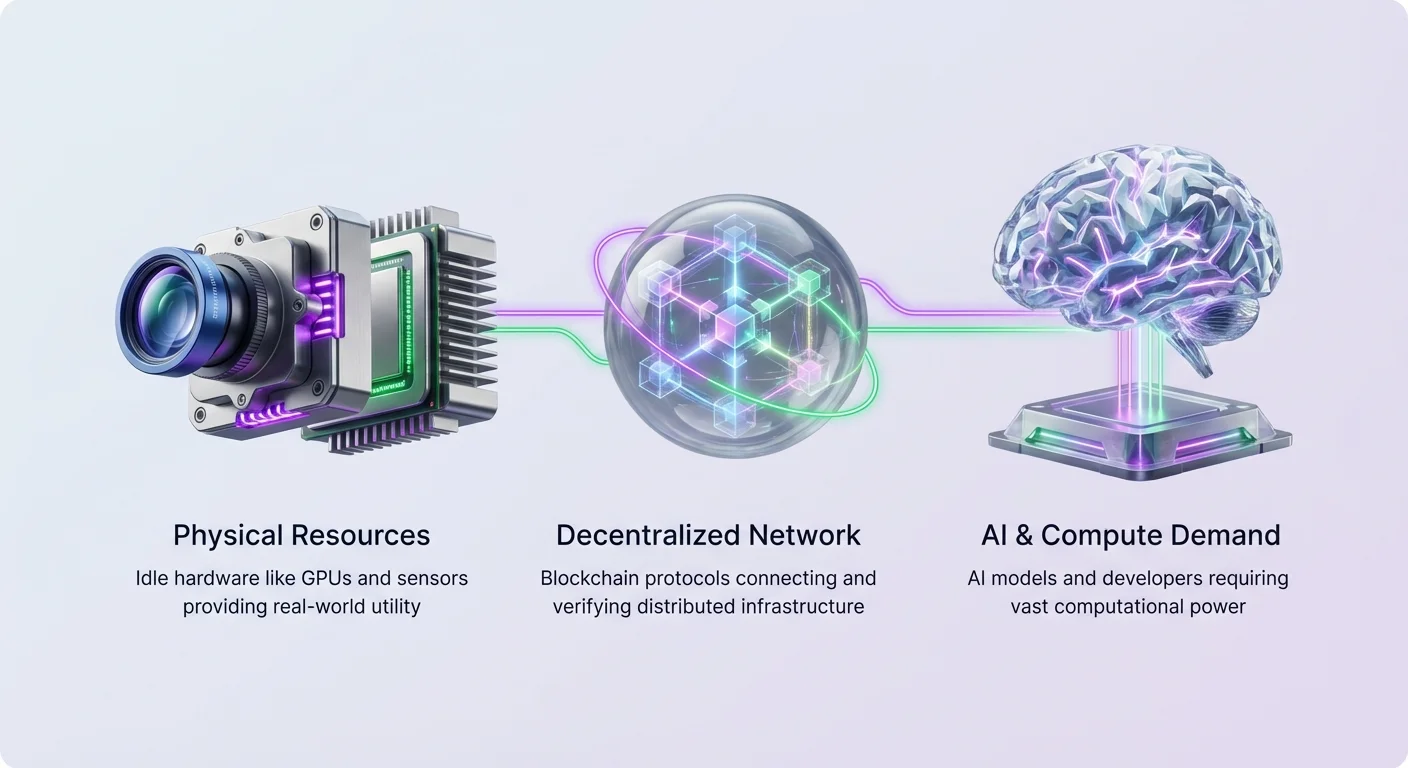
The rapid evolution of blockchain technology has moved beyond digital-only assets into the tangible world. A new sector known as Decentralized Physical Infrastructure Networks, or DePIN, is reshaping how we build and manage real-world resources. This model shifts control from centralized tech giants to distributed communities of individuals. By leveraging blockchain protocols, DePIN allows users to monetize idle hardware like GPUs, storage devices, and energy grids.
At its core, this movement represents a democratization of infrastructure. Traditionally, building a cloud computing network or a mapping service required billions of dollars in capital. Only massive corporations could afford the data centers and logistical networks necessary to operate at scale. DePIN flips this dynamic by incentivizing ordinary people to contribute their own hardware to a shared network.
The mechanism relies on token incentives to coordinate this activity. Participants, often called "providers" or "miners," connect their physical devices to the network. In exchange for their contributions—whether that is computing power, wireless coverage, or sensor data—they earn cryptocurrency rewards. This creates a circular economy where the network grows stronger as more participants join, increasing the utility and value of the underlying token.
The Convergence of AI and Blockchain
The intersection of Artificial Intelligence and blockchain is currently one of the most potent drivers of DePIN adoption. The explosion of generative AI models has created an insatiable demand for computing power. Training Large Language Models (LLMs) requires thousands of high-performance GPUs running in parallel for weeks or months.
Centralized cloud providers have struggled to keep up with this demand, leading to hardware shortages and skyrocketing prices. This bottleneck has created a perfect opening for decentralized alternatives. Networks can aggregate idle GPUs from data centers, crypto mining farms, and high-end consumer workstations into a unified resource pool.
This decentralized approach offers significant cost advantages. By tapping into underutilized hardware, these networks can offer computing power at a fraction of the cost of centralized services like AWS or Google Cloud. Developers and researchers gain access to affordable resources, while hardware owners generate passive income from equipment that would otherwise sit idle.
Architecture of a DePIN Network
A successful decentralized infrastructure project requires several technical layers to function correctly. It is not enough to simply connect a device to the internet. The network must verify that the device is working, measure its output, and distribute payments fairly. This requires a robust stack of blockchain technologies working in unison.
The bottom layer consists of the physical hardware itself. This could be a server-grade GPU, a 5G hotspot, or a smart energy meter. Above this sits the "middleware" layer, which handles the orchestration of tasks. For a compute network, this software manages the distribution of workloads, ensuring that a rendering job or AI training batch is sent to the correct machine.
The blockchain layer serves as the settlement and verification engine. Smart contracts record the contributions of each provider and automate the distribution of rewards. This transparency ensures that no single entity can manipulate the payout structure or censor participants.
The GPU Crisis and Decentralized Solutions
The current landscape of high-performance computing is defined by scarcity. As AI models become more complex, the hardware required to run them becomes increasingly specialized and expensive. The demand for chips like the NVIDIA H100 and A100 has outpaced supply, creating a "GPU crunch" that threatens to slow the pace of innovation.
Aggregating Idle Compute Power
Decentralized networks address this shortage by creating a marketplace for computing power. Platforms like NodeAI serve as aggregators, connecting supply with demand in a permissionless environment. Instead of building a new data center from scratch, these protocols unite thousands of existing servers into a global supercomputer.
This model is particularly effective for tasks that can be parallelized. For example, 3D rendering for movies or video games involves processing vast amounts of visual data. This workload can be split into small chunks and distributed across hundreds of different nodes. Each node processes its assigned frames and returns the results, drastically reducing the time required to complete the project.
The flexibility of this system allows for diverse use cases. Beyond AI and rendering, decentralized GPU networks support cloud gaming, where video games are processed on remote servers and streamed to user devices. This requires low-latency connections, which decentralized networks can provide by locating edge nodes closer to the end-user than centralized data centers.
Use Cases for Distributed GPUs
The versatility of GPU resources means that DePIN networks can serve multiple industries simultaneously. The same hardware that trains a financial algorithm in the morning can render a 3D animation in the afternoon. This maximizes the utility of the hardware and ensures consistent revenue for providers.
Primary Applications of Decentralized Compute:
| Application | Description | Resource Needs |
|---|---|---|
| AI Training | Teaching models to recognize patterns. | High VRAM, sustained uptime. |
| Inference | Running live AI models (chatbots). | Low latency, high availability. |
| Rendering | Processing 3D graphics/video. | High raw compute, burstable. |
For scientific research, this access is transformative. Universities and independent researchers often lack the budget for commercial cloud services. Decentralized networks offer a cost-effective alternative for running simulations in bioinformatics, climate modeling, and physics. By lowering the barrier to entry, DePIN accelerates scientific discovery.
The Role of Oracles in Verification
One of the most critical challenges in DePIN is the "Oracle Problem." A blockchain is a closed system; it cannot inherently see what is happening in the physical world. A smart contract on Ethereum does not know if a GPU in a basement in London is actually performing a calculation or just idling.
Bridging On-Chain and Off-Chain Data
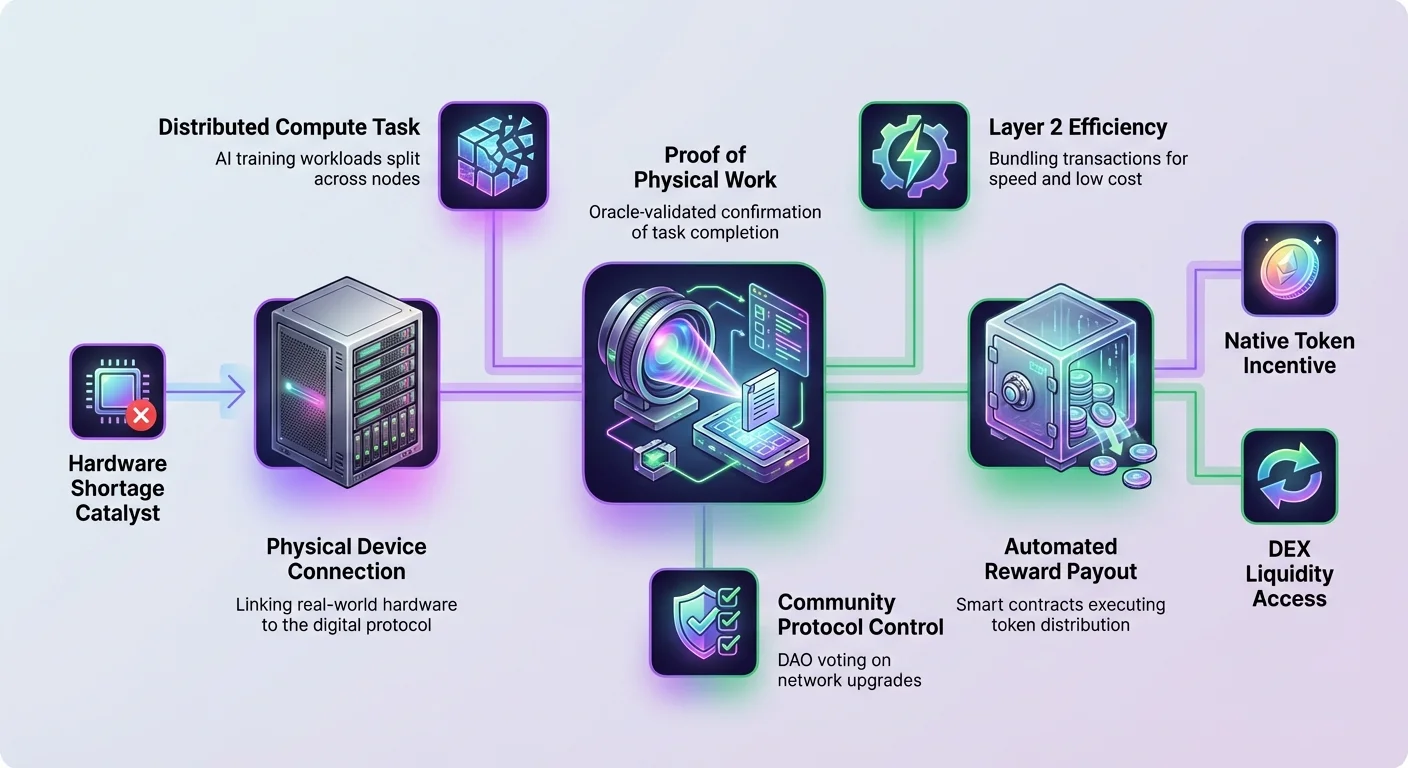
This is where decentralized oracle networks like Chainlink become essential. Oracles act as the bridge between the blockchain and the real world. In a DePIN context, oracles are responsible for "Proof of Physical Work." They verify that a device is active, online, and performing the tasks it claims to be doing.
The process involves multiple steps. First, the hardware provider submits a cryptographic proof that they have completed a task. The oracle network validates this proof against real-world data or benchmark tests. Once the data is verified by multiple independent nodes, it is aggregated and delivered to the smart contract.
Without robust oracles, a DePIN network is vulnerable to fraud. Bad actors could simulate hardware activity to drain the reward pool without contributing any actual value. Decentralized verification ensures that rewards are only distributed for legitimate work, maintaining the economic integrity of the ecosystem.
Automating Payouts and Maintenance
Oracles also facilitate automation within the network. For example, a smart contract can be programmed to release payments only when a specific performance metric is met. If a GPU node maintains 99.9% uptime over a month, the oracle reports this data, and the contract automatically releases a bonus reward.
Conversely, if a node goes offline or delivers corrupted data, the oracle triggers a penalty or "slashing" mechanism. This creates a self-regulating system where quality is incentivized and poor performance is penalized. This automation reduces the need for human intervention and allows the network to scale to millions of devices.
Scaling Infrastructure with Layer 2 Solutions
DePIN networks generate a massive number of transactions. Every time a device completes a micro-task, submits a "heartbeat" signal, or receives a micropayment, it interacts with the blockchain. On a mainnet like Ethereum, the cost of these transactions (gas fees) would make the network economically unviable.
The Necessity of High Throughput
Layer 2 scaling solutions, such as Polygon, provide the necessary infrastructure to handle this volume. By processing transactions off the main Ethereum chain and bundling them together, Layer 2s reduce fees to a fraction of a cent and increase transaction speeds significantly.
Zero-Knowledge (ZK) technology is particularly relevant here. ZK-rollups allow the network to prove the validity of a large batch of transactions without revealing the underlying data of every single interaction. This enhances privacy for hardware providers while maintaining the security guarantees of the main blockchain.
For a DePIN project, this means payments can be streamed in near real-time. A GPU provider doesn't have to wait a month for a paycheck; they can receive tokens every few minutes as they process data. This immediate feedback loop is a powerful incentive for user adoption.
Interoperability and the Superchain
The future of DePIN infrastructure lies in interoperability. Developers are building tools that allow different networks to communicate. A storage network on one chain might need to interact with a compute network on another. Shared liquidity layers and cross-chain messaging protocols facilitate this seamless integration.
Polygon’s development of a Chain Development Kit (CDK) allows DePIN projects to launch their own dedicated chains. These "app-chains" are tailored to the specific needs of the hardware network while sharing the security of the broader ecosystem. This modular approach prevents network congestion and allows each project to optimize its parameters for its specific hardware type.
Tokenomics and Financial Liquidity
The economic engine of any DePIN project is its token. This digital asset serves multiple roles: it is a medium of exchange for services, a reward for providers, and often a governance tool for decision-making. Designing a sustainable token economy is crucial for the long-term survival of the network.
The Role of DEXs and AMMs
For a token to have value, it must be liquid. Providers need to be able to convert their earned tokens into other assets to pay for electricity and hardware maintenance. Decentralized Exchanges (DEXs) like Uniswap provide this essential liquidity infrastructure.
Through Automated Market Makers (AMMs), liquidity pools allow for continuous trading without the need for centralized order books. Users deposit pairs of tokens (e.g., the DePIN token and a stablecoin like USDC) into a smart contract. Traders can then swap against this pool instantly.
This liquidity is permissionless. A new DePIN project does not need to pay a listing fee to a centralized exchange to get started. They can simply create a liquidity pool on a DEX, allowing the market to determine the price of their compute or storage resources.
Yield and Incentives
To attract capital, DePIN projects often use yield farming strategies. Users who provide liquidity to the DEX pools earn a portion of the trading fees. Aggregators like Yearn Finance can further optimize this by automatically moving funds to the most profitable pools.
However, tokenomics must balance emission with demand. If a network prints too many tokens to reward hardware providers without sufficient demand from users (developers needing compute), the token price will crash. Successful models often implement "burn" mechanisms, where a portion of the revenue generated from network usage is used to buy back and destroy tokens, reducing supply.
Governance and Community Control
Unlike centralized cloud providers where decisions are made in a boardroom, DePIN networks are often governed by their communities. This is typically achieved through a Decentralized Autonomous Organization (DAO). Token holders vote on key proposals that shape the future of the protocol.
The Power of the DAO
Governance tokens, such as the UNI token for Uniswap or the $GPU token for NodeAI, grant voting rights. Proposals might cover topics like changing the fee structure, approving new hardware types, or allocating treasury funds for marketing and development.
This structure ensures that the network remains aligned with the interests of its users. If the community feels that payouts are too low or that the network is ignoring a specific use case, they can propose and vote on changes. This creates a sense of ownership that is absent in Web2 platforms.
Challenges in Governance
Decentralized governance is not without challenges. It requires active participation from token holders to be effective. Apathy can lead to a small group of "whales" (large token holders) dominating the voting process. Furthermore, technical decisions often require specialized knowledge that the average voter may not possess.
To mitigate this, many projects use delegation systems. Token holders can delegate their voting power to trusted experts or community leaders who have the technical expertise to make informed decisions. This representative democracy model balances broad participation with informed governance.
Risks and Considerations
While the potential of DePIN is immense, participants must be aware of the inherent risks. The technology is still in its early stages, and the landscape is highly volatile. Technical bugs in smart contracts can lead to loss of funds, and hardware compatibility issues can affect earnings.
Impermanent Loss and Volatility
For those providing liquidity on DEXs, "impermanent loss" is a significant risk. This occurs when the price of the deposited tokens changes drastically compared to when they were deposited. In volatile crypto markets, this can sometimes outweigh the fees earned from trading.
Hardware providers also face market risk. The value of the reward token fluctuates. A mining rig that is profitable today might operate at a loss tomorrow if the token price drops or if energy costs rise. Providers must treat their hardware contribution as a business, calculating ROI based on fluctuating variables.
Regulatory Compliance
The regulatory environment for crypto assets remains uncertain in many jurisdictions. Projects that issue tokens must navigate complex securities laws. Some platforms, like World Liberty Financial, emphasize strict KYC (Know Your Customer) compliance to mitigate these legal risks, bridging the gap between decentralized tech and regulatory requirements.
Conclusion
Decentralized Physical Infrastructure Networks represent a fundamental shift in how we organize and maintain the physical backbone of the internet. By combining blockchain incentives with real-world hardware, DePIN creates a more efficient, open, and resilient alternative to centralized monopolies. It unlocks the value of idle resources and places control back into the hands of the community.
As the sector matures, the integration of robust oracles, scalable Layer 2 networks, and liquid financial markets will drive adoption. The convergence of AI hunger for compute and the efficiency of decentralized networks suggests that DePIN will be a dominant narrative in the coming years. From rendering graphics to powering the next generation of AI, the future of infrastructure is distributed.
DePIN empowers individuals to build the physical internet and share in the value they create.