
Digital asset markets rely on infrastructure that facilitates the exchange of value between participants. At the heart of the most common trading platforms lies the Centralized Exchange, often abbreviated as CEX. These platforms function as intermediaries, much like traditional stock exchanges or banks, connecting buyers and sellers in a controlled environment. To navigate these marketplaces effectively, a trader must understand the underlying mechanics that drive price discovery and trade execution.
The primary engine powering a centralized exchange is the order book. This digital ledger records the interests of market participants in real-time, displaying the prices at which users are willing to buy or sell a specific asset. Unlike decentralized alternatives that might use automated market maker algorithms, a CEX relies on this list of orders to match demand with supply.
Understanding how these components interact provides the foundation for all trading strategies. Whether one intends to hold assets for the long term or engage in frequent day trading, the ability to read an order book and interpret trading pairs is essential. It reveals the sentiment of the market, the depth of available liquidity, and the potential costs associated with entering or exiting a position.
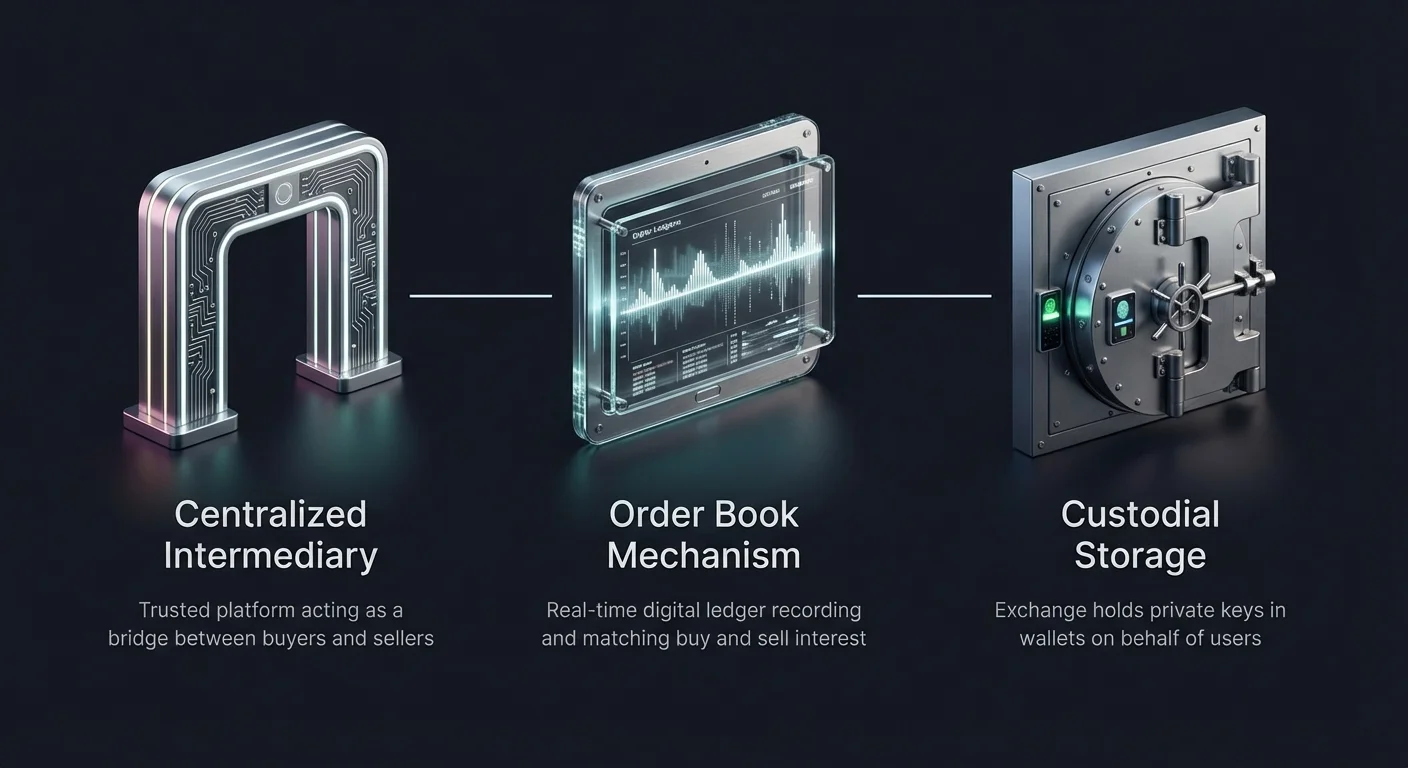
The Role of the Centralized Intermediary
A centralized exchange operates as a trusted third party between two traders. When a user creates an account, they typically deposit funds into a wallet controlled by the exchange. This model is known as custodial service. The exchange holds the private keys to the digital assets, effectively acting as a bank for cryptocurrencies. This centralization allows for extremely fast transaction speeds because trades occur on the exchange's internal database rather than on the blockchain itself.
In this system, the exchange is responsible for security, transaction matching, and balance updates. Because the trades happen off-chain, users do not have to wait for block confirmations or pay network gas fees for every individual trade. Instead, they pay trading fees to the platform for the service of matching their orders. This efficiency makes CEXs the primary gateway for new investors entering the crypto space.
The trade-off for this convenience is the requirement to trust the operator. Users rely on the exchange's security measures to protect their funds from theft or mismanagement. Additionally, because these entities are businesses, they are subject to regulations in the jurisdictions where they operate. This often necessitates identity verification processes, known as Know Your Customer (KYC), before a user can deposit fiat currency or withdraw significant amounts of crypto.
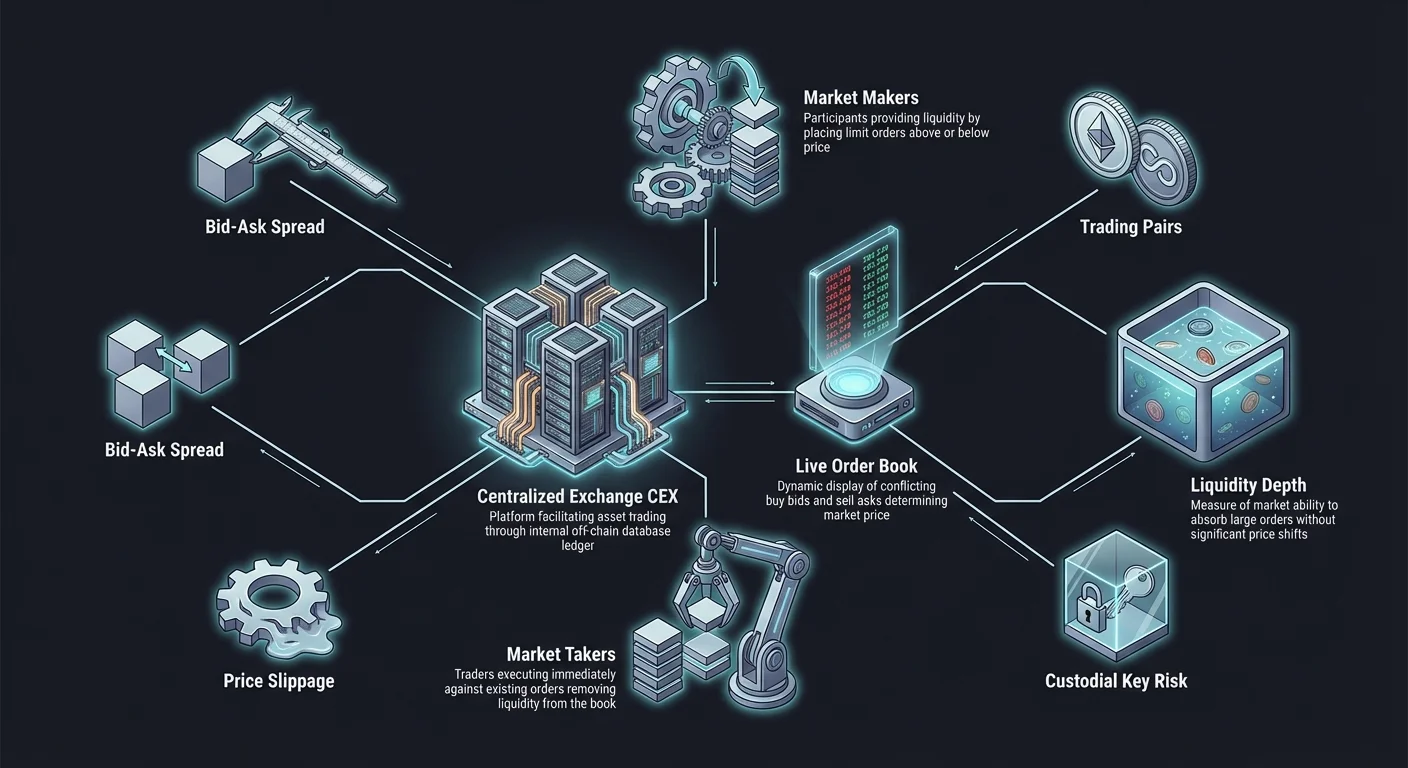
Deconstructing the Order Book
The order book is a dynamic, real-time list of buy and sell orders for a specific asset. It is generally divided into two distinct sections. The top half usually displays the "asks," or sell orders, which are often colored red. These represent the prices at which current holders are willing to part with their assets. The prices in this section ascend, with the lowest asking price sitting closest to the middle.
The bottom half of the order book displays the "bids," or buy orders, typically colored green. These represent the prices other users are willing to pay to acquire the asset. These prices are arranged in descending order, with the highest bid sitting at the top, closest to the middle. The interaction between these two sides determines the current market price of the asset.
Between the highest bid and the lowest ask lies a gap known as the "spread." This spread represents the difference in price between what a buyer wants to pay and what a seller wants to receive. In highly liquid markets with many participants, this spread is usually very small, sometimes just a fraction of a cent. In markets with fewer participants or lower activity, the spread can be significant, representing a higher cost to execute an immediate trade.
Market Makers and Market Takers
The ecosystem of an order book is populated by two distinct types of participants: makers and takers. Understanding this distinction is vital because it often dictates the fees a trader will pay.
Market Makers
Makers are traders who populate the order book with limit orders. They place buy orders below the current price or sell orders above the current price. By doing so, they are "making" the market by providing liquidity. They are not looking for immediate execution but are willing to wait for the price to come to them. Because they add depth to the order book and make it easier for others to trade, exchanges often incentivize makers with lower trading fees or even rebates.
Market TakersTakers are participants who agree to the current prices listed on the order book. They "take" the liquidity provided by the makers. If a trader wants to buy Bitcoin immediately, they will accept the lowest available selling price (the ask). This removes an order from the book. Because takers remove liquidity and require immediate service, they generally pay higher fees than makers.
| Role | Action | Liquidity Impact | Typical Fee Structure |
|---|---|---|---|
| Maker | Places Limit Order | Adds Liquidity | Lower Fees / Rebates |
| Taker | Places Market Order | Removes Liquidity | Higher Fees |
Types of Trading Orders
To interact with the order book, traders utilize specific order types that align with their strategy and urgency. The two most fundamental types are market orders and limit orders.
Market Orders
A market order acts as a command to buy or sell an asset immediately at the best available current price. It prioritizes speed over price certainty. When a user places a market buy order, the matching engine instantly pairs it with the lowest available sell order (ask) on the book. If the buy order is large, it may consume the first sell order and move up to the next, more expensive one. This ensures the trade happens instantly, but the final average price paid might be higher than the last traded price.
Limit Orders
A limit order allows a trader to set a specific price at which they are willing to buy or sell. For a buy limit order, the trader specifies the maximum price they will pay. For a sell limit order, they specify the minimum price they will accept. These orders do not execute immediately unless the market price matches the specified limit. Instead, they are placed on the order book, adding to the market depth. This type of order guarantees price but does not guarantee execution. If the market never reaches the limit price, the trade will never happen.
Understanding Trading Pairs
In the world of cryptocurrency exchanges, assets are never traded in isolation. They are always traded in pairs. A trading pair denotes which assets are being exchanged for one another. The structure is similar to foreign exchange markets. The first asset listed is the "base" currency, and the second is the "quote" currency.
For example, in the pair BTC/USDT, Bitcoin (BTC) is the base currency, and Tether (USDT) is the quote currency. The price displayed on the exchange represents how much of the quote currency is needed to purchase one unit of the base currency. If the price of BTC/USDT is 50,000, it means one Bitcoin costs 50,000 Tether.
Fiat and Stablecoin Pairs
The most common pairs involve a volatile cryptocurrency traded against a stable asset. This allows traders to easily track the fiat value of their holdings. Pairs like ETH/USD or BTC/USDT are highly liquid because they serve as the primary on-ramps and off-ramps for the market. Traders use these pairs to move in and out of volatile positions, effectively "cashing out" without leaving the crypto ecosystem.
Crypto-Cross Pairs
Exchanges also offer pairs that trade one volatile asset directly for another, such as ETH/BTC. In this example, Ethereum is priced in Bitcoin rather than dollars. These are known as cross pairs. Traders use these to speculate on the relative strength of one cryptocurrency against another. If a trader believes Ethereum will outperform Bitcoin, they would buy the ETH/BTC pair. This allows for portfolio adjustments without the need to convert back to fiat currency or stablecoins as an intermediate step.
The Concept of Liquidity
Liquidity is a measure of how easily an asset can be converted into another asset without affecting its price. In the context of an order book, liquidity refers to the volume of pending orders at various price levels. A "thick" or "deep" order book has a substantial amount of buy and sell orders close to the current market price.
Financial Liquidity
This aspect refers to the ease of entering or exiting a position with cash or cash equivalents. Major assets like Bitcoin and Ethereum generally have high financial liquidity on large centralized exchanges. This means a trader can sell a significant amount of Bitcoin and receive US Dollars (or stablecoins) almost instantly. Conversely, smaller, obscure tokens may lack this financial liquidity, making it difficult to sell large amounts without waiting days for buyers to appear.
Market LiquidityMarket liquidity specifically concerns the ability of the market to absorb large orders without significant price shifts. In a liquid market, a large buy order will not drive the price up significantly because there are enough sellers to satisfy the demand. In an illiquid market, a relatively small buy order might clear out all the sellers at the current price, forcing the buyer to pay much higher prices to fill the rest of their order. This phenomenon is known as price impact or slippage.
Slippage and Price Impact
Slippage occurs when a trade settles at a different price than expected. While this term is often associated with decentralized exchanges, it is equally relevant in centralized order books. When a trader places a large market order in a low-liquidity pair, they act as a "whale" in a small pond.
If the order book is thin, meaning there are few orders available at the current price, the matching engine must go deeper into the book to fill the request. For a buyer, this means purchasing the cheapest coins first, then the next cheapest, and so on, until the order is filled. The average price paid will be higher than the initial market price shown on the screen.
Traders must be vigilant about liquidity when trading pairs with lower trading volumes. While the displayed price might look attractive, the depth of the order book might not support a large trade at that specific price point. Advanced traders analyze the depth chart, a visual representation of the order book, to gauge how much capital is required to move the price by a certain percentage.
Reading Market Sentiment
The order book provides more than just a mechanism for trading; it acts as a window into market psychology. By observing the density of buy and sell orders, traders can infer support and resistance levels. A "buy wall" is a large concentration of buy orders at a specific price level. This suggests that many traders believe the asset is undervalued at that price and are poised to buy, potentially preventing the price from falling further.
Conversely, a "sell wall" is a massive accumulation of sell orders at a higher price level. This indicates that many holders intend to take profits at that point, creating a barrier that the price may struggle to break through. These walls can be organic, representing genuine market consensus, or artificial, placed by large entities to manipulate perception.
However, order books can be deceptive. Orders can be canceled at any moment before execution. A large buy wall might disappear seconds before the price reaches it, a practice sometimes called "spoofing." Therefore, while the order book offers valuable data, it represents intent rather than a guarantee. It shows what traders are saying they will do, which may differ from what they actually do when the market moves.
The Importance of Volume
Trading volume serves as a critical indicator of the validity of price action within an order book. Volume represents the total amount of an asset exchanged over a specific period, usually 24 hours. High volume indicates strong interest and participation. When prices rise on high volume, it suggests that the trend has conviction and is supported by many participants.
Low volume during a price move can indicate weakness. If the price of an asset spikes but very little trading actually occurred, it suggests that the move might be unsustainable or the result of a single large order in an illiquid market. Centralized exchanges display volume data prominently for every trading pair, helping users distinguish between active, healthy markets and dormant, risky ones.
Volume also relates directly to liquidity. Generally, higher volume pairs have tighter spreads and deeper order books. This correlation exists because active markets attract more market makers who can profit from the high turnover, even with small spreads. For beginners, sticking to high-volume pairs is a common strategy to ensure they can enter and exit positions efficiently without suffering from excessive slippage.
Custodial Risks and Security
While centralized exchanges offer user-friendly interfaces and high liquidity, they introduce custodial risk. When funds are deposited into an exchange account, the user essentially transfers ownership of those assets to the exchange's wallet. The user retains a claim to the assets, represented by the balance on their screen, but they do not control the private keys.
This structure makes centralized exchanges prime targets for hackers. If an exchange's security is breached, user funds can be stolen. Historically, there have been instances where exchanges became insolvent or mismanaged user deposits. This reality has popularized the phrase "not your keys, not your coins" within the cryptocurrency community.
To mitigate this risk, reputable exchanges employ extensive security measures. These include cold storage, where the majority of funds are kept offline in air-gapped devices, and two-factor authentication (2FA) for user accounts. Users are advised to use strong, unique passwords and enable 2FA to protect their individual accounts. Furthermore, it is a best practice to only keep funds on an exchange that are actively being used for trading, while moving long-term holdings to a self-custodial wallet.
Regulatory Compliance and Access
Centralized exchanges act as the primary bridge between the traditional financial world (fiat) and the crypto economy. Because they deal with national currencies and facilitate money transmission, they are subject to strict regulations. This is why most major CEXs require Identity Verification.
This process usually involves submitting government-issued identification, such as a passport or driver's license, and sometimes proof of address. This compliance is designed to prevent money laundering and illicit financing. While some privacy-focused users view this as a drawback, it provides a layer of legitimacy and legal recourse that does not exist in unregulated environments.
The regulatory status of an exchange also dictates who can use it. Some platforms are restricted in certain countries or states due to local laws. Traders must ensure they are using a platform that is legally authorized to operate in their jurisdiction to avoid the risk of having their accounts frozen or restricted.
Conclusion
Centralized exchanges remain the cornerstone of the cryptocurrency market, offering the liquidity and infrastructure necessary for efficient price discovery. Through the mechanism of the order book, these platforms organize the chaos of global demand and supply into an orderly stream of data. By understanding the interplay between bids, asks, makers, and takers, investors can navigate the market with greater confidence and precision.
The concept of trading pairs further organizes the digital asset landscape, allowing for seamless transitions between fiat currencies and cryptocurrencies, or between different digital assets directly. While the convenience and speed of CEXs are undeniable, they come with the responsibility of understanding custodial risks and the importance of security. Ultimately, the order book is a tool—a reflection of collective market sentiment—and mastering its interpretation is a fundamental skill for any participant in the digital economy.
Successful trading begins with understanding the mechanics of the marketplace before risking capital.