
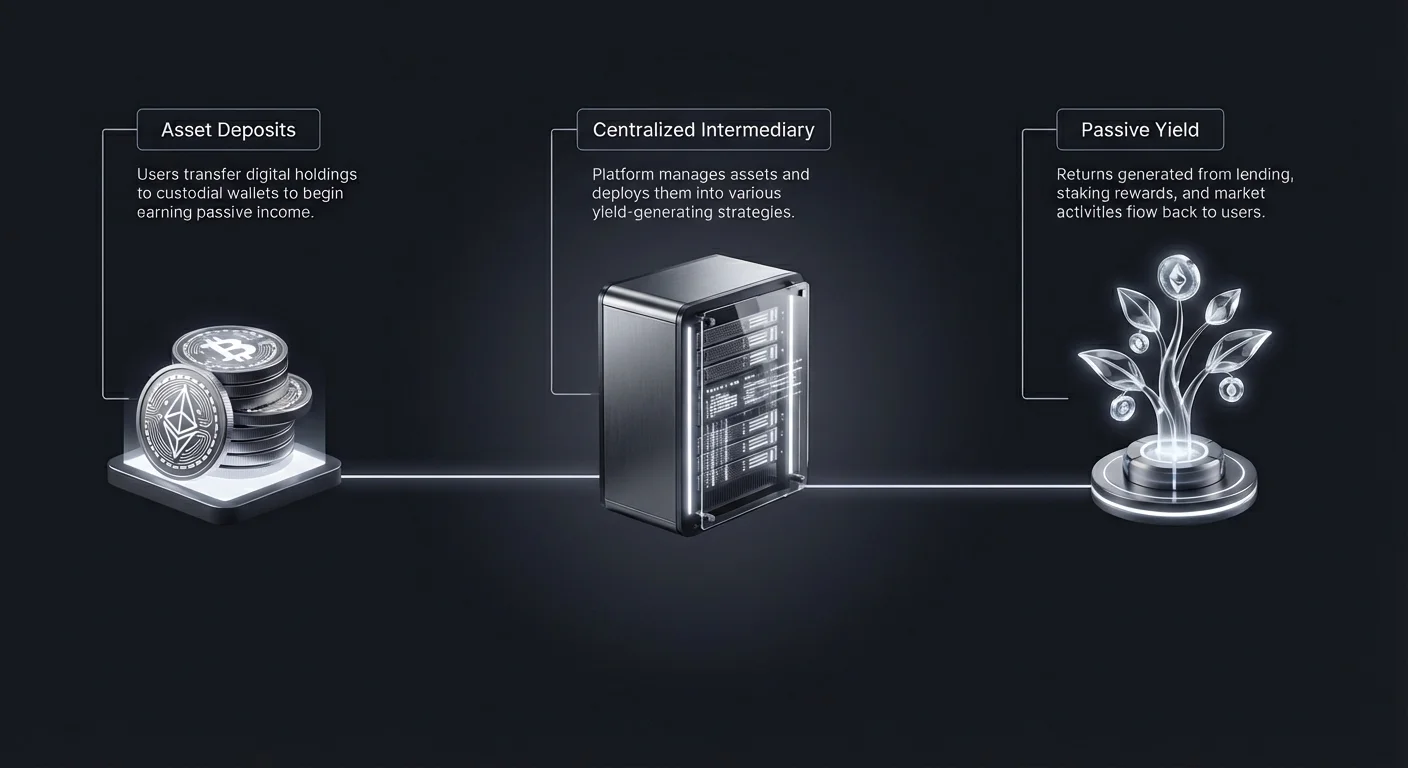
The digital asset economy has evolved significantly beyond simple buy-and-hold strategies or high-frequency day trading. Investors increasingly seek ways to generate passive income from their cryptocurrency holdings without constantly monitoring market charts. Centralized staking and lending platforms have emerged as the primary gateway for this passive income activity. These platforms act as intermediaries, bridging the gap between holders who wish to earn interest and borrowers who need liquidity. By depositing assets into these ecosystems, users can access yields that often surpass those found in traditional banking sectors.
However, the promise of high returns comes with a complex profile of risks that differs fundamentally from traditional finance. Unlike a bank savings account, which is typically insured and regulated by strict government standards, crypto yield products operate in a more dynamic and less predictable environment. The "yield" generated is not guaranteed by a central bank but is instead derived from market activities such as lending to institutional traders, providing liquidity, or participating in blockchain validation mechanisms.
Understanding the mechanics behind these yields is the first step in assessing their safety. When a user deposits Bitcoin or a stablecoin into a centralized exchange's savings product, they are effectively loaning their asset to the platform. The platform then deploys these assets to generate revenue, a portion of which is returned to the depositor as interest. This transfer of control introduces counterparty risk, meaning the safety of the capital depends entirely on the financial health and security practices of the platform managing it.
The Mechanics of Centralized Yield Generation
To accurately assess risk, one must distinguish between the different methods used to generate yield. The three primary categories found on centralized exchanges are lending services, staking participation, and flexible savings accounts. Each method involves different underlying activities and risk profiles, even if the user interface presents them similarly.
Lending Services and Interest
In a lending model, the platform takes user deposits and lends them to third parties. These borrowers are often institutional investors, market makers, or other traders seeking leverage. The platform charges the borrower an interest rate and passes a percentage of that rate back to the depositor. The safety of this yield depends heavily on the platform's lending standards. If the platform lends to risky borrowers who default, the depositor's funds could be in jeopardy unless the platform has a robust reserve fund.
Staking on Centralized Exchanges
Staking differs from lending in that the yield comes from the blockchain network itself, not from a borrower. Networks like Ethereum or Solana use a Proof-of-Stake consensus mechanism where token holders validate transactions. Centralized exchanges simplify this process by pooling user assets to run validator nodes. The rewards generated by the network are then distributed to users. The risk here involves technical failures by the exchange's validator node, which can lead to "slashing" or penalties that reduce the principal amount.
Flexible Savings and Earn Products
Many platforms offer "earn" products that function like high-yield savings accounts. These are often hybrids that might utilize a mix of lending, staking, and treasury management strategies to pay interest. Users typically enjoy the ability to withdraw funds at any time, known as flexible access. However, the opacity of how the yield is actually generated in these omnibus accounts can make it difficult for users to gauge the specific risks they are taking.
Analyzing Counterparty and Platform Risk
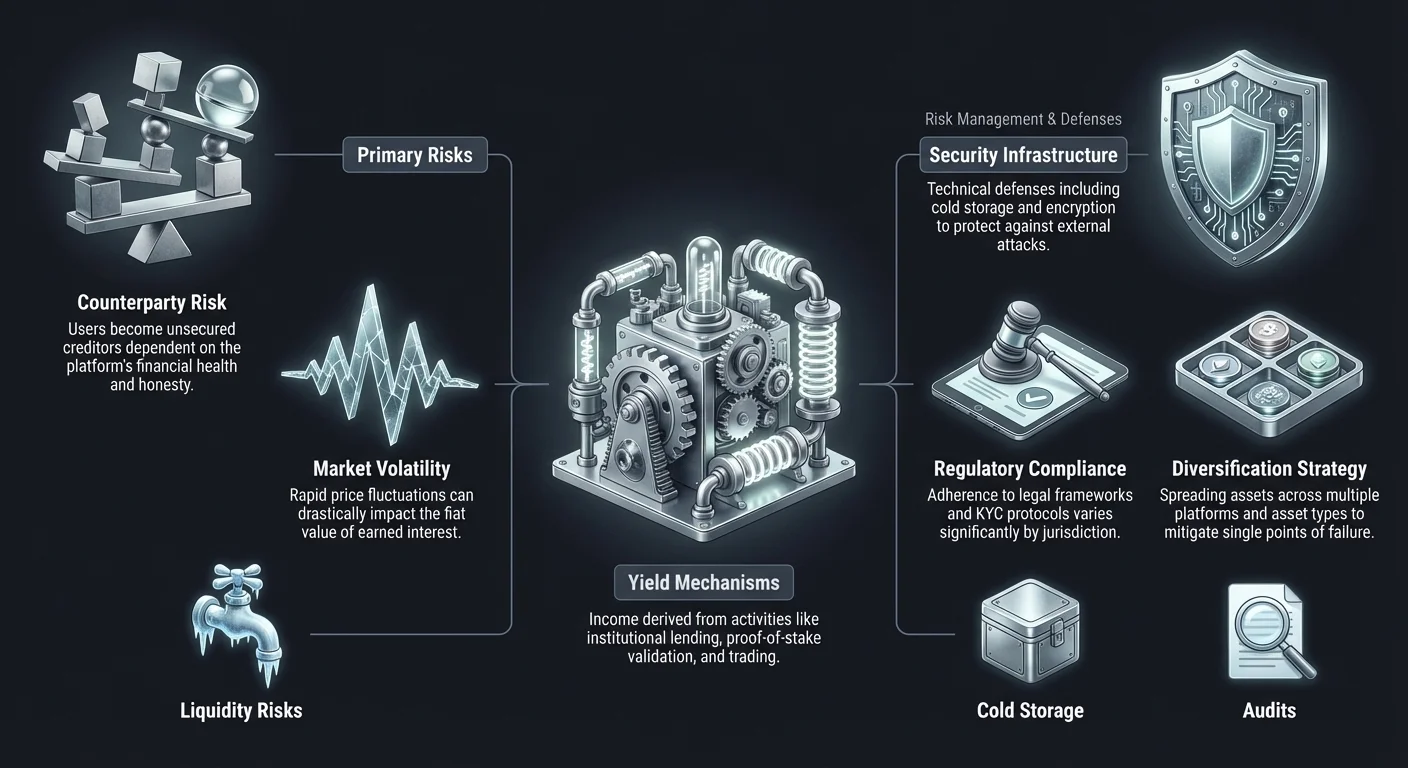
The most significant risk in centralized passive yield is counterparty risk. When investors transfer cryptocurrency to a lending platform or exchange to earn interest, they transfer custody of their private keys to that entity. In the cryptocurrency industry, this is often summarized by the phrase "not your keys, not your crypto." Once the assets are in the platform's wallet, the user becomes an unsecured creditor of that platform.
If the platform faces insolvency due to poor management, hacks, or market crashes, users may face significant challenges in recovering their funds. Unlike traditional banks where deposits are often insured up to a specific limit by government agencies, crypto deposits generally lack such comprehensive protection. While some platforms carry private insurance policies, these usually cover theft or cybersecurity breaches rather than business failure or insolvency.
Assessing a platform's solvency is difficult for the average user because centralized exchanges are not always required to publish audited financial statements. Users must rely on "Proof of Reserves" attestations or third-party audits, which provide a snapshot of assets but may not fully disclose liabilities. Therefore, the reputation, longevity, and regulatory standing of the platform become critical proxies for trust and safety.
Security Infrastructure and Asset Protection
The technical security of a centralized platform is the primary defense against the loss of funds due to external attacks. Evaluating a platform’s security infrastructure requires looking beyond marketing claims and understanding the specific protocols in place. A platform offering high yields is of little value if the underlying assets are vulnerable to theft.
Cold Storage Implementation
The gold standard for asset protection is cold storage. This involves keeping the vast majority of digital assets offline, disconnected from the internet, and often distributed geographically. By minimizing the amount of crypto held in "hot wallets" (online wallets used for immediate liquidity), platforms reduce the attack surface available to hackers. Reviewing a platform's policy on cold storage percentages is a vital part of risk assessment.
Authentication and Access Controls
User-level security is equally important. Robust platforms enforce mandatory or optional Two-Factor Authentication (2FA). The most secure forms of 2FA involve hardware keys or authenticator apps rather than SMS, which is susceptible to SIM-swapping attacks. Additionally, features like withdrawal whitelisting allow users to restrict outgoing transactions to known addresses, providing a final safety net if an account is compromised.
Certifications and Audits
Professional audits serve as independent verifications of a platform's security claims. Certifications such as SOC 1 Type 2 and SOC 2 Type 2 indicate that a platform has undergone rigorous examination of its internal controls, data privacy, and financial reporting. These audits are common in traditional finance and are increasingly adopted by top-tier crypto exchanges to demonstrate maturity and reliability.
Regulatory Compliance and Legal Standing
The legal framework surrounding crypto lending and staking varies wildly by jurisdiction. Platforms that operate in strict regulatory environments, such as New York (via the BitLicense) or the European Union (under MiCA regulations), are generally subject to higher standards of consumer protection. Regulatory compliance often mandates the segregation of client funds from corporate operational funds.
This segregation is crucial. It ensures that if the exchange faces legal or financial trouble, user assets are distinct from the company's balance sheet. Platforms that operate in unregulated offshore jurisdictions may offer higher yields due to lower compliance costs, but they also strip the user of legal recourse in the event of a dispute.
Know Your Customer (KYC) and Anti-Money Laundering (AML) protocols are also indicators of a platform's legitimacy. While some users prefer privacy, strict identity verification processes suggest the platform is attempting to work within the global financial legal system. This reduces the risk of the platform being shut down by authorities for facilitating illicit finance, an event that typically results in the freezing of all user assets.
The Loan-to-Value (LTV) Ratio and Collateral
For platforms that generate yield through lending, the Loan-to-Value (LTV) ratio is a critical metric for maintaining system solvency. This ratio represents the loan amount divided by the value of the collateral backing it. For example, a borrower depositing $10,000 in Bitcoin to borrow $5,000 in cash has an LTV of 50%.
Calculating Risk Exposure
Low LTV ratios are safer for the platform and, by extension, the yield-earning depositor. They provide a buffer against market volatility. If the value of the Bitcoin collateral drops, the platform needs enough room to liquidate the collateral to cover the loan before the value falls below the loan amount. Platforms that allow high LTV ratios (e.g., 80% or 90%) are engaging in riskier lending practices.
Liquidation Triggers and Margin Calls
Risk management relies on efficient liquidation protocols. If the market moves against a borrower and their LTV rises above a critical threshold, the platform must issue a margin call or automatically sell the collateral. In volatile crypto markets, prices can crash within minutes. If the platform's liquidation engine is too slow, or if liquidity dries up, the platform may end up with bad debt. This bad debt eats into the reserves used to pay interest to depositors.
Over-Collateralization
Most responsible crypto lending is over-collateralized. This means borrowers must deposit more value than they withdraw. This is the opposite of fractional reserve banking. Over-collateralization protects the lender (the yield earner) by ensuring that there is always an asset backing the loan. Assessing whether a platform engages in under-collateralized lending to institutional partners is a key step in due diligence.
Liquidity Risks and Withdrawal Restrictions
Liquidity risk refers to the inability to convert assets back into cash or withdraw them from the platform when desired. In the context of passive yield, this often manifests during times of extreme market stress when many users attempt to withdraw simultaneously. If the platform has locked user funds into long-term illiquid investments to generate yield, it may pause withdrawals.
Fixed-term savings accounts explicitly trade liquidity for higher yields. By agreeing to lock assets for 30, 60, or 90 days, the user accepts that they cannot access their capital even if the market crashes. This inability to react to price movements is a hidden cost of the yield. While the interest rate may be attractive, the potential loss from a declining asset price during the lock-up period can far exceed the interest earned.
Flexible accounts offer lower rates but allow instant access. However, even flexible accounts are subject to platform-wide liquidity crises. Users should review the "Terms of Service" regarding withdrawal limits. Many platforms reserve the right to throttle withdrawals during periods of high network congestion or unusual market activity, leaving yield-seekers effectively trapped during critical moments.
Interest Rate Determination and Sustainability
The Annual Percentage Yield (APY) offered by platforms is not arbitrary; it is driven by supply and demand dynamics. Understanding how these rates are derived helps investors spot unsustainable offers. If a platform offers significantly higher rates than the market average, it suggests they are taking on significantly higher risks to generate that return.
Stablecoin Yield Dynamics
Yields on stablecoins (like USDT or USDC) are typically higher than fiat savings accounts because of the demand for leverage in the crypto market. Traders are willing to pay high interest rates to borrow stablecoins to buy more Bitcoin (going long). When the market is bullish, demand for borrowing stablecoins rises, pushing up yields for depositors. Conversely, in bear markets, demand for leverage falls, and stablecoin yields usually compress.
Volatile Asset Yields
Yields on volatile assets like Bitcoin or Ethereum often come from short-sellers borrowing the asset to bet against it, or from staking rewards on Proof-of-Stake networks. The rates fluctuate based on network activity and trading volume. A sudden spike in APY for a specific altcoin might indicate a liquidity crunch where the platform is desperate to attract deposits, which should be viewed as a warning sign rather than an opportunity.
Tax Implications of Passive Yield
Earning interest on cryptocurrency introduces tax complexities that differ from simple capital gains. In many jurisdictions, the interest earned from staking or lending is treated as ordinary income at the fair market value of the token at the time it is received. This means the investor owes tax on the income even if they have not sold the token.
If the price of the token subsequently drops, the investor may still owe taxes based on the higher value at the time of receipt. This mismatch can create a tax liability that exceeds the current value of the assets. Furthermore, converting the earned interest into fiat currency or another crypto triggers a separate capital gains event (profit or loss).
Record-keeping becomes a significant burden for yield earners. Every interest payout—whether daily, weekly, or monthly—is a taxable event. Users must maintain detailed logs of the date, time, asset value, and amount received. Some centralized platforms provide tax reporting tools, but ultimately the responsibility lies with the user to report income accurately.
Comparing CeFi and DeFi Risks
Investors often weigh Centralized Finance (CeFi) against Decentralized Finance (DeFi) when seeking yield. While CeFi platforms act as custodians, DeFi platforms use smart contracts to automate lending and borrowing without intermediaries. Each approach carries distinct risks that must be balanced against potential rewards.
Custodial vs. Non-Custodial
In CeFi, the risk is human and institutional. Users trust the company's management and security teams. In DeFi, the risk is technical. Users retain control of their keys (non-custodial), but they trust the code of the smart contract. If the code contains a bug or an exploit, funds can be drained irreversibly. CeFi offers a user-friendly interface and customer support, which can be vital for resolving access issues, whereas DeFi offers transparency but zero recourse in the event of user error or code failure.
Ease of Use vs. Control
CeFi platforms streamline the yield process. They handle the technical complexities of staking nodes, managing gas fees, and rebalancing portfolios. For this convenience, they take a cut of the rewards. DeFi requires the user to interact directly with blockchain protocols, managing their own transactions and security. While DeFi eliminates the middleman fee, it increases the risk of operational errors, such as sending funds to the wrong address or falling victim to a phishing scam on a fake interface.
Yield Variance
DeFi yields are often more volatile and transparent, programmed directly into the protocol based on real-time liquidity pools. CeFi yields are determined by the platform and may be "smoothed" to provide a stable user experience. However, CeFi platforms may also subsidize yields using marketing budgets to acquire users, creating an illusion of profitability that cannot be sustained long-term.
Evaluating Platform Reputation and History
A platform's track record is one of the most reliable indicators of its safety profile. Investors should investigate the history of any exchange before depositing funds. Key factors include the longevity of the platform, its leadership team's public visibility, and its response to past challenges.
Platforms that have survived multiple market cycles (bull and bear markets) without halting withdrawals have demonstrated operational resilience. Conversely, newer platforms that have not been stress-tested by a market crash present higher uncertainty. Investigating whether a platform has ever been hacked is crucial. If it was hacked, how did they respond? Did they reimburse users from their own funds, or did users suffer losses?
User reviews and community feedback can provide early warning signs of trouble. Patterns of complaints regarding delayed withdrawals, poor customer support responsiveness, or sudden changes in terms of service often precede larger systemic failures. Transparency reports and regular communication from leadership during downtime also signal a commitment to user trust.
Margin Trading and Yield Generation
The connection between yield generation and margin trading is direct. The interest paid to depositors often comes from fees paid by margin traders. Margin trading involves borrowing funds to trade positions larger than the user's account balance would normally allow. This amplifies both gains and losses.
Leverage Mechanics
When a platform offers 10x or 100x leverage, they are lending substantial amounts of capital to traders. While this generates significant interest income (yield), it introduces systemic risk. If a large number of high-leverage traders are liquidated simultaneously during a "flash crash," the platform's insurance fund must be capable of absorbing the losses. If the fund is insufficient, the platform may face a liquidity shortfall.
Risks to the Passive Lender
Passive yield earners are indirectly exposed to the risks taken by these aggressive traders. While the lender is not trading on margin themselves, their funds are fueling the ecosystem that supports it. If the risk management engine of the exchange fails to close out losing positions fast enough, the losses could theoretically exceed the collateral held, eating into the depositor pool. Therefore, understanding the leverage limits and risk policies of a platform is a component of passive yield assessment.
Stablecoin Savings Accounts
Stablecoin savings accounts are popular because they mitigate the price volatility associated with Bitcoin or Ethereum while offering yields far above fiat currency rates. Tokens like USDC or USDT are pegged to the US Dollar, theoretically maintaining a $1 value. However, the "peg" itself is a risk vector.
If the issuer of the stablecoin fails to maintain the reserves backing the token, the stablecoin can lose its peg, dropping below $1. In this scenario, earning 5% or 10% APY becomes irrelevant if the principal value drops by 50%. Users must assess not only the exchange offering the yield but also the stability and transparency of the stablecoin issuer itself.
Furthermore, regulatory scrutiny on stablecoins is increasing. Changes in law regarding how stablecoins can be issued or transacted could impact liquidity. If a specific stablecoin is delisted or restricted in a jurisdiction, users earning yield on that asset may face difficulties converting it back to fiat currency.
The Impact of Market Volatility on Yield
Crypto markets are notoriously volatile, and this volatility impacts passive yield strategies in multiple ways. The most obvious is the valuation of the interest earned. If an investor earns 5% APY in Bitcoin, but the price of Bitcoin drops by 50% over the year, the investor has a net loss in fiat terms despite the "passive income."
Bull Market Yields
During bull markets, yields generally increase. Optimism drives borrowing demand, and staking rewards (in fiat terms) appreciate in value. This creates a compounding effect where the investor gains from both asset appreciation and high interest rates. This euphoric phase often masks underlying risks, as platforms are flush with liquidity and defaults are rare.
Bear Market Risks
In bear markets, the dynamic reverses. Borrowing demand dries up, leading to lower interest rates. Simultaneously, the value of the collateral backing loans drops. This is when platforms are most vulnerable to insolvency. A "bank run" scenario is more likely in a bear market when fear drives users to withdraw assets en masse. Passive investors must remain vigilant during downturns, as the risk of platform failure increases just as the returns on yield decrease.
Automated Trading as Passive Yield
Beyond simple lending and staking, automated trading strategies like grid trading are often marketed as passive income sources. These tools automatically place buy and sell orders at predetermined intervals within a price range. While technically "automated," they differ significantly from savings accounts.
Grid Trading Mechanics
A grid bot profits from normal market volatility. It buys when the price dips slightly and sells when it rises slightly. In a sideways market, this generates a steady stream of small profits, which can be viewed as a form of yield. The user does not need to actively manage the orders once the parameters are set.
Operational Risks
The risk in grid trading is directional. If the market breaks out of the grid range—either plummeting below the lowest buy order or skyrocketing above the highest sell order—the bot stops functioning effectively. In a crash, the user is left holding a bag of depreciating assets bought on the way down. While fees are often low or non-existent on some platforms to encourage this activity, it requires more active monitoring than a standard savings account.
| Feature | Staking | Lending | Grid Trading |
|---|---|---|---|
| Source of Yield | Network Rewards | Borrower Interest | Market Volatility |
| Principal Risk | Low (Slashing) | Med (Default) | High (Market Direction) |
| Complexity | Low | Low | Medium |
Diversification Strategies for Risk Management
Diversification is the only "free lunch" in investing, and it applies heavily to crypto yield. Relying on a single platform or a single asset for passive income creates a single point of failure. If that platform fails, the entire portfolio is lost.
Platform Diversification
Spreading assets across multiple reputable exchanges and lending platforms mitigates counterparty risk. If one platform halts withdrawals, the investor still has access to funds on others. This strategy requires managing multiple accounts and sets of security credentials, but the safety benefits are substantial.
Asset Allocation
Diversifying the types of assets generating yield is also prudent. A balanced yield portfolio might include stablecoins for lower-volatility income, blue-chip cryptos like Bitcoin and Ethereum for long-term growth potential, and perhaps a small allocation to higher-yield altcoins. Mixing "earn" products with direct on-chain staking can also balance custodial and non-custodial risks.
Exit Strategies and Liquidity Management
A passive investment strategy still requires an active exit plan. Investors should define clear triggers for when to withdraw funds from yield-generating accounts. These triggers could be based on changes in platform terms, strange spikes in interest rates (signaling risk), or general market conditions.
Maintaining a portion of one's portfolio in purely liquid assets—held in a personal hardware wallet rather than a yield account—provides a safety net. This "dry powder" ensures that the investor is not completely exposed to the systemic risks of the lending ecosystem. The temptation to earn yield on 100% of holdings should be resisted in favor of a balanced approach that prioritizes the preservation of capital over maximizing returns.
Future Trends in Centralized Yield
The landscape of centralized staking and lending is shifting toward greater regulation and transparency. The industry is moving away from opaque "black box" lending models toward verified, on-chain proof of reserves and liabilities. Insurance products for crypto deposits are beginning to emerge, although they are still in their infancy and often come with high premiums or limited coverage.
As traditional financial institutions enter the space, the line between crypto yield and traditional banking may blur. We are likely to see more "hybrid" platforms that offer the regulatory safety of a bank with the technological rails of cryptocurrency. Until then, investors must operate with a high degree of caution, conducting their own due diligence and treating every deposit as a risk-based decision.
Conclusion
Centralized staking and lending platforms offer compelling opportunities for crypto investors to grow their holdings passively. By leveraging mechanisms like lending, staking, and automated strategies, users can outperform traditional fixed-income products. However, these rewards are inextricably linked to risks such as counterparty insolvency, regulatory uncertainty, and market volatility. Security measures like cold storage and 2FA are essential baselines, but they cannot eliminate the fundamental risks of transferring custody.
Success in earning passive yield requires a disciplined approach to risk assessment. Investors must look beyond the advertised APY and scrutinize the platform's financial health, security infrastructure, and legal standing. Diversifying across platforms and assets, understanding the tax implications, and maintaining a portion of funds in self-custody are critical strategies for protecting capital. As the industry matures, transparency and safety protocols will likely improve, but for now, vigilance remains the investor's most valuable asset.
The safest yield is one where you understand the source of the return and control the risks involved.