
Investing in the cryptocurrency market often feels like a full-time job requiring constant attention to price charts and news cycles. The volatility inherent in digital assets creates an environment where prices swing dramatically within hours or even minutes. For many investors, the stress of trying to time these movements leads to poor decision-making and emotional trading.
Building wealth in this sector does not strictly require you to be glued to a screen or possess expert technical analysis skills. A shift toward automated investment systems allows participants to accumulate assets steadily without the interference of human emotion. By using tools like recurring buys and automated savings protocols, investors can construct a hands-off portfolio.
This approach focuses on long-term accumulation rather than short-term speculation. It utilizes strategies that have been effective in traditional finance for decades but are now adapted for the speed and structure of the blockchain economy. The goal is to remove the guesswork from the equation entirely.
By automating the purchasing process, you eliminate the hesitation that occurs during market dips and the FOMO that strikes during rallies. The system executes the plan regardless of sentiment. This consistency is the foundation of passive wealth building in the crypto space.
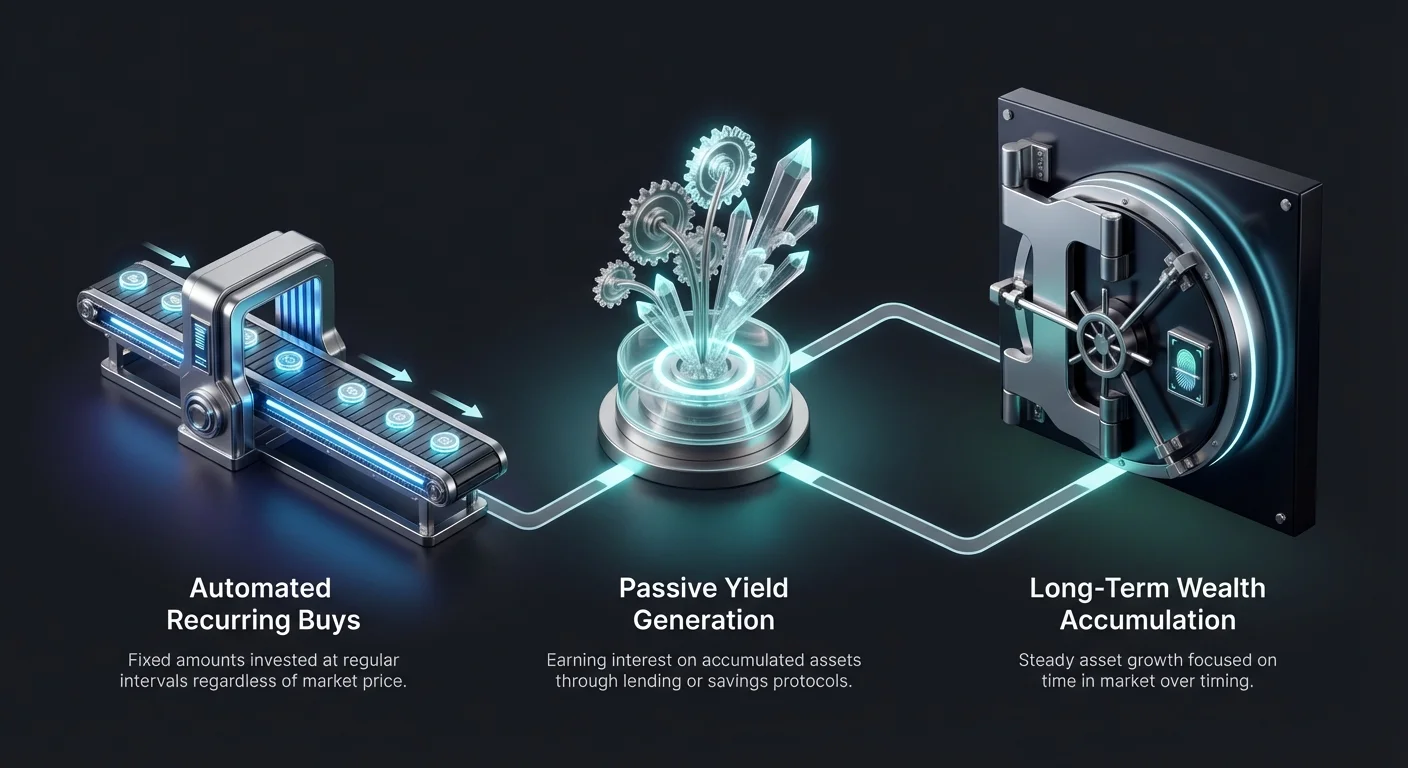
Understanding Dollar-Cost Averaging (DCA)
Dollar-cost averaging is the cornerstone of most automated investment strategies. It is a technique where an investor allocates a fixed dollar amount to purchase a specific asset at regular intervals. This happens regardless of the asset's price at the time of the purchase.
The Mechanism of Volatility Smoothing
The primary function of DCA is to mitigate the impact of volatility on the average cost of the investment. When prices are high, the fixed dollar amount buys fewer units of the asset. Conversely, when prices are low, that same amount purchases more units.
Over time, this results in a lower average cost per unit compared to the average market price. This smoothing effect is particularly valuable in the crypto market, where double-digit percentage moves are common. It turns market downturns into accumulation opportunities without requiring the investor to manually "buy the dip."
By spreading purchases out, you avoid the risk of deploying a large lump sum of capital at a local market peak. This preserves capital efficiency and reduces the immediate paper losses that can occur after a sudden market correction.
Psychological Benefits of Automation
One of the most significant advantages of dollar-cost averaging is its impact on investor psychology. Trying to time the market is notoriously difficult, even for professional traders. It requires predicting the exact moment a price hits its lowest or highest point.
When investors attempt to time the market, they often freeze during crashes due to fear that prices will go lower. Alternatively, they may chase prices during a pump due to greed. Automation removes these emotional hurdles entirely.
The discipline provided by a DCA strategy ensures that investment continues through bear markets. These are often the periods that yield the highest long-term returns because assets are accumulated at suppressed prices. The automated system adheres to the plan when human resolve might fail.
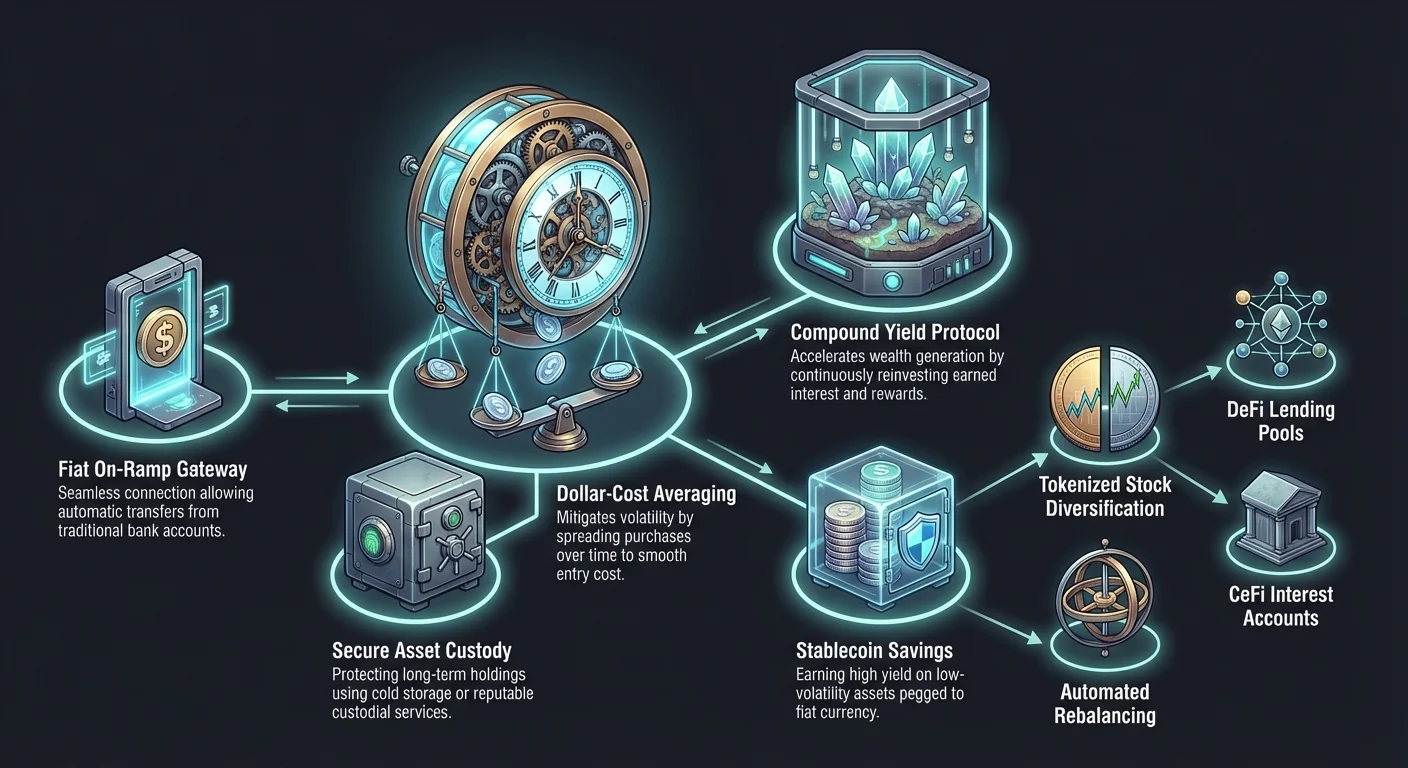
Comparing Lump-Sum vs. Automated Buying
To understand the potential of automated buying, it is helpful to compare it against lump-sum investing in different market scenarios. Source data illustrates how these strategies perform during extreme market conditions, such as "buying the top" or "catching the bottom."
Scenario 1: Buying the Market Top
Consider a scenario where an investor enters the market right before a massive crash. If an investor placed a single lump-sum purchase of Bitcoin at the peak in early 2018, they would have faced a significant loss two years later. The value of that single purchase would have dropped by approximately 50% as the price corrected.
In contrast, a dollar-cost averaging strategy starting at that same peak would have yielded different results. By investing a small fixed amount weekly over those same two years, the investor would have continued buying as the price fell. This lowers the average entry price significantly.
Data suggests that in this specific timeframe, the DCA strategy would have turned a potential 50% loss into a modest profit of around 11%. The automated buying captured the lower prices during the bear market, recovering the initial "high" buys much faster than the lump-sum approach.
Scenario 2: Catching the Market Bottom
The counter-argument to DCA involves "catching the bottom," or investing a lump sum at the lowest possible price. If an investor managed to buy at the absolute bottom in early 2019, a lump-sum investment would have outperformed DCA significantly over a two-year period.
However, accurately identifying the bottom is a matter of luck or extreme skill. Most investors who try to wait for the bottom end up missing the entry entirely or buying back in at much higher prices. While the lump sum offers higher theoretical returns in a bull run, it carries maximum risk.
DCA acts as a hedge against this uncertainty. It may produce lower returns than a perfectly timed lump-sum buy in a rising market, but it protects the investor from the disastrous consequences of mistiming a large entry. It prioritizes risk management over maximum theoretical yield.
Setting Up Automated Recurring Buys
Most modern cryptocurrency exchanges now offer built-in features to facilitate dollar-cost averaging. These systems are often labeled as "Recurring Buys" or "Auto-Invest" and are designed to make the process seamless for users.
Choosing the Right Platform
The first step in establishing an automated system is selecting a reliable exchange. Key factors to consider include security, fee structures, and the availability of desired assets. Centralized exchanges are the most common venue for these tools due to their ease of use and fiat integration.
When evaluating a platform for recurring buys, look for one that supports direct bank transfers or debit card linkages. This connection allows the exchange to pull funds automatically at the set interval. Without this integration, the user must manually deposit cash, which defeats the purpose of full automation.
Security features such as two-factor authentication (2FA) and cold storage of assets are non-negotiable. Since the strategy involves long-term holding, ensuring the chosen platform has a robust track record of protecting user funds is essential.
Configuring Interval and Amount
Once a platform is selected, the investor must define the parameters of the strategy. This involves setting the frequency of the purchase and the capital allocated per transaction. Common intervals include daily, weekly, bi-weekly, or monthly options.
| Frequency | Best For | Considerations |
|---|---|---|
| Daily | High volatility assets | Higher transaction count |
| Weekly | General accumulation | Balances fees and smoothing |
| Monthly | Salary-aligned investing | Less smoothing effect |
Most investors align their recurring buys with their income schedule. For example, setting a buy to occur the day after a paycheck is deposited ensures that investing is treated as a mandatory expense rather than an afterthought.
While advanced strategies exist, such as adjusting buys based on technical indicators like the 34-day Exponential Moving Average, simple interval-based buying is superior for most. It avoids the stress of analysis and keeps the system passive.
Financial Implications and Costs
While automated investing simplifies the process, investors must be aware of the costs involved. Recurring buys are transactions, and transactions incur fees. Understanding these costs is vital to ensuring they do not erode the profits generated by the strategy.
Transaction Fees and Cash Drag
Exchanges charge fees for executing trades. These can be flat fees or a percentage of the transaction value. For frequent purchases, such as daily buys, flat fees can become prohibitively expensive. A percentage-based fee structure is generally more favorable for smaller, frequent transactions.
Investors should also consider "cash drag." This occurs when cash sits in an account waiting to be deployed. In a DCA strategy, some capital is always held back for future intervals. In a rapidly rising market, this cash is not generating returns, which can lead to underperformance compared to being fully invested.
However, this drag is the price paid for the risk reduction that DCA provides. It is a calculated trade-off. To minimize the impact of fees, some investors choose less frequent intervals, such as monthly, to reduce the total number of transactions while still maintaining the discipline of regular investing.
Hidden Spreads in Auto-Buy Tools
Many "one-click" or simplified recurring buy interfaces charge a spread rather than a transparent trading fee. The spread is the difference between the market price and the price the exchange charges the user.
For example, if Bitcoin is trading at $50,000, the auto-buy tool might execute the purchase at $50,200. This hidden cost can add up significantly over hundreds of recurring transactions.
It is important to check if the platform's recurring buy feature uses the standard market trading fee schedule or a retail-oriented spread. Using a platform with low, transparent maker/taker fees is critical for maximizing the efficiency of a long-term automated system.
Generating Passive Yield on Holdings
Once assets are acquired through automated buying, they can be put to work to generate additional passive income. Holding cryptocurrency in a non-interest-bearing wallet is akin to stuffing cash under a mattress.
Crypto Savings Accounts
Crypto savings accounts allow users to deposit their digital assets and earn interest. These accounts function similarly to traditional bank savings accounts but typically offer significantly higher Annual Percentage Yields (APY). The interest is often paid out in the same cryptocurrency that is deposited.
This compounding effect accelerates wealth generation. As interest is earned, it is added to the principal balance, and subsequent interest calculations are based on this larger amount. Over long periods, this exponential growth can substantially increase the total holding size without any additional capital injection.
Platforms offer different terms for these accounts. Flexible savings accounts allow users to withdraw funds at any time, offering liquidity but usually lower rates. Fixed-term accounts require locking assets for a specific period, such as 30 or 90 days, in exchange for higher interest rates.
Centralized vs. Decentralized Yield
There are two main avenues for earning yield: Centralized Finance (CeFi) and Decentralized Finance (DeFi). CeFi platforms are custodial, meaning the company holds the private keys to the assets. Users trust the platform to manage the funds and pay out interest.
DeFi platforms operate using smart contracts on a blockchain. Users interact directly with the protocol, retaining control of their assets through non-custodial wallets. Yield in DeFi is often generated through lending protocols or liquidity provision.
DeFi eliminates the middleman, potentially offering higher returns and greater transparency. However, it introduces smart contract risks. If the code contains a bug or vulnerability, it can be exploited. CeFi platforms offer a more user-friendly experience and customer support but carry counterparty risk if the company becomes insolvent.
Leveraging Lending Platforms
Crypto lending platforms are a specific subset of the yield ecosystem. They connect borrowers who need liquidity with lenders looking to earn interest. By depositing assets into a lending pool, investors effectively become the bank.
The Mechanics of Crypto Lending
In this model, lenders deposit cryptocurrencies into a pool managed by the platform or protocol. Borrowers can then take loans from this pool. To secure the loan, borrowers must provide collateral, typically in the form of other cryptocurrencies.
The interest paid by the borrowers is distributed to the lenders, minus a fee taken by the platform. This system is often over-collateralized, meaning the borrower must deposit more value than they borrow. This protects the lender in case the borrower defaults or the value of the collateral drops.
For the passive investor, participating as a lender is a "set it and forget it" strategy. Once the assets are deposited into the lending protocol, they begin accruing interest immediately. There is no need to actively manage the loan or vet individual borrowers, as the protocol handles collateralization and liquidation automatically.
Loan-to-Value (LTV) Ratios
Understanding the Loan-to-Value ratio is essential for assessing the safety of a lending platform. The LTV represents the percentage of the collateral's value that is borrowed. For example, a 50% LTV means that for every $10,000 of collateral, $5,000 can be borrowed.
Lower LTV ratios generally indicate a safer lending environment. They provide a larger buffer against market volatility. If the value of the collateral drops, there is still enough equity to cover the loan before a liquidation event is triggered.
For lenders, platforms that enforce strict, conservative LTV ratios are preferable. They reduce the risk of bad debt entering the system. If the market crashes and collateral values plummet, high LTV loans are more likely to become under-collateralized, potentially leading to losses for the depositors.
Tokenized Stocks: Diversifying Automation
A truly robust wealth-building system often extends beyond pure cryptocurrencies. Tokenized stocks represent a convergence of traditional finance and blockchain technology, allowing for greater diversification within a crypto-native portfolio.
Accessing Traditional Markets via Crypto
Tokenized stocks are digital tokens that represent shares of publicly traded companies or Exchange Traded Funds (ETFs). These tokens track the price movements of the underlying asset, such as Apple, Tesla, or the S&P 500. They can be bought, sold, and held in crypto wallets.
This innovation allows investors to gain exposure to the stability and growth of traditional equity markets without leaving the crypto ecosystem. It removes the need to manage separate brokerage accounts or move fiat currency back and forth between banking systems.
Integrating tokenized stocks into an automated strategy provides a hedge against the specific risks of the crypto market. If the crypto market enters a downturn, traditional equities may perform differently, smoothing out the overall portfolio volatility.
Fractional Ownership and 24/7 Trading
One of the key benefits of tokenized stocks is fractional ownership. In traditional markets, buying a single share of a high-priced stock might be prohibitive for smaller investors. Tokenized stocks allow users to purchase fractions of a share, often with as little as a few dollars.
This makes it easier to construct a diversified portfolio with limited capital. An automated recurring buy can allocate $50 across ten different high-value stocks, something that would be impossible with whole shares.
Additionally, tokenized stocks often trade 24/7, unlike traditional stock markets which have rigid opening and closing hours. This continuous liquidity aligns better with the always-on nature of the crypto market, allowing automated systems to execute buys at any time of day or week.
Strategic Asset Selection for Automation
Not all assets are suitable for a "hands-off" approach. The philosophy of automated investing assumes that the asset will appreciate over a long time horizon. Therefore, asset selection is the most critical one-time decision an investor makes.
Identifying Long-Term Fundamentals
For a dollar-cost averaging strategy to work, the asset must have strong long-term fundamentals. If an asset's value goes to zero, averaging down simply increases the total loss. Investors should focus on assets with established network effects, developer activity, and real-world utility.
Bitcoin is the most common candidate for DCA strategies due to its historical track record and status as a store of value. Its market maturity compared to other digital assets makes it a safer bet for multi-year accumulation plans.
Ethereum and other major infrastructure tokens are also popular choices. These assets power vast ecosystems of decentralized applications, providing a fundamental demand for the token beyond pure speculation.
Avoiding High-Volatility Speculation
New or low-cap cryptocurrencies are generally poor candidates for automated hands-off investing. These assets are prone to extreme volatility and failure rates. They require active monitoring and risk management, which contradicts the passive nature of this strategy.
Automated systems work best when applied to the "blue chips" of the crypto world. These assets may offer lower short-term upside compared to a viral meme coin, but they offer the consistency and survivability required for a wealth-building plan that spans years.
Investors can create a "basket" of assets for their recurring buys. For example, allocating 50% to Bitcoin, 30% to Ethereum, and 20% to a diversified index of other tokens. This balances stability with growth potential.
Risk Management in Automated Systems
While automated systems reduce the need for daily attention, they introduce specific risks that must be managed. These risks are primarily related to the technology and platforms used to execute the strategy.
Platform and Custodial Risk
When using a centralized exchange for recurring buys and yield generation, the investor is exposing themselves to custodial risk. The exchange holds the assets. If the exchange is hacked, mismanages funds, or faces regulatory shutdowns, the investor's funds are in jeopardy.
To mitigate this, investors should stick to reputable, regulated exchanges with proof of reserves and insurance policies. Diversifying funds across multiple platforms can also reduce the impact of a single point of failure.
For significant amounts of capital, it is often recommended to periodically withdraw accumulated assets from the exchange to a self-custodial hardware wallet. This secures the wealth offline, though it removes the ability to earn yield on those specific coins.
Regulatory Uncertainty
The regulatory landscape for cryptocurrencies, particularly regarding lending and yield products, is evolving. Products available today may be restricted tomorrow. Automation scripts running on an exchange might be paused if the exchange is forced to halt operations in a specific jurisdiction.
Investors must stay informed about major regulatory changes that could affect their chosen platforms. While the trading strategy is hands-off, the oversight of the infrastructure cannot be completely ignored.
Lending products have faced particular scrutiny in various regions. Investors utilizing these tools should be aware that interest-bearing accounts might be subject to changes in terms or availability based on legal rulings.
The Role of Stablecoins in Automation
Stablecoins—cryptocurrencies pegged to fiat currencies like the US Dollar—play a unique role in automated wealth systems. They offer a way to earn high yields without exposing the principal to the price volatility of assets like Bitcoin.
Earning Yield with Low Volatility
Many lending platforms and savings accounts offer their highest interest rates on stablecoins. Rates can range significantly higher than traditional bank savings accounts. This presents an opportunity for a conservative segment of a portfolio.
An investor might allocate a portion of their monthly investment to buying stablecoins and immediately depositing them into a yield-bearing account. This portion of the portfolio acts as a cash equivalent that grows steadily, unaffected by market crashes.
This strategy is often used to build a reserve fund or "dry powder." The interest earned provides a consistent income stream that can be reinvested into more volatile assets during market dips or simply compounded to grow the stable reserve.
Risks of De-pegging
The primary risk with stablecoins is the potential for the token to lose its peg to the target currency. Not all stablecoins are created equal. Some are backed 1:1 by cash and equivalents in a bank, while others are algorithmic or backed by other crypto assets.
Investors should prioritize stablecoins with high transparency, regular audits, and robust backing mechanisms. Relying on a stablecoin that loses its value defeats the purpose of using it as a safe haven.
Diversifying between different types of trusted stablecoins can further mitigate this risk. Rather than holding all funds in one specific dollar-pegged token, spreading it across two or three major issuers protects against issuer-specific failures.
Advanced Automation: Rules-Based Strategies
For investors who want slightly more optimization than simple interval buying, rules-based strategies offer a middle ground. These systems still run automatically but execute based on specific market conditions rather than just time.
Incorporating Technical Indicators
Some platforms allow users to set up recurring buys that only trigger if the price is below a certain threshold or moving average. For example, a rule might state: "Buy $100 of Bitcoin every week, but only if the price is below the 200-week moving average."
This approach aims to improve the average entry price by avoiding purchases during overheated market phases. It increases the efficiency of the capital deployed. However, it introduces the risk that the market stays above the threshold for long periods, resulting in missed accumulation.
Another variation involves variable purchasing amounts. A strategy could be set to buy the standard amount during normal conditions, but double the purchase amount if the price drops by 10% in a week. This aggressively buys the dip automatically.
Reinvesting Dividends and Rewards
True compounding requires the reinvestment of earnings. Automated systems can be configured to take the interest earned from savings accounts or staking rewards and funnel it back into the investment pool.
On some platforms, this happens automatically ("auto-compounding"). On others, the interest is paid into a separate wallet. Setting up a workflow to periodically sweep these earnings back into the lending pool or use them to buy more of the base asset accelerates growth.
This cycle creates a flywheel effect. The asset base generates yield, the yield buys more assets, and the larger asset base generates even more yield. Over a multi-year horizon, this is a powerful driver of wealth creation.
Exit Strategies and Rebalancing
Building wealth is only half the equation; realizing it is the other. A truly comprehensive automated system should also include plans for taking profit or rebalancing the portfolio.
Automated Rebalancing tools
Over time, different assets in a portfolio will grow at different rates. This can lead to a portfolio becoming skewed. For example, if Bitcoin doubles in price while stablecoins stay flat, the portfolio is now much more exposed to Bitcoin's volatility than originally intended.
Automated rebalancing tools can periodically adjust the portfolio back to its target allocations. The system automatically sells a portion of the outperforming asset and buys more of the underperforming asset.
This enforces the discipline of "selling high and buying low" without human intervention. It keeps the risk profile of the portfolio consistent with the investor's original goals.
Scaling Out
Just as DCA is used to enter the market, it can be used to exit. Investors can set up "reverse DCA" or automated sell orders to liquidate a portion of their holdings as prices rise. This secures profits incrementally.
For example, an investor might configure a system to sell 10% of their holdings if the price reaches a specific target. This locks in gains while leaving the majority of the position open to capture further upside.
Having a pre-defined exit plan prevents the common mistake of riding an asset all the way up and then all the way back down. Automation ensures that profits are actually realized and moved to safety.
Conclusion
Building hands-off wealth in the cryptocurrency market is a shift from active speculation to strategic accumulation. By utilizing dollar-cost averaging, investors neutralize the chaos of market volatility and remove the emotional liabilities that lead to poor trading decisions. The mathematical advantage of smoothing out entry prices over long timeframes turns market fluctuations from a threat into a tool for growth.
Coupling these recurring buy strategies with yield-generating mechanisms like crypto savings accounts and lending platforms supercharges the wealth-building process. This dual approach ensures that assets are not only being accumulated steadily but are also working to generate compound interest around the clock. The integration of tokenized stocks further broadens the horizon, allowing for a diversified portfolio that spans both digital and traditional asset classes within a single ecosystem.
Success in this arena does not require constant monitoring, but it does require careful setup and platform selection. Understanding the risks of custody, regulatory changes, and asset selection is paramount. Once established, however, a well-structured automated system provides the most reliable path to long-term financial growth in the digital economy. It grants the investor the most valuable asset of all: time freedom.
Consistency and time in the market will almost always outperform timing the market.