
At the heart of the modern digital asset revolution lies a shift in how humanity records value and information. For centuries, society relied on centralized ledgers controlled by powerful intermediaries to track ownership. Banks, governments, and corporations acted as the sole gatekeepers of these records. They maintained the "master copy" of who owned what, and individuals had to trust these entities to act honestly and securely. If a bank’s server failed or a government decided to freeze assets, the user had little recourse.
Distributed Ledger Technology, or DLT, represents a fundamental departure from this centralized model. Rather than relying on a single entity to maintain the truth, DLT spreads the record-keeping process across a vast network of independent computers. This structure creates a system where no single participant is in charge. Instead of a top-down hierarchy, the network operates through coordination and cooperation among equals, laying the foundation for decentralized trust.
This technology is often described as "headless" because it lacks a central authority figure. The system is owned and maintained by the sum total of its users, node operators, and validators. This opt-in model means that participation is voluntary, and the rules are enforced by software rather than by decree. It effectively removes the need to ask for permission to transact or store value.
The most famous implementation of DLT is the blockchain. While all blockchains are distributed ledgers, not all distributed ledgers are blockchains. However, in the context of cryptocurrencies like Bitcoin and Ethereum, blockchain is the dominant architecture. It allows for the creation of digital scarcity and immutable records without requiring a trusted middleman. This shift from trusted intermediaries to verifiable code is changing the landscape of finance, data management, and digital identity.
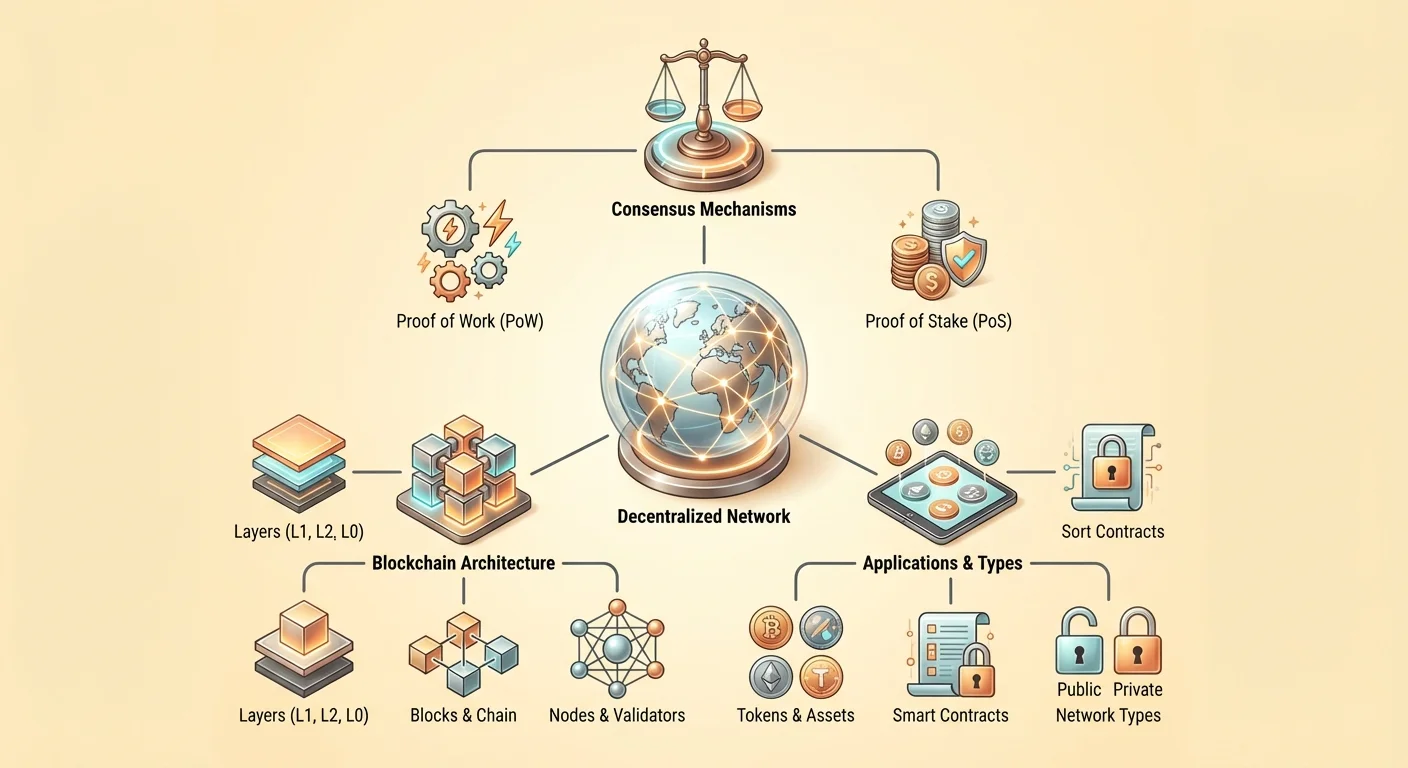
The Architecture of Digital Records
To understand how these systems function, one must look at the underlying structure of the data. A blockchain is essentially a digital record of transactions that is copied and shared across a network of computers. These computers are referred to as nodes. Each node maintains a copy of the ledger, ensuring that there is no single point of failure. If one node goes offline, the network continues to operate seamlessly using the remaining nodes.
Blocks and Chains
The term "blockchain" comes from the way data is organized. Validated transactions are grouped together into containers called blocks. Each block has a specific storage capacity. Once a block is filled with transaction data, it is sealed and cryptographically linked to the block that came before it. This linking process creates a chronological chain of data.
This structure is critical for security. Because each block contains a unique code derived from the previous block, any attempt to alter a past transaction would require changing every subsequent block in the chain. This would require an immense amount of computational power, making the history of the ledger practically immutable.
The Role of Nodes
Nodes are the backbone of the infrastructure. They act as the auditors of the system. When a transaction is broadcast to the network, nodes independently verify that the sender has sufficient funds and that the transaction adheres to the protocol's rules. This verification process happens redundantly across the globe.
There are different types of nodes with varying responsibilities. Some nodes store the entire history of the blockchain, while others only store a portion. Mining nodes or validator nodes take on the additional task of proposing new blocks to the network. This decentralized validation ensures that no fake bitcoin can be created and no double-spending occurs, detailing the roles of nodes, blocks, and consensus.
Decentralization and Security
The distribution of the ledger provides robust security benefits. In a centralized database, a hacker only needs to breach one server to manipulate records or steal data. In a decentralized network, an attacker would need to overpower more than half of the global network to alter the ledger. This is known as a 51% attack.
For established networks like Bitcoin, the cost and energy required to execute such an attack are prohibitively high. This makes the system extremely durable and resistant to corruption. The ledger becomes a shared source of truth that survives even if large sections of the network are disrupted.

Consensus Mechanisms Explained
Since there is no central bank or administrator to decide which transactions are valid, the network needs a way to agree on the state of the ledger. This process of reaching agreement among independent participants is known as consensus. Consensus mechanisms are the rules and protocols that govern how the network validates transactions and secures the chain.
The Double-Spend Problem
Before the invention of Bitcoin, digital cash faced a major hurdle known as the double-spend problem. Digital files, like JPEGs or MP3s, are easy to copy perfectly. If digital money acts like a file, a user could theoretically send the same token to two different merchants simultaneously.
Centralized systems solve this by having a bank subtract the balance from one account and add it to another. In a decentralized system, the consensus mechanism solves this. It ensures that everyone agrees on the order of transactions. If a user tries to spend the same coins twice, the network accepts the first valid transaction and rejects the second, preventing fraud without human intervention, effectively eliminating the double spend problem.
Incentivizing Honest Behavior
Consensus mechanisms rely on economic incentives to function. Participants who help secure the network are rewarded, typically with newly minted cryptocurrency and transaction fees. Conversely, those who attempt to cheat the system often face economic penalties or simply waste their resources for no gain.
This alignment of incentives is crucial. It turns potential adversaries into cooperators. Because the system is open, anyone can join. The protocol must assume that some actors may be malicious. By making it profitable to play by the rules and costly to break them, the network remains secure even in a hostile environment.
Proof of Work (PoW)
Proof of Work is the consensus mechanism pioneered by Bitcoin. It associates the security of the network with physical energy and hardware. In this system, specialized computers known as miners compete to solve complex mathematical puzzles. These puzzles are difficult to solve but easy to verify once the solution is found.
The process of solving these puzzles is called mining. It requires significant computational power and electricity. When a miner finds a solution, they broadcast it to the network along with a new block of transactions. Other nodes verify the solution, and if it is valid, the block is added to the blockchain. The winning miner receives a block reward in the form of cryptocurrency.
This mechanism makes the ledger incredibly secure. To rewrite the blockchain history, an attacker would need to control more than 50% of the network's total computing power. This would require massive amounts of specialized hardware and electricity, making an attack economically irrational. The energy expenditure serves as a wall of cryptographic security protecting the network's integrity against 51% attack vectors.
However, the energy consumption of Proof of Work is a subject of debate. Critics point to the environmental impact, while proponents argue that the energy provides essential security for a global, censorship-resistant monetary network. The difficulty of the puzzles adjusts automatically to ensure blocks are produced at a consistent rate, regardless of how much computing power enters or leaves the network.
Proof of Stake (PoS)
Proof of Stake offers an alternative approach to consensus that eliminates the need for energy-intensive mining. Instead of using physical hardware and electricity to secure the network, participants use capital. In this model, users lock up, or "stake," a certain amount of the network's native cryptocurrency to become validators.
Validators are responsible for checking transactions, verifying activity, and adding new blocks to the chain. The network selects a validator to propose a new block based on the amount of crypto they have staked and the duration of their lock-up. This process is often randomized to prevent manipulation.
The security in a Proof of Stake system comes from the financial commitment of the validators. If a validator attempts to attack the network or validate fraudulent transactions, a portion or all of their staked assets can be confiscated. This penalty, known as slashing, ensures that validators have a strong financial incentive to act honestly.
Ethereum, the second-largest cryptocurrency by market capitalization, successfully transitioned from Proof of Work to Proof of Stake. This shift significantly reduced the network's energy consumption. Proof of Stake is generally viewed as more energy-efficient and scalable, though debates continue regarding its impact on centralization compared to Proof of Work.
Navigating Blockchain Layers
As blockchain technology has matured, it has become clear that a single layer cannot handle every requirement of a global financial system. To address issues of scalability, speed, and interoperability, the industry has developed a layered architecture. Different layers serve distinct functions, working together to create a cohesive ecosystem.
Layer 1: The Foundation
Layer 1 refers to the base network or the underlying infrastructure. Bitcoin and Ethereum are prime examples of Layer 1 blockchains. This layer is responsible for the most critical aspects of the network: security, consensus, and final settlement. It is the ultimate source of truth.
Every transaction effectively settles on Layer 1. However, because this layer prioritizes security and decentralization, it can often be slow and expensive to use directly. The block space is limited, and when demand is high, transaction fees can rise significantly. This limitation led to the development of secondary layers designed to handle higher volumes of activity.
Layer 2: Scalability Solutions
Layer 2 protocols are built on top of Layer 1 blockchains. Their primary goal is to increase transaction speed and reduce costs without compromising the security of the base layer. Layer 2 protocols achieve this by processing transactions off the main chain and then settling the final results back on Layer 1.
Examples of Layer 2 solutions include the Lightning Network for Bitcoin and various "rollups" for Ethereum like Polygon or Arbitrum. By bundling hundreds or thousands of transactions into a single submission to the main chain, these protocols drastically improve efficiency. Users enjoy instant transfers and negligible fees while still benefiting from the security of the underlying blockchain.
Layer 0 and Layer 3
Layer 0 acts as the connective tissue of the blockchain world. It facilitates interoperability, allowing different Layer 1 blockchains to communicate and transfer value between each other. Networks like Polkadot and Cosmos function at this level, creating a foundation for a multi-chain universe.
Layer 3 typically refers to the application layer. This is where user-facing applications, or dApps, reside. It focuses on user experience and specific use cases, such as gaming or decentralized finance interfaces. These applications interact with the underlying layers to execute smart contracts and move assets, shielding the user from the complex technical processes occurring below.
Types of Blockchain Networks
Not all blockchains operate with the same level of openness. Depending on the intended use case, the architecture can vary significantly regarding who can read the ledger and who can write to it. These distinctions define the governance and utility of the network.
Public Blockchains
Public blockchains are permissionless and fully decentralized. Networks like Bitcoin and Ethereum fall into this category. Anyone with an internet connection can join the network, operate a node, and participate in consensus. The ledger is transparent, meaning anyone can view the transaction history.
These networks are censorship-resistant and do not rely on any central entity. They are best suited for global currencies and open financial applications where neutrality and trustlessness are paramount. However, they often face challenges regarding privacy and scalability compared to more controlled environments.
Private and Permissioned Blockchains
Private blockchains are controlled by a single organization or entity. They are often used for internal data management or supply chain tracking within a company. Access to the network is restricted, and the ledger is not viewable by the public. This allows for high speed and privacy but sacrifices decentralization.
Permissioned blockchains sit somewhere in the middle. They are often managed by a consortium of organizations. While not open to the general public, they are decentralized among the members of the consortium. This hybrid model is popular for enterprise solutions where participants need to trust each other partially but still require a shared, immutable record.
Tokens and Digital Assets
Within these distributed networks, tokens act as the vehicle for value and utility. While the terms "coin" and "token" are often used interchangeably, there is a technical distinction. A coin, like Bitcoin (BTC) or Ether (ETH), is the native asset of a specific blockchain. It is used to pay for transaction fees and incentivize the network's security.
Tokens, on the other hand, are assets created on top of existing blockchains. They represent a wide variety of value and rights. For instance, the Ethereum network allows developers to create entirely new tokens using standards like ERC-20. These tokens function within the Ethereum ecosystem but serve different purposes.
| Token Type | Primary Function | Examples |
|---|---|---|
| Utility Tokens | Access to services or products | Filecoin, LINK |
| Security Tokens | Represent ownership or shares | Real Estate tokens |
| Governance Tokens | Voting rights in protocols | UNI, AAVE |
Utility tokens grant users access to specific applications or services. Governance tokens allow holders to vote on changes to a protocol, decentralizing the decision-making process. Security tokens represent ownership in real-world assets, such as company equity or real estate, and are often subject to stricter regulatory compliance.
Non-fungible tokens (Tokens) represent unique items rather than interchangeable currency. Unlike bitcoin, where every unit is identical, each NFT has a unique digital signature. This makes them ideal for representing art, collectibles, identity credentials, and even property deeds on the blockchain.
Censorship Resistance and Immutability
One of the defining characteristics of public distributed ledgers is censorship resistance. This refers to the inability of any third party to prevent a user from transacting or to confiscate their assets. In traditional finance, banks and governments can freeze accounts or block payments based on political or regulatory motivations.
In a truly decentralized network, valid transactions cannot be stopped. As long as the user follows the protocol rules and pays the required fee, the network will process the transfer. This feature provides financial freedom to individuals living under oppressive regimes or facing hyperinflation and capital controls.
Immutability is the technical partner to censorship resistance. Once a transaction is confirmed and buried under subsequent blocks, it becomes permanent. It cannot be reversed or altered. This prevents fraud and creates a reliable historical record that does not depend on the honesty of a human archivist.
This immutability is vital for the integrity of digital money. It ensures that no one can "cook the books" or retroactive change ownership. While this means that mistakes like sending funds to the wrong address are irreversible, it also guarantees that a received payment is final and settlement is absolute.
The Role of Stablecoins in DLT
Volatility is a common trait of many cryptocurrencies. To bridge the gap between the stability of fiat currencies and the technological benefits of DLT, the market developed stablecoins. These are digital assets pegged to the value of stable assets like the US Dollar.
Stablecoins allow traders and businesses to use blockchain technology for payments and settlement without exposure to wild price swings. Understanding Stablecoins is crucial for market participants. They live on public blockchains, enabling 24/7 global transfers that settle in minutes rather than days.
There are two main types of stablecoins: centralized and decentralized. Centralized stablecoins, like USDT and USDC, are backed by reserves of fiat currency held in bank accounts. Users trust the issuing company to maintain full reserves. Decentralized stablecoins use algorithms and crypto-collateral to maintain their peg, reducing reliance on traditional banking infrastructure but often introducing higher complexity and risk.
Conclusion
Distributed Ledger Technology and consensus mechanisms have fundamentally altered the way the world approaches data and value. By replacing centralized gatekeepers with decentralized networks, these systems offer a new paradigm of trust. The evolution from simple barter to digital, immutable ledgers represents a technological leap that enhances security, transparency, and individual sovereignty. Whether through the energy-intensive security of Proof of Work or the capital-efficient model of Proof of Stake, these protocols ensure that the truth is maintained by the many rather than the few.
As the technology continues to mature through various layers and applications, its impact expands beyond simple currency. From censorship-resistant financial tools to efficient supply chain tracking and digital identity, DLT provides the infrastructure for a more open and interconnected global economy. While challenges regarding scalability and regulation remain, the core innovation of achieving consensus without a central authority continues to drive development and adoption across industries.
The shift from centralized trust to decentralized verification creates a financial system where rules are enforced by code, ensuring transparency and access for everyone.