
For most retail investors, the process of realizing profits is simple: click "Sell" on an exchange. However, for large professional entities like Crypto Venture Capital (VC) funds, turning digital assets into deployable capital is far more complex.
VC funds invest huge amounts of money—often tens or hundreds of millions of dollars—into early-stage blockchain projects. These funds do not simply hold Bitcoin or Ethereum; they acquire large allocations of new, often unreleased, tokens. While their investment phase (due diligence and deployment) is challenging, the most critical phase for determining the fund’s success is the exit strategy: the methodical process of selling these digital assets back to the market to generate a profit for their investors, known as Limited Partners (LPs).
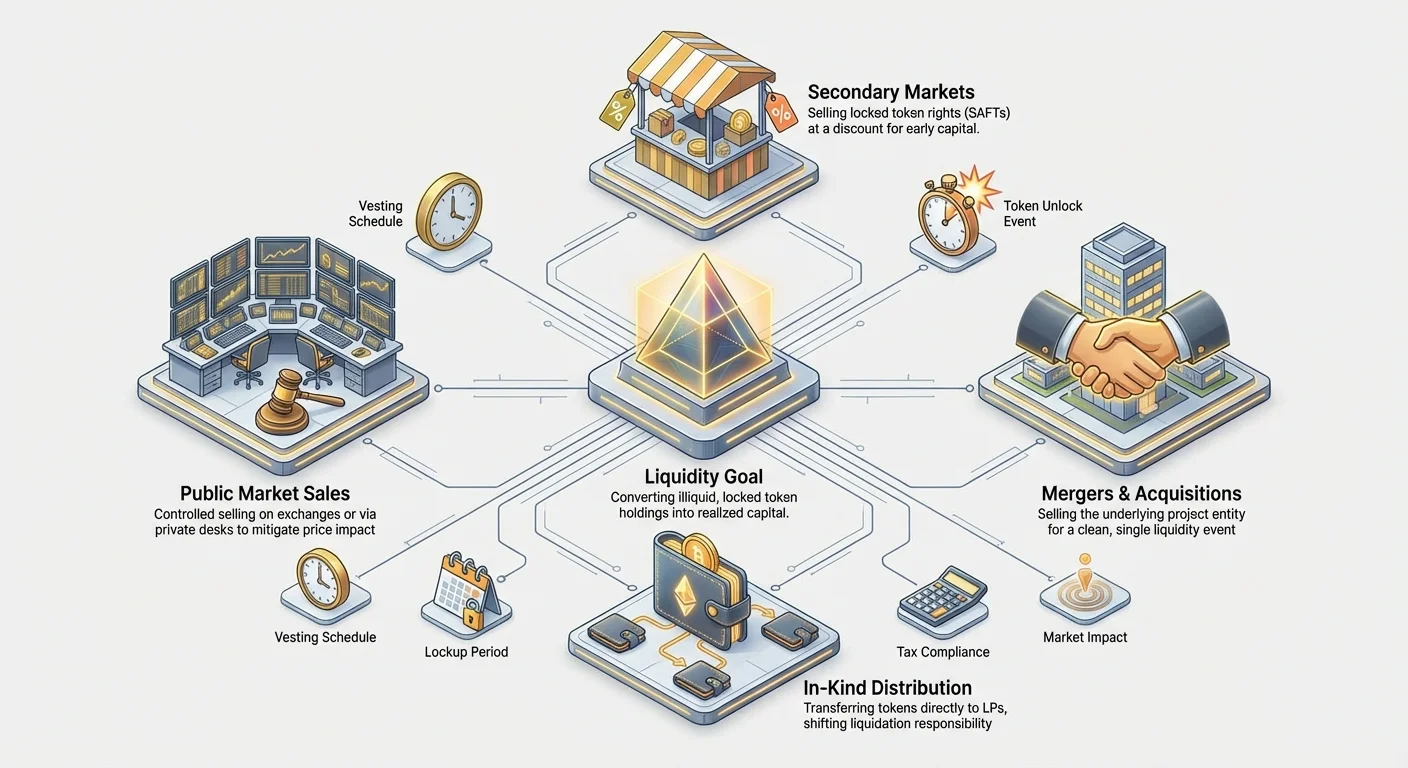
In traditional finance, VCs exit by selling shares when the startup goes public (IPO) or is acquired (M&A). In the crypto world, exits involve navigating dynamic public token markets, adhering to complex contractually enforced limitations (lockups), and employing sophisticated selling techniques to avoid crashing the very market they are trying to profit from. Effective management of blockchain portfolio liquidity is the ultimate measure of a crypto VC's skill. This guide breaks down the methods VCs use to convert illiquid, locked-up tokens into realized gains.
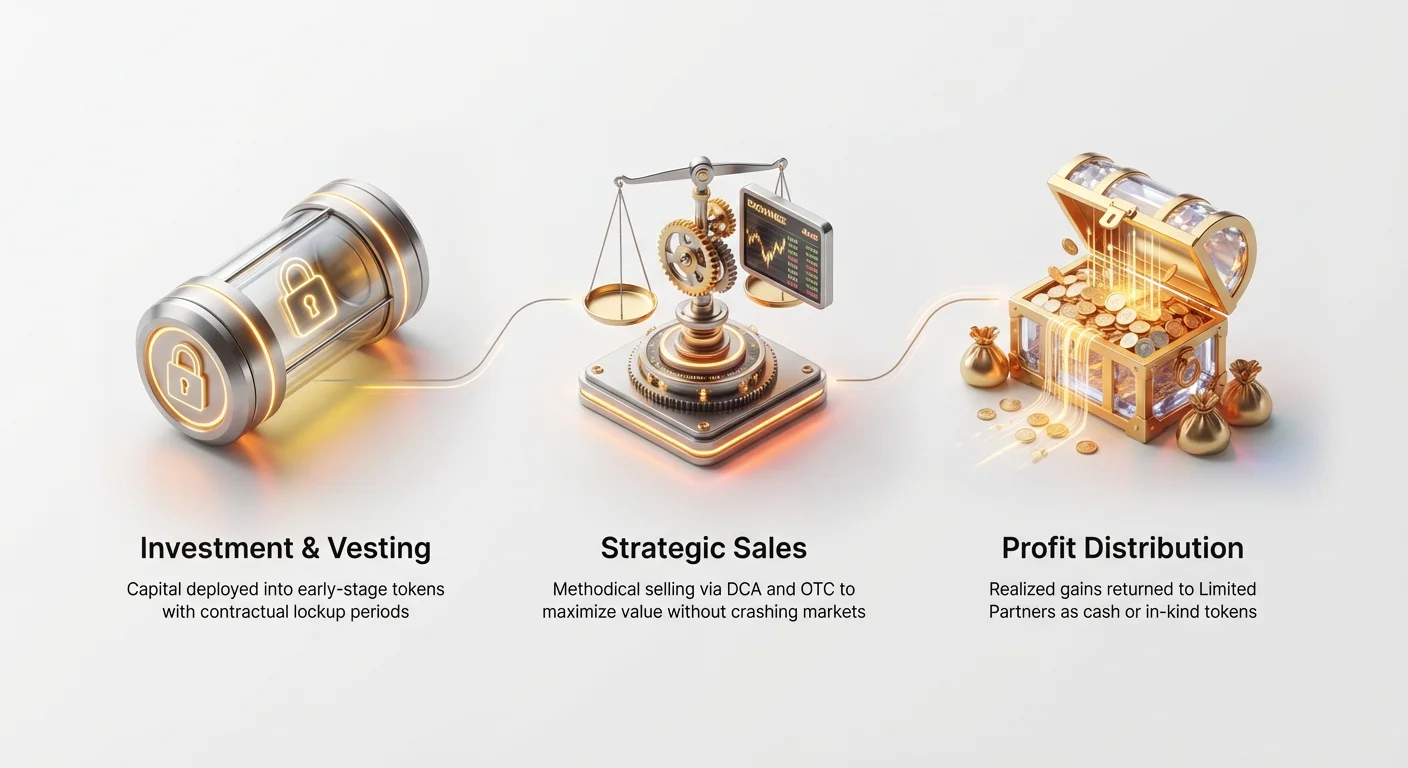
The Foundation of Crypto Exits: Vesting and Lockups
The single biggest difference between traditional and crypto VC exits is the concept of token lockups and vesting schedules. When a VC invests in a private token sale, they do not receive immediately tradable tokens. Instead, their assets are contractually restricted to protect the project’s long-term stability.
Understanding Vesting Schedules
Vesting is the process by which an investor gradually gains full ownership rights over an asset. A lockup is a period during which the asset cannot be transferred or sold, regardless of vesting status.
In the context of crypto VC, the vesting schedule dictates when and how much of the purchased token supply becomes available for the fund to sell. These schedules are put in place by the project team to prevent early investors from immediately dumping their large allocations onto the market, which would create a massive supply shock and destroy confidence in the newly launched token.
A typical VC vesting schedule might look like this:
- The Cliff: A mandatory waiting period, usually 6 to 12 months, during which zero tokens are unlocked. If a VC invested in January, they receive nothing until the following January.
- Linear Release: After the cliff, tokens are released linearly over a specified period (e.g., 24 to 36 months). For instance, if a fund purchased 10 million tokens with a 1-year cliff and 2-year vesting, they would receive 416,666 tokens every month for 24 consecutive months after the cliff ends.
Negotiation Tactics for Early Liquidity
For VCs, negotiating favorable vesting terms is essential for managing token unlocks effectively. Shorter lockups mean faster returns for their LPs, but they must balance this against the project’s need for price stability.
Experienced VCs leverage their reputation and institutional capital to secure slight advantages in vesting terms compared to smaller retail participants. They might negotiate for:
- Shorter Cliffs: Reducing the initial waiting period to 6 months instead of 12.
- Early Release Clauses: Terms allowing a small percentage (e.g., 5%) of tokens to be unlocked immediately upon the Token Generation Event (TGE), providing immediate, albeit limited, liquidity to cover initial fund expenses or test market appetite.
- Performance-Based Acceleration: If the project hits specific technical or adoption milestones, the remaining vesting schedule might be sped up.
The Criticality of the 'Unlock Event'
The end of the cliff period marks the official "Unlock Event." This date is highly anticipated and feared by the market. When billions of dollars worth of previously restricted tokens are suddenly available to sell, the supply influx can drastically depress the token’s price.
VC funds must coordinate internally to ensure that their eventual sales do not become the primary driver of this price depression. The fund's fiduciary duty requires them to sell at the best possible price, but doing so recklessly violates their relationship with the project team (their partners) and potentially harms their reputation in the ecosystem. This tension defines the challenge of crypto VC exit strategies.
The Primary Exit: Strategic Sales Post-Unlock
Once tokens are unlocked and free to move, the VC fund begins its official exit process. The goal is simple: maximize profit while minimizing negative market impact. This typically requires methodical, planned selling executed over many months or even years.
De-Risking the Portfolio: Dollar-Cost Averaging (DCA)
A fund holding $50 million worth of a token cannot simply place a limit order on a centralized exchange (CEX) and expect it to fill without tanking the price. Instead, VCs employ a strategy similar to retail investors' Dollar-Cost Averaging (DCA), but in reverse—Dollar-Cost Exiting (DCE).
DCA involves selling small, consistent amounts of the asset over a long period. This approach provides several benefits:
- Averaging the Sale Price: It mitigates the risk of selling everything at a momentary market low. By selling across an entire price cycle, the fund achieves an average sale price.
- Reduced Slippage: Smaller orders are filled quickly and closer to the advertised market price, whereas a massive order would "slip" by consuming all available liquidity down the order book.
- Market Stealth: Consistent, low-volume sales are harder for market participants to track, avoiding the creation of panic selling based on the perception that the smart money is fleeing.
The execution of these sales is often handled by sophisticated trading desks using algorithms that monitor liquidity across multiple exchanges and execute sales only during periods of high trading volume.
Over-The-Counter (OTC) Desk Utilization
When a crypto VC needs to sell a significantly large quantity—say, $5 million to $50 million worth—the standard DCA method may be too slow, or the volume too large for public order books. This is where Over-The-Counter (OTC) desks become essential.
An OTC desk facilitates private, direct trades between two large parties, bypassing public exchanges entirely.
- How it Works: The VC fund approaches an institutional broker (the OTC desk) and requests to sell 20 million tokens. The broker then privately finds a large institutional buyer—perhaps a hedge fund, another VC looking to increase their position, or a high-net-worth individual—willing to absorb the entire block at a negotiated price (usually slightly below the public market price).
- Benefits: Crucially, this trade does not appear on any public order book or impact the token’s spot price. It is the preferred method for managing large, concentrated sales without creating negative market sentiment or significant slippage.
Exchange Relationships and Listing Timing
Institutional funds often maintain close communication with centralized exchanges (CEXs). Their goal is to ensure that when a significant unlock occurs, the CEX is prepared to handle the expected volume.
Sometimes, a VC may coordinate with the project team to time their unlock releases or sales to coincide with major positive news, new exchange listings, or general market rallies. While VCs must adhere to ethical practices, strategically timing sales around increased natural liquidity is part of responsible portfolio management. Furthermore, strong relationships with exchanges can sometimes lead to the CEX offering specialized trading services or block trades directly to the VC fund.
Generating Liquidity on Secondary Markets
Waiting for the 12-month lockup to end is often too long for VC funds that need to return capital to their Limited Partners sooner. To address this illiquidity, specialized secondary markets have emerged, allowing funds to sell their restricted assets before the official unlock.
Pre-Launch Token Sale Transactions
In the crypto VC world, investment often starts with a SAFT (Simple Agreement for Future Tokens). The SAFT is a legal contract stating that the investor will receive tokens at a future date, provided the project launches successfully. While the tokens themselves are locked, the rights to those future tokens can be sold.
Secondary market transactions allow Fund A to sell its SAFT rights to Fund B at a significant discount.
- The Buyer’s Motivation: Fund B buys the tokens cheaply because they anticipate higher potential returns. They accept the risk that the project might fail or the market conditions upon unlock might be poor.
- The Seller’s Motivation: Fund A receives immediate, albeit discounted, cash flow. This is crucial for managing fund-level liquidity, paying operational costs, or realizing a fast return on a risky bet.
These transactions are complex, involving legal reassignment of the contract and the associated vesting schedule, and they are typically only accessible to accredited investors and professional funds.
Specialized Secondary Platforms
In recent years, specialized platforms have emerged specifically to facilitate the trading of illiquid, restricted assets, including venture equity and locked crypto tokens. These platforms act as organized marketplaces for private transactions.
These markets provide two core functions:
- Price Discovery: They help establish a fair market price for assets that are not yet publicly traded, usually through sealed bids or private auctions.
- Legal Facilitation: They handle the complex legal transfer documentation needed to move the contractual rights from the seller to the buyer.
For a VC looking to offload a portion of its restricted holdings, these platforms offer a regulated environment to find institutional buyers without relying solely on their private network.
Understanding the Discounting of Locked Assets
The defining characteristic of selling tokens pre-unlock is the required discount. Since the buyer cannot access the tokens immediately and takes on the risk of price volatility, they demand compensation for that illiquidity and time horizon.
This "illiquidity premium" often results in the locked tokens being sold at a 30% to 50% discount compared to the token’s projected or already achieved public listing price.
Example Scenario: A project’s token launches at $1.00 on a CEX. VC Fund X holds 10 million tokens locked for 18 months. If Fund X sells these locked tokens on the secondary market, they might be forced to sell them at $0.60 per token (a 40% discount). While Fund X foregoes $0.40 per token, they receive instant capital 18 months earlier than their vesting schedule allows.
Deciding whether to take a large discount for immediate liquidity versus waiting for full vesting is a central decision point in managing portfolio liquidity.
The Corporate Exit: Mergers and Acquisitions (M&A)
While most crypto VC exits involve selling tokens on the open market, an equally important exit strategy is the corporate acquisition, or M&A. This happens when the underlying company or project, rather than the token itself, is purchased by a larger entity.
M&A as a Clean Liquidity Event
A corporate acquisition often represents the cleanest, most definitive exit for a VC fund. Instead of relying on volatile market sales over years, an M&A deal typically provides a large, single influx of capital (either cash, stablecoins, or equity in the acquiring company) in one transaction.
M&A is often pursued when:
- Technology Acquisition: A larger blockchain protocol or a Web2 tech giant wants to integrate the smaller company’s specialized technology (e.g., a specific scaling solution, a unique wallet, or an expert development team).
- Stalled Token Performance: The project has strong technology but its token has failed to gain traction or is mired in regulatory uncertainty. The VC might prefer selling the corporate entity for a guaranteed return rather than facing a prolonged, low-value token exit.
In an M&A scenario, the acquiring company buys the equity of the founding team and the VC investors, often dissolving the token or integrating it into their own ecosystem.
Due Diligence in Blockchain M&A
Institutional due diligence (DD) in crypto M&A is significantly more complex than traditional tech acquisitions, requiring a deep dive into both corporate structure and decentralized technology.
Key areas of focus during the M&A DD process include:
- Smart Contract Audits: The acquiring entity must meticulously audit the smart contracts to ensure there are no vulnerabilities, backdoors, or unaccounted-for token supplies that could lead to liability post-acquisition.
- Regulatory Status of the Token: The legal classification of the token (Is it a security? A utility token?) is paramount. The acquiring company must understand the regulatory risk they are taking on, especially across different jurisdictions.
- Treasury Management: VCs and the acquiring party must reconcile the project’s decentralized treasury—how much ETH, stablecoins, or native tokens the project itself holds, and how those funds were managed and accounted for. This often requires forensic accounting within the blockchain ledger.
The successful navigation of this complex due diligence framework is vital for ensuring the M&A exit is legally and financially sound.
Valuation Challenges: Token vs. Treasury
A unique challenge in crypto M&A valuation is separating the value of the corporate entity (the team, intellectual property, and brand) from the value of the token and the project’s treasury.
If a company is valued at $100 million, but its treasury holds $70 million in highly liquid assets (like USDC or ETH), the actual purchase price for the technology and team is only $30 million. Conversely, if the company holds 50% of its own native token, the valuation must account for the dilutive effect of those tokens being released or burned post-acquisition.
The VC’s job during M&A negotiation is to ensure that their initial equity stake (or token investment) is accurately translated into a fair price based on these fluid, layered crypto valuations.
Distribution and Compliance: Returning Capital to Limited Partners (LPs)
The final step in the VC exit process is distributing the realized profits back to the Limited Partners (LPs)—the endowments, family offices, and wealthy individuals who invested in the fund. This step requires stringent financial controls and comprehensive compliance.
Cash vs. In-Kind Distributions
When a VC fund realizes profits from a sale, they must decide whether to distribute the proceeds as cash (fiat currency or stablecoins) or "in-kind" (the actual tokens themselves).
Cash Distributions (The Standard)
- The fund sells the tokens (using DCA or OTC), converts the proceeds to fiat or stablecoins, and sends the cash to the LPs.
- Pros: Simplicity. LPs receive readily usable currency and the fund handles all the complexity of the liquidation process.
- Cons: The fund takes on the full burden of liquidating potentially large token reserves and the associated market risk.
In-Kind Distributions (Unique to Crypto)
- The fund transfers the realized tokens directly from the fund’s wallet to the individual wallets of the LPs, based on their ownership percentage.
- Pros: It shifts the responsibility and timing of the market sale to the LPs. LPs can choose to hold the token long-term, potentially benefitting from further upside, or liquidate immediately.
- Cons: Complexity. This requires careful coordination, as every LP needs a secure, compatible wallet. Crucially, the tax burden and liquidity risk are transferred entirely to the LP.
Crypto VC funds often prefer in-kind distributions for highly volatile or large-cap tokens where they believe LPs might want to hold the asset long-term. However, smaller or riskier assets are usually liquidated for cash by the fund itself.
Navigating Complex Crypto Tax Implications
Tax reporting is arguably the most administratively demanding part of the exit process, especially given the multi-jurisdictional nature of both VC funds and their LPs.
When a crypto VC sells tokens, the fund incurs a capital gains event. Calculating the tax liability requires accurately tracking the cost basis for every single token sold, which can be immensely complicated if the tokens were acquired through multiple investment rounds, at different prices, and with varying vesting schedules.
Key Tax Hurdles:
- Cost Basis Tracking: Utilizing FIFO (First-In, First-Out) or LIFO (Last-In, First-Out) accounting methods to determine the actual profit realized on each token sale.
- International Reporting: If the fund is domiciled in a tax-friendly jurisdiction (e.g., Cayman Islands) but has LPs in high-tax jurisdictions (e.g., U.S. or Europe), the fund must generate comprehensive K-1-like reports detailing the nature of the income, ensuring LPs can comply with their local rules.
- Treatment of In-Kind Distributions: When tokens are distributed in-kind, the fund needs to meticulously document the fair market value (FMV) of the tokens at the exact moment of distribution. This FMV becomes the new cost basis for the LP, allowing them to calculate their own future capital gains accurately.
Professional crypto tax platforms are essential tools for VCs, automating the massive task of transaction reconciliation and tax calculation to ensure compliance and audit readiness.
LP Reporting and Transparency
Finally, accountability demands maximum transparency regarding crypto VC exit strategies. The fund manager (General Partner, or GP) must report regularly to the LPs, detailing the rationale behind every major liquidity decision:
- Why were 15% of the holdings sold via OTC this quarter?
- Why were the remaining tokens in Project Z distributed in-kind instead of being liquidated for cash?
- How did the sales strategy mitigate the market impact of the latest token unlock?
Clear reporting builds trust and justifies the Carried Interest—the percentage of profits the GP keeps as performance fee. Effective liquidity management and transparent reporting are crucial for ensuring LPs reinvest in the fund’s next iteration.
Conclusion
Managing portfolio liquidity is the high-stakes balancing act that defines the success of a crypto venture capital fund. Unlike traditional investing, crypto VC requires simultaneous mastery of contractual restrictions (vesting and lockups), dynamic public market mechanics (DCA and OTC sales), specialized secondary market maneuvering, and complex regulatory compliance.
From negotiating shorter vesting periods to strategically employing OTC desks to prevent market disruption, every decision revolves around the goal of maximizing returns while ensuring a stable, sustainable exit. By carefully planning for token unlocks and utilizing tailored strategies like M&A or in-kind distributions, professional crypto funds can effectively convert their illiquid, restricted assets into realized profits, fulfilling their commitment to their Limited Partners and fueling the next generation of blockchain innovation.