
Welcome to the comprehensive guide for generating passive income through digital assets. The decentralized finance (DeFi) revolution has created a plethora of opportunities for users to earn yield on their crypto holdings, moving far beyond simply buying and holding. Whether you are a newcomer looking for a safe way to earn interest on stablecoins or a seasoned retail investor aiming to maximize returns through advanced strategies like liquid staking, understanding the mechanics of these systems is crucial.
This guide is designed to demystify the complex world of crypto yield generation. We will structure our journey from the simplest, lowest-risk options—centralized crypto savings accounts—to the most sophisticated, high-reward strategies like yield farming and optimizing with Liquid Staking Derivatives (LSDs). Our goal is to equip you with a robust crypto savings strategy that focuses not just on maximizing staking yield, but also on managing risk, maintaining flexibility, and navigating the operational complexities, ensuring you can build the best passive crypto income strategy tailored for your financial goals in 2025 and beyond.
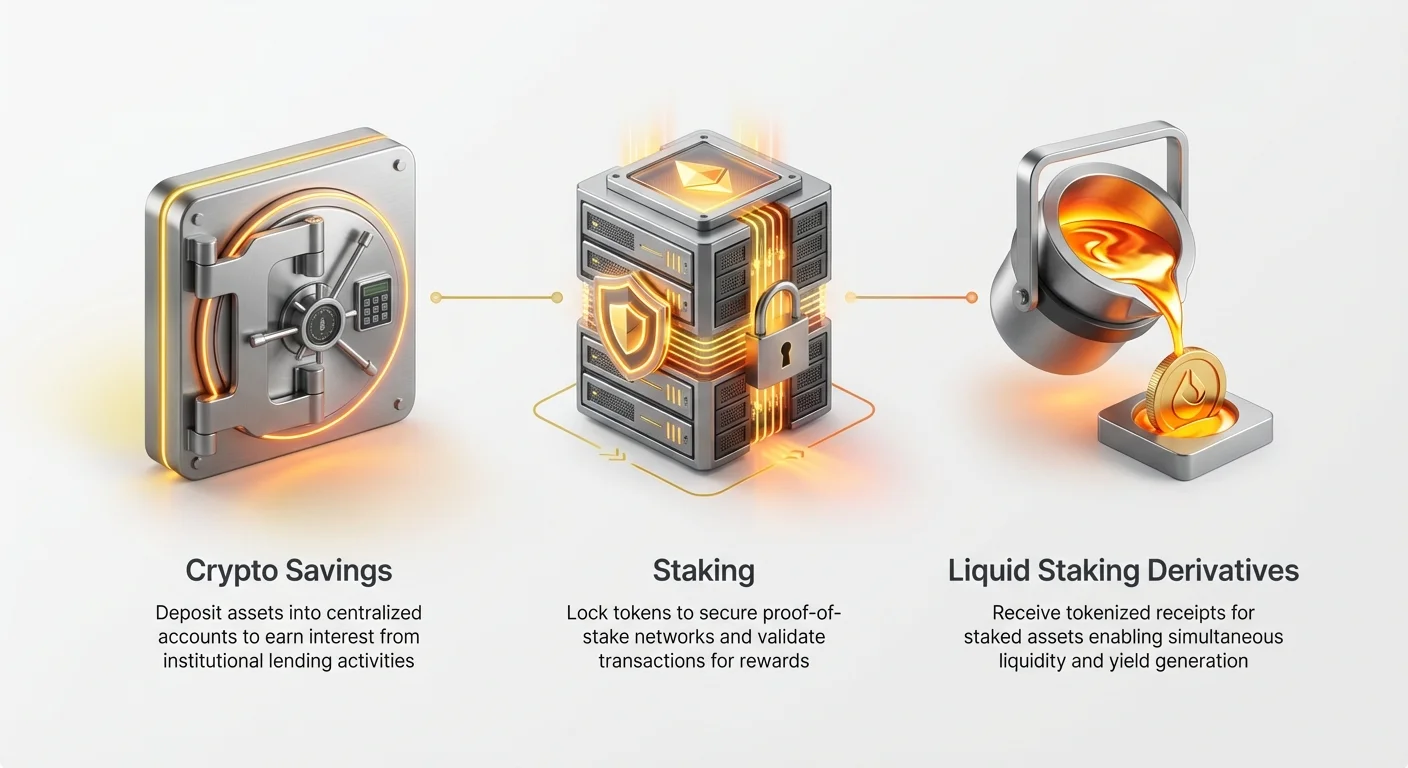
The Foundation: Understanding Basic Crypto Yield Streams
Before diving into advanced optimization, it is essential to distinguish between the two primary ways ordinary users generate passive crypto income: centralized savings and decentralized staking.
Centralized Crypto Savings Accounts: Simplicity and Custody
The simplest entry point for earning yield is through a Centralized Exchange (CEX) or a dedicated custodial platform. These accounts operate similarly to traditional bank savings accounts, but with a crypto twist.
How CEX Savings Products Work
When you deposit funds into a CEX savings product, you are essentially lending those assets to the exchange. The exchange then pools these funds and uses them for various purposes:
- Lending to Institutional Clients: Providing capital to large firms for margin trading or shorting.
- Internal Liquidity: Using funds to facilitate smooth trading and instant withdrawals for other users.
In return for loaning your crypto, the exchange pays you interest, often expressed as an Annual Percentage Yield (APY). This is a familiar and straightforward model, making it ideal for beginners who prioritize ease of use and access.
Flexible vs. Fixed Terms: The Trade-off of Liquidity
CEX savings accounts typically offer two primary types of deposit terms, impacting your overall crypto savings strategy:
- Flexible Terms: These allow you to withdraw your assets at any time, usually with minimal notice. The advantage is liquidity and zero commitment, but the trade-off is typically a lower APY.
- Fixed Terms (or Lock-up Deposits): These require you to lock your assets for a defined period (e.g., 30, 60, or 90 days). Because the exchange has guaranteed access to the capital for that duration, they can offer a significantly higher APY. However, premature withdrawal often incurs a penalty or forfeits the accrued interest.
Actionable Tip: Use flexible terms for stablecoins (USDC, USDT) that you might need to deploy quickly for trading opportunities. Reserve fixed terms for assets you plan to hold long-term (e.g., Bitcoin or Ether) where liquidity is not an immediate concern.
The Role of Staking: Powering Proof-of-Stake Networks
Staking is fundamentally different from CEX savings because it is decentralized and serves a critical function within the blockchain network itself. Staking is the mechanism used by Proof-of-Stake (PoS) blockchains (like Ethereum, Solana, Cardano, and Polkadot) to secure the network, validate transactions, and create new blocks.
Delegated Staking vs. Running a Validator Node
For most retail users, running a full validator node is prohibitively complex, requiring specialized hardware, high technical expertise, and a substantial minimum capital requirement (e.g., 32 ETH for Ethereum).
Delegated Staking is the beginner-friendly solution. You "delegate" your stake (your tokens) to an existing, professional validator. The validator performs the complex technical work, and the network distributes the rewards (newly minted tokens and transaction fees) proportionally between the validator and all the users who delegated their tokens to them.
Key Concepts in Staking:
- Rewards: Paid in the native currency of the chain (e.g., ETH rewards for staking ETH).
- Slashing: A penalty mechanism where a validator (and their delegators) lose a portion of their staked assets if the validator acts maliciously or fails to maintain uptime. This is why choosing a reliable validator is crucial.
- Unbonding Period: The time required to unlock your staked assets so they can be traded or spent. This period varies significantly by chain (e.g., a few days up to 28 days) and is a critical factor in liquidity management.
Deep Dive into Staking: Maximizing Yield and Security
Optimizing staking yield requires strategic chain selection, validator vetting, and careful management of lock-up periods.
Choosing the Right Staking Chain for High Yield
The effective APY (Annual Percentage Yield) for staking varies based on network demand, the total amount of assets already staked, and the chain’s inflation rate.
Ethereum (ETH) Staking: The Low-Risk Anchor
Ethereum is the largest PoS network. While its base APY might be lower than some newer chains (historically 3-5%), it is generally considered the foundational, lowest-risk option due to its massive network security, maturity, and deep liquidity.
High-Yield Alternatives (Solana, Polkadot, Cardano)
For maximizing staking yield, looking beyond Ethereum to emerging and established L1s (Layer 1 blockchains) can be beneficial:
| Blockchain | Key Feature for Staking | Typical APY Range | Focus |
|---|---|---|---|
| Solana (SOL) | Extremely fast block finality; high delegation participation. | 6% – 8% | Speed and high transaction volume yields. |
| Polkadot (DOT) | Complex nominating system; crucial for network security and parachain auctions. | 10% – 14% | Infrastructure and interoperability yield. |
| Cardano (ADA) | Highly distributed pools; simple delegation process (no lock-up). | 3% – 5% | Consistent, reliable yield structure. |
Strategy Note: When analyzing staking rewards, always look at the real yield—the APY minus the network’s inflation rate. A chain offering 20% APY might be inflating its supply heavily, diluting the value of your existing holdings.
Vetting Validators: Minimizing Slashing Risk
Delegating your stake is an act of trust. If your chosen validator is "slashed" (penalized), your staked funds are at risk.
Key Validator Selection Criteria
- Commission Rate: This is the fee the validator takes before distributing rewards. Lower is generally better, but a zero-commission validator may be unstable or temporary. A competitive rate (3% to 10%) ensures the validator is financially incentivized to maintain high uptime.
- Uptime History: Validators must be online 24/7 to process transactions. Check the chain’s explorer tools to view the validator’s historical performance. Consistently high uptime (99%+) is critical.
- Self-Stake Amount: A validator who stakes a significant amount of their own tokens demonstrates commitment and a higher incentive to avoid slashing (they risk their own capital).
- Decentralization: Avoid delegating to large CEX validators (like Coinbase or Binance). This consolidates power and potentially exposes you to regulatory risk. Seek smaller, independent validators to support network decentralization.
Managing Unbonding Periods and Opportunity Cost
The unbonding period is the mandatory waiting time before you can liquidate your staked assets. This waiting period is a security feature, preventing a sudden, massive withdrawal of staked assets that could destabilize the network.
Impact on Strategy: A long unbonding period (e.g., 28 days for Polkadot) creates opportunity cost. If the market crashes during this 28-day window, you cannot quickly sell your tokens, forcing you to ride out the volatility.
Best Practice: Only stake capital that you are comfortable having locked up for the asset's typical unbonding duration. If you require higher liquidity, the next section—Liquid Staking—is your optimal path.
Maximizing Flexibility with Liquid Staking Derivatives (LSDs)
The biggest drawback of traditional delegated staking is the illiquidity created by the lock-up period. Liquid Staking Derivatives (LSDs) are a groundbreaking innovation that solves this problem, providing users with capital efficiency and the ability to earn compounding yield.
What are Liquid Staking Derivatives (LSDs)?
An LSD is a tokenized receipt for your staked assets. When you stake your ETH through a liquid staking protocol (like Lido or Rocket Pool), the protocol immediately issues you an LSD token (e.g., stETH or rETH) in return.
How LSDs Achieve Simultaneous Yield and Liquidity
- Staking Yield: The protocol stakes your underlying ETH on the Ethereum network and automatically adds the earned rewards back into the pool. The value of your LSD token increases relative to the underlying asset over time, or the LSD balance automatically grows.
- Liquidity: The LSD token (stETH) is transferable, tradable, and usable across the DeFi ecosystem while your original ETH is locked and earning staking rewards.
Example: If you deposit 1 ETH into a liquid staking platform, you receive 1 stETH. That 1 stETH can then be used as collateral for a loan, traded on a decentralized exchange (DEX), or deposited into a liquidity pool to earn additional yield—effectively earning double rewards.
Integrating LSDs into an Optimized Crypto Savings Strategy
LSDs allow users to engage in advanced strategies known as "LSDfi" (Liquid Staking Derivatives Finance). This is how users maximize staking yield far beyond the base network rate:
1. Collateralized Lending
Deposit your LSD (e.g., stETH) into a decentralized lending protocol (like Aave or Compound) as collateral. You can then borrow stablecoins (like USDC) against the value of the stETH.
- Benefit: You continue to earn staking rewards on the stETH collateral while utilizing the borrowed stablecoins for other investments or liquidity needs.
- Risk: Managing liquidation risk if the price of ETH or stETH drops too low.
2. Liquidity Provision (LP Farming)
Pair your LSD with the underlying asset or a stablecoin on a DEX to earn trading fees and potentially governance tokens.
- Example: Providing liquidity in an stETH/ETH pool. Since these assets should remain closely pegged, the risk of impermanent loss is significantly reduced (see Section 4). This generates yield from trading fees on top of the base staking reward.
3. Yield Aggregators and Vaults
Some decentralized yield aggregators automatically compound your LSDs or use them in complex strategies, streamlining the process of moving collateral to lending markets and auto-compounding the returns. This is ideal for maximizing yield without constant manual management.
Key Risks Associated with LSDs
While powerful, LSDs introduce specific risk vectors that traditional staking does not:
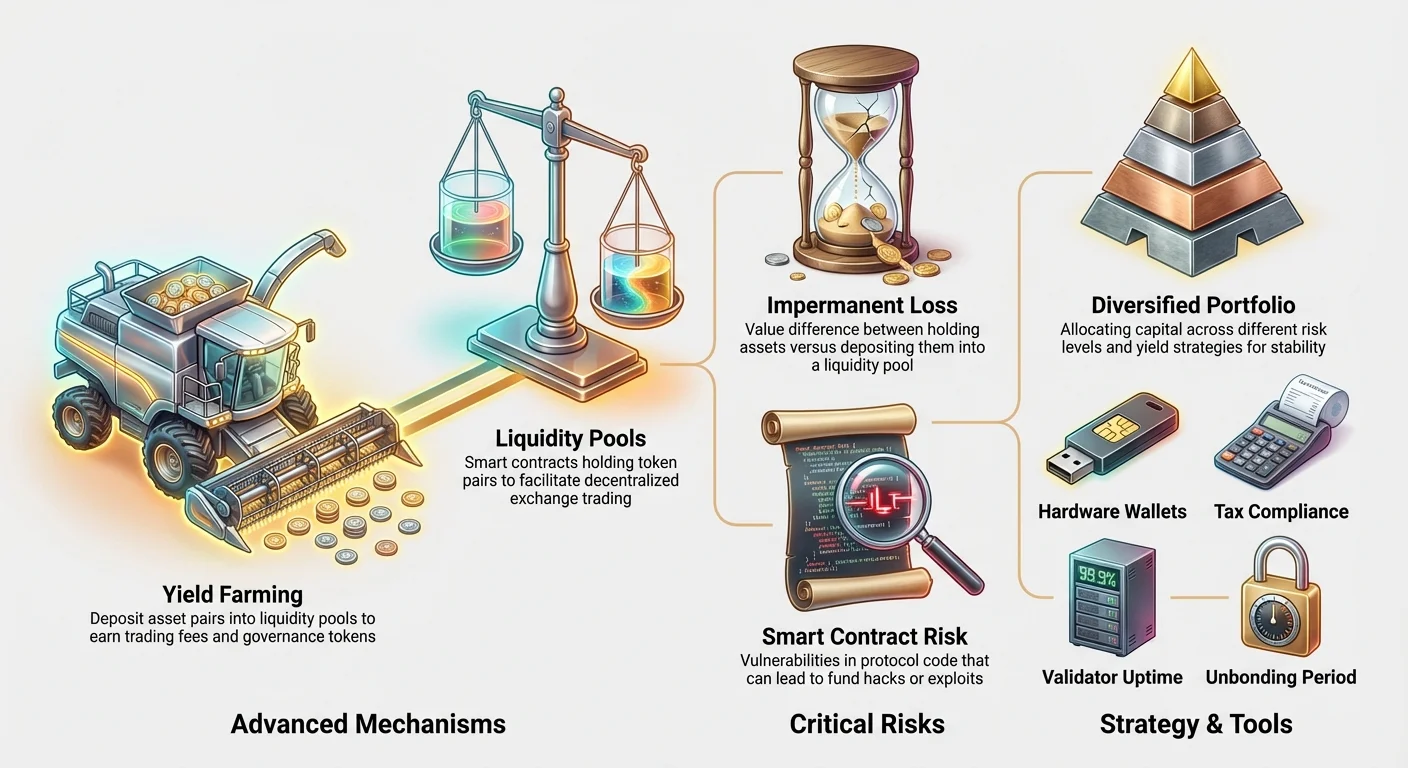
- Smart Contract Risk: The LSD protocol (Lido, Rocket Pool) is governed by smart contracts. If a vulnerability exists or is exploited, all staked funds are potentially at risk.
- De-Pegging Risk: The LSD token should always trade close to the value of the underlying asset (e.g., stETH should equal 1 ETH). However, in times of extreme market stress or technical uncertainty, the peg can temporarily break, meaning you may only be able to sell your LSD token for less than the value of the underlying asset.
- Centralization Concerns: Some LSD providers control a large portion of the staked supply on a chain (e.g., Lido on Ethereum), creating centralization risks for the network. Supporting smaller LSD providers helps mitigate this systemic risk.
Advanced Yield Strategies: Introducing Yield Farming and Liquidity Provision
Once you master basic staking and LSDs, the next level of passive income generation involves participating in liquidity pools and engaging in yield farming. This is where the potential for maximizing staking yield exponentially increases, but so too does the complexity and risk.
Defining Liquidity Pools (LPs)
Liquidity pools are the backbone of Decentralized Exchanges (DEXs). They are pools of two or more tokens locked in a smart contract that facilitate trading between those assets.
The Mechanics of Providing Liquidity
- Deposit Pairing: To become a Liquidity Provider (LP), you must deposit equal dollar values of two tokens (e.g., $1,000 worth of Token A and $1,000 worth of Token B).
- LP Tokens: In return, you receive an LP token, which represents your share of the total pool.
- Earning Trading Fees: Whenever another user trades using that pool (e.g., swapping Token A for Token B), they pay a small fee. These fees are automatically distributed proportionally to all LP token holders. This fee generation is your base yield.
Understanding and Optimizing Yield Farming
Yield farming is the process of generating additional income on top of the base trading fees earned from the liquidity pool.
The Role of Governance Tokens
Many DeFi protocols reward LPs with the protocol’s native governance token (often referred to as the farm token). This reward is usually denominated as a very high APY figure.
- Total Yield Calculation: Farming yield = Trading Fees + Governance Token Rewards.
- The Incentive: Protocols use these high rewards to quickly attract deep liquidity, making their DEX more efficient than competitors.
Strategy: The crypto savings strategy here involves searching for high-APY farms that reward tokens with long-term value potential, or frequently selling the reward token to realize profits.
The Major Risk: Impermanent Loss Explained
Impermanent Loss (IL) is the single most critical concept in yield farming, and it is the primary reason why high APYs in farming can be misleading.
Defining Impermanent Loss
Impermanent Loss is the difference in value between simply holding two assets in your wallet (HODLing) and depositing them into a liquidity pool. IL occurs when the price ratio between the two deposited assets changes drastically.
Simple Example (The Apple/Orange Ratio):
- Initial Deposit: You deposit 100 Apples and 100 Oranges, priced equally at $1 each. Total value: $200.
- Price Change: The price of Apples doubles to $2, while Oranges remain at $1.
- Arbitrage and Rebalancing: Arbitrage traders use the pool to buy the cheaper asset (Oranges) and sell the more expensive asset (Apples) until the pool rebalances to maintain the 50/50 dollar ratio.
- Withdrawal: When you withdraw, the pool must now hold a different quantity of assets to maintain the equal dollar split (e.g., 66 Apples and 133 Oranges).
- The Loss: If you had simply held the 100 Apples and 100 Oranges, the total value would be $300 (100x$2 + 100x$1). When you withdraw from the pool, the value might only be $290. The $10 difference is the Impermanent Loss.
Key Point: The loss is "impermanent" because it only becomes permanent when you withdraw your funds. If the prices return to their original ratio, the IL disappears. However, if the price divergence is permanent, the loss is realized upon withdrawal.
Strategies for Impermanent Loss Mitigation
Effective liquidity providers minimize IL while maximizing staking yield through strategic pair selection:
- Stablecoin Pairs (Low IL): Pairing stablecoins (e.g., USDC/USDT) provides the safest route. Since the assets should remain pegged at $1, the price ratio rarely changes, resulting in very low IL and steady fee income. This is the optimal entry for beginners into LP farming.
- LSD/Underlying Pairs (Medium IL): Pairing an LSD (like stETH) with its underlying asset (ETH) is a common strategy. Since the two tokens are closely correlated and should maintain a tight peg, IL risk is far lower than pairing two volatile assets.
- High Volatility Pairs (High IL): Pairing a major token (e.g., ETH) with a brand-new, highly volatile governance token offers the highest APR, but also the highest risk of IL wiping out those high rewards if the smaller token crashes or moons significantly faster than the major one.
Rule of Thumb: Only enter highly volatile pairs if the farming rewards (governance tokens) are high enough to consistently offset the potential impermanent loss.
Navigating the Risks: Security, Lockups, and Withdrawal Windows
A robust crypto savings strategy must prioritize risk management over absolute yield chasing. Higher yields almost always correlate directly with higher underlying risk.
Risk Management Layer 1: Custody and Centralized Risk
For users relying on CEX savings products, the primary risk is custodial risk.
The Danger of Custodial Failure
When you deposit crypto into a centralized exchange, you surrender control of your private keys—you do not truly own the crypto, the exchange does. If the exchange suffers a hack, faces regulatory seizure, or becomes insolvent (as seen in major crypto collapses), your assets may be frozen or lost entirely. This is the definition of custodial risk.
Mitigation:
- Diversification: Do not keep all assets on a single exchange.
- Proof of Reserves: Prioritize exchanges that regularly publish Proof of Reserves (PoR) audits to verify they hold sufficient assets to cover user liabilities.
- Use Hardware Wallets: For assets you do not need for immediate yield or trading, transfer them off the exchange and into a self-custody hardware wallet.
Risk Management Layer 2: Decentralized Smart Contract Risk
For staking, LSDs, and yield farming, the core risk shifts from institutional failure to smart contract vulnerability.
Audits and Protocol Maturity
Every decentralized protocol is essentially software code. If the code contains bugs or exploits, hackers can drain the pool of funds.
Mitigation:
- Prioritize Audits: Only use protocols that have been publicly audited by reputable blockchain security firms (e.g., CertiK, Trail of Bits). Audited code reduces, but does not eliminate, risk.
- Evaluate Total Value Locked (TVL): Protocols with very high TVL and protocols that have been operating successfully for a long time (e.g., Uniswap, Aave, Lido) are often considered more robust simply because their contracts have withstood extensive market testing.
- Small Incremental Deposits: Start with a small percentage of your capital to test a new protocol before committing a significant amount.
The Role of Withdrawal Windows and Flexibility
The best passive crypto income strategy balances high yield with access to funds. Flexibility is key, especially during bear markets or sudden upward volatility.
Analyzing Unbonding Periods (Staking)
If you are staked directly, you must factor in the full unbonding duration. If the asset suddenly gains 50%, you might have to wait 14-28 days before you can sell, missing the peak.
Strategy for Flexibility: Use a combination of methods:
- Keep 10-20% of the asset in liquid form (non-staked).
- Utilize LSDs for the bulk of the stake, as LSD tokens can be sold instantly on a DEX, bypassing the chain’s unbonding period entirely.
Managing Liquidity Pool Lockups
While most DeFi liquidity pools do not have mandatory lock-up periods, the fees charged by the network (gas fees) can make frequent entry and exit expensive. The true 'lock-up' is often the high transaction cost of moving funds repeatedly.
Best Practice: Only deposit into liquidity pools if you intend to keep the funds there for a sustained period (months, not days) to ensure the accrued yield outweighs the entry and exit fees.
Integrating Crypto Insurance Solutions
Advanced users can mitigate smart contract risk by purchasing insurance. Services like Nexus Mutual or InsurAce offer coverage that pays out if a specific DeFi protocol is hacked or exploited. This can be an expensive but highly effective hedge for large capital deployments in yield farming.
Building a Diversified Passive Income Portfolio Strategy
To truly maximize staking yield and ensure stability, your approach should be structured and diversified across different yield types and risk levels.
The Pyramid of Crypto Yield Risk
A useful mental model for building a portfolio is the Pyramid of Risk, where the foundation is the largest allocation and lowest risk, and the peak is the smallest allocation and highest risk.
| Allocation Level | Strategy Example | Risk Profile | Target Allocation (Example) |
|---|---|---|---|
| Foundation (Base) | Stablecoin CEX Savings; Hardware Wallet Storage. | Very Low | 40% – 50% |
| Mid-Layer 1 | Blue-chip ETH/SOL Delegated Staking; Safe CEX Fixed Term. | Low to Medium | 30% – 40% |
| Mid-Layer 2 | LSD Collateralized Lending; Stablecoin Liquidity Pools (e.g., Curve). | Medium | 10% – 15% |
| Apex (Peak) | Volatile Asset Yield Farming; New Protocol Staking; Leverage. | High to Very High | 5% – 10% |
Strategy 1: The 70/20/10 Rule for Conservative Yield
This allocation model is tailored for the beginner or conservative investor focused on capital preservation:
- 70% Safe Yield (Savings & Direct Staking): Allocated to established, non-volatile methods. This includes stablecoins in CEX fixed terms and direct staking of major assets like ETH or BTC (if wrapped/tokenized for staking). This ensures steady, predictable income.
- 20% Strategic LSDs: Used for liquid staking (e.g., stETH, mSOL). This maintains high liquidity and allows for secondary yield strategies (like pairing stETH with ETH) without relying on highly volatile reward tokens.
- 10% Aggressive Farming: Allocated to high-APR yield farms, often involving new or governance tokens. This allocation is the "risk capital" used to chase the highest rewards, understanding that impermanent loss or smart contract failure could zero out this portion.
Strategy 2: Focusing on Real Yield vs. Inflationary Yield
A common mistake in yield optimization is chasing the highest advertised APY, which is often paid out in inflationary governance tokens.
Real Yield refers to rewards paid in an established currency (e.g., ETH, USDC, or trading fees). These rewards do not rely on the future appreciation of a new token.
Inflationary Yield refers to rewards paid in a newly minted protocol token. If the protocol token price drops faster than the rewards are earned, the net gain can be negative.
Optimization Focus: In 2025, prioritize protocols that demonstrate sustainable revenue models (i.e., those that distribute trading fees or service fees) over protocols that rely solely on new token issuance to attract liquidity. LSD collateral pools often fall into the high Real Yield category.
Operationalizing Your Strategy: Tools, Wallets, and Tax Compliance
The best passive crypto income strategy requires rigorous execution and accurate record-keeping. Technology and compliance are just as important as the yield strategy itself.
Wallet Selection for DeFi and Staking
The wallet is the key to interacting with decentralized finance. Your choice of wallet affects security, usability, and compatibility with staking platforms.
Hardware Wallets (The Security Standard)
For storing large amounts of crypto and managing the private keys for your staked assets, a hardware wallet (e.g., Ledger, Trezor) is mandatory. It provides the highest level of security against online threats.
Software Wallets (The DeFi Gateway)
Software wallets (e.g., MetaMask, Phantom, Keplr) are crucial for interacting with DEXs, liquid staking protocols, and yield farms.
- Key Requirement: The wallet must support the specific chain you are using (e.g., Phantom for Solana staking, MetaMask for Ethereum/EVM chains).
- Best Practice: Keep a small amount of "gas money" (native token for transaction fees) in your software wallet and keep the bulk of your assets secured via connection to your hardware wallet.
Tracking and Reporting Yield Streams
The decentralized nature of staking and farming creates complex tax reporting requirements. Every reward received, and often every swap or trade, is considered a taxable event.
The Necessity of Crypto Tax Software
Manual tracking of DeFi activity is nearly impossible due to the sheer volume of micro-transactions (reward payouts, farming deposits, swapping governance tokens, etc.).
Integration Guide:
- Select a Platform: Choose a crypto tax software solution (e.g., Koinly, CoinTracker) that specializes in tracking DeFi activities.
- API Integration (CEX): Link all your centralized exchange accounts via API keys.
- Wallet Integration (DeFi): Import the public addresses of all your software wallets. The software will analyze the blockchain data to categorize:
- Staking Rewards: Typically treated as ordinary income upon receipt (taxed based on fair market value at the time of payout).
- Yield Farming Rewards (Governance Tokens): Treated as ordinary income upon receipt.
- Swaps (Trading): Treated as capital gains or losses (selling one asset to buy another).
Critical Advice: Do not wait until the end of the year to track yield. Sync your wallets weekly to ensure accuracy and prevent data overload.
The Tax Implications of Staking and Farming
Understanding when you realize income is vital for your crypto savings strategy:
- Staking Rewards: In most jurisdictions (including the US), staked rewards are considered taxable income at the moment you receive control over them (i.e., when they hit your wallet).
- LSD Appreciation: If you hold an auto-compounding LSD (like stETH), the mechanism of taxation can be complex. In some jurisdictions, the gradual appreciation in the token’s value relative to the underlying asset is treated as accrued income, while in others, it is only taxed upon final withdrawal or sale. Consult a specialized tax professional.
- Liquidity Provision (LP): Depositing into an LP is generally not a taxable event. However, receiving LP fees and governance tokens is a taxable event. Selling those governance tokens creates a second taxable event (a capital gain/loss).
Best Practices for Monitoring Performance
To ensure you are truly maximizing staking yield, you must regularly monitor your returns net of risk and cost.
- Monitor Gas Fees: Use gas tracking tools (like Etherscan) to determine the lowest-cost times of day to execute complex DeFi transactions (often late night or weekends). High gas fees can negate small yield gains.
- Rebalancing Strategy: Periodically rebalance your yield farming allocations. If a farm’s APY drops significantly or the price of the reward token plummets, withdraw the funds and re-deploy them into a higher-performing or lower-risk strategy (e.g., moving from volatile farming back to stablecoin staking).
- Liquidation Thresholds: If you are using LSDs as collateral for a loan, always set alerts for your liquidation threshold. Maintain a healthy collateralization ratio (e.g., 200%+) to prevent sudden margin calls during market dips.
Conclusion: Achieving Sustainable Passive Crypto Income
Optimizing staking and crypto savings accounts is a dynamic, continuous process that requires moving beyond the simple "buy and hold" mindset. By adopting a structured crypto savings strategy, differentiating between custodial savings and decentralized staking, and strategically integrating advanced tools like Liquid Staking Derivatives, you can unlock superior capital efficiency.
The path to maximizing staking yield involves three core principles: diversification, risk mitigation (especially Impermanent Loss), and operational diligence (tracking and taxes). While the promise of the best passive crypto income in 2025 lies in advanced techniques like LSDfi and optimized yield farming, success hinges on a solid foundation built upon reliable staking pools and comprehensive risk awareness. Start small, understand the mechanics of liquidity, and let your digital assets work for you.