The evolution of cryptocurrency has moved far beyond simple peer-to-peer value transfer. As the blockchain ecosystem matures, the economic models underpinning digital assets have become increasingly sophisticated. Utility tokens now serve as the lifeblood of decentralized networks, coordinating behavior, securing infrastructure, and distributing value among participants. These assets are no longer just speculative vehicles. They are functional components of complex digital economies. Understanding how these tokens capture and accrue value is essential for navigating the modern Web3 environment.
At the core of this evolution is the shift from static holding to active participation. Early crypto assets primarily functioned as digital commodities or currencies. Today, utility tokens act as keys that unlock specific network services or rights. This transition has given rise to diverse economic frameworks known as tokenomics. These models define how a token interacts with its parent protocol. They determine how value flows from users to the protocol and, ultimately, to the token holders themselves.
The varying approaches to value accrual reflect the specific needs of different blockchain sectors. A decentralized exchange requires deep liquidity. An oracle network requires absolute data accuracy. A cloud computing platform requires reliable hardware availability. Consequently, developers have engineered distinct economic incentives to meet these requirements. We can categorize these into several primary models, including work tokens, fee distribution mechanisms, advanced staking systems, and governance structures. Each model presents a unique thesis on how a digital token should retain value over time.
The Work Token Model
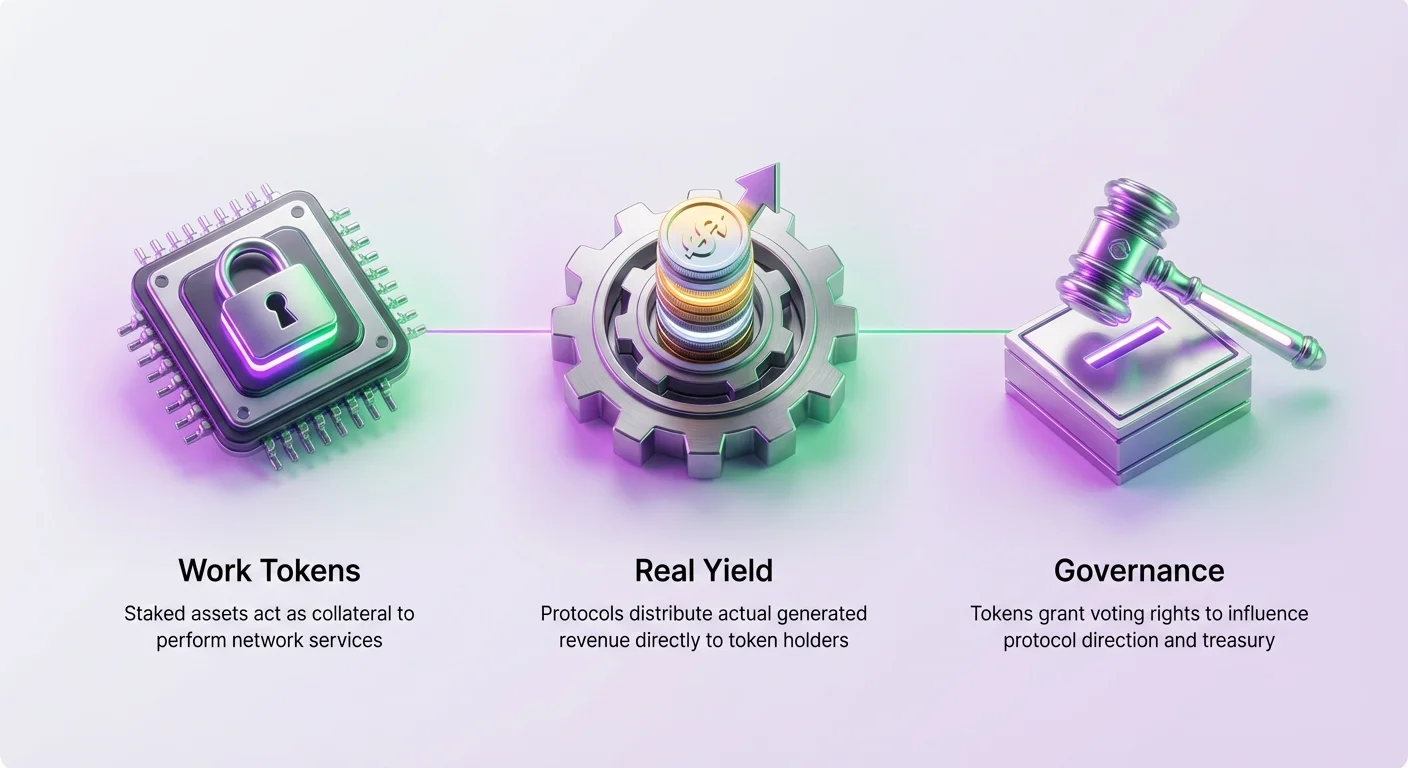
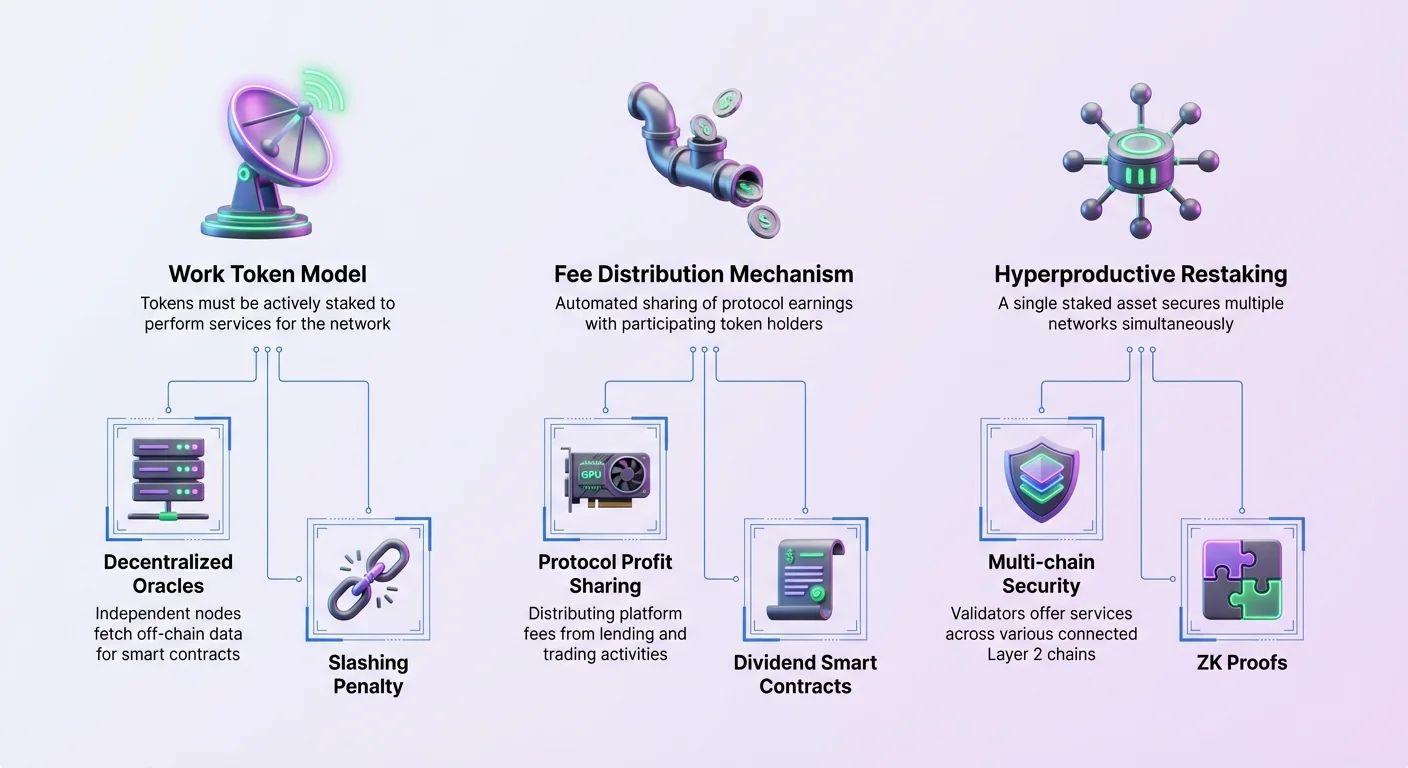
One of the most robust economic designs in the blockchain space is the work token model. In this system, the token serves as a form of collateral or licensure required to perform a service for the network. The asset does not just sit in a wallet. It must be actively staked or utilized to generate revenue. This creates a direct correlation between the growth of the network's utility and the demand for the token. As the demand for the service increases, service providers must acquire more tokens to capture that work.
Decentralized Oracle Networks
Chainlink provides the quintessential example of the work token model through its decentralized oracle network. Smart contracts on blockchains like Ethereum are isolated. They cannot access real-world data, such as stock prices or weather reports, on their own. Chainlink solves this by using independent nodes to fetch off-chain data. However, trusting a single node introduces a central point of failure. To mitigate this, the network employs a system where node operators stake LINK tokens to participate.
The staking mechanism acts as a security bond. If a node provides incorrect or malicious data, their staked tokens can be penalized or "slashed." This economic structure ensures that oracles have a financial incentive to stay honest and reliable. When a smart contract requests data, it pays fees to the node operators. The LINK token therefore acts as both the currency of payment and the collateral for network security. The value accrual comes from the necessity of the token to perform the work of data delivery.
Resource Allocation and Compute
The work token model also extends to physical infrastructure networks. NodeAI utilizes this framework to disrupt the cloud computing market. The platform connects high-demand AI applications with idle GPU power. In this ecosystem, the $GPU token facilitates the exchange of computational resources. Users who need processing power for tasks like training large language models (LLMs) or rendering 3D graphics pay for access.
Unlike traditional centralized cloud providers that hoard profits, this decentralized model distributes revenue to the participants providing the hardware. The token coordinates this marketplace. It ensures that those contributing valuable resources—such as H100 or A100 chips—are compensated. This creates a circular economy where the utility of the token is tied directly to the tangible output of computing power. The asset derives value from the actual industrial demand for artificial intelligence processing rather than speculation alone.
Fee Distribution and Real Yield
A major trend in modern tokenomics is the move toward "real yield." Early decentralized finance (DeFi) protocols often rewarded users by printing new tokens, leading to inflation that diluted value. Newer models focus on distributing actual protocol revenue to token holders. This approach mirrors traditional dividend-paying stocks but operates through automated smart contracts. It aligns the interests of the protocol and its community by sharing the financial success of the platform.
Protocol Profit Sharing
Yearn Finance exemplifies this shift toward revenue-based value accrual. Yearn operates as a yield aggregator, automatically moving user funds between different lending protocols to maximize returns. The protocol charges fees for this service. Instead of retaining all these fees in a centralized treasury, the system directs a portion of the profits to YFI token holders.
To participate in this value stream, holders typically engage in governance or staking. For instance, voting on protocol decisions might require locking tokens for a specific period. In return for this active governance participation, users earn a share of the protocol’s earnings. This creates a "dividend" mechanism where the yield comes from legitimate business activity—lending and trading fees—rather than inflationary emissions. The token effectively represents a claim on the future cash flows of the decentralized autonomous organization (DAO).
Staking for Ethereum Rewards
NodeAI takes revenue sharing a step further by distributing rewards in a highly liquid, external asset: Ethereum (ETH). The platform’s economic model allocates a significant percentage of revenue to stakers. Specifically, a portion of the fees generated from renting out GPU power is paid directly to those who stake the $GPU token.
This model is significant because it eliminates the sell pressure often associated with rewards paid in the native token. When a protocol pays rewards in its own token, recipients frequently sell it to realize profits, driving the price down. By distributing ETH, NodeAI allows stakers to earn hard assets while holding their position in the native token. This strengthens the long-term value proposition of the asset, as holding it becomes a productive activity generating unrelated, stable yield.
Hyperproductive Assets and Restaking
As blockchain architecture evolves from single chains to complex ecosystems, staking models are adapting to become more capital efficient. Traditional staking involves locking assets to secure a single network. New paradigms, such as those introduced by Polygon 2.0, are pioneering the concept of "hyperproductive" tokens. This evolution aims to solve the problem of fragmented liquidity and security across Layer 2 scaling solutions.
The Evolution of Polygon
Polygon began as a sidechain scaling solution for Ethereum, helping to reduce congestion and high gas fees. Its original token, MATIC, was used for standard Proof-of-Stake validation. However, as Polygon transitions to a network of Zero-Knowledge (ZK) powered Layer 2 chains, the economic role of the token is expanding. The introduction of the POL token represents a shift toward a third-generation asset class.
In this new architecture, the token is not limited to validating a single chain. Instead, it enables "restaking" across multiple chains within the ecosystem. Validators can stake POL to secure the main hub while simultaneously offering services to various connected Layer 2 networks. These services might include generating ZK proofs, sequencing transactions, or ensuring data availability.
Multiplying Utility
The "hyperproductive" designation stems from the ability of the token to earn rewards from multiple sources simultaneously. A single unit of capital—the staked POL—can perform multiple roles across the ecosystem. This creates a multiplier effect on the potential yield for validators. They are not just earning inflation rewards; they are collecting transaction fees from every chain they actively support.
This model significantly increases the demand for the token as the ecosystem grows. Every new chain that launches on the Polygon network represents a new stream of potential revenue for stakers. It aligns the security of the network with the economic incentives of the participants. The more useful the network becomes, the more valuable the staking position becomes, creating a positive feedback loop of security and value accrual.
Governance and Strategic Control
Governance tokens grant holders the right to influence the direction of a protocol. While often criticized for lacking direct financial utility, the power to control a massive decentralized treasury or change protocol parameters holds immense intrinsic value. This model relies on the premise that the ability to steer a project is a premium feature worth paying for. The design of governance rights varies significantly across projects, ranging from open transferable markets to restricted, non-transferable systems.
The Uniswap Approach
Uniswap is the largest decentralized exchange (DEX) by volume, utilizing an Automated Market Maker (AMM) model. The UNI token was launched to decentralize the protocol's stewardship. Holders of UNI can vote on critical proposals, including fee tier adjustments, expansion to new blockchains like Arbitrum or Optimism, and the allocation of the project’s massive treasury.
While UNI does not currently pay a direct fee switch to holders, the governance power dictates the future of the protocol. This includes the potential to turn on a fee switch in the future, which would direct trading fees to token holders. The value of the token is partially derived from this option value—the possibility that the governance body will eventually vote to distribute revenue. Furthermore, the launch of Uniswap v4 and Unichain demonstrates how governance steers technical innovation, influencing market efficiency and adoption.
Non-Transferable Governance
World Liberty Financial (WLF) introduces a distinct variation of the governance model. The platform, associated with high-profile political figures, aims to promote stablecoin adoption and DeFi lending. Its native token, WLFI, serves strictly as a governance instrument. Crucially, the token is non-transferable and cannot be sold or traded for profit. It does not confer economic rights like dividends.
This governance-only model is a radical departure from standard crypto economics. It removes the speculative premium entirely. The value of the token exists solely in its utility for decision-making. This ensures that only participants genuinely interested in the long-term management of the protocol acquire the token. By preventing the token from being traded, the project aims to align incentives strictly around governance quality rather than price appreciation.
Liquidity Incentives and Ecosystem Growth
Decentralized exchanges and financial protocols live and die by their liquidity. Without sufficient assets in the pools, traders experience high slippage and poor execution. To solve this, protocols use tokens to incentivize users to deposit their assets. This practice, known as liquidity mining or yield farming, distributes tokens to users who act as market makers.
The AMM Economic Engine
In the Uniswap model, users deposit pairs of tokens (e.g., USDC and ETH) into smart contracts. These liquidity providers (LPs) earn trading fees whenever a user swaps against their pool. The AMM formula ($x * y = k$) ensures continuous liquidity but exposes LPs to risks like impermanent loss. To compensate for this risk, many platforms distribute additional governance or utility tokens to LPs.
This creates a symbiotic relationship. The protocol needs liquidity to function. The users provide liquidity in exchange for fees and token rewards. The token becomes the primary tool for renting liquidity from the market. While Uniswap itself stopped native liquidity mining years ago, the model remains the industry standard for bootstrapping new marketplaces.
Ecosystem Retention
Verse, the rewards and utility token for the Bitcoin.com ecosystem, utilizes this model to drive engagement. Users can provide liquidity to the Verse DEX to earn yield. Beyond simple trading fees, the token functions as a loyalty mechanism. It encourages users to stay within the ecosystem by offering rewards for staking, trading, and interacting with various decentralized applications (dApps).
By integrating the token into a broader suite of products—from wallets to payment services—the protocol creates multiple demand sinks. Users accumulate the token through engagement and then redeploy it to earn further yield or access exclusive features. This velocity of money within a closed-loop ecosystem helps sustain the token's value by ensuring it is constantly being used, staked, or earned rather than just sold.
| Economic Model | Primary Utility | Value Accrual Mechanism | Example Asset |
|---|---|---|---|
| Work Token | Service Collateral | Staking to perform work and earn fees | Chainlink (LINK) |
| Real Yield | Profit Sharing | Distribution of protocol revenue to holders | NodeAI ($GPU) |
| Governance | Voting Power | Control over treasury and protocol upgrades | Uniswap (UNI) |
| Hyperproductive | Multi-chain Security | Restaking across connected networks | Polygon (POL) |
Conclusion
The landscape of utility token economics has shifted from simple speculation to sophisticated value capture mechanisms. Early models relied heavily on the promise of future utility, often without a clear path to sustainability. The current generation of tokens, however, integrates deeply into the operational fabric of their respective protocols. Whether through ensuring data integrity, incentivizing liquidity, or securing multiple blockchain layers, these assets are engineered to perform specific, vital functions.
Understanding the differences between these models is crucial for assessing the long-term viability of a project. A work token like LINK requires a different analytical framework than a governance token like UNI or a revenue-sharing asset like $GPU. The former relies on the demand for oracle services, while the latter depends on the profitability of the underlying infrastructure. As the industry matures, we can expect these models to converge and evolve, creating even more complex hybrids that prioritize efficiency and real-world alignment.
True utility is found where a token is not just a product to be sold, but a necessary tool required to keep a digital economy running.