
The rise of decentralized gaming has fundamentally shifted how players interact with virtual worlds. In traditional gaming, assets like skins or currency exist solely on a company's central server. If that server shuts down, the assets vanish. Web3 gaming alters this dynamic by using blockchain technology to give players true ownership of digital items. These items live in a cryptocurrency wallet rather than a game database. This shift places the responsibility of security and asset management directly onto the player.
Choosing the right wallet is critical for this ecosystem. It serves as your login credential, your bank account, and your inventory management system all at once. Because modern games require rapid interactions, such as buying items or trading characters instantly, the wallet must handle high transaction volumes without significant delays or exorbitant fees.
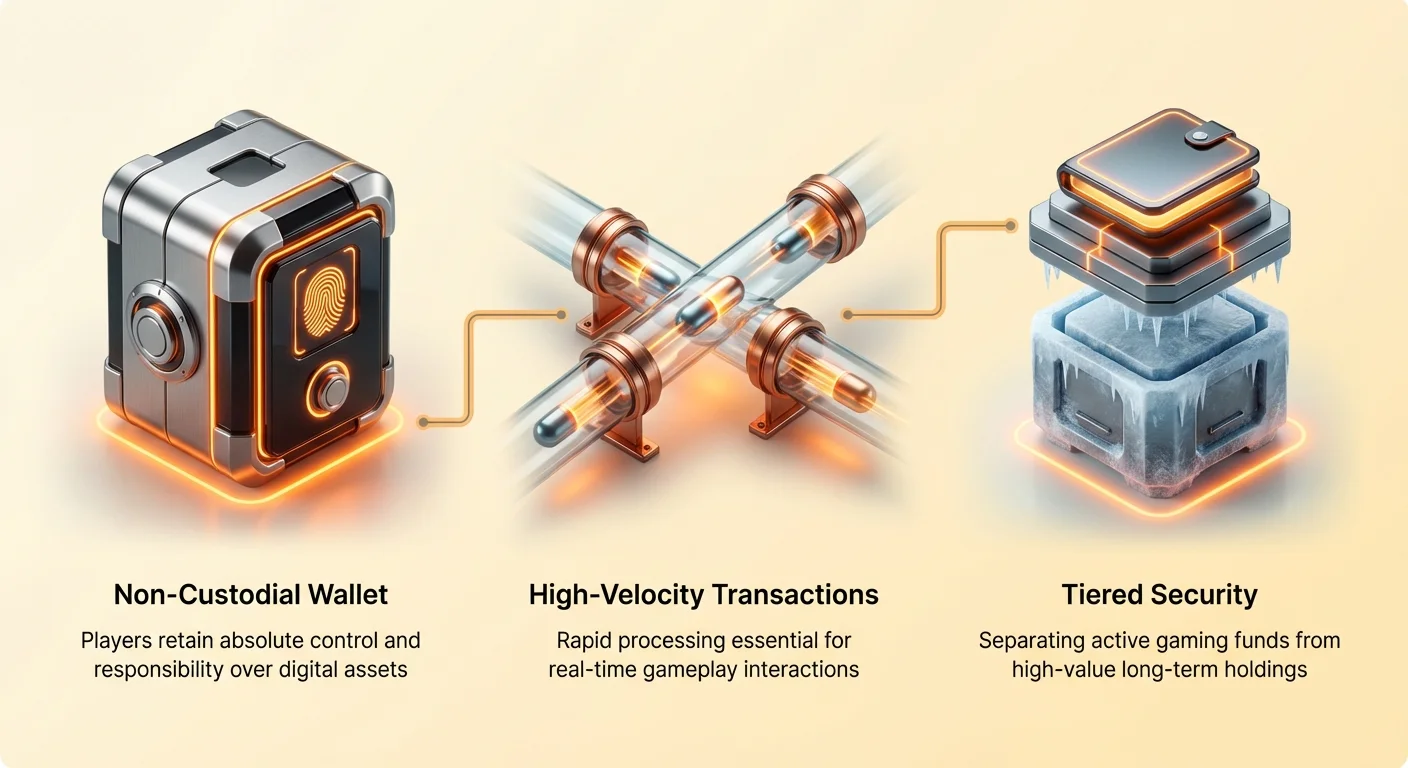
Security becomes paramount when dealing with high-volume gaming wallets. Unlike a simple storage wallet that might sit dormant for months, a gaming wallet interacts with third-party applications frequently. Every time a player connects to a game or signs a transaction, there is a potential vector for exposure. Balancing the need for speed and frequent connectivity with rigorous security protocols is the primary challenge for players in this space.
The Mechanics of Browser Extension Wallets in Gaming
Seamless DApp Integration
Browser extension wallets act as a bridge between a standard web browser and the blockchain. When a player visits a Web3 game, the extension injects code into the website that allows the game to recognize the user's account. This eliminates the need to create a new username and password for every single game. The wallet address itself becomes the universal identity. This integration is essential for games that run directly in browsers, allowing for instant retrieval of character data and inventory items stored on the chain.
Managing Transaction Signatures
In a gaming environment, players often perform dozens of actions in a single session. Browser extensions streamline this by popping up signature requests only when necessary. For high-volume games, some wallets offer "auto-approve" features for specific contracts or small transactions to prevent gameplay interruption. However, users must remain vigilant. The ease of clicking "confirm" can lead to accidental approval of malicious contracts if the game site is compromised or if the user lands on a phishing site mimicking a popular game.
Local Encryption and Private Keys
Despite running in a browser, these wallets do not store private keys on the internet. The keys are encrypted locally on the device. When a game requests a transaction, the signing happens on the user's computer, and only the signed result is broadcast to the network. This ensures that the private key is never exposed to the game developers or the web servers. This architecture is vital for maintaining security while allowing the frequent, fast-paced interactions required by modern strategy and role-playing games.
Mobile Wallets for On-the-Go Asset Management
Mobile wallets have evolved from simple storage apps into powerful interfaces for the decentralized web. For gamers, mobile wallets provide the flexibility to manage assets without being tethered to a desktop computer. These applications often utilize the secure enclave of a smartphone, adding a layer of hardware-level security to the software. This is particularly useful for trading in-game items or claiming rewards while away from the main gaming rig.
The user interface of mobile wallets is designed for efficiency. Features like biometric authentication allow players to sign transactions using a fingerprint or face scan, which is significantly faster than typing a complex password. This speed is crucial during time-sensitive in-game events or marketplace drops where seconds determine success. Furthermore, many mobile wallets now support the same dApp connectivity as browser extensions, using an internal browser to render game interfaces directly within the secure wallet app.
Synchronization is another key benefit. Many players use the same wallet address across both desktop and mobile devices. By importing the seed phrase into a mobile app, a player can monitor their high-value gaming NFTs and token balances in real time. This dual-access approach ensures that if a desktop device is compromised or fails, the player retains immediate access to their funds and inventory through their smartphone backup.
High-Volume Transaction Solutions and Scalability
The Role of Layer 2 Networks
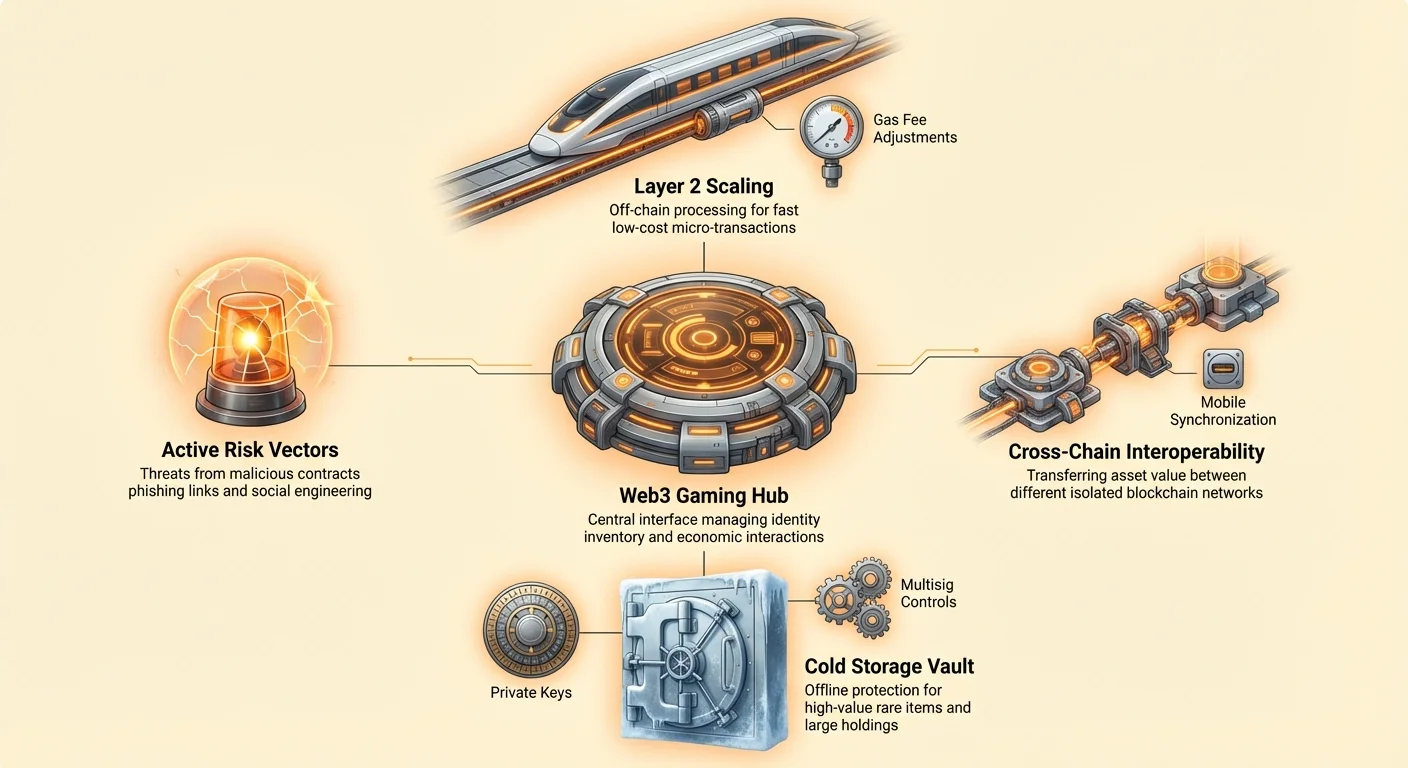
Mainstream blockchains like Ethereum often suffer from congestion, leading to slow speeds and high costs that are unsuitable for gaming. A single move in a game cannot cost $10 in gas fees. To solve this, many gaming ecosystems utilize Layer 2 scaling solutions or sidechains like Polygon. These networks process transactions off the main chain, bundling them together to reduce costs drastically. Wallets integrated with these networks allow gamers to perform hundreds of micro-transactions—such as picking up loot or upgrading armor—for fractions of a cent.
Lightning Network for Bitcoin Gaming
For games built on the Bitcoin network, the Lightning Network provides a similar solution. It is a second-layer protocol that enables instant, high-volume micro-transactions. Without Lightning, Bitcoin transactions would take too long to confirm for real-time gameplay. Lightning wallets open payment channels that allow value to stream back and forth instantly. This capability allows for innovative gaming mechanics, such as streaming satoshis (tiny fractions of Bitcoin) to a player for every second they stay alive in a game or every enemy they defeat.
Managing Throughput and Latency
High-volume gaming requires wallets that can handle rapid-fire requests without crashing or desyncing. Specialized gaming wallets prioritize connection stability with Remote Procedure Call (RPC) nodes. An RPC node is the communication point between the wallet and the blockchain. If the node is slow, the game lags. Advanced wallets allow users to switch between different nodes or use custom endpoints to ensure that their transaction data is broadcast immediately, providing a competitive edge in fast-paced economic games.
Asset Bridges and Multi-Chain Interoperability
The modern Web3 gaming landscape is fragmented across various blockchain networks. One game might run on Solana due to its high speed, while another runs on Ethereum for its security. Asset bridges are the infrastructure that allows players to move value between these isolated networks. A player might earn tokens in a Solana-based racing game but want to use that value to buy a sword in an Ethereum-based RPG.
Wallets with integrated bridging features simplify this complex process. Instead of visiting a risky third-party website to swap tokens, users can execute cross-chain transfers directly within the wallet interface. This reduces the risk of clicking on phishing links or copying the wrong contract address. The wallet handles the technical heavy lifting, interacting with the bridge smart contracts to lock assets on one chain and mint the equivalent representation on the destination chain.
This interoperability extends to NFTs as well. While bridging non-fungible tokens is more complex than bridging currency, advanced wallets are beginning to support this functionality. This capability is essential for the vision of the "metaverse," where a digital item is not stuck in one game but can be transported and utilized across different virtual environments. Multi-chain wallets serve as the passport for this travel, holding disparate assets from various chains in a single, unified view.
Security Risks in High-Interaction Environments
| Security Threat | Description | Prevention Strategy |
|---|---|---|
| Malicious Contracts | Code that drains wallets upon approval | Use audits and limit allowances |
| Phishing Links | Fake game sites stealing keys | Bookmark official URLs strictly |
| Clipboard Hijacking | Malware swapping addresses on paste | Verify first/last 4 chars before send |
Connecting a wallet to a game requires granting permissions. A common scam involves a game asking for permission to spend an unlimited amount of a specific token. If the game's contract is malicious or gets hacked, the attacker can drain all approved tokens from the user's wallet without further authorization. Gamers must be disciplined about revoking these permissions regularly. Tools exist within wallet interfaces to review and remove access for old games that are no longer being played.
Another significant risk is the social engineering prevalent in gaming communities. Scammers often pose as support staff or developers in Discord channels, sending links that look legitimate but lead to wallet-draining scripts. Because gamers are used to clicking links for drops or updates, they are high-value targets. A dedicated gaming wallet should never hold a user's life savings. It is best practice to treat a gaming wallet as a "hot wallet" carrying only what is needed for the session.
The Cold Storage Strategy for High-Value Assets
Segregating Asset Tiers
Serious collectors often hold gaming assets worth thousands of dollars. Keeping these items in a browser extension or mobile wallet that connects to game servers daily is reckless. The superior strategy is to use a cold storage solution, such as a hardware wallet or a paper wallet, for high-value items. These wallets remain offline and are never directly connected to a game's smart contract. The player transfers only the necessary items to their "hot" gaming wallet when they intend to use or sell them.
Generating Offline Keys
For the ultimate security, players can generate keys on a device that has never touched the internet. This process, often used for creating paper wallets, involves downloading the generator software, disconnecting the computer from the network, and then creating the keys. This ensures that no malware or keylogger could have intercepted the private key during generation. While this method is less convenient for daily trading, it provides a fortress-like vault for rare skins, land parcels, or large amounts of game currency that are being held for the long term.
The Role of Multi-Signature Wallets
Guilds and gaming clans often pool resources to purchase expensive assets like virtual land or capital ships. A standard wallet gives one person total control, which creates a risk of theft. Multi-signature (multisig) wallets solve this by requiring multiple approvals for any transaction. For example, a guild treasury might require three out of five officers to sign a transaction before funds can be moved. This structure is critical for the organizational side of Web3 gaming, ensuring that no single bad actor can drain the group's collective resources.
Understanding Non-Custodial Control
The defining feature of Web3 gaming wallets is their non-custodial nature. In a custodial setup, like a traditional crypto exchange or a standard bank, a third party holds the keys and controls the funds. If that third party freezes the account, the user loses access. In non-custodial wallets, the user is the sole custodian. This means the game developer cannot confiscate items, ban a player from accessing their own inventory, or reverse a trade.
However, this freedom comes with total responsibility. If a player loses their seed phrase—the master password for the wallet—there is no "forgot password" button. The assets are lost forever. This reality necessitates a robust backup strategy. Players must write down their recovery phrases on physical media, such as paper or metal plates, and store them in secure locations. Digital storage of seed phrases (like screenshots or cloud notes) is highly discouraged due to the risk of cloud hacks.
This self-sovereignty is what enables the "play-to-earn" and open economy models of Web3. Because the assets are truly owned by the player, they can be sold on secondary markets that the game developer does not control. The wallet facilitates this by adhering to open standards. Any marketplace that supports the standard can display and trade the items, decoupling the in-game economy from the game's proprietary interface.
Advanced Features for Power Users
Customizing Gas Fees
In competitive gaming moments, such as a race to mint a limited-edition item, network congestion can cause transactions to fail. Advanced wallets allow users to manually adjust the "gas" or network fee they are willing to pay. By paying a higher fee, a player encourages miners or validators to prioritize their transaction over others. Mastering this mechanic is often the difference between securing a rare drop and missing out entirely.
Managing Multiple Identities
Privacy is a concern for many gamers who do not want their entire financial history linked to their gaming profile. Wallets allow for the creation of an infinite number of public addresses derived from a single seed phrase. A player can generate a fresh address for every new game they play. This segregates activities, making it difficult for on-chain analysts to build a complete profile of the user's net worth or gaming habits. This feature also adds a layer of security; if one specific game address is compromised via a bad contract allowance, the other addresses remain safe.
Integrated Swap Aggregators
Modern wallets often include built-in decentralized exchange (DEX) aggregators. This feature scans multiple liquidity sources to find the best price for a token swap. For a gamer who just earned a specific game token and wants to convert it to a stablecoin (like USDT or USDC) to lock in profits, this can be done instantly within the wallet. This removes the need to send funds to an external exchange, reducing the number of steps and potential points of failure in the transaction process.
Conclusion
Web3 gaming wallets represent the intersection of entertainment and finance, demanding a unique balance of accessibility and rigorous defense. As games move entirely on-chain, the wallet acts as the primary interface for identity, inventory, and economic interaction. The ability to handle high-volume transactions through Layer 2 solutions and Lightning networks is essential for maintaining the fluid experience gamers expect. Without these scaling technologies, the friction of blockchain latency would make modern gameplay impossible.
Furthermore, the integration of asset bridges and multi-chain support acknowledges the fragmented reality of the current ecosystem. Players are no longer confined to a single walled garden; they operate across a sprawling metaverse of interconnected networks. However, this freedom amplifies security risks. Adopting a tiered security strategy—using hot wallets for active play and cold storage for high-value holdings—is the only viable path for long-term asset protection.
Ultimately, the power of decentralized gaming lies in ownership. Non-custodial wallets ensure that the time and effort invested in virtual worlds translate into tangible, sovereign assets. As the technology matures, wallets will likely become even more invisible, automating the complexities of bridges and gas fees while preserving the core tenet of user control. Mastering these tools is the first step for any player looking to participate in the future of digital economies.
Treat your gaming wallet like cash in your pocket and your cold storage like a bank vault.