
Digital asset security is a fundamental concept for anyone interacting with the blockchain ecosystem. It refers to the specific measures and practices used to safeguard cryptocurrencies, digital documents, and multimedia from unauthorized access or loss. Unlike traditional banking where a financial institution guards your funds, the world of crypto operates on a peer-to-peer basis. This structure means you can send value anywhere in the world without asking for permission.
However, this freedom brings a significant shift in responsibility. You alone are often responsible for protecting your assets. If you lose the access mechanism to your funds, there is no customer support line that can restore them for you. This reality makes understanding the different wallet archetypes essential for every user.
A cryptocurrency wallet is not a storage container for digital coins in the way a physical wallet holds cash. Instead, it functions more like a keychain. A Bitcoin wallet is a device or program used to send and receive bitcoins. It manages the necessary credentials that allow you to move funds on the blockchain.
The Debit Card Analogy
To understand how this works, consider the debit card currently in your pocket. The card itself is not money. Instead, it is a tool that grants you access to money held in a bank account. It contains information like an account number and a password or PIN that verifies your identity.
Crypto wallets function similarly. They hold the "account" information needed to access value on the digital ledger. The primary difference lies in control. A debit card is controlled by a centralized entity, such as a bank, which can freeze the account or deny a transaction. Bitcoin wallets interact with a network that no single person or organization controls.
The Mechanics of Ownership
At the core of every wallet model lies the concept of keys. These cryptographic tools are what differentiate a viewer of the blockchain from an owner of assets on the blockchain. Understanding private keys is the first step in evaluating whether a custodial, self-custody, or shared model fits your needs.
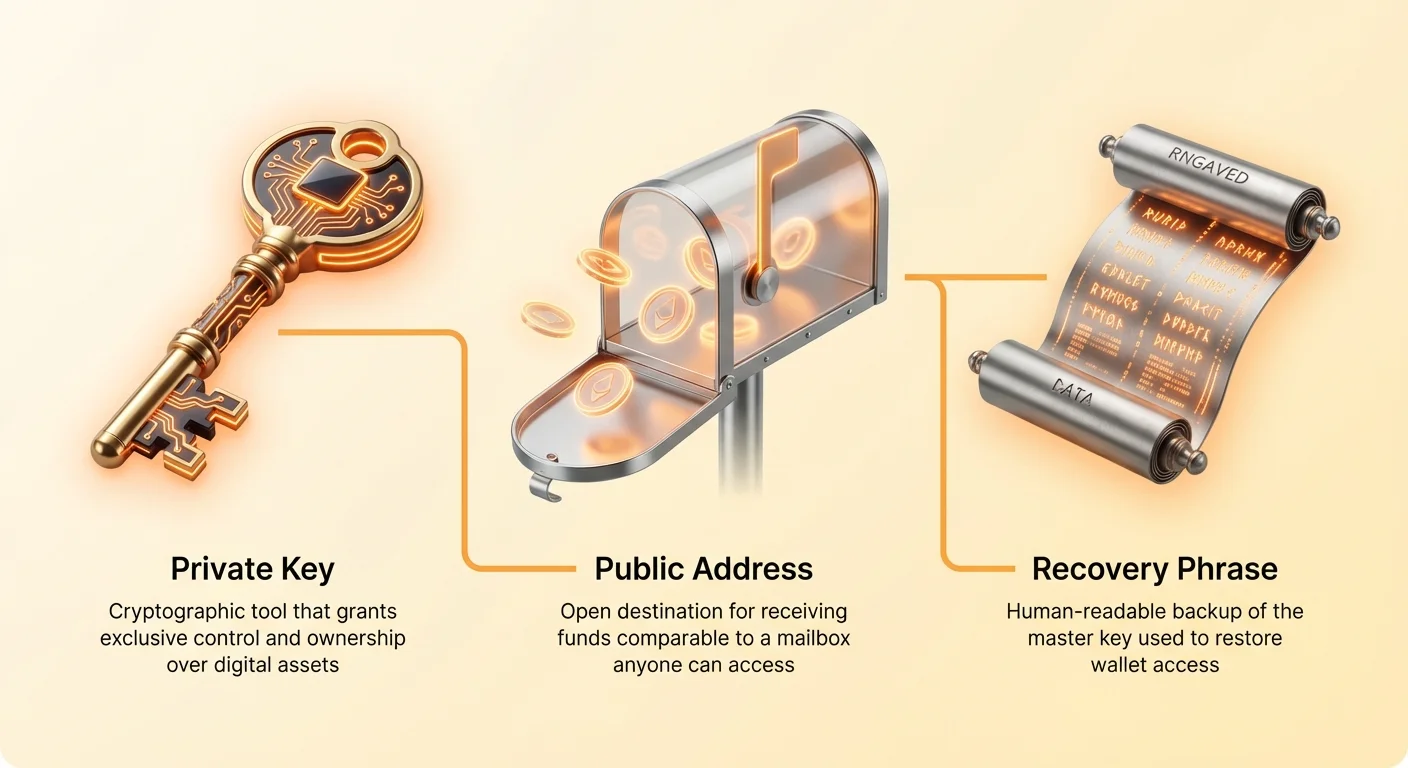
A private key is a randomly created string of characters, often a 256-bit secret number. It acts as the super-secret password to your cryptocurrency address. Every public location on the blockchain has a matching private key. If you lose this key, you lose the ability to move the assets tied to that address.
Public vs Private Keys
The relationship between public and private keys is often compared to a mailbox. The public key, or address, is like the mailbox itself. Anyone can see it, and anyone can drop mail (crypto) into it. You can share this address freely without compromising security.
The private key is the physical key that opens the mailbox box. Only the person holding this key can retrieve the contents and send them elsewhere. In technical terms, the wallet uses the private key to create a digital signature. This signature proves you own the funds and authorizes the transaction, which the network then validates.
The Recovery Phrase
Because raw private keys are long strings of hexadecimal characters, they are unwieldy and prone to human error during transcription. To solve this, modern wallets use a recovery phrase, also known as a seed phrase or secret passphrase. This is a list of words, usually between 12 and 24, drawn from a specific dictionary.
This phrase allows you to reconstruct your wallet and gain access to your funds even if your hardware device is destroyed or your phone is lost. It is a human-readable format of your master private key. Anyone with these words can access your funds, so they must be guarded as strictly as the private key itself.
Archetype 1: Custodial Wallets
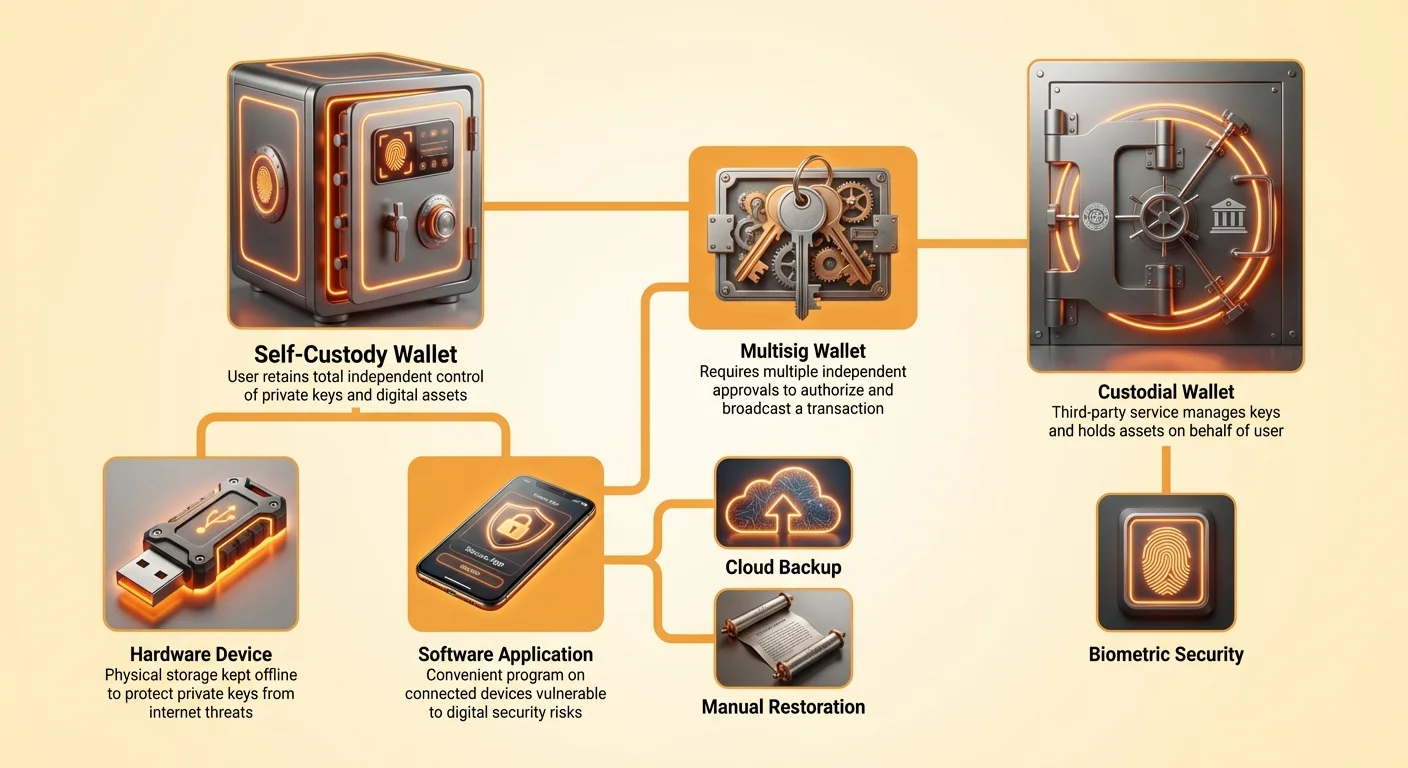
The custodial model is the most familiar to people coming from the traditional financial system. In this archetype, a third party retains custody of your assets on your behalf. This is standard practice for banks and many centralized cryptocurrency exchanges.
When you use a custodial wallet, you do not hold the private keys. Instead, you have a login and password for a platform that holds the keys. When you want to make a withdrawal or a trade, you are technically asking the platform for permission to move the funds.
The Risks of Third-Party Control
While custodial wallets offer convenience, they introduce significant third-party risk. Since you are not in full control, you are exposed to the stability and integrity of the service provider. If the exchange or platform goes bankrupt, you may lose access to your cryptoassets. Recovery processes in these scenarios are often drawn out over years and rarely result in full compensation.
There is also the risk of regulatory interference. Because taking custody of financial assets is a regulated activity, centralized exchanges are subject to the laws of the jurisdictions where they operate. A government could force a platform to restrict withdrawals or freeze accounts. This has historical precedence in the traditional banking sector, such as when banks restricted withdrawals in Greece in 2015.
Operational Limitations
Custodial wallets often impose operational friction that self-custody models do not. You may encounter withdrawal limits or processing delays. The exchange might charge extra fees to move your own money off their platform. In rare cases, they may prevent withdrawals altogether during periods of high market volatility.
Additionally, these platforms are high-value targets for hackers. While security has improved, centralized databases of private keys remain a single point of failure. If a custodial platform is breached, user funds can be stolen en masse. Unlike bank deposits in some regions, these crypto deposits are generally not insured by the government.
Archetype 2: Self-Custody Models
The self-custodial model, often called non-custodial, represents the original ethos of cryptocurrency. In this archetype, the user retains total control of their digital assets at all times. The software provider acts merely as an interface for managing the keys, but they never have access to the keys themselves.
When you use a self-custodial wallet, you do not need to ask for permission to use your funds. There is usually no account approval process. Anyone can download the software and generate a new address immediately. This permissionless nature ensures that no government or corporation can prevent you from transacting.
Direct Blockchain Interaction
Self-custodial wallets provide direct access to public blockchains. This connectivity allows for features that custodial accounts often lack. For example, users can customize the network fees they pay to miners and validators. You can choose to pay a higher fee for a faster transaction or a lower fee if you are not in a rush.
Furthermore, holding your own keys enables interaction with smart contracts and decentralized applications (dApps). This opens the door to decentralized finance (DeFi) products. Users can earn passive income, trade on decentralized exchanges, or borrow against their assets without an intermediary.
The Responsibility of Being Your Own Bank
The trade-off for this autonomy is responsibility. In a self-custodial model, if you lose your private key or recovery phrase, your funds are gone forever. There is no password reset button that a company can press for you.
This model requires users to be diligent about backups. You must record your recovery phrase and store it securely, often on paper in a physical location. If your phone breaks or you delete the app, that backup is the only way to restore access.
| Feature | Custodial Wallet | Self-Custody Wallet |
|---|---|---|
| Control of Funds | Third-party | User only |
| Private Key Access | Held by provider | Held by user |
| Transaction Type | Permissioned | Permissionless |
Archetype 3: Shared Control (Multisig and MPC)
Between the extremes of sole custody and third-party custody lies the shared control model. This often takes the form of a multisig (multi-signature) wallet. A multisig wallet requires more than one person or device to approve a transaction before it is broadcast to the network.
In this setup, you decide how many participants the wallet has and how many signatures are required to move funds. A common configuration is a "2 of 3" or "3 of 6" wallet. For example, in a "3 of 6" wallet, there are six participants, but at least three must approve any spending request.
Security Through Collaboration
Multisig wallets are excellent for improving security. A family could set up a wallet where two out of three members must sign a transaction. This protects the funds if one person loses their private key, as the other two can still access the assets. It also provides protection against theft or coercion.
If a thief forces one person to sign a transaction, the funds cannot move because the other signatures are missing. This structure is also widely used for organizational treasuries. A company can ensure that no single board member can drain the corporate funds. Instead, a consensus of board members is required to authorize expenses.
Multi-Party Computation (MPC)
Related to the concept of multisig is Multi-Party Computation (MPC). While traditional multisig uses distinct private keys for each participant, MPC splits a single private key into multiple shards. These shards are distributed among different parties or devices.
Related to the concept of multisig is Multi-Party Computation (MPC). While traditional multisig uses distinct private keys for each participant, MPC splits a single private key into multiple shards. These shards are distributed among different parties or devices.
Hardware vs. Software Implementations
Regardless of whether you choose self-custody or a shared model, you must decide on the physical form of your wallet. The two main categories are hardware wallets and software wallets. Each offers a different balance of security and convenience.
Hardware Wallets
Hardware wallets are physical devices that store private keys offline. They are considered the most secure type of storage because the keys theoretically cannot be accessed by the internet. When a user wishes to make a transaction, they plug the device into a computer, usually via USB.
Hardware wallets are physical devices that store private keys offline. They are considered the most secure type of storage because the keys theoretically cannot be accessed by the internet. When a user wishes to make a transaction, they plug the device into a computer, usually via USB.
Software Wallets
Software wallets exist as applications on desktop computers, smartphones, or web browsers. They are convenient for everyday use and allow for quick access to funds. However, because they run on devices connected to the internet, they are susceptible to viruses and phishing schemes.
While hacking incidents are rare for individual users who practice good hygiene, software wallets are inherently more vulnerable than cold storage. To mitigate this, users should employ strong passwords and biometric locks. Many software wallets are now integrating with hardware devices to offer the best of both worlds.
Backup and Restoration Strategies
The most critical aspect of self-custody is the backup process. If your digital device fails, your backup is the only lifeline to your assets. Historically, this meant writing down 12 to 24 words on a piece of paper. While secure from digital hackers, paper backups are vulnerable to fire, water, and physical theft.
Storing a piece of paper safely can be difficult. Furthermore, managing multiple wallets means managing multiple lists of words. If you have separate wallets for Bitcoin, Ethereum, and other chains, the burden of physical document management increases significantly.
Cloud Backup Solutions
To address the friction of manual backups, modern wallets have introduced automated cloud backup services. This system allows you to create a single custom password that decrypts a file stored in a cloud service like Google Drive or Apple iCloud.
This method combines the security of encryption with the convenience of cloud storage. The cloud provider hosts the encrypted file, but they cannot read it because they do not have your decryption password. If you lose your device, you simply reinstall the app, log in to your cloud account, and enter your custom password.
Manual Restoration
For those who prefer to avoid cloud services, manual restoration remains a viable option. This involves entering the 12-word recovery phrase directly into a new wallet instance. When entering these words, they must be lowercase and separated by single spaces.
This process works across different wallet software, provided they use the same industry standards. If you generated a seed phrase on one self-custody app, you can typically import that same phrase into a different hardware or software wallet to regain access to your funds.
Security Best Practices
Regardless of the wallet archetype you choose, adhering to security best practices is non-negotiable. The first rule is to never store passwords or seed phrases in digital form without encryption. Taking a screenshot or a digital photo of your handwritten seed phrase opens you up to theft if your gallery is compromised.
For most people, physically writing down the phrase and storing it in a secure place is the best strategy for manual backups. If the assets are of significant value, it is wise to make copies of the paper backup and store them in separate secure locations. This protects against local disasters like a house fire.
Password Management
If you use a software wallet, ensure you use a strong, unique password. Do not reuse passwords from other sites. Enabling two-factor authentication (2FA) on any associated cloud accounts adds a necessary layer of protection.
When using the cloud backup service, the master password you create acts as the final barrier. An attacker would need access to your Google or Apple account and your decryption password to steal your funds. This multi-layered approach makes unauthorized access extremely difficult.
How to Choose the Right Wallet
Choosing the best Bitcoin or crypto wallet depends on your specific needs. Security should be the primary factor. Look for wallets that integrate facial or fingerprint recognition. This makes daily access easy while maintaining a high barrier to entry for thieves.
Reputation is another vital metric. Since wallets are software, they can contain bugs or malicious code. It is important to use wallets that have been around for years and have active user bases. Checking forums and app store reviews can provide insight into the reliability of the software.
Fee Customization and Features
Advanced users should look for wallets that allow fee customization. Being able to set the exact byte/satoshi rate for Bitcoin or gas price for Ethereum can save significant money over time. Presets like "fast," "medium," and "slow" are useful features for general users.
Consider whether you need a multichain wallet. If you hold various assets like Bitcoin, Ethereum, and Solana, using a single app that supports all of them simplifies management. Features like unlimited wallet creation allow you to organize funds into "spending" and "savings" categories within the same app.
Conclusion
The landscape of digital asset security is defined by the choice between convenience and control. Custodial wallets offer a familiar, bank-like experience where a third party manages the technical complexities for you. However, this comes at the cost of censorship resistance and introduces the risk of platform insolvency. For those who prioritize ease of use over ownership, this model may suffice, but it contradicts the core philosophy of cryptocurrency.
Self-custody models restore the power of ownership to the individual. By holding your own private keys, you eliminate reliance on intermediaries and gain direct access to the global blockchain economy. While this requires greater personal responsibility regarding backups and security hygiene, it ensures that your assets remain truly yours. Innovations like cloud backups have significantly lowered the barrier to entry for this model, making self-custody more accessible than ever.
Shared control models, such as multisig and MPC, offer a middle ground that enhances security for groups and high-net-worth individuals. By requiring multiple approvals for transactions, these archetypes eliminate single points of failure. Ultimately, the right choice depends on your technical comfort, the value of your assets, and your need for collaborative control.
The most secure wallet is one where you control the keys and possess a verified, offline backup.