
Bitcoin mining is often misunderstood as simply a way to generate digital currency, similar to printing money. While the creation of new coins is a key outcome, the primary function of mining is to provide a critical service to the decentralized network. Miners act as the auditors and security guards of the blockchain ecosystem. They validate transactions, secure the historical ledger against tampering, and maintain the steady heartbeat of the network.
This service is not performed out of altruism. The protocol is designed with a sophisticated incentive structure that aligns the self-interest of the miner with the health of the network. By expending resources to secure the chain, miners are compensated with digital assets. This relationship forms the backbone of the entire economic model, ensuring that the system remains robust without a central authority.
The incentives for providing this mining service come in two distinct forms: block rewards and transaction fees. Together, these revenue streams motivate participants to deploy massive amounts of computational power. This power, known as hashrate, protects the network from attacks and ensures that transactions are processed irreversibly. Understanding how these incentives function requires looking beneath the surface of the hardware and energy consumption involved.
The Mechanism of Proof of Work
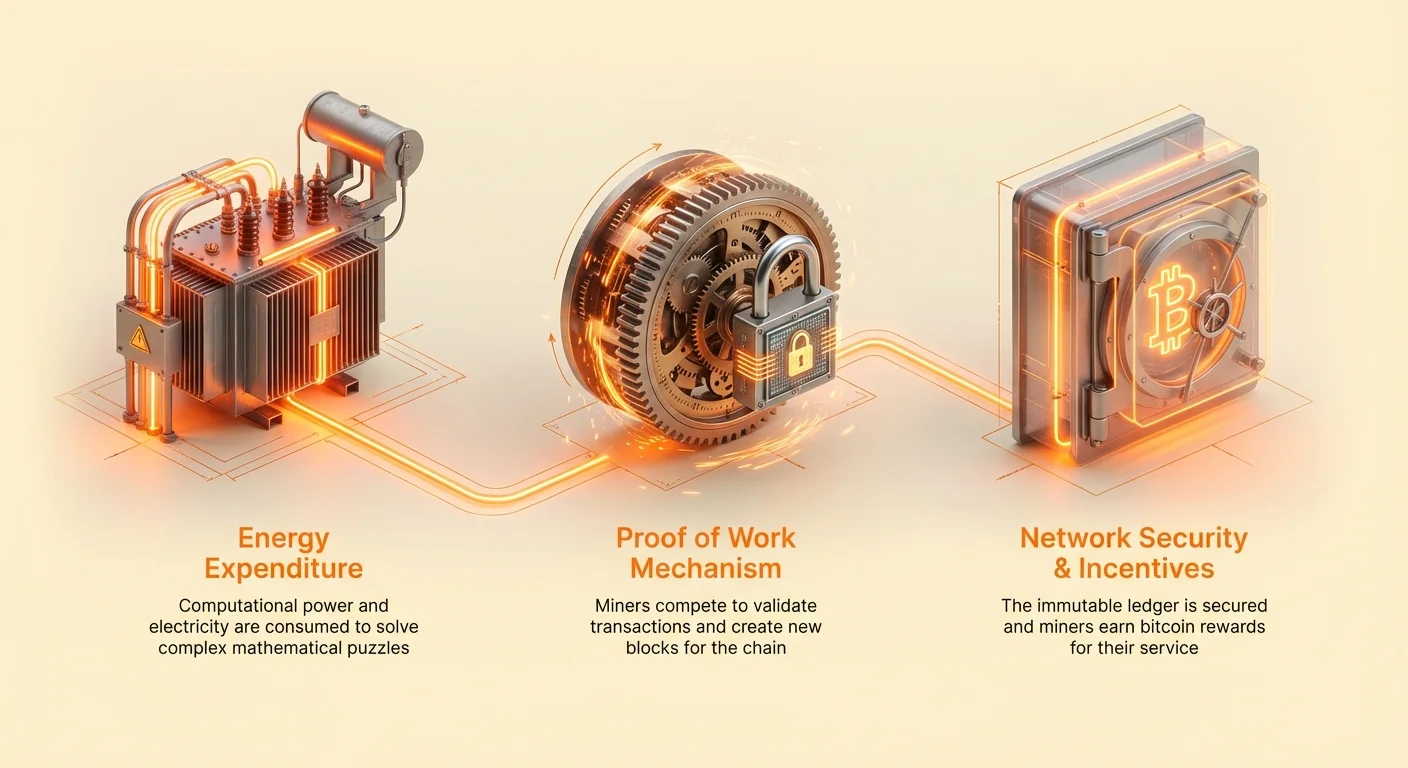
At the core of the mining service is the consensus mechanism known as Proof of Work (PoW). This system requires miners to solve complex mathematical puzzles to earn the right to add the next block of transactions to the blockchain. The "work" refers to the expenditure of energy and computational cycles. This requirement is not arbitrary; it creates a physical cost to participate in the network.
The puzzle involves finding a specific number, called a nonce, that produces a hash result meeting the network's difficulty target. This process is akin to a global lottery where having more powerful hardware allows a miner to buy more tickets. The miner who finds the solution first broadcasts it to the network. Other participants can easily verify the solution, proving that the necessary work was performed.
By tying digital record-keeping to physical energy expenditure, the protocol ensures security. To alter historical records, an attacker would need to redo the work for all subsequent blocks, a task that becomes exponentially more expensive as the chain grows. This thermodynamic barrier protects the ledger from manipulation and fraud.
Sybil Resistance and Decentralization
Proof of Work serves a vital role in preventing Sybil attacks. In a Sybil attack, a malicious actor creates multiple fake identities to gain disproportionate influence over a network. In traditional digital systems, creating a new identity is often cheap or free. However, in a PoW system, influence is not determined by the number of accounts or IP addresses a user controls.
Instead, influence is strictly tied to computational power. To gain 51% control of the network, an attacker cannot simply create millions of fake nodes. They must acquire and power 51% of the global mining hardware. This physical, economic barrier makes such attacks prohibitively expensive and logistically difficult to execute.
This structure promotes decentralization by ensuring that no single entity can easily dominate the verification process. While mining pools have concentrated some power, the underlying requirement for physical hardware and electricity prevents the kind of centralized control seen in traditional financial databases.
The Economics of Block Rewards
The primary incentive for miners is the block reward. This is the amount of newly minted bitcoin granted to the miner who successfully solves the mathematical puzzle and adds a new block to the chain. This reward serves as the distribution mechanism for the currency, releasing new supply into circulation at a predictable rate.
When the network launched, the block reward was set at 50 bitcoins per block. This generous initial subsidy was necessary to bootstrap the network. It encouraged early adopters to commit resources to mining when the asset had little to no market value. Without this substantial reward, there would have been little reason for anyone to expend electricity on an unproven system.
As the network matured, the reliance on this subsidy began to shift. The protocol includes a hard-coded rule that reduces the block reward over time. This reduction is central to the asset's economic policy, differentiating it from fiat currencies that can be inflated indefinitely by central banks.
The Halving Schedule
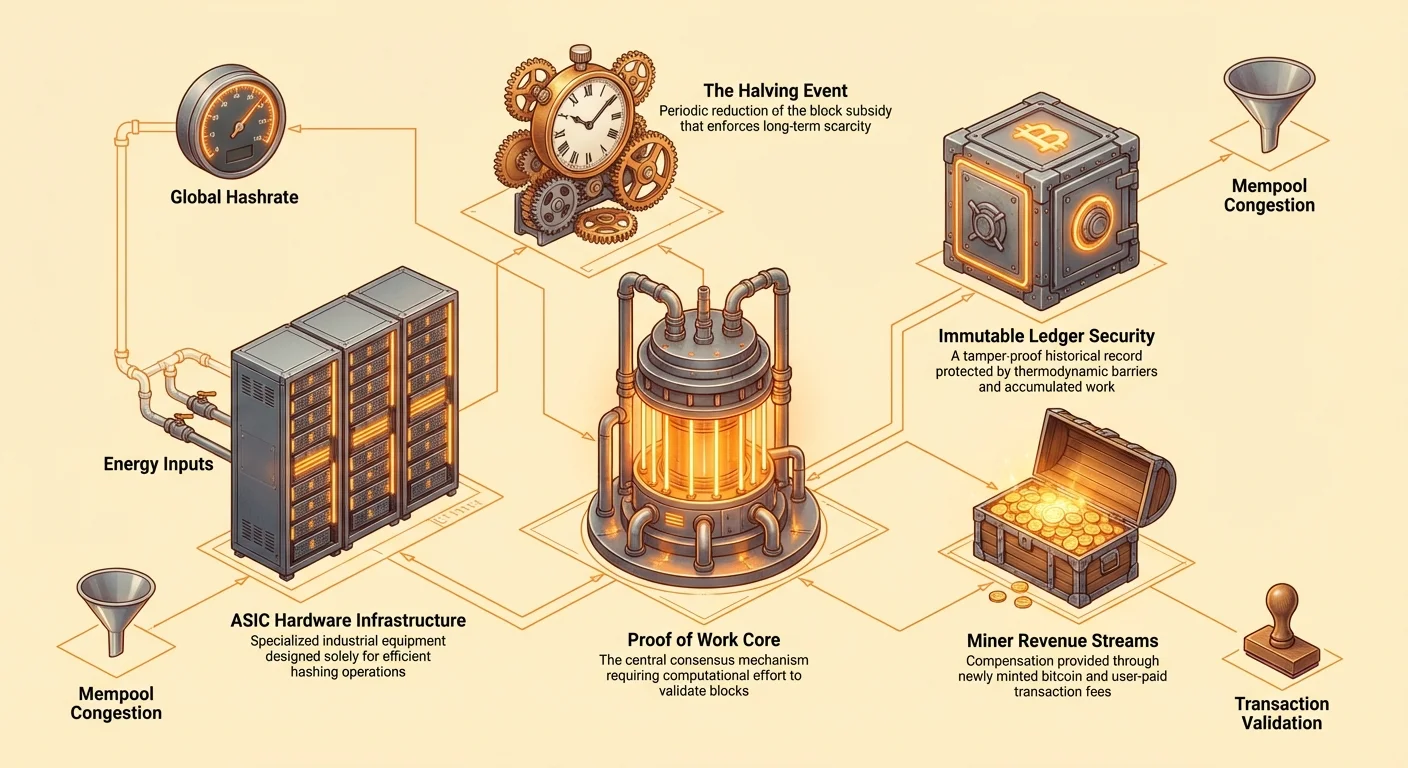
Approximately every four years, or specifically every 210,000 blocks, a "halving" event occurs. During this event, the block reward is cut in half. This mechanism is the engine of the deflationary economic model. It ensures that the supply of new coins entering the market slows down over time, enforcing scarcity and predictability.
| Halving Era | Year | Block Reward (BTC) | Inflation Impact |
|---|---|---|---|
| Launch | 2009 | 50.00 | High initial distribution |
| First | 2012 | 25.00 | First supply shock |
| Second | 2016 | 12.50 | Increased scarcity |
| Third | 2020 | 6.25 | Maturing asset class |
The first halving in 2012 reduced the reward to 25 bitcoins. Subsequent halvings in 2016 and 2020 lowered it to 12.5 and 6.25, respectively. The upcoming halving in 2024 will further reduce the issuance to 3.125 bitcoins per block. This process will continue until the maximum supply of 21 million coins is reached, estimated to occur around the year 2140.
For miners, the halving represents a significant periodic shock to revenue. Overnight, the amount of bitcoin earned for the same amount of work is cut by 50%. This forces less efficient operations to shut down or upgrade their hardware. Historically, these supply shocks have also been associated with market cycles, as the reduced flow of new supply meets fluctuating demand.
Inflation Rate Implications
The halving schedule directly dictates the inflation rate of the currency. In the early days, the supply grew rapidly. However, each halving steps the inflation rate down significantly. For example, after the 2020 halving, the annual inflation rate dropped to approximately 1.77%.
Following the 2024 halving, the inflation rate is projected to drop below 1%, specifically around 0.85%. This puts the digital asset's supply growth well below that of gold, which typically increases its above-ground supply by about 1.6% annually.
This programmatic monetary policy provides certainty to participants. Unlike central bank policies which can change based on political or economic pressures, the issuance schedule of Bitcoin is immutable. Miners and investors can project the exact supply at any future date, allowing for long-term planning and investment strategies.
Transaction Fees and the Mempool
While block rewards currently make up the bulk of miner revenue, transaction fees play an increasingly critical role. Every transaction broadcast to the network includes a fee paid by the sender. These fees are collected by the miner who includes the transaction in a block.
The fee market is driven by the supply and demand for block space. Each block has a limited capacity, currently effectively capped around 1MB to 4MB depending on the transaction types. When users want to send funds, their transactions enter a waiting area known as the mempool.
Miners, acting as rational economic agents, prioritize transactions that offer the highest fees per byte of data. This creates a competitive auction for block space. During periods of high network congestion, the mempool fills up with unconfirmed transactions. Users who need their transfers processed quickly must attach higher fees to outbid others.
Fee Determinants and Strategy
Transaction fees are not based on the dollar amount being sent. Instead, they are calculated based on the data size of the transaction, measured in satoshis per byte. A complex transaction involving multiple inputs and outputs requires more data and thus costs more to process than a simple transfer.
For example, if a user receives small amounts of bitcoin from ten different people and then tries to send the total amount to someone else, the transaction will be large in terms of data. It must reference ten different history records (inputs). This results in a higher fee compared to sending the same value from a single source.
Users can customize their fees using their wallet software. If a transaction is not urgent, a user can set a lower fee and wait for network congestion to drop. The transaction might sit in the mempool for hours or days until a miner picks it up during a quiet period. Conversely, urgent payments require "fast" fee settings to ensure inclusion in the next block.
The Long-Term Transition
As the block reward continues to halve every four years, it will eventually become negligible. By the year 2140, the block reward will reach zero. At that point, miners will rely entirely on transaction fees to sustain their operations.
This transition is a gradual process designed to shift the security budget from an inflationary subsidy to a user-funded model. The assumption is that as the network adoption grows, the volume and value of transactions will increase. This should generate sufficient fee revenue to incentivize miners to continue securing the chain.
We are already seeing glimpses of this future during high-traffic periods. There have been instances where the total fees collected in a block exceeded the block reward itself. This validates the theory that a fee-based security model is viable, provided there is sustained demand for block space.
Energy Consumption Reality
The energy consumption of Bitcoin mining is a subject of intense debate. Critics argue it is wasteful, while proponents view it as a necessary cost for securing a global monetary network. The reality is that Proof of Work is designed to be energy-intensive. This energy expenditure is the "proof" that secures the history of the ledger, fueling security.
However, the narrative that mining is purely detrimental to the environment lacks nuance. Mining is a location-agnostic industry. Miners can set up operations anywhere there is an internet connection and power. This unique characteristic drives them to seek out the cheapest possible energy sources.
Often, the cheapest energy is renewable energy that would otherwise go to waste. Hydroelectric dams, for example, often produce more electricity than local grids can consume, especially during rainy seasons. Miners can utilize this "stranded" energy, providing revenue to renewable infrastructure projects that might otherwise be economically unviable.
Efficiency and Heat Recycling
The mining industry is ruthlessly competitive. Profit margins are often thin, squeezed by the costs of hardware and electricity. This economic pressure drives rapid innovation in energy efficiency. Modern mining hardware, known as Application Specific Integrated Circuits (ASICs), is orders of magnitude more efficient than the CPUs and GPUs used in the early years.
Miners are also incentivized to reduce their cooling costs, which constitute a significant portion of their energy bill. This has led to the adoption of immersion cooling technologies and the strategic location of farms in cooler climates.
Furthermore, the heat generated by mining rigs is increasingly being repurposed. Innovative projects are using the thermal exhaust from miners to heat greenhouses, dry lumber, or warm residential buildings. This cogeneration approach improves the overall efficiency of the energy used, transforming a waste product into a valuable resource.
Comparisons and Context
When evaluating energy consumption, it is important to compare it against the utility provided. Traditional banking systems, gold mining operations, and military infrastructures used to secure fiat currencies also consume vast amounts of energy. These costs are often hidden or distributed, making direct comparisons difficult.
Bitcoin's energy usage is transparent and easy to estimate based on the network hashrate. This transparency sometimes works against it in public perception, as the aggregate number looks large. However, unlike traditional data centers that must be located near population centers, mining farms often utilize excess capacity in remote areas, stabilizing grids rather than competing for residential power.
The shift toward sustainable mining is also driven by regulation and corporate responsibility (ESG) mandates. Publicly traded mining companies are under pressure to disclose their energy mix, pushing the industry toward a greener profile over time.
Mining Difficulty and Hashrate
The stability of the network relies on the relationship between hashrate and mining difficulty. Hashrate is the total computational power connected to the network at any given moment. A higher hashrate implies that more miners are participating, which makes the network more secure and resistant to attacks.
However, if hashrate increases, blocks could be found too quickly, speeding up the issuance of new coins. To prevent this, the protocol includes a difficulty adjustment mechanism. Every 2,016 blocks, the network recalculates the difficulty of the mining puzzle.
If blocks were mined faster than the ten-minute target average during the previous period, the difficulty increases. This makes the puzzle harder to solve. If blocks were mined too slowly, the difficulty decreases. This self-correcting thermostat ensures that the issuance of bitcoin remains steady regardless of how many miners join or leave the network.
Hashrate as a Security Metric
Hashrate figures are often expressed in exahashes per second (EH/s). These astronomical numbers represent the quintillions of calculations performed every second by the network. As hashrate climbs, the cost to attack the network climbs with it.
A "51% attack" involves a malicious actor gaining control of more than half the network's hashrate. This would allow them to double-spend coins or reorganize recent blocks. As the global hashrate grows, the hardware and electricity required to mount such an attack become impossibly expensive.
Consequently, hashrate is the most direct metric for network security. A dropping hashrate can indicate miner capitulation, usually due to price drops making mining unprofitable. Conversely, a rising hashrate indicates a healthy, investing ecosystem where miners are confident in the long-term value of the asset.
The Double-Spend Solution
The fundamental problem that digital cash systems faced prior to Bitcoin was the "double-spend" problem. Digital files are easily copied. Without a central authority to track balances, nothing stopped a user from spending the same digital token at two different merchants or accounts.
Mining solves this through the timestamped, chained structure of the blocks. When a miner validates a block, they are confirming that the inputs used in those transactions have not been spent previously. Once a block is added to the chain, it becomes part of the shared history.
To reverse a transaction, an attacker would have to rewrite that block and all subsequent blocks. Because the honest network is constantly extending the chain with new work, the attacker would have to work faster than the rest of the world combined to catch up and overtake the main chain.
Confirmation Depth
This probabilistic security increases with every new block. A transaction with zero confirmations (sitting in the mempool) is considered insecure and reversible. Once included in a block, it has one confirmation.
Most merchants and exchanges wait for a specific number of confirmations before considering a payment final. Six confirmations, which takes about one hour, is the industry standard for high-value transfers. At this depth, the probability of a successful double-spend attack is statistically near zero.
For smaller payments, fewer confirmations may be acceptable. The risk of a reorganization must be weighed against the value of the transaction. Mining effectively converts electricity into settlement assurance, providing a trustless mechanism for finalizing value transfer.
Nodes vs. Miners
It is important to distinguish between the roles of miners and nodes, as they are often confused. While all miners run nodes, not all nodes are miners. A Bitcoin node is a computer that stores a copy of the blockchain and validates transactions against the consensus rules.
Nodes act as the referees of the network. They check that miners are following the rules. If a miner produces a block that is invalid—for example, by awarding themselves too much bitcoin or including a double-spend—the nodes will reject it. The miner's work and energy expenditure will be wasted.
| Feature | Miner | Full Node |
|---|---|---|
| Primary Role | Create new blocks (Security) | Validate ledger (Audit) |
| Incentive | Block Rewards + Fees | Self-sovereignty / Privacy |
| Hardware | Specialized ASICs | Standard Laptop / PC |
| Cost to Run | High (Electricity + Hardware) | Low (Storage + Bandwidth) |
Running a node does not generate revenue. Individuals and businesses run nodes to independently verify their own transactions without relying on third parties. This ensures they are interacting with the valid network and protects their privacy.
The interplay between miners and nodes provides checks and balances. Miners secure the chain with energy, but nodes define the rules. Miners cannot force changes to the protocol if the economic majority of nodes refuses to accept the new software. This separation of powers prevents miners from having absolute control over the network governance.
Hardware Evolution and Infrastructure
In the early days of the network, mining could be performed on a standard home computer CPU. As the value of the asset grew, the competition intensified. Miners moved to Graphics Processing Units (GPUs), which were more efficient at performing the specific hashing calculations required.
Eventually, the industry shifted to Field Programmable Gate Arrays (FPGAs) and finally to Application Specific Integrated Circuits (ASICs). ASICs are specialized chips designed to do only one thing: SHA-256 hashing. They cannot browse the web or render video games.
This specialization dramatically increased the hashrate but also the barrier to entry. Today, competitive mining requires significant capital investment. It is no longer feasible for a hobbyist to mine profitably with a single laptop.
The Rise of Mining Farms
This industrialization led to the creation of massive mining farms. These are warehouse-scale facilities dedicated to housing thousands of ASIC machines. They are equipped with industrial cooling systems and high-capacity electrical infrastructure.
Operators of these farms negotiate power purchase agreements directly with energy providers to secure low rates. They often locate in regions with cooler climates to reduce cooling costs, such as Scandinavia, Canada, or mountainous regions of the United States.
Despite this industrial scaling, the protocol allows for pool mining. Individual miners can connect their hardware to a mining pool. The pool coordinates the work of thousands of small miners, treating them as a single large entity. Rewards are then distributed proportionally based on the work contributed. This allows smaller players to receive consistent payouts rather than waiting years to find a block solo.
Future Challenges and Solutions
As the mining industry matures, it faces several challenges. The primary concern is the diminishing block reward. As the subsidy decreases, the network's security budget depends more heavily on transaction fees. If transaction volume does not generate enough fees to cover mining costs, hashrate could drop, potentially weakening security.
However, the ecosystem is evolving to address this. Layer-2 solutions like the Lightning Network allow for thousands of transactions to occur off-chain, with only the final settlement recorded on the main blockchain. This increases the utility of the network while potentially allowing for higher fees on the base layer for high-value settlements.
Additionally, the concept of "merged mining" allows miners to secure multiple blockchains simultaneously without expending extra energy. This could provide additional revenue streams. Innovations in hardware efficiency also continue to lower the operational break-even point for miners.
Regulatory Landscape
Regulation remains a significant variable. Governments around the world have taken varied approaches to mining, from outright bans to tax incentives for using renewable energy. Regulatory clarity is essential for the long-term stability of the mining sector.
Bans in major economies, such as China's crackdown in 2021, demonstrated the network's resilience. Following the ban, the hashrate plummeted but quickly recovered as miners relocated to more friendly jurisdictions. This event proved that the decentralized network could survive a hostile attack from a state actor.
Moving forward, integration with the energy grid seems likely to deepen. Miners are increasingly viewed as flexible load balancers that can help stabilize power grids by consuming excess energy during low demand and powering down during peak hours. This symbiotic relationship could secure the industry's place in the global energy infrastructure.
Conclusion
Mining as a service is a complex interplay of cryptography, economics, and physics. It transforms raw energy into digital security, providing the immutable foundation necessary for a decentralized monetary system. Through the mechanism of Proof of Work, miners are incentivized to act honestly, securing the ledger in exchange for block rewards and transaction fees.
While challenges regarding energy consumption and long-term security budgets exist, the industry continues to adapt. The shift toward renewable energy and the evolution of fee markets suggest a resilient future. As the network approaches its supply cap, the role of miners will transition, but their service as the guardians of the blockchain remains indispensable.
Bitcoin mining converts electricity into truth, creating a secure and immutable record of ownership without central authority.