
The decentralized finance ecosystem offers sophisticated financial instruments that grant users unparalleled control over their assets. Unlike traditional banking systems where risk is often opaque and managed centrally, DeFi places the responsibility of risk management directly on the user. This shift requires a deep understanding of the mechanisms that govern protocol solvency and asset security.
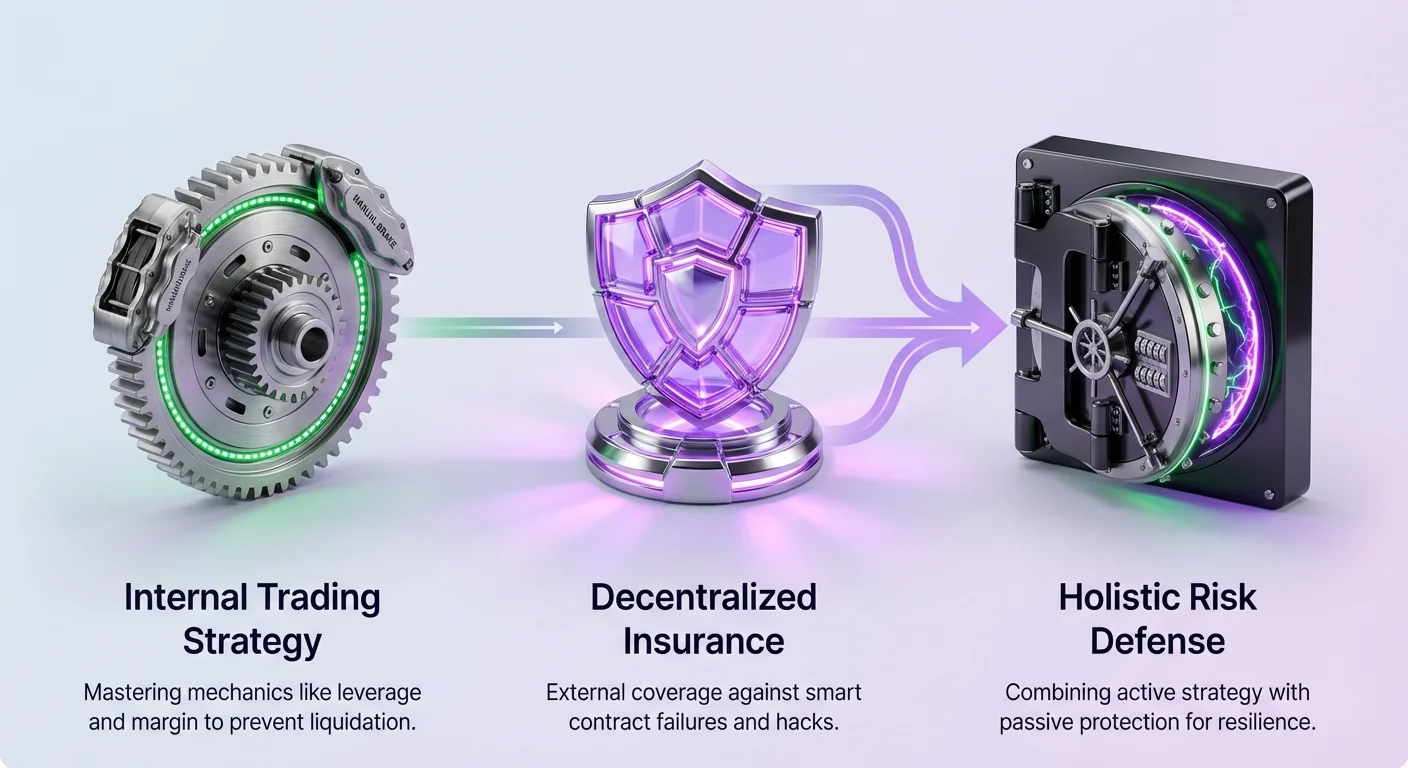
Participants in this space must navigate two distinct categories of risk mitigation. The first involves understanding the internal mechanics of trading protocols, specifically how leverage, margin, and liquidation engines function. These are non-insurance mitigations where knowledge and strategy prevent loss. The second involves utilizing external safety nets, such as decentralized coverage, to protect against systemic failures that cannot be mitigated through trading behavior alone.
By mastering both the technical parameters of derivatives trading and the protective layers of on-chain insurance, users can build a robust defense against market volatility and smart contract vulnerabilities. This comprehensive approach ensures that engagement with advanced financial tools remains sustainable and secure.
The Mechanics of Decentralized Derivatives
Derivatives in decentralized finance represent a fundamental shift in how value is exchanged and speculated upon. Unlike spot trading, where a user purchases and holds an asset directly, derivatives allow for the trading of financial contracts that derive their value from an underlying cryptocurrency. This distinction is critical for understanding the enhanced utility these instruments provide.
When buying an asset in the spot market, the investor expresses an implicit view that the asset's value will rise. However, this limits the strategies available to the user. Derivatives expand this capability by enabling participants to profit from both upward and downward market movements. They serve as flexible tools for expressing market sentiment regardless of direction.
The primary vehicle for this activity in DeFi is the perpetual futures contract. These contracts mimic the price action of the underlying asset but do not have an expiration date. This allows traders to hold positions for as long as they can maintain the necessary collateral requirements.
Directional Trading Strategies
In the context of perpetual derivatives, trading consists of taking either a long or a short position. These terms define the user's relationship to the market's future price action. Understanding the mechanics of these positions is the first step in non-insurance risk mitigation, as selecting the wrong direction without protection can lead to rapid capital erosion.
Going long signifies a belief that the underlying asset will appreciate in value. To execute this, a trader buys a perpetual contract. For example, if a user believes Bitcoin will rise from its current price, they purchase a BTC perpetual contract. If the price rises, the value of the contract increases, generating a profit that can be realized upon closing the position.
Conversely, going short allows a trader to express a bearish sentiment. This involves selling a perpetual contract with the expectation that the asset's value will decline. If the price of Ethereum falls, the short seller profits from the difference. This capability is essential for hedging portfolios against market downturns, a strategy unavailable in simple spot trading.
The Role of Leverage
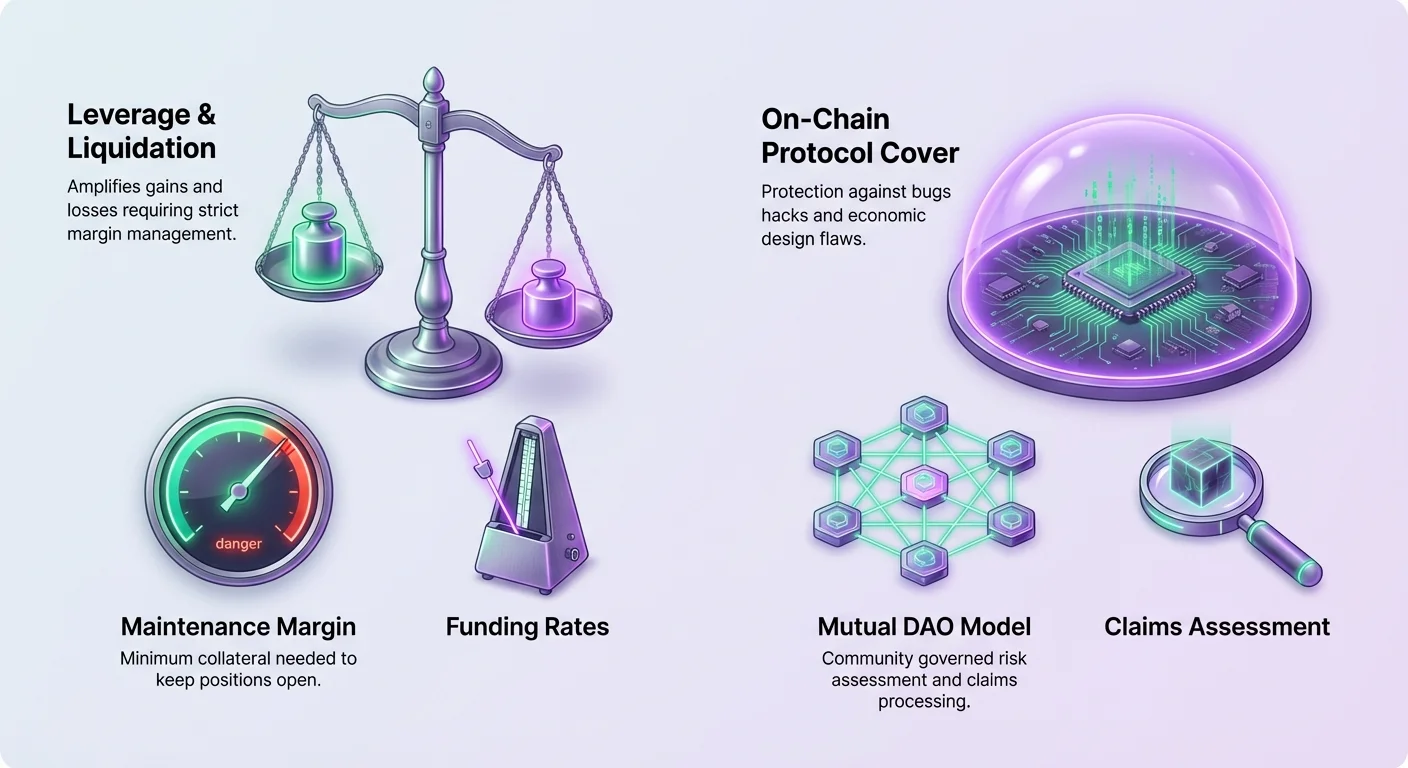
Leverage is a powerful feature inherent to derivatives that amplifies both potential returns and potential risks. It allows a trader to control a position size that exceeds their deposited collateral. For instance, a deposit of 100 USDC combined with 3x leverage enables the purchase of 300 USDC worth of contracts, illustrating core leverage trading mechanics.
While leverage increases purchasing power, it also serves as a primary source of liquidation risk. As the leverage multiplier increases, the price movement required to wipe out the initial collateral decreases. A position with 20x leverage is far more sensitive to volatility than a position with 1x leverage.
New users are strongly encouraged to utilize lower leverage settings, typically 1x or less, to mitigate the risk of total loss. The maximum leverage available varies by market and asset volatility. For example, major assets like BTC might offer up to 20x leverage, while more volatile assets like AVAX might be capped at 10x.
Liquidation Risk and Automated Protection
The concept of liquidation is central to the health of any derivatives protocol. It is the automated mechanism used to ensure that a trader can always cover their losses. In decentralized systems, there is no central broker to issue a margin call via telephone; instead, smart contracts automatically close positions when collateral falls below a critical threshold.
Liquidation occurs when the value of the collateral is no longer sufficient to support the open position. This process protects the solvency of the entire protocol and the counterparties involved in the trade. When a position is liquidated, the protocol seizes the collateral and often charges a liquidation fee, resulting in a significant financial loss for the trader.
Understanding the mathematics of liquidation is the most effective form of non-insurance mitigation. By calculating the exact price at which a position will be closed, traders can adjust their strategies and collateral management to avoid this automated enforcement.
Initial versus Maintenance Margin
To effectively manage liquidation risk, one must distinguish between initial margin and maintenance margin. These two factors dictate the lifecycle of a trade and serve as the primary "health factors" for any open position, central to understanding collateralization.
Initial margin refers to the amount of collateral required to open a new position or increase the size of an existing one. It acts as the barrier to entry, ensuring the trader has "skin in the game" before entering the market.
Maintenance margin is the minimum amount of collateral that must remain in the account to keep the position open. This threshold is lower than the initial margin. If the value of the collateral drops below the maintenance margin due to adverse price movements, the liquidation engine triggers.
Calculating Liquidation Scenarios
The relationship between leverage and liquidation price is inverse and non-linear. Higher leverage brings the liquidation price closer to the entry price, leaving little room for market noise. Consider a scenario where a trader enters a long position on Bitcoin at a price of $20,000 with $100 of collateral.
At 1x leverage, the trader effectively buys $100 worth of Bitcoin. The liquidation price would be drastically low, around $600, making it extremely unlikely that the position would be liquidated under normal market conditions. This demonstrates how low leverage acts as a protective buffer.
However, increasing leverage to 10x changes the math significantly. With the same $100 collateral, the trader controls $1,000 worth of Bitcoin. In this scenario, the liquidation price rises to $18,600. A mere 7% drop in the asset's price would trigger a total loss of collateral.
| Leverage | Position Size (USD) | Liquidation Price (Approx) | Risk Level |
|---|---|---|---|
| 1x | 100 | $600 | Ultra Low |
| 2x | 200 | $10,600 | Low |
| 5x | 500 | $16,600 | Moderate |
| 10x | 1000 | $18,600 | High |
Short Position Risks
Shorting introduces a different risk profile. When going long, the maximum loss is capped at the value of the collateral, as the asset price cannot fall below zero. However, when shorting, the potential loss is theoretically infinite because an asset's price can rise indefinitely.
Using the same example of $100 collateral and a Bitcoin entry price of $20,000, a 1x short position would have a liquidation price of $39,400. If the price doubles, the collateral is exhausted.
At higher leverage, the window for error tightens rapidly. A 10x short position would face liquidation at $21,400. This means a price increase of just over 7% would result in the automated closure of the trade. This asymmetry necessitates vigilant monitoring of short positions.
Funding Rates and Market Balance
Beyond liquidation, traders must contend with funding rates, a mechanism designed to tether the price of the perpetual contract to the spot price of the underlying asset. Funding rates function as a periodic payment exchanged between long and short traders.
This mechanism ensures that the derivative market does not deviate too far from the actual market value of the asset. It acts as an automated balancing force, incentivizing traders to take the opposing side of a skewed market.
Sentiment and Payment Direction
The direction of the funding payment depends on the relationship between the perpetual price and the underlying spot price. When the perpetual contract is trading at a price higher than the underlying asset, market sentiment is considered bullish. In this state, there are more long positions than short positions.
To correct this, the system requires traders holding long positions to pay a fee to those holding short positions. This payment discourages excessive longing and rewards shorting, helping to drive the price down toward the spot price.
Conversely, when the perpetual price is trading below the underlying asset, sentiment is bearish. In this scenario, short sellers must pay fees to long holders. Understanding this dynamic is crucial because funding fees can erode potential profits over time, acting as a "tax" on the majority consensus.
Execution Strategies for Risk Control
Mitigating risk in decentralized derivatives also involves the precise execution of trade orders. The method by which a trader enters or exits a market can significantly impact their exposure to slippage and unexpected price entries.
There are two primary methods for opening positions: market orders and limit orders. A market order executes immediately at the current best available price in the order book. While this guarantees entry, it exposes the trader to price volatility in the moments between submission and execution, requiring knowledge of optimal trade execution.
A limit order allows the trader to specify an exact price at which they are willing to buy or sell. The order will only execute if the market reaches that price or better. For example, a buy limit order at $21,500 will strictly execute at $21,500 or lower. This control prevents entering positions at unfavorable valuations.
Closing Positions
Risk mitigation does not end at entry. Knowing how to efficiently close a position is vital for realizing gains and preventing losses from reversing. Closing a position settles the contract, converting unrealized gains or losses into realized changes in the account balance.
If a trade is profitable, closing it locks in the earnings. If the trade is in a loss, closing it prevents further capital depletion. Protocols provide options to fully or partially close positions, allowing traders to scale out of trades as their risk tolerance changes.
Protocol and Smart Contract Risks
While traders can mitigate market risks through leverage management and careful execution, they face a different category of risk inherent to the infrastructure itself. Decentralized finance relies on smart contracts—code stored on a blockchain that executes commands automatically.
Even the most robust trading strategies cannot protect against bugs, hacks, or exploits within the protocol's code. If a smart contract malfunctions or is manipulated by a malicious actor, user funds can be drained regardless of the health of their individual trading positions.
This brings us to the necessity of external protection. Where internal mitigation strategies focus on market behavior, external insurance strategies focus on technical and systemic failure. This creates a holistic approach to safety that accounts for both human error and machine failure.
The Architecture of Decentralized Insurance
Decentralized insurance platforms offer a solution to the unique risks of the crypto ecosystem. These platforms utilize blockchain technology to increase efficiency and transparency compared to traditional insurance models.
Traditional insurance often suffers from high overhead costs related to workforce, real estate, and bureaucratic processing. Decentralized applications (DApps) streamline this by using smart contracts to automate policy issuance and capital management. This efficiency reduces the cost burden on the provider and potentially lowers premiums for the user.
Furthermore, these platforms operate 24/7, reflecting the non-stop nature of the crypto markets. There are no banking hours or holidays in DeFi, and insurance protocols mirror this availability, ensuring coverage can be purchased or claimed at any time.
The Mutual Model
A prominent model in this sector is the mutual, exemplified by platforms like Nexus Mutual. In this structure, the platform is governed as a Decentralized Autonomous Organization (DAO) owned wholly by its members.
Capital is held in a shared risk pool used to pay out valid claims. Unlike traditional insurance companies where decisions are made by opaque internal boards, decentralized mutuals involve the community in the assessment of risk and the approval of claims.
This community-driven approach aligns incentives. Members hold the platform's token (such as NXM) to participate in governance, assess coverage proposals, and vote on the direction of the protocol. This creates a transparent ecosystem where risk assessment is crowdsourced rather than centralized.
Types of On-Chain Coverage
Decentralized insurance is not a one-size-fits-all product. Users must select specific types of cover that match their activities and risk exposure. The most common form is smart contract cover or protocol cover.
Protocol cover protects against financial losses resulting from unintended uses of smart contract code. This includes hacks, bugs, or economic design flaws that allow attackers to steal funds. For users depositing large amounts of collateral into derivatives exchanges or lending protocols, this cover is essential.
It is important to verify exactly what a policy covers. Some policies might cover a specific lending platform but not a yield aggregator built on top of it. Users must assess which DApps they are interacting with—whether lending on Aave, trading on dYdX, or providing liquidity on a DEX—and purchase corresponding protection.
Custody and De-Peg Risks
Beyond smart contract failure, risks exist regarding asset custody and stability. While self-custody in a web3 wallet is the gold standard for security, users often interact with centralized entities or stablecoins.
Custody cover can protect assets held on centralized exchanges against insolvency or hacks. Although the ethos of DeFi encourages self-custody, pragmatic users who must use centralized services can mitigate the associated counterparty risk through insurance.
Additionally, peg protection is available for stablecoins. If a stablecoin loses its 1:1 peg to the dollar (or other fiat currency), peg cover can reimburse the holder for the devaluation. This is crucial for traders who keep their "dry powder" in stablecoins to avoid stablecoin volatility.
The Process of Buying Protection
Acquiring insurance in DeFi is a permissionless process facilitated by web3 wallets. The prerequisite for this activity is a self-custodial wallet containing the necessary cryptocurrency for premiums and transaction fees.
The process begins with identifying the need for insurance. A user engaging in high-value transactions on a derivatives platform has a clear use case. Once the risk is identified, the user connects their wallet to the insurance DApp.
The user then selects the specific protocol they wish to insure. They must specify the coverage amount—usually denominated in ETH or a stablecoin like DAI or USDC—and the duration of the policy. The platform calculates a premium based on these inputs and the perceived risk of the protocol.
Upon confirmation, the transaction is executed on-chain. The premium is paid, and the cover becomes active immediately. This seamless integration allows users to layer protection onto their trading activities in minutes.
Claims Assessment and Payouts
The true test of any insurance product is the claims process. In decentralized insurance, this process differs significantly from the traditional model. Claims are often assessed by the community or automated oracles rather than a centralized claims adjuster.
To make a claim, a cover holder submits a request through the DApp, usually providing proof of loss and details of the incident. It is critical that the incident falls within the specific wording of the cover bought.
Once submitted, the claim undergoes a review process. In a mutual model, members might vote on the validity of the claim based on the evidence provided. If the community consensus is that a valid loss occurred under the terms of the policy, the payout is authorized.
Since the funds are held in smart contracts, the payout can be processed programmatically once approved. This reduces the timeline for receiving funds compared to traditional systems where bureaucratic delays are common.
Integrating Mitigation Strategies
The most effective risk management strategy involves a synthesis of internal mitigation and external insurance. Non-insurance mitigation focuses on preventing loss through disciplined trading. This includes using low leverage, understanding liquidation thresholds, and monitoring health factors.
However, disciplined trading cannot stop a protocol hack. This is where insurance serves as the final backstop. By combining conservative leverage (active mitigation) with comprehensive protocol cover (passive protection), a user creates a defense-in-depth strategy.
For example, a trader might limit their leverage to 2x to ensure their liquidation price is far from the current market price. Simultaneously, they purchase cover for the exchange they are using. If the market crashes, their low leverage protects them. If the exchange is hacked, their insurance protects them.
Portfolio Health Maintenance
Maintaining the health of a DeFi portfolio requires constant vigilance. Margin requirements change as asset prices fluctuate. Funding rates can slowly bleed a position if left unchecked. Regular monitoring is required to ensure that maintenance margins are not breached.
Tools like risk calculators provided by platforms can help users model scenarios before entering trades. These simulators allow traders to see exactly how changes in collateral or position size affect their liquidation risk.
Integrating these tools into a daily routine transforms risk management from a passive hope into an active discipline. The goal is to never be surprised by a liquidation event or a protocol failure.
Conclusion
Navigating the decentralized finance landscape requires a dual approach to security. Traders must first master the internal mechanics of their positions, utilizing low leverage and strict margin management to mitigate the risk of liquidation. This active management serves as the first line of defense, ensuring that market volatility does not result in automated losses.
However, even the most disciplined strategy remains vulnerable to systemic risks inherent in blockchain infrastructure. Decentralized insurance provides the necessary redundancy, offering protection against smart contract failures and technical exploits. By layering these non-insurance mitigation techniques with robust on-chain coverage, participants can engage with the open financial system with confidence and resilience.
True risk mitigation is achieved not by avoiding the market, but by mastering the mechanics of protection.