
The cryptocurrency markets operate 24 hours a day, 7 days a week, moving with volatile speed that is impossible for a human trader to consistently track. Whether you are a full-time trader or a curious newcomer, the promise of automation—having software execute your trading strategy flawlessly while you sleep—is highly appealing.
However, many beginner guides treat trading bots merely as features or products. To truly succeed in crypto trading automation, you must understand the underlying technical architecture that makes these programs function. This foundational knowledge allows you to select secure platforms, understand strategy limitations, and manage your risk effectively.
This guide will move beyond simple feature lists to explain the mechanics of how crypto trading bots work, focusing on the essential technical bridge between your strategy and the exchange—the Application Programming Interface (API).
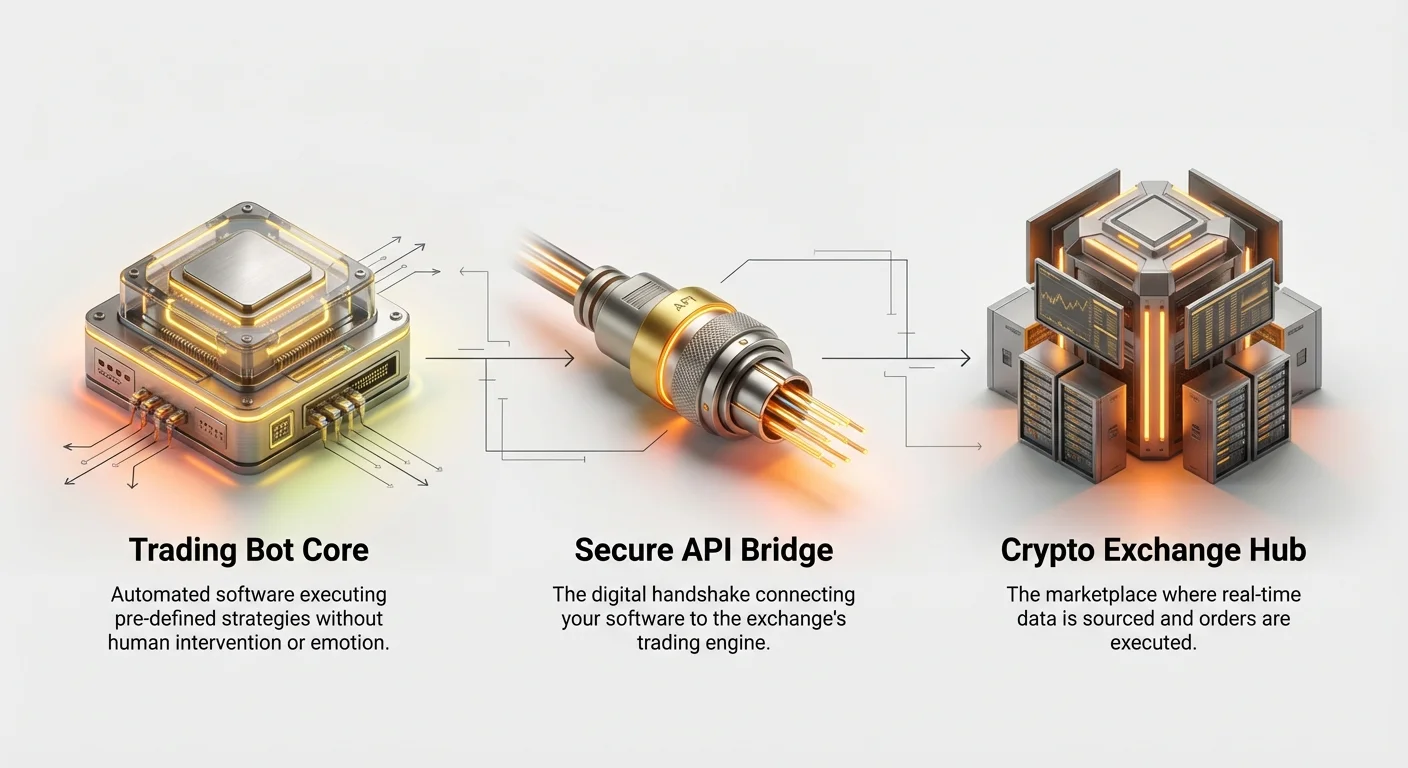
What Exactly is a Crypto Trading Bot?
A crypto trading bot is a piece of software designed to interact with cryptocurrency exchanges and execute trades on behalf of the user, based on pre-defined criteria, rules, and indicators. Essentially, it is an automated version of a human trader, executing conditional orders without the intervention of emotion, fatigue, or slow manual input.
The primary goal of automation is not necessarily guaranteed profit (as no strategy is flawless) but rather optimization: ensuring trade execution is immediate, adhering strictly to a strategy, and maximizing the efficiency of capital usage across highly volatile markets.
Bots vs. Manual Trading: Speed and Emotion
The most significant advantage of a trading bot is its speed and discipline.
- Speed (Latency): Bots can analyze market data, calculate an entry or exit point based on complex formulas, and submit an order to an exchange in milliseconds. A human trader, by contrast, must process information, manually input trade details, and click "submit"—a process that can take many seconds, or even minutes, during times of high market volatility.
- Discipline (Emotionless Execution): Human trading is often derailed by fear (selling too early during a dip) or greed (holding onto a profitable position for too long). A bot has no emotions. If its programming states, "Sell when the price reaches $50,000," it will sell immediately, regardless of whether the market looks like it might go higher. This strict adherence to strategy is crucial for long-term consistency.
Types of Bot Logic
Trading bots implement strategies based on different logical structures, ranging from simple to highly complex. Understanding the logic is the first step in understanding trading bot architecture.
- Indicator-Based Bots (Trend Following): These bots rely on technical analysis indicators (like Moving Averages or RSI) to determine entry and exit points. Their logic is strictly conditional: If Indicator X crosses Indicator Y, place a market buy order.
- Arbitrage Bots: These sophisticated programs capitalize on small, momentary price differences for the same asset across two or more different exchanges. The bot must execute a simultaneous buy on one exchange and a sell on the other to capture the difference before the market corrects itself.
- Grid Bots: These bots place a series of staggered buy and sell orders around a specific price range. They profit from small price fluctuations within a defined channel, repeatedly buying low and selling high. This strategy is effective in choppy, range-bound markets.
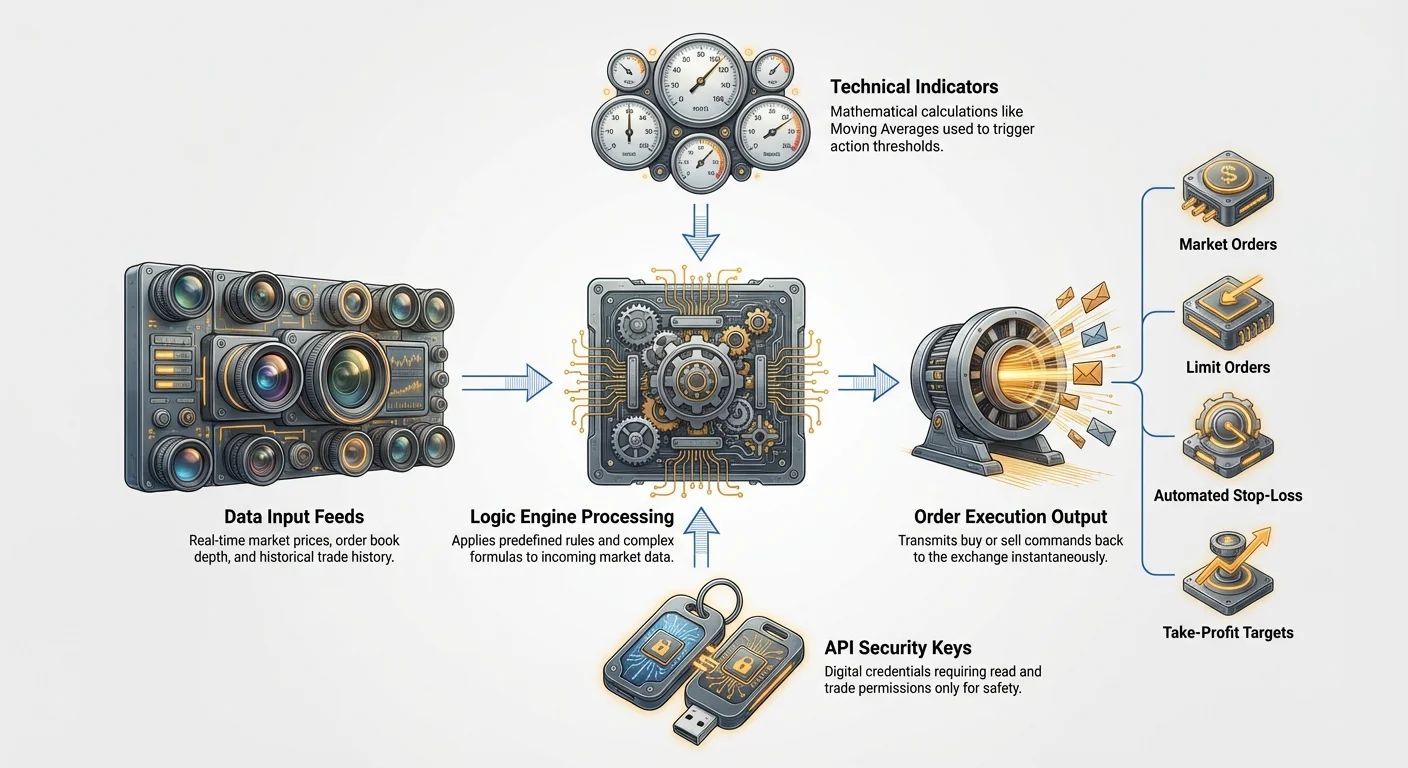
The Core Architecture: Connecting to the Exchange
For a bot to buy or sell cryptocurrency, it cannot simply access the internet like a web browser. It requires a secure, authorized, machine-to-machine connection to the exchange's trading engine. This critical link is facilitated by the API.
Introducing the API (Application Programming Interface)
The API (Application Programming Interface) is the backbone of all crypto API trading. You can think of the API as a set of rules and protocols that allows two different software programs to communicate with each other.
In the context of automation, the exchange provides the API, and your trading bot uses it to send requests.
A bot utilizes the API to perform two main functions:
- Reading Data (Input): The bot constantly sends requests to the exchange via the API to fetch real-time data, such as current asset prices, volume, order book depth, and the history of recent trades. This data forms the "input" the bot uses for its strategic calculations.
- Executing Actions (Output): When the bot's strategy conditions are met, it uses the API to send specific commands back to the exchange, such as
place_buy_order,cancel_order, orget_account_balance.
Without a properly configured API connection, your trading bot is just code; it has no ability to interact with the market.
API Keys and Security: The Digital Handshake
To ensure that only authorized bots and programs can access your account, exchanges require the use of API keys. This is the "digital handshake" that verifies the bot’s identity.
An API key typically consists of two parts:
- API Key (Public Key): This is like your username. It identifies the application making the request.
- Secret Key (Private Key): This is like your password. It is used to generate a digital signature for every request, proving that the request truly came from you. This key must never be shared or stored insecurely.
When setting up your API key on an exchange, you define its permissions. This is arguably the most important security step for any beginner trader engaging in automation. Permissions generally fall into three categories:
- Read-Only: Allows the bot to view balances and market data, but not execute trades. (Safest)
- Trading: Allows the bot to view balances and place/cancel orders. (Required for automation)
- Withdrawal: Allows the bot to move funds out of your exchange account. It is a fundamental security best practice to NEVER enable withdrawal permission for a trading bot.
By restricting the API key to "Read and Trade" permissions only, you ensure that even if a malicious actor gained access to your bot's keys, they could execute bad trades but could not steal your funds by withdrawing them to an external wallet.
Exchange Requirements and Limitations
Exchanges govern how the API can be used to maintain system stability and fairness. Two key limitations affect bot performance:
- Rate Limits: Exchanges impose restrictions on how many API requests a single user (or bot) can make per second or minute. If your bot exceeds the rate limit, the exchange will temporarily block it. High-frequency or arbitrage bots must be meticulously coded to manage these limits efficiently.
- Fees: Every trade executed incurs a trading fee, which reduces the potential profit. Successful bot strategies must account for these fees. For instance, a high-frequency bot generating hundreds of tiny trades must have a net profit margin that significantly exceeds the cumulative trading fees.
Anatomy of a Bot: Input, Logic, and Output
Regardless of the strategy it implements (grid trading, trend following, or arbitrage), every functional trading bot follows a continuous, cyclical workflow: Input, Logic Processing, and Output. This cycle is the practical implementation of the underlying trading bot architecture.
Input: Data Feeds and Signals
The bot's success depends entirely on the quality and speed of its incoming data.
- Price Data (The Ticker): The most fundamental input is the current price of the cryptocurrency pair (e.g., BTC/USDT). The bot constantly polls the API for the latest market price.
- Order Book Data: This data shows the current standing buy and sell orders waiting to be filled. Deep order book data allows the bot to assess market liquidity and potential slippage (the difference between the expected price of a trade and the price at which the trade is executed).
- Historical Data: To calculate indicators (like Moving Averages), the bot needs access to past price data, often presented as candlestick charts (Open, High, Low, Close, Volume data).
These inputs are often fed into the bot via a stream of data known as a WebSocket connection, which provides instant updates rather than requiring the bot to repeatedly ask (poll) the server.
The Logic Engine: Strategy Implementation
The logic engine is the heart of the bot—it’s where the trading strategy is executed. This engine takes the input data, processes it through complex formulas, and decides whether an action should be taken.
The logic is built on strict conditional statements (If/Then rules).
Example Logic (Beginner Buy Signal):
- Input: Current BTC price is $48,000.
- Logic:
- Condition A: The 7-Day Moving Average (MA) is $47,000.
- Condition B: The 21-Day MA is $47,500.
- Rule: IF the 7-Day MA crosses above the 21-Day MA (a bullish crossover signal) AND the current price is less than $48,001, THEN generate a BUY signal.
- Output: Place a market buy order for 0.01 BTC.
The logic engine must continuously run this calculation across all monitored assets, ensuring that no potential signal is missed.
Output: Placing and Managing Orders
Once the logic engine generates a trade signal, the bot uses the API to send a request to the exchange to execute the trade. The effectiveness of the trade depends heavily on how the bot handles different order types.
- Market Orders: The bot requests an immediate purchase or sale at the current best available price. Market orders guarantee execution but risk higher slippage if the order is large or the market is volatile.
- Limit Orders: The bot places an order only to be executed when the price reaches a specific level (e.g., "Buy 1 ETH at exactly $3,200"). Limit orders ensure a fixed price but risk non-execution if the market moves too quickly past the limit.
- Order Management: Beyond placing the initial order, a professional bot must manage existing open positions. If the market conditions change, the bot must have the capacity to cancel pending limit orders, move stop-loss orders, or adjust target prices in real time—all through continuous API communication.
Understanding Trading Indicators: The Bot's Eyes
For a human trader, technical analysis indicators serve as tools to interpret market psychology and predict momentum. For a bot, these indicators are the precise mathematical thresholds that trigger action. The bot cannot "feel" the market; it only processes the numbers derived from these formulas.
Here are three fundamental indicators often used as the basis for automated trading strategies:
Moving Averages (MA): Spotting Trends Simply
A Moving Average calculates the average price of an asset over a specific period (e.g., 50 days or 200 hours). It smooths out price fluctuations to help identify the primary direction of the trend.
- How the Bot Uses It: Bots typically use two MAs of different lengths (e.g., a fast MA like 10-period and a slow MA like 50-period). The logic relies on Crossovers:
- If the fast MA crosses above the slow MA, it suggests an upward trend is beginning (Bullish Signal: BUY).
- If the fast MA crosses below the slow MA, it suggests a downward trend is starting (Bearish Signal: SELL).
- Bot Implementation: The bot continuously calculates both MAs and checks their relationship in real-time. When a cross occurs, the API is triggered to submit the corresponding trade order.
Relative Strength Index (RSI): Measuring Momentum
The RSI is a momentum oscillator that measures the speed and change of price movements. It is scaled from 0 to 100 and is primarily used to identify conditions where an asset is potentially overbought or oversold.
- RSI Thresholds:
- Readings above 70 suggest the asset is overbought (potential SELL signal).
- Readings below 30 suggest the asset is oversold (potential BUY signal).
- How the Bot Uses It: A bot might be programmed to trigger a counter-trend trade: If RSI drops below 30, place a Limit Buy order, expecting a price bounce. Conversely, a sell signal might trigger if the RSI rises above 70. This logic is crucial for mean-reversion strategies, where the asset is expected to return to its average price.
Bollinger Bands (BB): Defining Volatility Boundaries
Bollinger Bands consist of a central Moving Average and two lines (bands) plotted two standard deviations above and below the MA. The bands widen when volatility is high and narrow when volatility is low.
- How the Bot Uses It: BBs are excellent for defining a channel or range.
- Buy Signal: The price touches or breaks the lower band.
- Sell Signal: The price touches or breaks the upper band.
- Bot Implementation (Volatility Strategy): A bot using BBs might be programmed to aggressively trade volatility. If the bands narrow significantly (suggesting low volatility), the bot might prepare to enter a position just before a predicted volatility spike. If the price moves outside the bands, the bot might either initiate a trade (expecting mean reversion) or use the breakout as a continuation signal, depending on its strategy.
Practical Strategy Example: Arbitrage Bot Logic
While standard bots trade on time-based indicators on a single exchange, arbitrage bots leverage the speed of the API connection across multiple exchanges simultaneously.
The Arbitrage Loop:
- Input (Multi-API): The bot uses simultaneous API connections to Exchange A (e.g., Coinbase) and Exchange B (e.g., Kraken) to fetch the real-time price of BTC/USD on both platforms.
- Logic:
- Check Price A: $50,000
- Check Price B: $50,050
- Condition: Calculate the profit margin: ($50,050 - $50,000) = $50.
- Rule: IF the profit margin exceeds the combined trading fees on both exchanges (e.g., 0.1% total), THEN execute the trade.
- Output (Simultaneous Execution):
- Send API request to Exchange A:
Market_Buy_Order(1 BTC)at $50,000. - Send API request to Exchange B:
Market_Sell_Order(1 BTC)at $50,050.
- Send API request to Exchange A:
This must happen in milliseconds. If the execution is not nearly instantaneous, the price discrepancy will vanish (a process called arbitrage closure), leaving the bot with losses from failed execution and fees. This high-speed requirement highlights why secure, low-latency API architecture is paramount for specialized bots.
Implementing Robust Risk Management
A trading bot is a powerful tool, but it is only as good as the risk parameters you impose. Beginners often make the mistake of focusing solely on potential profits without building protective mechanisms into the automation strategy. Risk management must be coded into the trading bot architecture, not applied manually afterward.
Stop-Loss and Take-Profit Orders: Automated Protection
These are the fundamental tools for limiting losses and securing gains. Bots must be programmed to automatically calculate and place these orders immediately after an entry trade is confirmed.
- Automated Stop-Loss: This order automatically sells the asset if the price drops to a specific level, preventing catastrophic losses. A bot’s logic might dictate a fixed risk per trade, such as "Never lose more than 2% of capital on any single trade."
- Trailing Stop-Loss: This is a more sophisticated bot feature. It allows the stop-loss price to move up as the asset price increases but locks in if the price reverses. This allows the bot to protect profits during a strong uptrend.
- Take-Profit Orders: These orders automatically sell a portion or all of the position when a pre-determined profit target is hit. This ensures profits are realized and prevents holding onto a trade that might reverse after reaching its peak.
Position Sizing and Capital Allocation
A disciplined bot never risks its entire capital on one trade. The logic engine must include rules for capital allocation.
- Risk per Trade: The bot is typically programmed to use only a small percentage of the total portfolio (e.g., 1% to 5%) on any single entry. This diversification protects the portfolio from being wiped out by a single, unexpected market event.
- Maximum Exposure: The bot’s architecture defines the maximum amount of total portfolio value it is allowed to hold in open positions at any given time. If this limit is reached, the bot must cease placing new buy orders, even if a strong signal is generated.
The Dangers of Over-Optimization (Curve Fitting)
A common mistake when developing a bot strategy is curve fitting. This happens when a strategy is tuned so perfectly to past historical data that it performs flawlessly in backtests (simulations) but fails dramatically when deployed in live, forward-looking market conditions.
The best practice for bot development is to use simple, robust logic that works across different market environments, rather than complex logic that is highly optimized for one specific historical event. The bot must be designed to adapt to conditions that were not present in the historical data used for testing.
Choosing and Securing Your Automation Platform
When starting with automated trading, you must decide where your bot will run and how you will secure the connection between the bot and the exchange.
Cloud-Based Services vs. Self-Hosted Bots
The decision often comes down to convenience versus control:
| Feature | Cloud-Based (SaaS) Services (e.g., 3rd party platforms) | Self-Hosted Bots (VPS, local machine) |
|---|---|---|
| Setup & Maintenance | Very easy. Automated updates, managed infrastructure. | Difficult. Requires coding knowledge, setup of a Virtual Private Server (VPS). |
| Uptime/Latency | High uptime, optimized connection to multiple major exchanges. | Dependent on the user’s internet connection and VPS provider. User is responsible for monitoring. |
| Security | API keys are stored by a third-party service; risk is centralized. | Keys are stored locally (more secure if managed properly). User is fully responsible for security. |
| Cost | Monthly subscription fees. | Cost of VPS hosting, development time. |
For beginners, cloud-based services are recommended as they handle the complexities of uptime, latency, and core security, allowing the user to focus purely on strategy development and risk management. However, be absolutely certain that the platform is reputable and adheres to the highest security standards, especially regarding API key storage (keys should be encrypted).
Essential Security Practices
The technical mechanics of automation introduce inherent security risks, primarily centered on the API keys.
- Restrict API Permissions: As discussed, only grant the API key Read and Trade permissions. Never grant withdrawal access.
- IP Whitelisting: If your exchange allows it, restrict API access to a specific list of IP addresses (IP Whitelisting). If you use a cloud service, whitelist the IP addresses provided by that service. If you use a VPS, whitelist the VPS's static IP address. This ensures that even if a hacker steals your key, they cannot use it from their own computer.
- Secure Storage: Never store API keys in plain text on your computer, in an email, or in insecure cloud storage. Use secure, encrypted password managers for local access, or ensure your cloud bot provider uses industry-standard encryption protocols.
- Regular Key Rotation: Change your API keys periodically (e.g., every few months). If a key is compromised, changing it limits the duration of the vulnerability.
By understanding the architecture—how the bot uses the API for real-time data input and executes conditional orders as output—traders gain the critical foundation needed to move beyond simple feature lists and build truly robust and secure automated trading systems.
Conclusion
Automated crypto trading systems are fundamentally pieces of software designed to execute predefined conditional logic with speed and discipline via secure API connections to centralized exchanges. Mastering this ecosystem requires understanding that success isn't defined by finding a "magic" bot, but by mastering the technical fundamentals:
- API Connectivity: Ensuring a fast, secure connection via API keys with limited, safe permissions (Read/Trade only).
- Robust Logic: Translating profitable human strategies into precise, measurable, indicator-based logic (If X, Then Y).
- Mandatory Risk Rules: Coding in automated Stop-Loss, Take-Profit, and capital allocation limits to protect the portfolio from unexpected volatility or flawed strategy execution.
For new retail investors, the journey into automation should start slowly: practice with demo accounts, test strategies using backtesting tools, and prioritize platform security before deploying any capital. By respecting the underlying mechanics and rigorously implementing coded risk management, you can effectively leverage automation to optimize your crypto trading workflow.