
Digital asset security is the foundation of participating in the cryptocurrency ecosystem. Unlike traditional finance, where banks and institutions act as guardians of your wealth, the crypto world often places that responsibility directly on you. This shift requires a fundamental change in how individuals view ownership and protection. In the traditional system, losing a credit card is an inconvenience that a phone call can resolve. In the realm of digital assets, losing access to your funds can be irreversible.
The concept of a "wallet" in cryptocurrency is often misunderstood. A physical wallet stores cash and cards inside it. A digital wallet, however, does not store tokens or coins within the software or device itself. Instead, your assets live on the public blockchain, assigned to specific addresses. The wallet is simply a tool that manages the keys required to access and move those assets. It is more akin to a keychain than a billfold.
Choosing the right method to store and manage these keys is the most critical decision a user makes. The options range from trusting third parties to managing sophisticated hardware devices or complex multi-signature setups. Each approach offers a different balance of security, convenience, and control. Understanding the mechanics behind these layers helps you make informed decisions about how to best protect your digital wealth from theft, loss, or unauthorized access.
The Mechanics of Ownership
Private Keys and Control
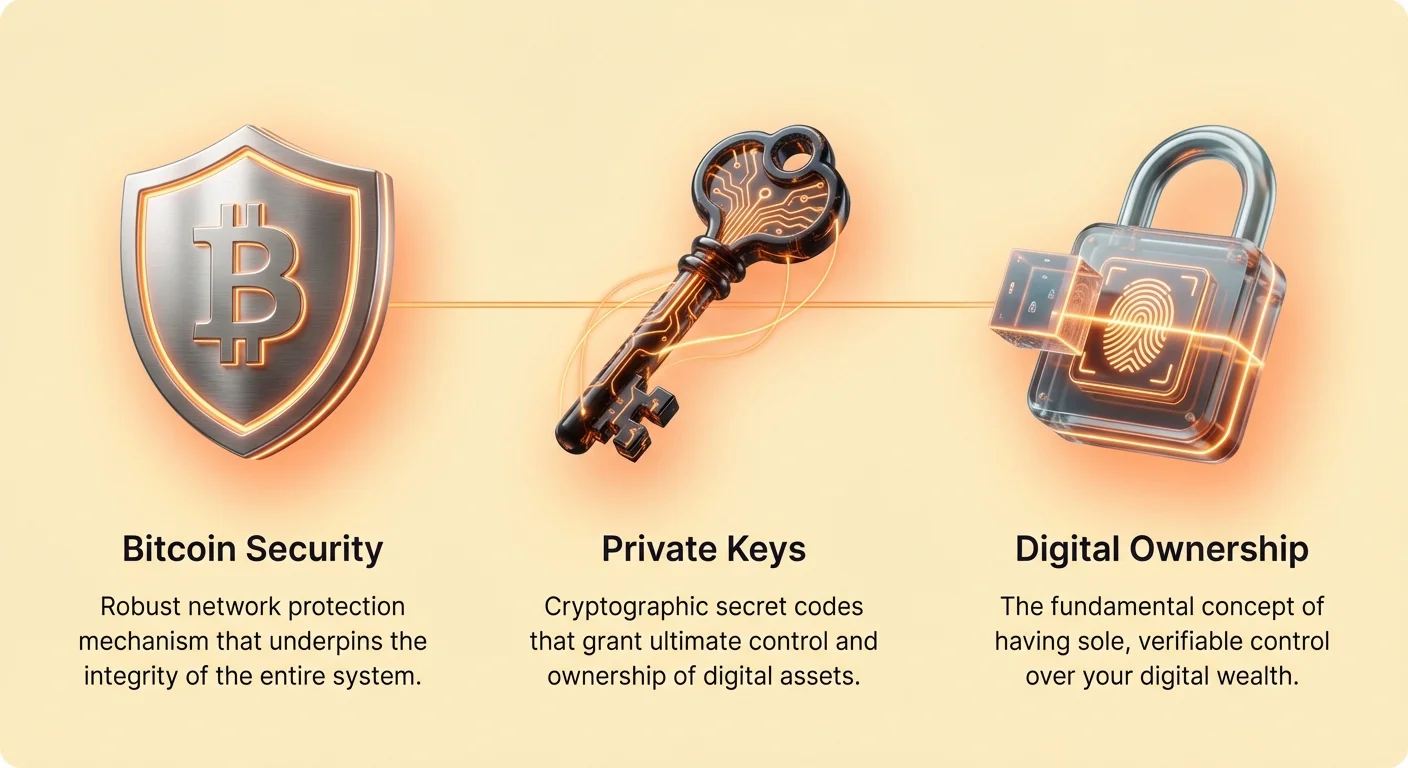
At the heart of every digital wallet lies the private key. This is a randomly generated string of characters, typically a 256-bit number, that functions as the ultimate password for your assets. It is the mathematical proof of ownership. Anyone who possesses this key has full control over the funds associated with it. They can sign transactions, move funds, and effectively become the owner of the assets. For a comprehensive guide, review The Private Key Primer.
Because raw private keys are long and difficult for humans to handle, modern wallets use a recovery phrase. This is a list of 12 to 24 random words generated by the wallet software. This sequence acts as a human-readable version of your master key. It allows you to reconstruct your wallet and regain access to your funds on any compatible device. Safeguarding this phrase is identical to safeguarding the private key itself.
Public Addresses and Transactions
While the private key must remain secret, the public key is designed to be shared. Your wallet derives the public key from your private key using cryptographic functions. This public key is then hashed to create your wallet address. You can think of the address as a mailbox where anyone can deposit letters or funds. The private key is the unique key that opens the mailbox to retrieve or send the contents.
When you initiate a transaction, your wallet uses the private key to create a digital signature. This signature proves to the network that you have the authority to move the funds without revealing the private key itself. The network verifies the signature against your public key. If they match, the transaction is approved and added to the blockchain. This process ensures that ownership can be verified publicly while control remains private.
Custodial Versus Self-Custodial Models
The Traditional Custodial Approach
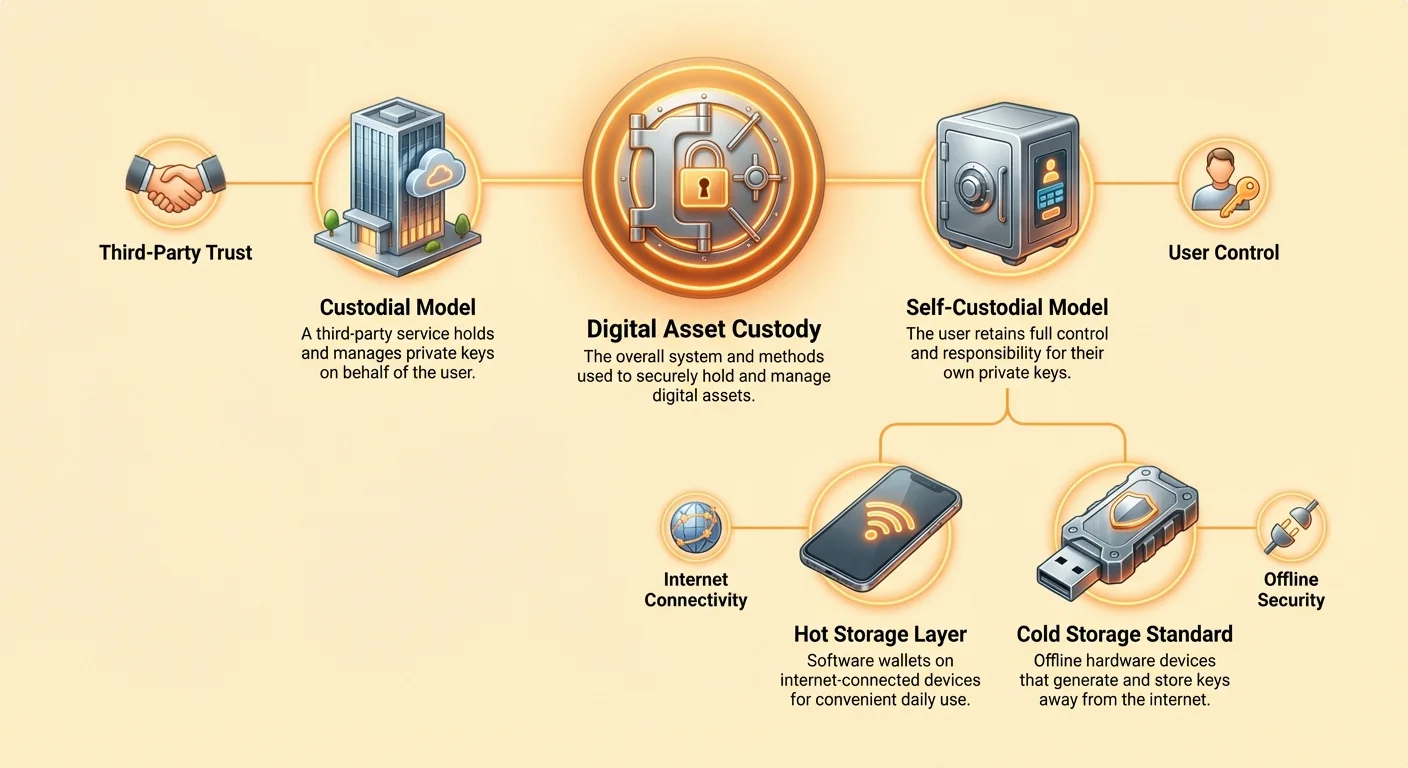
Custodial wallets are services where a third party holds the private keys on your behalf. This model mirrors traditional banking. When you use a centralized exchange or a brokerage app, you are trusting that company to secure your funds, relying on their third-party security guarantees. You log in with a username and password, and the company manages the underlying blockchain interactions.
The primary advantage of this model is familiarity. If you forget your password, you can contact customer support to reset it. However, this convenience comes with significant trade-offs. You do not technically control your cryptocurrency; you have a claim against the company. If the exchange halts withdrawals, goes bankrupt, or falls victim to a hack, you may lose access to your assets.
The Power of Self-Custody
Self-custodial wallets, also known as non-custodial wallets, place full control in your hands. No third party has access to your private keys. You do not need to ask for permission to transact, and no account approval process exists. Anyone can download a self-custodial wallet app and begin using it immediately. This model aligns with the core ethos of cryptocurrency: peer-to-peer value transfer without intermediaries.
This autonomy protects you from third-party risks. Governments or corporations cannot freeze your specific wallet or deny you service based on your location or financial activities. In history, there have been instances where traditional financial systems restricted access to funds during economic crises, such as in Greece in 2015. Self-custody ensures that you remain the sole proprietor of your assets regardless of institutional stability.
| Feature | Custodial Wallet | Self-Custodial Wallet |
|---|---|---|
| Key Control | Third-party holds keys | You hold keys |
| Recovery | Customer support reset | Recovery phrase only |
| Censorship | Account can be frozen | Cannot be frozen |
Software Wallets: The Hot Storage Layer
Accessibility and Connectivity
Software wallets, often called "hot wallets," are applications that run on internet-connected devices like smartphones, desktops, or web browsers. They are popular because they are often free, easy to install, and highly convenient for daily use. Because they reside on devices we use constantly, they make spending or trading crypto as easy as sending an email.
These wallets are ideal for managing smaller amounts of cryptocurrency meant for active use. They often support a wide range of digital assets and can interact directly with decentralized applications (dApps). This connectivity allows users to engage in decentralized finance (DeFi), play blockchain-based games, or manage non-fungible tokens (NFTs) directly from the wallet interface.
Security Considerations for Hot Wallets
The constant connection to the internet is the primary vulnerability of hot wallets. Because the private keys are generated and stored on a device that goes online, they are theoretically susceptible to malware, viruses, and remote hacking attempts. If a computer or smartphone is compromised, attackers could potentially extract the private keys or manipulate transactions.
Despite these risks, modern software wallets employ strong encryption and security measures. Many use biometric authentication, such as fingerprint or facial recognition, to prevent unauthorized physical access. For most users, the risk is manageable for small amounts, provided they follow good security hygiene. However, storing life-changing amounts of wealth on a hot wallet is generally discouraged compared to offline alternatives.
Hardware Wallets: The Cold Storage Standard
Offline Key Generation
Hardware wallets are physical devices designed specifically to secure cryptocurrency private keys. These devices look like USB drives and generate private keys in an offline environment. This method, known as cold storage, ensures that the keys never touch the internet. Even when the device is plugged into a computer to manage funds, the keys remain isolated within the device's secure element. For a technical breakdown, read our hardware wallet deep dive.
This isolation protects against almost all forms of remote hacking. A virus on your computer cannot read the keys stored on the hardware wallet. This makes hardware wallets the gold standard for long-term storage of significant value. They provide peace of mind that software wallets cannot match, as the attack surface is drastically reduced.
The Transaction Signing Process
When you want to send funds using a hardware wallet, the process involves a physical confirmation. You initiate the transaction on your computer or phone interface. The unsigned transaction data is sent to the hardware wallet. The device then uses its internal private key to sign the transaction offline.
Once signed, the device sends only the valid signature back to the computer, which broadcasts it to the blockchain network. At no point does the private key leave the device. You typically must press a physical button on the hardware wallet to confirm the action. This physical requirement means a hacker would need to physically steal your device and know your PIN to move your funds.
Multi-Signature Vaults: Distributed Trust
How Multisig Works
Multi-signature, or multisig, technology adds an advanced layer of security by requiring multiple approvals for a transaction. A standard wallet is a "single-signature" wallet, meaning one key is enough to authorize spending. A multisig wallet is like a vault with two or more keyholes. You can configure it to require a specific number of keys to open.
For example, a "2-of-3" multisig wallet involves three private keys, and any two of them are required to sign a transaction. These keys can be stored on different devices or held by different people. This setup eliminates the single point of failure. If one key is lost or stolen, the funds remain secure because the attacker cannot move them without the second key.
Use Cases for Shared Control
Multisig wallets are excellent for organizational treasuries and family security. A company can set up a wallet where board members hold keys, and a majority must agree to release funds. This prevents any single employee from embezzling assets. It creates a system of checks and balances that is enforced by the blockchain code itself. Review our guide on practical multisig use cases for more examples.
For individuals, multisig offers redundancy. You might hold one key on your phone, one on a hardware wallet, and keep a third backup key in a safe deposit box. If you lose your phone, you can still recover your funds using the hardware wallet and the backup. This setup protects you from both theft and accidental loss of keys.
The Critical Role of Backups
Managing Recovery Phrases
Regardless of the wallet type, backups are the ultimate safety net. For most self-custodial wallets, this backup takes the form of the recovery phrase mentioned earlier. Writing this phrase down on paper and storing it securely is the traditional advice. You should never store this phrase digitally, such as in a screenshot or text file, as that exposes it to online threats.
However, managing physical paper backups can be onerous. Paper can degrade, be lost, or be destroyed by fire or water. Furthermore, users with multiple wallets for different blockchains may find themselves managing several different phrases. If a user loses the paper backup and the device breaks, the funds are lost forever. There is no "forgot password" link for a manual recovery phrase.
Automated Cloud Backup Solutions
To address the usability challenges of manual backups, some modern wallets offer automated cloud backup services. This system encrypts the wallet's recovery data and stores it in a personal cloud account, such as Google Drive or iCloud. The encryption is secured by a custom password that only the user knows.
This approach creates a balance between security and convenience. If you lose your device, you simply reinstall the app on a new phone, log into your cloud account, and enter your decryption password. This restores access to all your crypto assets without needing to type in 12 or 24 words. While it introduces a dependency on the cloud provider, the encryption ensures the provider cannot access the funds.
Evaluating Wallet Features
Fee Customization
When choosing a custody layer, consider how the wallet handles network fees. Transactions on blockchains require fees paid to miners or validators. The best wallets allow you to customize these fees. You might choose a "fast" setting with a higher fee for urgent transactions or a "slow" setting to save money when time is not a factor.
Advanced wallets provide granular control, letting you set the exact price you are willing to pay. This is particularly useful during periods of high network congestion. Wallets that do not offer fee customization may default to high rates, causing you to overpay for simple transfers.
Reputation and History
The reputation of the wallet provider is paramount. Since wallet software manages critical secrets, any bug or malicious code could result in total loss. You should look for wallets with a long track record of security and positive community feedback. Open-source wallets allow independent developers to audit the code, which increases trust.
Researching user reviews on app stores and forums can reveal potential issues. A wallet that has been active for years with millions of users is generally a safer bet than a brand-new application. Established providers often have rigorous testing procedures and update their software regularly to patch vulnerabilities.
Conclusion
Navigating the landscape of digital asset custody requires balancing security with usability. No single solution fits every scenario. For daily spending and interacting with decentralized applications, a reputable mobile wallet offers the necessary speed and convenience. For long-term savings, hardware wallets provide the robust offline protection required to sleep soundly at night. Advanced users and organizations may find the distributed security of multi-signature vaults to be the most appropriate choice, depending on the need, making matching wallet choice essential.
Ultimately, the shift to self-custody empowers you to be your own bank, but it also demands that you act as your own security guard. Whether you choose a hot wallet, a cold storage device, or a complex multisig setup, the safety of your funds depends on how well you manage your keys and backups. By understanding the trade-offs of each method and adhering to best practices, you can confidently secure your digital future.
The most secure wallet is the one you understand how to use correctly.