
Entering the cryptocurrency market for the first time involves more than just a financial transaction. It requires a fundamental decision about how you intend to interact with the digital asset ecosystem. Unlike traditional banking where a single institution handles custody, transfer, and security, the crypto landscape offers multiple entry points. Each entry point dictates a different level of responsibility, privacy, and control over your funds.
The process of acquiring your first digital asset usually follows one of three distinct paths. You might choose a centralized exchange, which mimics a traditional stock brokerage. You could opt for a peer-to-peer marketplace, which functions more like a digital classifieds section with safety mechanisms. Alternatively, you might use a non-custodial wallet app to purchase directly from a third-party provider without leaving your personal interface.
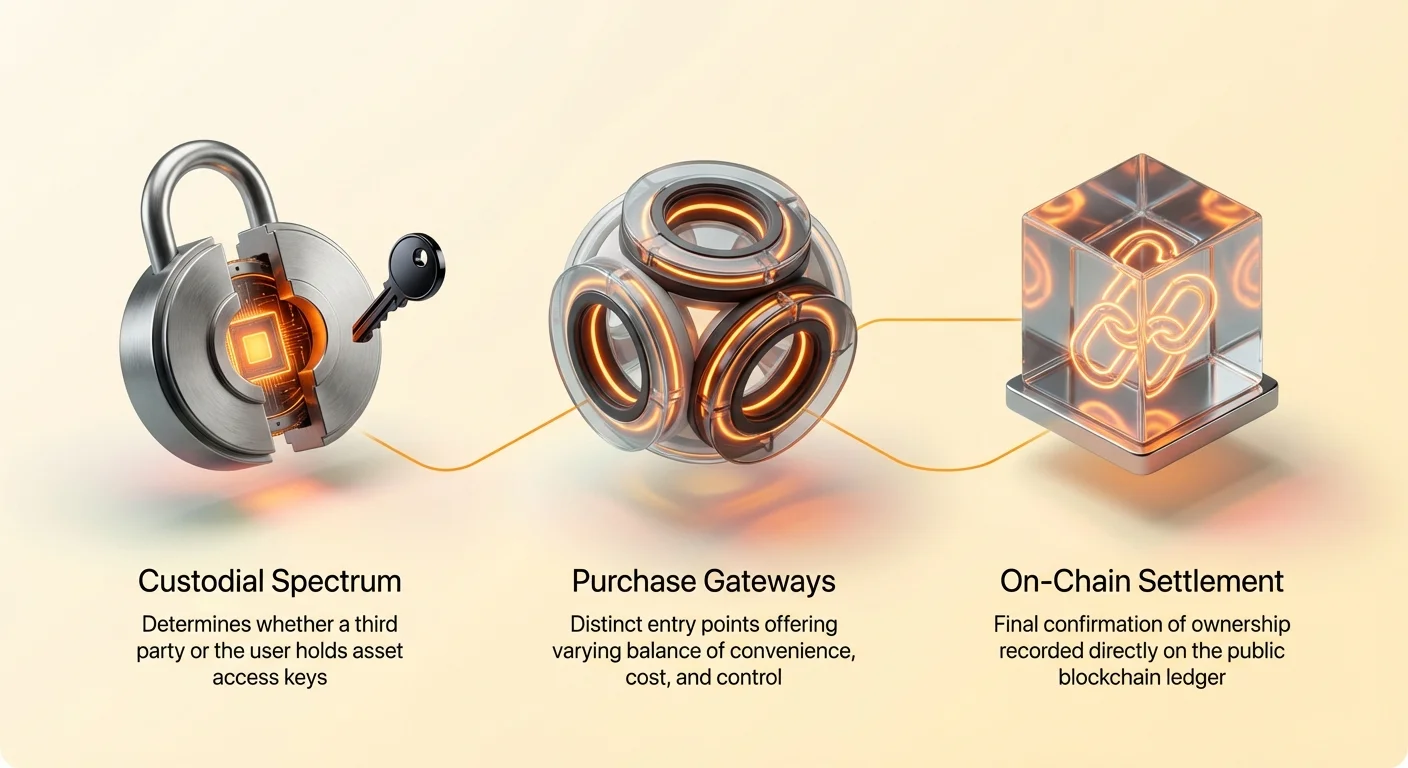
Understanding these flows is critical because they determine where your assets sit immediately after purchase. This distinction affects everything from security risks to how quickly you can actually use the funds. The choice you make for your first purchase often sets the precedent for how you manage your digital wealth moving forward. It is a balance between convenience, cost, and the philosophical ethos of decentralization.
The Foundation: Custody and Control
Before examining the specific buying methods, it is necessary to understand the concept of custody. In the world of Bitcoin and other cryptocurrencies, custody refers to who holds the keys to the assets. This is the most significant differentiator between the various purchasing flows.
Custodial Services vs. Self-Custody
When you use a custodial service, you are trusting a third party to secure your digital assets. This model is similar to a traditional bank. You have a login and password to access an account, but the institution holds the actual funds. In crypto terms, they hold the private keys. If the institution pauses withdrawals or suffers a security breach, you may lose access to your holdings.
Self-custody, or non-custody, means you possess the private keys yourself. There is no middleman to block transactions or freeze accounts. The responsibility for security falls entirely on you. If you lose your access credentials, no customer support agent can restore them. This model offers total financial sovereignty but requires a higher degree of user education and personal responsibility.
The Role of Private Keys
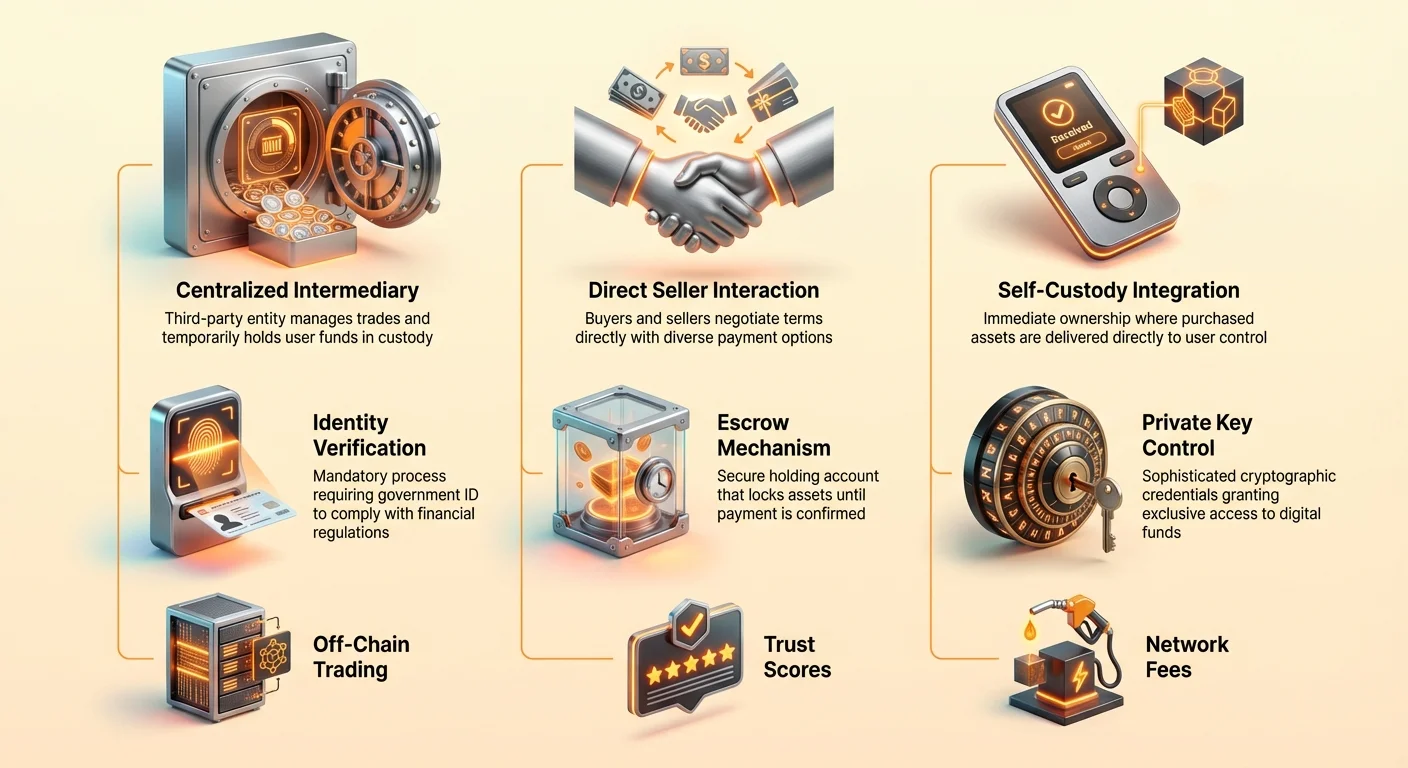
A private key is essentially a sophisticated password that grants access to your digital funds. It is a long string of alphanumeric characters or a set of words known as a recovery phrase. In a self-custodial wallet, this key is generated on your device and encrypted.
When you buy through a centralized entity, you do not see this key. You only see a balance on a screen. When you buy through a self-custodial wallet, the transaction settles directly onto the blockchain at an address controlled by your private key. Understanding this distinction clarifies why buying methods differ so drastically in terms of security and utility.
Method 1: Centralized Exchanges (CEX)
Centralized exchanges act as intermediaries between buyers and sellers. They are often the first port of call for newcomers because they offer a familiar user experience. The interface typically resembles online banking or stock trading platforms.
The Onboarding Experience
To use a centralized exchange, you must first create an account. This involves providing an email address and creating a password. Once the account is active, you usually cannot trade immediately. You must link a funding source, such as a bank account, credit card, or debit card.
The platform holds any fiat currency you deposit until you execute a trade. When you decide to buy Bitcoin or another asset, the exchange matches your buy order with a sell order from another user or from its own liquidity pool. The transaction occurs off-chain within the exchange's internal database. This means the blockchain does not record the transaction immediately; the exchange simply updates your account balance.
Identity Verification Protocols
Regulated exchanges must comply with strict financial laws. This compliance introduces a step known as Know Your Customer (KYC). Users are required to verify their identity by uploading government-issued identification, such as a passport or driver’s license. Sometimes, a selfie or proof of address is also necessary.
This process can take anywhere from a few minutes to several days, depending on the platform's efficiency and backlog. While this adds a layer of friction, it provides a safeguard against money laundering and fraud. For users who prioritize privacy, handing over sensitive personal data to a centralized entity is a significant drawback of this buying method.
Liquidity and Withdrawal Restrictions
The primary advantage of centralized exchanges is liquidity. Because they aggregate millions of users, it is easy to buy or sell large amounts of cryptocurrency without significantly impacting the price. They also offer advanced trading features like limit orders and margin trading.
However, purchasing on an exchange means the assets remain in the exchange's wallet, not yours. To take full control, you must initiate a withdrawal to a personal wallet. This step often incurs a withdrawal fee and can be subject to delays. Exchanges may pause withdrawals during periods of high volatility or for security audits, leaving your funds temporarily inaccessible.
Method 2: Peer-to-Peer (P2P) Marketplaces
Peer-to-peer trading platforms take a different approach. Instead of matching orders automatically through an order book, they connect buyers directly with sellers. This method functions like a marketplace where individuals post advertisements offering to sell crypto at specific prices and payment terms.
Direct Interaction and Negotiation
In a P2P flow, you browse listings to find a seller who accepts your preferred payment method. These methods are vastly more diverse than standard exchanges. You might find sellers accepting bank transfers, digital payment apps, gift cards, or even cash in person.
Once you select a seller, you initiate a trade request. The terms are often negotiable, but the price may differ from the global spot price. Sellers often charge a premium for the convenience and privacy they offer. This lack of deep liquidity means it can be harder to fill very large orders instantly compared to a centralized exchange.
The Role of Escrow Services
Safety in P2P transactions is maintained through an escrow service provided by the platform. When a trade is initiated, the seller’s cryptocurrency is locked in a secure holding account. The seller cannot run away with the coins, and the buyer cannot receive them until payment is confirmed.
The buyer sends the agreed fiat payment directly to the seller using the chosen method. Once the seller confirms receipt of the funds, the platform releases the crypto from escrow to the buyer’s wallet. If there is a disagreement, such as a seller claiming they never received payment, the platform steps in to mediate the dispute using evidence like bank receipts.
Privacy and Reputation Systems
P2P platforms often require less stringent identity verification than centralized exchanges, specifically for smaller amounts. This appeals to users seeking greater privacy. However, because you are dealing with strangers, trust is established through reputation systems.
Platforms track user history, displaying statistics on completed trades and feedback scores. Buyers are encouraged to trade only with sellers who have high completion rates and positive reviews. While this mitigates risk, the possibility of encountering scams remains higher than on regulated centralized exchanges, requiring users to be more vigilant.
Method 3: In-Wallet Purchasing
Modern self-custody wallets have integrated purchasing capabilities directly into their interfaces. This method bridges the gap between the convenience of an exchange and the security of self-custody. It effectively removes the step of withdrawing funds from an exchange to a private wallet.
The Self-Custody Advantage
When you buy through a wallet app, the purchased assets are delivered directly to an address you control. There is no intermediate stage where a third party holds your coins. This aligns with the core philosophy of cryptocurrency: eliminating counterparty risk.
Because the wallet is non-custodial, you do not need to ask for permission to move your funds after the purchase is complete. You can send them to another address, use them for payments, or interact with decentralized finance (DeFi) protocols immediately. This immediacy is a significant benefit for users who intend to use their crypto rather than just speculate on its price.
Integration with Payment Providers
Wallet developers typically partner with third-party payment processors to facilitate these transactions. When you click "Buy" in a wallet app, you are technically interacting with an integrated service. These processors handle the fiat side of the transaction, accepting credit cards or bank transfers.
The integration is usually seamless, meaning you do not leave the app environment. However, the underlying payment processor will still require identity verification. Even though the wallet itself does not collect your data, the fiat on-ramp provider must comply with financial regulations.
Comparing Speed and Fees
In-wallet purchases are generally designed for speed and ease of use. They are ideal for users who want to acquire moderate amounts of crypto quickly and secure it immediately. The trade-off is often cost.
The convenience of direct-to-wallet purchasing can come with higher fees compared to the spot market rates found on professional trading exchanges. You are paying for the combined service of the payment processor and the network fees required to send the assets on-chain immediately. For many users, the slight premium is worth the elimination of withdrawal steps and the assurance of self-custody.
Comparing the Workflows
Choosing between these methods depends on what you value most: cost, convenience, or control. Centralized exchanges favor active traders who need low fees and advanced tools. P2P platforms favor those needing payment flexibility or privacy. In-wallet purchases favor long-term holders who prioritize security and ownership.
| Feature | Centralized Exchange (CEX) | P2P Marketplace | In-Wallet Purchase |
|---|---|---|---|
| Custody | Third-party holds funds | Self-custody or Web wallet | Self-custody immediately |
| Privacy | Low (Strict KYC) | Medium/High (Depends on seller) | Medium (Processor KYC) |
| Speed | Fast trading, slow withdrawal | Varies by payment method | Fast settlement |
| Fees | Generally lowest | Variable premiums | Convenience fees apply |
| Payment Types | Bank/Card | Diverse (Cash, Gift Cards) | Card/Bank/Apple Pay |
| Difficulty | Medium (Brokerage style) | High (Manual interaction) | Low (Streamlined) |
The Mechanics of the Transaction
Regardless of the method chosen, the underlying technology of Bitcoin and other cryptocurrencies remains the same. When assets move from a seller or exchange to your personal wallet, the transaction occurs on the public blockchain.
Public Addresses and Transactions
To receive cryptocurrency, you must provide a destination. This is your public address, a string of characters derived from your public key. It functions similarly to an email address or bank account number. You can safely share this address to receive funds.
Most wallets display this address as a QR code to prevent transcription errors. When purchasing from an exchange or P2P seller, you will often need to copy and paste this address into a withdrawal field. If you are buying directly within a wallet app, the software automatically detects your address, eliminating the risk of sending funds to the wrong location.
Network Fees and Miners
Every transaction on the blockchain requires a network fee. This fee is not paid to the wallet provider or the exchange, but to the miners or validators who secure the network. These fees act as an incentive for miners to include your transaction in the next block. In times of high network congestion, fees can rise. Exchanges often batch withdrawals to save on these costs, but when you manage your own wallet, you are responsible for the fee. Advanced wallets allow you to customize this fee based on how urgently you need the transaction confirmed.
In times of high network congestion, fees can rise. Exchanges often batch withdrawals to save on these costs, but when you manage your own wallet, you are responsible for the fee. Advanced wallets allow you to customize this fee based on how urgently you need the transaction confirmed. Higher fees generally result in faster processing times.
Block Confirmations
Unlike a credit card authorization which happens in seconds, blockchain transactions require confirmation. A confirmation occurs when a transaction is included in a block and added to the blockchain. For Bitcoin, a new block is mined roughly every ten minutes.
When you receive funds from a P2P trade or a withdrawal, the balance may appear as "pending" or "unconfirmed" initially. It is standard practice to wait for a certain number of confirmations (often three to six) before considering the transaction final. This irreversibility is a hallmark of crypto transactions; once sent, they cannot be clawed back like a credit card chargeback.
Security Considerations
The freedom of managing your own assets comes with risks that do not exist in traditional finance. Understanding these risks is as important as understanding the buying process.
Exchange Vulnerabilities
Centralized exchanges are prime targets for hackers because they hold vast amounts of user funds in "hot wallets" connected to the internet. While security standards have improved, high-profile hacks and insolvencies still occur. Leaving funds on an exchange for long periods exposes you to the risk that the platform might fail.
If you choose to buy via an exchange, it is highly recommended to move significant holdings to a self-custody wallet. This practice mitigates the risk of third-party failure. Additionally, enabling strong security measures like two-factor authentication (2FA) on your exchange account is mandatory to prevent unauthorized access.
Backups and Seed Phrases
For self-custody wallets, the primary risk is the loss of the private key or recovery phrase. This phrase is a list of 12 to 24 random words generated when you create the wallet. It is the only way to restore access to your funds if your device is lost, stolen, or damaged.
Best practices dictate writing this phrase down on paper and storing it in a secure, physical location. Never store it digitally on a cloud drive or take a screenshot, as these can be compromised by malware. Some modern wallets offer encrypted cloud backups, which simplify this process by allowing you to use a password to decrypt a file stored in your personal cloud account.
Identifying Fraud
The irreversible nature of crypto transactions makes fraud detection vital. Phishing attacks are common, where scammers create fake websites that look identical to legitimate exchanges or wallet providers. These sites trick users into entering their login credentials or recovery phrases.
Always verify the URL of the website you are visiting. Be skeptical of unsolicited messages on social media or email that promise giveaways or ask for help with transactions. Legitimate wallet providers and exchanges will never ask for your private keys or recovery phrase. If a deal sounds too good to be true, especially in P2P markets, it almost certainly is.
Understanding Denominations
New investors often face psychological barriers regarding the price of a single unit of cryptocurrency. This is known as unit bias. When a single Bitcoin is priced in the tens of thousands of dollars, it can feel unaffordable.
The Concept of Divisibility
It is a common misconception that you must buy a whole coin. Cryptocurrencies are highly divisible. Bitcoin, for instance, can be divided into 100 million smaller units called satoshis (or sats). You can purchase a fraction of a Bitcoin for as little as a few dollars.
This divisibility applies to almost all digital assets. Whether you buy via an exchange, P2P, or wallet, you enter the amount you wish to spend in your local currency (e.g., $100). The system calculates the exact fraction of the crypto asset you will receive. Understanding this helps users focus on the percentage gain or loss of their investment rather than the arbitrary price of a whole unit.
Post-Purchase Management
Once the purchase is complete and the funds are in your wallet, the flow is not over. You must now manage the asset. This involves monitoring the balance, ensuring the wallet software is up to date, and perhaps utilizing the asset for payments.
Wallet apps allow you to create multiple sub-wallets to organize funds. You might separate savings from spending money. If you used an exchange, you should double-check that the withdrawal address matches your wallet exactly. Regular auditing of your security settings and backup mechanisms ensures that your digital wealth remains accessible only to you.
Conclusion
Navigating the first purchase of cryptocurrency is a gateway to understanding the broader concepts of decentralized finance. Whether you choose the familiar path of a centralized exchange, the direct route of a P2P marketplace, or the integrated security of an in-wallet purchase, the end goal is the same: establishing ownership of a digital asset.
Each method offers a distinct trade-off between ease of access and control. Exchanges provide a bridge from the traditional financial world but require trust in a central entity. P2P markets offer privacy and flexibility but demand vigilance. Self-custody wallets provide the truest form of ownership but place the burden of security squarely on the user. Understanding these dynamics ensures that your entry into the market is safe, secure, and aligned with your financial goals.
The most secure path for most users is purchasing directly into a self-custody wallet to ensure immediate ownership.