
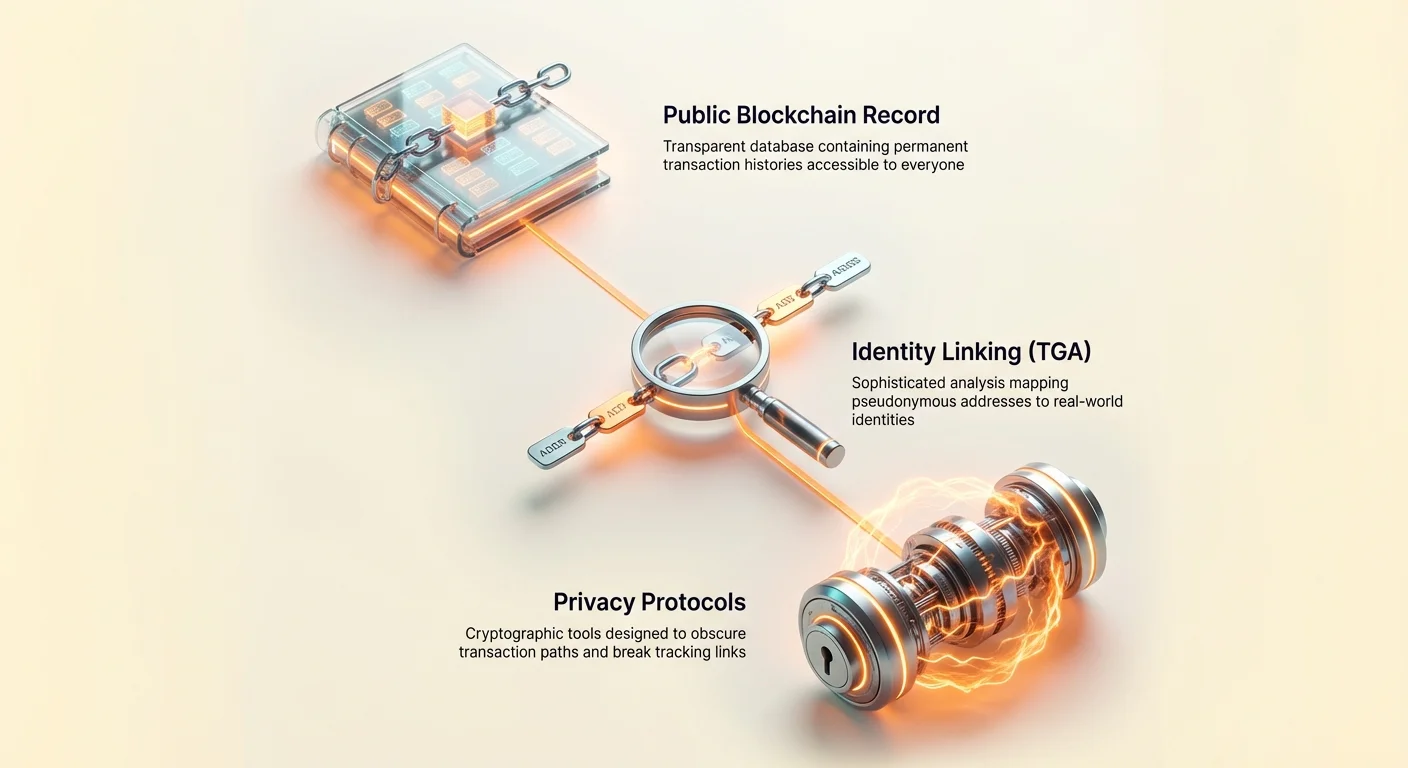
When users first enter the world of decentralized finance, they often encounter the term "anonymous." However, a critical distinction must be made: default cryptocurrencies like Bitcoin and Ethereum are not anonymous; they are pseudonymous. Every single transaction, its amount, and its destination are permanently recorded on a public, immutable ledger. While this ledger uses wallet addresses instead of names, sophisticated tracking tools can often link these addresses back to real-world identities.
For those dedicated to financial self-sovereignty, privacy is paramount. It protects wealth from unwanted scrutiny, shields businesses from competitor analysis, and ensures personal transactions remain private, much like cash. This need has driven the development of advanced tools—Privacy Wallets and Mixer Protocols—designed to obscure transactional history and reclaim anonymity.
This guide explores the technological mechanics of these tools, contrasts their underlying principles (CoinJoin vs. Zero-Knowledge Proofs), and critically assesses the significant regulatory and compliance risks that accompany their use. Understanding these trade-offs is essential for anyone seeking to utilize advanced privacy techniques in the current global financial climate.
The Illusion of Anonymity: How Crypto Transactions Are Tracked
To appreciate the need for privacy tools, we must first understand how conventional cryptocurrency transactions are tracked and de-anonymized.
The Public Ledger and Pseudonymity
The Bitcoin and Ethereum networks operate on transparent blockchains. A blockchain is essentially a public database that anyone can view. While you do not see the name "Jane Doe" making a transfer, you see an alphanumeric address (a pseudonym) sending a specific amount of crypto to another address at a specific time.
This pseudonymous nature means that if an attacker or tracking entity can link just one of your addresses to your real identity—perhaps through a Know Your Customer (KYC) check when buying crypto on a centralized exchange (CEX)—they can begin mapping your entire financial history on that chain.
Understanding Transaction Graph Analysis (TGA)
The primary method used by forensic firms and regulators to de-anonymize transactions is Transaction Graph Analysis (TGA). TGA is a sophisticated method of data analysis used to follow the flow of funds across the blockchain.
How TGA Works:
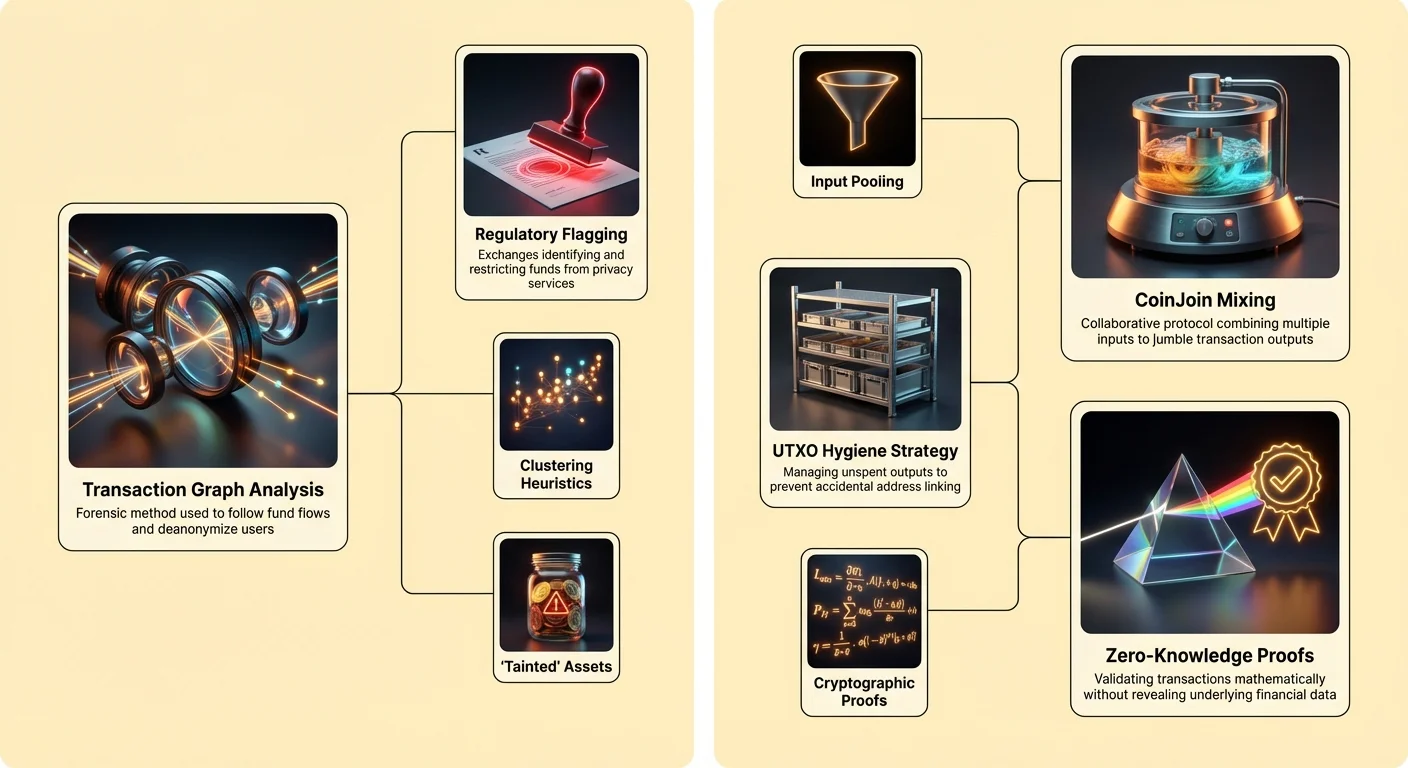
- Clustering: Analysts treat transactions as nodes on a map. They use heuristic rules (common assumptions about how people spend money) to cluster multiple addresses likely controlled by the same entity. For example, if a transaction uses multiple input addresses to fund a single output, those input addresses are usually deemed to belong to the same wallet owner.
- Chaining: Once clusters are identified, the analysts follow the chain of funds forward and backward.
- Identity Link: The key step is linking a cluster to a real identity. This often happens when funds move into or out of a regulated service (like a major centralized exchange) which has mandatory KYC documentation associated with specific addresses.
TGA creates a comprehensive, often permanent, record of where funds came from and where they went. Privacy tools exist specifically to break these clusters and obscure the path, rendering TGA ineffective.
Technological Pillars of Anonymity: Wallets vs. Protocols
Privacy solutions generally fall into two categories: those built into specialized wallets and blockchains, and those implemented as external protocols that can be layered onto existing chains.
Category 1: Wallets with Built-in Privacy Features (Privacy Coins)
The most robust form of crypto privacy comes from networks designed from the ground up to be confidential. These networks use dedicated privacy coins and require specialized wallets to handle their unique cryptography.
Examples of Built-in Privacy:
- Monero (XMR): Achieves privacy through three main methods: Ring Signatures (hiding the sender), Ring Confidential Transactions (hiding the amount), and Stealth Addresses (hiding the receiver). All transactions are private by default, making TGA nearly impossible.
- Zcash (ZEC): Offers both transparent (public) and "shielded" (private) transactions. The shielded transactions utilize a highly advanced cryptographic technique known as Zero-Knowledge Proofs (ZKPs) to verify transfers without revealing the transaction details. Privacy wallets for Zcash must be able to compute these complex proofs.
The advantage of this category is that privacy is mandatory or the default setting, meaning the network is inherently resistant to tracking. The drawback is that these coins often face tighter regulatory scrutiny and are less liquid than major assets like Bitcoin or Ethereum.
Category 2: External Mixer Protocols (The Add-on Approach)
These protocols, often referred to as "mixers" or "tumblers," are external services or software layers applied to existing transparent blockchains (primarily Bitcoin and sometimes Ethereum). They aim to interrupt the link between the origin and destination of funds without changing the underlying protocol.
The most famous example is CoinJoin. Users retain custody of their funds but temporarily combine their transaction inputs with others in a large "mixing pool." The resulting output is a transaction where all participants receive their original amount back, but from a set of inputs that cannot be deterministically matched to the corresponding outputs.
The advantage here is that users can gain privacy on the most established networks (Bitcoin). The primary disadvantages are potential centralized control (if the coordinator is malicious) and, increasingly, regulatory risk, which views these protocols as high-risk tools.
Deep Dive: CoinJoin and the Concept of Collaborative Privacy
CoinJoin is an essential concept for Bitcoin privacy advocates. It is not a centralized service but rather a protocol that allows multiple users to combine their transaction inputs into a single, massive transaction.
How CoinJoin Works to Break Transaction History
Imagine four people, Alice, Bob, Carol, and David, each want to send 1 BTC, but they do not want external observers to know who received their specific coin.
- Coordination: They agree to participate in a CoinJoin transaction managed by a coordinator (who helps organize the transaction but does not take custody of the funds).
- Input Pooling: All four users provide their 1 BTC inputs to the transaction builder.
- Output Generation: The transaction is constructed to have outputs corresponding to the requested amounts (e.g., four outputs of 1 BTC each). Critically, the inputs are completely jumbled relative to the outputs.
- Broadcast: When the combined transaction is signed and broadcasted to the blockchain, all outputs appear to have originated from the entire pool of inputs.
The Privacy Effect: To an external chain analysis firm, they see four inputs and four outputs of equal amounts. They cannot tell whether Alice’s original 1 BTC went to the first, second, third, or fourth output address. The transaction graph is effectively broken at this point because the deterministic link between the sender and receiver is lost within the transaction pool.
Limitations and Success Factors of CoinJoin
While effective, CoinJoin is not a perfect solution and relies heavily on user behavior and operational security (OpSec).
- Equal Amounts: CoinJoin is most effective when all participating amounts are equal (e.g., mixing 0.1 BTC with three other 0.1 BTC inputs). If one input is 10 BTC and the others are 0.1 BTC, it reduces the anonymity set because the 10 BTC input must correspond to the 10 BTC output.
- Anonymity Set Size: The privacy gained is directly proportional to the number of participants. A CoinJoin transaction with 100 participants provides far greater ambiguity (anonymity set of 100) than one with only 3 participants.
- Coordinator Risk: While the coordinator cannot steal the funds, a malicious or compromised coordinator could potentially log metadata (like IP addresses) that could later be used to de-anonymize participants, though this is a challenge for decentralized CoinJoin protocols.
- Transaction Fees and Time: Mixing requires coordination, which adds complexity, time, and typically higher transaction fees compared to a simple point-to-point transfer.
Deep Dive: Zero-Knowledge Proofs (ZKPs) for Full Confidentiality
Zero-Knowledge Proofs represent a revolutionary advance in cryptography that moves beyond collaborative mixing and instead focuses on mathematical certainty. ZKPs are the foundation of true, guaranteed transactional confidentiality.
What is a Zero-Knowledge Proof? (Simplified)
A Zero-Knowledge Proof is a method by which one party (the Prover) can prove to another party (the Verifier) that a specific statement is true, without revealing any information beyond the validity of the statement itself.
In the context of cryptocurrency, the "statement" is: "I possess sufficient funds to make this transfer, and I have the private key required to authorize it."
Using ZKPs, a user can prove the following to the network:
- They own the tokens being spent.
- The token amount being spent is valid (e.g., not minting new tokens).
- The destination address is valid.
Crucially, all of this is proven without revealing the sender's address, the receiver's address, or the specific transaction amount on the public ledger.
ZKPs in Action: Shielded Transactions
The best practical application of ZKPs for privacy today is Zcash’s implementation of shielded transactions.
When a user deposits Zcash into a "shielded pool," the funds are essentially encrypted. When they send a shielded transaction, the system generates a ZKP (often using complex protocols like zk-SNARKs or zk-STARKs) that satisfies the network’s consensus rules.
- Default Privacy: Unlike CoinJoin, which is an optional, collaborative step, ZKPs provide privacy as a foundational property of the transaction itself. There is no anonymity set to worry about; the transaction is mathematically opaque to all external observers.
- Auditability: Despite the confidentiality, ZKPs allow for selective disclosure. Owners of shielded funds can generate "viewing keys" which they can share with auditors or regulatory bodies. This allows the necessary third party to verify that the owner is compliant (e.g., paying taxes on earnings) without revealing the data to the rest of the world. This is often cited as the bridge between robust privacy and regulatory compliance.
The trade-off here is complexity and computational cost. Generating ZKPs is computationally intensive, requiring significant processing power and sometimes leading to larger, more expensive transactions than simple Bitcoin transfers.
Strategic Anonymity: Preventing Chain Analysis and Evasion Techniques
Advanced users seeking maximum privacy must move beyond simply using a tool and adopt a comprehensive strategy for managing their entire crypto lifecycle, focused on confusing the heuristics of TGA firms. This falls under advanced operational security (OpSec).
Best Practices for Wallet Management and UTXO Hygiene
The fundamental weakness TGA exploits is the reuse of addresses and the clustering of inputs. Strategic users must manage their Unspent Transaction Outputs (UTXOs) carefully.
What is a UTXO? When you receive Bitcoin, you don't receive a balance in an account; you receive "coins" that are designated as unspent outputs (UTXOs). When you spend 1 BTC from a wallet that received 5 BTC, you spend the entire 5 BTC UTXO and receive 4 BTC back as "change" to a new address. TGA analysts assume this change address is still controlled by you.
Hygiene Tips:
- Avoid Address Reuse: Never reuse a receiving address. Most modern privacy wallets generate a new address for every incoming transaction, but users must ensure they do not accidentally send funds back to an old address.
- Segregate Funds: Treat different UTXOs as separate buckets of money. Do not mix "clean" coins (those acquired via KYC exchanges) with "mixed" or "privacy-enhanced" coins in the same transaction. This prevents contamination, where clean coins can lend their identity to the entire transaction cluster.
- Separate Spending Histories: Maintain separate wallets (even on separate hardware devices) for different activities: investing, spending, and long-term storage.
Techniques for Evasion: Timing, Amounts, and Non-Standard Paths
Beyond UTXO management, true evasion involves deliberately introducing noise and complexity into the transaction graph.
- Slow Mixing (Time Delay): After using a mixing protocol like CoinJoin, immediately spending the output coin diminishes the privacy benefit. Analysts may simply follow the funds forward quickly. Strategic users introduce time delays (days or weeks) before spending the newly mixed coins, making the path harder to trace in real-time.
- Using Non-Standard Amounts: When receiving the mixed output, users often choose non-standard, randomized amounts rather than clean, round numbers (e.g., receive 0.09873 BTC instead of 0.1 BTC). This breaks the TGA heuristic that relies on clean, equal-amount outputs.
- Layer 2 and Cross-Chain Bridges: Moving funds off the main chain onto Layer 2 solutions (like the Lightning Network for Bitcoin) or bridging assets to different blockchains (like moving wrapped Bitcoin to a privacy-focused layer 1) creates "gaps" in the TGA tracking process. While the entrance and exit points may be known, the activity within the secondary network is often opaque to the main chain tracker.
- DCA (Dollar-Cost Averaging) Out: Rather than withdrawing a large lump sum from a mixed wallet, withdraw small, frequent amounts over time to further randomize the transaction graph fingerprint.
The Regulatory Landscape: Legal and Compliance Risks
The greatest challenge facing users of privacy tools is not technological but regulatory. While privacy is a right in many jurisdictions, global anti-money laundering (AML) and counter-terrorism financing (CTF) regulations have put technologies designed for anonymity under intense pressure.
The Case of Centralized Mixers and Regulatory Crackdowns
In the past, many mixing services were centrally operated, requiring users to send funds to a third party who would mix them and send them back (or to a recipient). These centralized services were extremely vulnerable to regulatory action. Governments have explicitly targeted such services, viewing them as crucial infrastructure for illicit finance, particularly in cases involving cybercrime, sanctions evasion, and ransomware.
While decentralized protocols like CoinJoin are harder to shut down because no central entity controls the funds, law enforcement actions set a strong precedent: financial privacy tools, regardless of their legitimate use, are considered high-risk infrastructure.
Personal Responsibility and KYC/AML Obligations
The core conflict is between the user's desire for privacy and the obligations imposed on regulated financial entities (like centralized exchanges and traditional banks).
The "Taint" Risk: When funds have passed through a recognized mixer protocol, centralized exchanges often label those funds as "tainted" or "high-risk."
- Flagging: Exchanges use their own TGA tools to identify mixed inputs.
- Risk Assessment: If a user attempts to deposit mixed coins, the CEX may flag the account, suspend the transaction, or even require additional, stringent KYC documentation regarding the source of the funds.
- De-Risking: Financial institutions, including banks that process fiat off-ramps from CEXs, operate under severe scrutiny. They prefer to "de-risk" by avoiding any customer associated with flagged funds, potentially impacting the user's ability to convert crypto back to fiat.
Jurisdictional Risk: The legal status of privacy tools varies globally. In highly regulated jurisdictions (like the US, EU, and UK), using tools specifically designed to circumvent AML/KYC tracking—even for entirely legitimate personal reasons—can lead to increased scrutiny and potential legal difficulty if the user cannot prove the source of funds if audited. For sophisticated investors and finance professionals, the reputational risk alone may outweigh the privacy benefit.
Conclusion
Transactional privacy is a fundamental component of financial self-sovereignty, allowing individuals to control their own data and financial history. Technologies like CoinJoin and Zero-Knowledge Proofs offer powerful, verifiable methods to break the surveillance capabilities of Transaction Graph Analysis. ZKPs offer a mathematically robust and arguably more compliant path (due to viewing keys), while CoinJoin offers an effective, collaborative method for users on Bitcoin.
However, the pursuit of anonymity must be balanced with the practical realities of the global regulatory environment. For those who seek advanced privacy, success is determined not just by choosing the best privacy wallet or protocol, but by rigorous operational security, careful management of UTXOs, and, most importantly, a clear understanding of the legal risks associated with moving funds across the compliance border between transparent and opaque financial systems. For the self-sovereign adopter, diligence is the most important defense.