
Introduction
The global financial system has long been fragmented, with banking networks operating in isolation and international transfers remaining slow and expensive. Stellar was created to address these specific inefficiencies. Launched in 2014, Stellar is a decentralized, open-source blockchain network designed to facilitate the movement of money across borders. Unlike many blockchain projects that focus on speculation or strictly digital ecosystems, Stellar aims to bridge the gap between traditional financial institutions and the emerging world of digital assets. Its primary mission is to foster financial inclusion by making payments faster, cheaper, and more accessible to individuals and businesses worldwide.
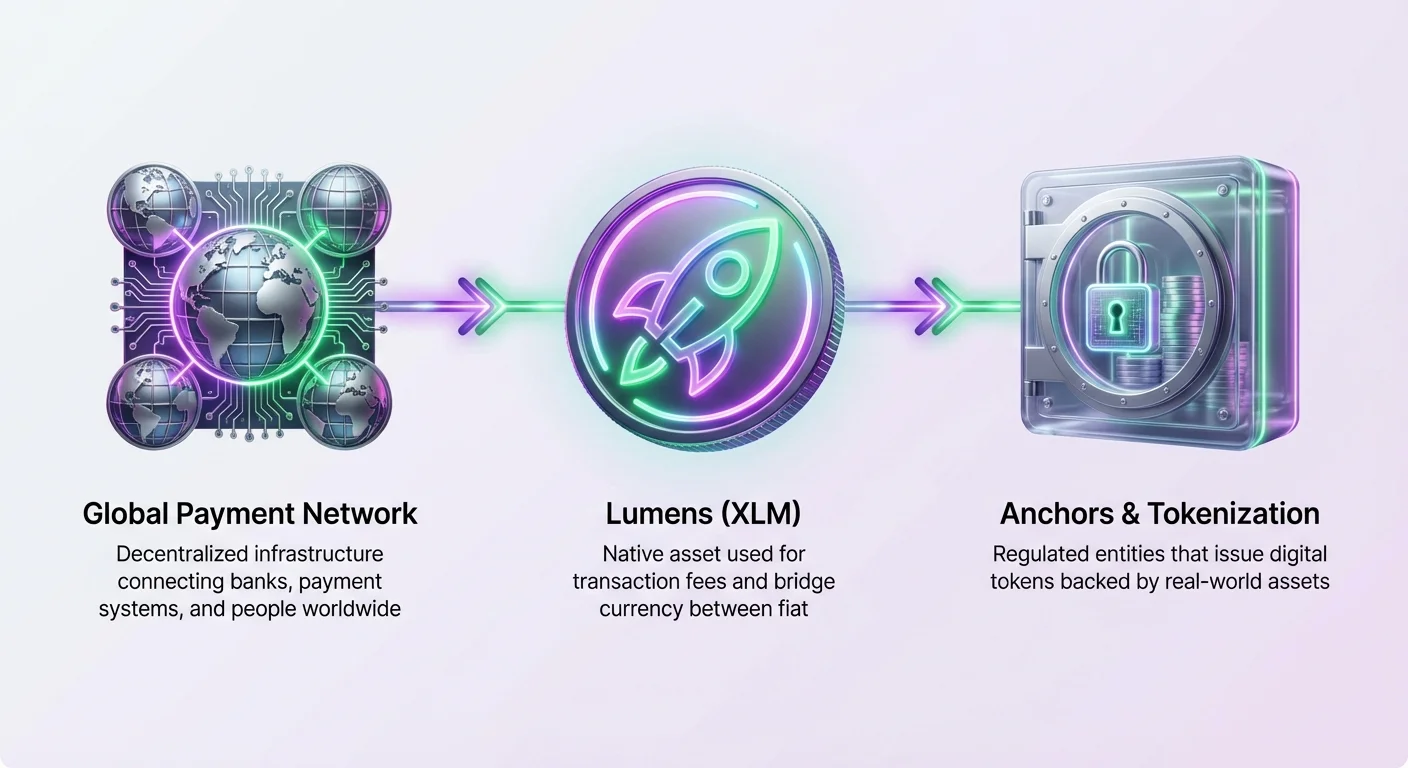
At its core, the network functions as a global transaction rail. It connects banks, payment systems, and people, allowing value to move as easily as email. The network supports the creation, sending, and trading of digital representations of all forms of money, from dollars and euros to Bitcoin. This flexibility allows it to serve as a unifying infrastructure for disparate financial systems. The platform is supported by a nonprofit organization, the Stellar Development Foundation, which guides its development and growth. This governance structure emphasizes transparency and open participation, differentiating it from profit-driven competitors.
The network’s native digital asset, the Lumen (XLM), plays a critical operational role in keeping the system efficient. However, the platform's true power lies in its ability to tokenize real-world assets and settle transactions in seconds. As the blockchain industry evolves, Stellar has expanded beyond simple payments. Recent technical upgrades in 2025 have introduced advanced smart contract capabilities and improved scalability, positioning the network as a robust foundation for decentralized finance and institutional asset management.
The Stellar Consensus Protocol
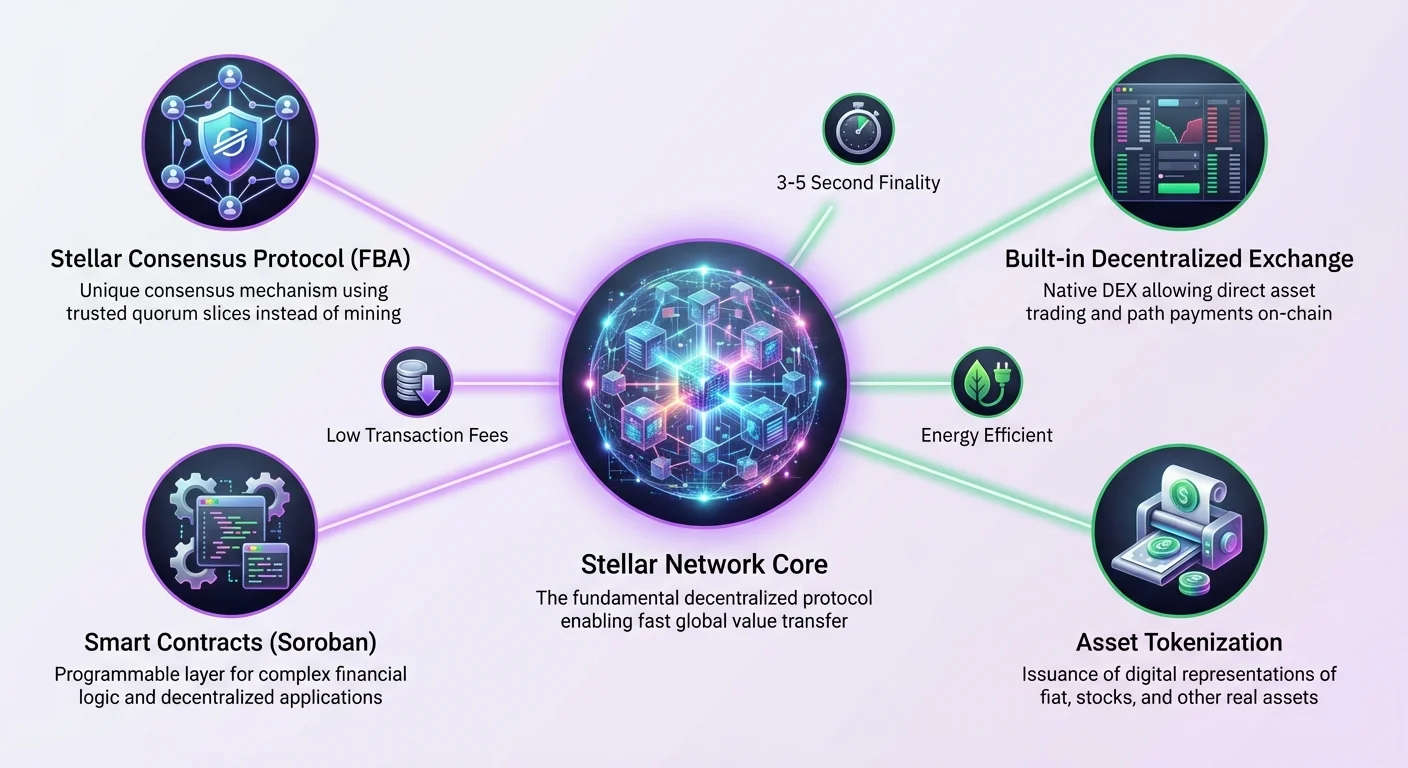
The engine driving the network is the Stellar Consensus Protocol (SCP). This mechanism is fundamentally different from the Proof-of-Work systems used by Bitcoin or the standard Proof-of-Stake models found in other chains. SCP is based on a concept called the Federated Byzantine Agreement. In this system, there is no mining and no single entity that decides which transactions are valid. Instead, the network relies on a cooperative process where independent nodes agree on the state of the ledger.
In a Proof-of-Work system, security is derived from raw computational power and energy expenditure. SCP achieves security through a web of trust relationships. Each participating node in the network selects a specific set of other nodes that it trusts to provide accurate information. These groups are known as "quorum slices." When a node observes that the trusted members of its quorum slice agree on a transaction set, it accepts that set as valid.
Because these individual slices overlap across the entire network, the system creates a unified global consensus. This approach allows Stellar to process transactions with exceptional speed. Blocks, or ledgers, are closed and confirmed within three to five seconds. This near-instant finality is a critical requirement for a payments-focused network, as it allows merchants and financial institutions to treat crypto transfers with the same immediacy as cash or credit card authorizations.
Energy Efficiency and Sustainability
A significant advantage of the Stellar Consensus Protocol is its environmental profile. Traditional mining operations require vast amounts of electricity to solve complex mathematical puzzles. In contrast, Stellar nodes communicate via simple messages to reach agreement. The energy required to run a node is roughly equivalent to running a standard computer server. This efficiency makes the network one of the most eco-friendly sustainable options in the blockchain space.
This sustainability is becoming increasingly important for enterprise partners. Major financial institutions and remittance companies are under pressure to reduce their carbon footprints. By utilizing a consensus mechanism that does not rely on energy-intensive mining, Stellar offers a compliant and green solution for companies looking to integrate blockchain technology without compromising their environmental, social, and governance (ESG) goals.
The Role of Lumens (XLM)
While the network is designed to transfer any type of asset, the native token, XLM, is essential for the technical operation of the ledger. XLM serves two primary functions: paying transaction fees and preventing ledger spam. Every transaction on the network incurs a small fee, which is paid in XLM. These fees are deliberately kept extremely low—typically fractions of a cent. This cost structure ensures that the network remains accessible for micropayments and remittances, use cases that are often priced out of other blockchain networks.
The fee system acts as a deterrent against malicious actors. Without a cost attached to transactions, an attacker could flood the network with millions of spam requests, clogging the system and preventing legitimate transfers. By requiring a nominal fee in XLM, the protocol makes such attacks economically unfeasible. Additionally, every account on the network is required to hold a minimum balance of XLM. This prevents the creation of infinite empty accounts that would bloat the ledger size and degrade performance.
Beyond fees and security, XLM functions as a universal bridge currency. In a cross-border transaction, a sender might hold U.S. dollars while the recipient needs Euros. If there is no direct market between these two currencies on the network, the protocol can use XLM as an intermediary. The system automatically converts dollars to XLM, and then XLM to Euros, in a single atomic transaction. This liquidity bridging capability ensures that value can flow seamlessly between any two assets, even if they are rarely traded against each other.
Anchors and Tokenized Assets
The concept of "Anchors" is what makes Stellar useful for real-world financial applications. Blockchains are digital systems that cannot intrinsically hold physical cash or commodities. Anchors bridge this gap. They are regulated entities—such as banks, fintech companies, or money service businesses—that accept deposits of traditional assets and issue corresponding tokens on the Stellar network.
How the Anchor Model Works
The process begins when a user deposits fiat currency, such as U.S. dollars, with an Anchor. In return, the Anchor issues a digital token representing that deposit to the user’s Stellar account. This token can then be sent, traded, or held on the blockchain with the speed and security of a cryptocurrency. When a user wishes to cash out, they send the token back to the Anchor, who burns the digital asset and releases the corresponding fiat funds to the user’s bank account.
This system relies on trust. Users must trust that the Anchor has the reserves to back the tokens they have issued. To maintain this trust, reputable Anchors comply with regulatory standards and often undergo audits. This model allows the network to support a limitless variety of assets. You can find tokens representing Nigerian Naira, Argentine Pesos, gold, or even stocks, all coexisting on the same ledger.
Real-World Assets (RWAs)
In recent years, the tokenization of Real-World Assets (RWAs) has become a major growth area. Financial institutions are using Stellar to issue digital versions of treasury bonds, corporate debt, and other investment vehicles. For example, major asset management firms have launched tokenized money market funds on the network. These products allow investors to hold assets that yield interest while enjoying the instant settlement and portability of a blockchain token.
The Stellar Development Foundation set a target to reach billions of dollars in tokenized RWAs by 2025. This shift highlights the network's evolution from a simple payment rail to a sophisticated infrastructure for digital finance. By placing traditional assets on a blockchain, issuers can reduce administrative costs, improve transparency, and offer 24/7 trading capabilities that legacy markets cannot match.
The Native Decentralized Exchange
Unlike many other blockchains where decentralized exchanges (DEXs) are separate applications built on top of the network, Stellar features a DEX built directly into its core protocol. Every token issued on the network can be traded against any other token without the need for a third-party intermediary or complex smart contract wrappers. The order book is stored directly on the ledger, making it a fundamental part of the network's architecture.
This built-in DEX powers a unique feature known as "path payments." When a user initiates a payment, the network effectively looks at the order books to find the best exchange rate. A user can send one currency, and the recipient can receive another, with the conversion happening instantly in the background. For instance, a user in the United States can send dollars, and a recipient in Mexico can receive pesos. The protocol handles the swap through the DEX during the transit.
This native exchange capability ensures that liquidity is shared across the entire ecosystem. It reduces the friction typically associated with currency conversion and international transfers. Because the DEX is part of the base layer, it benefits from the same security and speed as standard payment transactions. There are no gas wars or variable fees dependent on smart contract complexity; a trade costs the same negligible fee as a simple transfer.
Smart Contracts and Programmability
For much of its history, Stellar prioritized simplicity and efficiency over complex programmability. However, the landscape has shifted, and the network has evolved to support advanced functionality. The introduction of Protocol 23 and the integration of smart contract capabilities mark a significant turning point. These upgrades allow developers to build sophisticated decentralized applications (dApps) directly on the network.
Protocol 23 and Soroban
Protocol 23 represents a major technical overhaul. It introduces features designed to enhance scalability, such as parallel transaction execution. In many older blockchains, transactions are processed sequentially, which can create bottlenecks during periods of high traffic. Parallel execution allows independent transactions to be processed simultaneously, significantly increasing the network's throughput.
The platform's smart contract environment, known as Soroban, enables developers to write complex financial logic. This includes automated market makers (AMMs), lending protocols, and decentralized autonomous organizations (DAOs). These contracts operate with the same speed and low cost that define the broader network. The move toward Turing-complete smart contracts allows Stellar to compete directly with other DeFi-focused blockchains while maintaining its advantages in payments.
EVM Compatibility
To further expand its ecosystem, Stellar has introduced compatibility with the Ethereum Virtual Machine (EVM). The EVM is the industry standard for smart contracts, used by Ethereum and many other major networks. By supporting EVM, Stellar allows developers to port existing applications written in Solidity code over to its network with minimal changes.
This interoperability is crucial for adoption. It lowers the barrier to entry for developers who are already familiar with Ethereum's tools and languages. It also opens the door for cross-chain applications, where assets and data can move more freely between Stellar and other blockchain ecosystems. This strategic move positions the network not just as a payment specialist, but as a versatile platform capable of supporting a wide range of Web3 innovations.
Use Cases: Remittances and Micropayments
The remittance industry has long been plagued by high fees and slow settlement times. Traditional money transfer operators often charge fees exceeding 6% of the principal amount, a cost that disproportionately affects migrant workers sending money home. Stellar addresses this issue by removing the chain of intermediaries that typically handle cross-border funds.
Through partnerships with major money transfer services like MoneyGram, the network enables cash-to-crypto on-ramps in over 170 countries. A user can walk into a physical location, deposit cash, and have it converted to a digital stablecoin like USDC on Stellar. This digital dollar can be sent instantly to a recipient in another country, who can then cash it out for local currency. This process bypasses the correspondent banking network, reducing both cost and time.
Beyond large transfers, the network’s low fee structure unlocks the potential for micropayments. On traditional payment rails, credit card processing fees make transactions under a few dollars economically unviable. On Stellar, where fees are fractions of a cent, it becomes possible to send payments as small as a few pennies. This capability enables new business models, such as pay-per-article journalism, metered bandwidth billing, or small-scale peer-to-peer tipping.
Institutional Adoption and Enterprise Utility
Institutional interest in blockchain technology has moved from exploration to implementation. Stellar has positioned itself as a compliant and reliable partner for enterprises. The network’s focus on asset control and regulatory adherence makes it attractive for banks and financial institutions. Features like "clawback," which allows issuers to recover tokens in cases of fraud or regulatory requirement, provide the safety nets that regulated entities need.
Partnerships with organizations such as Paxos, SG Forge, and VersaBank demonstrate this institutional traction. These entities utilize the network for issuing stablecoins and managing digital liabilities. The ability to define strict authorization rules for who can hold or trade a specific token is essential for securities and regulated financial products.
Furthermore, the network is actively used in Central Bank Digital Currency (CBDC) pilots. Governments exploring the digitization of their national currencies require infrastructure that is secure, scalable, and controllable. Stellar’s permissioning features and proven consensus mechanism make it a strong candidate for the underlying infrastructure of future national digital currencies.
Comparative Analysis
To understand Stellar's position in the market, it is helpful to compare it with other major blockchain networks. While Bitcoin acts as a digital store of value and Ethereum serves as a world computer for decentralized applications, Stellar occupies a specialized niche focused on the efficient movement of value.
| Feature | Stellar (XLM) | Bitcoin (BTC) | Ethereum (ETH) |
|---|---|---|---|
| Consensus | SCP (Federated Byzantine) | Proof-of-Work | Proof-of-Stake |
| Speed | 3-5 Seconds | ~10-60 Minutes | ~12 Seconds |
| Primary Focus | Payments & Tokenization | Store of Value | General Purpose dApps |
Bitcoin is secure but slow and energy-intensive, making it less suitable for buying coffee or sending quick remittances. Ethereum offers immense programmability but has historically struggled with high and unpredictable transaction fees, which can price out smaller users. Stellar strikes a balance by offering enough programmability for financial applications while maintaining the low, predictable costs required for global payments.
Unlike Ripple (XRP), which is a private company that largely focuses on selling software to banks, Stellar is supported by a nonprofit foundation. This open-source ethos encourages a broader range of developers and community projects to build on the network without needing permission or licensing deals.
Challenges and Considerations
Despite its strengths, the network faces significant challenges. The primary hurdle is the reliance on Anchors. The system works beautifully if there are reliable, liquid Anchors for every major currency. However, if a specific region lacks a trustworthy Anchor, the network’s utility in that area is limited. Building this physical infrastructure of regulated partners is a slow and capital-intensive process.
Competition is another factor. The blockchain payment sector is crowded. Layer-2 solutions on Ethereum, fast monolithic chains like Solana, and the enduring presence of Ripple all vie for the same market share. Stellar must constantly innovate to prove that its specialized architecture offers better value than general-purpose blockchains that are also becoming faster and cheaper.
Additionally, while the network is decentralized, the dominance of the Stellar Development Foundation in funding and guiding development can lead to questions about centralization. The Foundation holds a significant amount of XLM, which it uses to provide grants and support the ecosystem. Ensuring that the network remains robust and independent of any single organization is a long-term goal that requires a growing and active community of independent validators and developers.
Conclusion
Stellar Lumens has established itself as a vital infrastructure layer for the digital economy. By focusing on the practical problems of cross-border payments and asset tokenization, it offers a tangible solution to financial exclusion. The combination of the Stellar Consensus Protocol, the built-in decentralized exchange, and the Anchor model creates a cohesive system where money can move globally with the friction of a text message.
As the network integrates smart contracts and deeper institutional partnerships, its utility is expanding beyond simple transfers into the realm of programmable finance. Whether for a migrant worker sending funds home, a bank issuing a digital bond, or a developer building a global savings app, the platform provides the necessary tools for a more connected financial future.
Stellar transforms how money moves by connecting banks, payment systems, and people through a fast, low-cost, and energy-efficient decentralized network.