
Entering the world of cryptocurrency trading requires making a fundamental choice about where to conduct your business. This decision typically falls between two distinct categories of platforms. On one side, you have Centralized Exchanges (CEXs), which operate much like traditional banks or stock brokerages. On the other, you have Decentralized Exchanges (DEXs), which rely on code and peer-to-peer networks.
Choosing between a CEX and a DEX is not merely a matter of preference but a strategic decision that impacts your security, costs, and trading capabilities. The right platform for a high-frequency day trader may be entirely wrong for a privacy-focused long-term investor. Understanding the mechanical and philosophical differences between these exchange types is the first step toward building a successful trading strategy.
This guide explores the operational structures, fee models, and risk profiles of both exchange types. By examining how liquidity works, how prices are determined, and where custody of assets truly lies, you can align your choice with your specific trading style. Whether you prioritize speed and ease of use or autonomy and privacy, knowing the nuances of each platform is essential for navigating the crypto market.
The Centralized Exchange Model
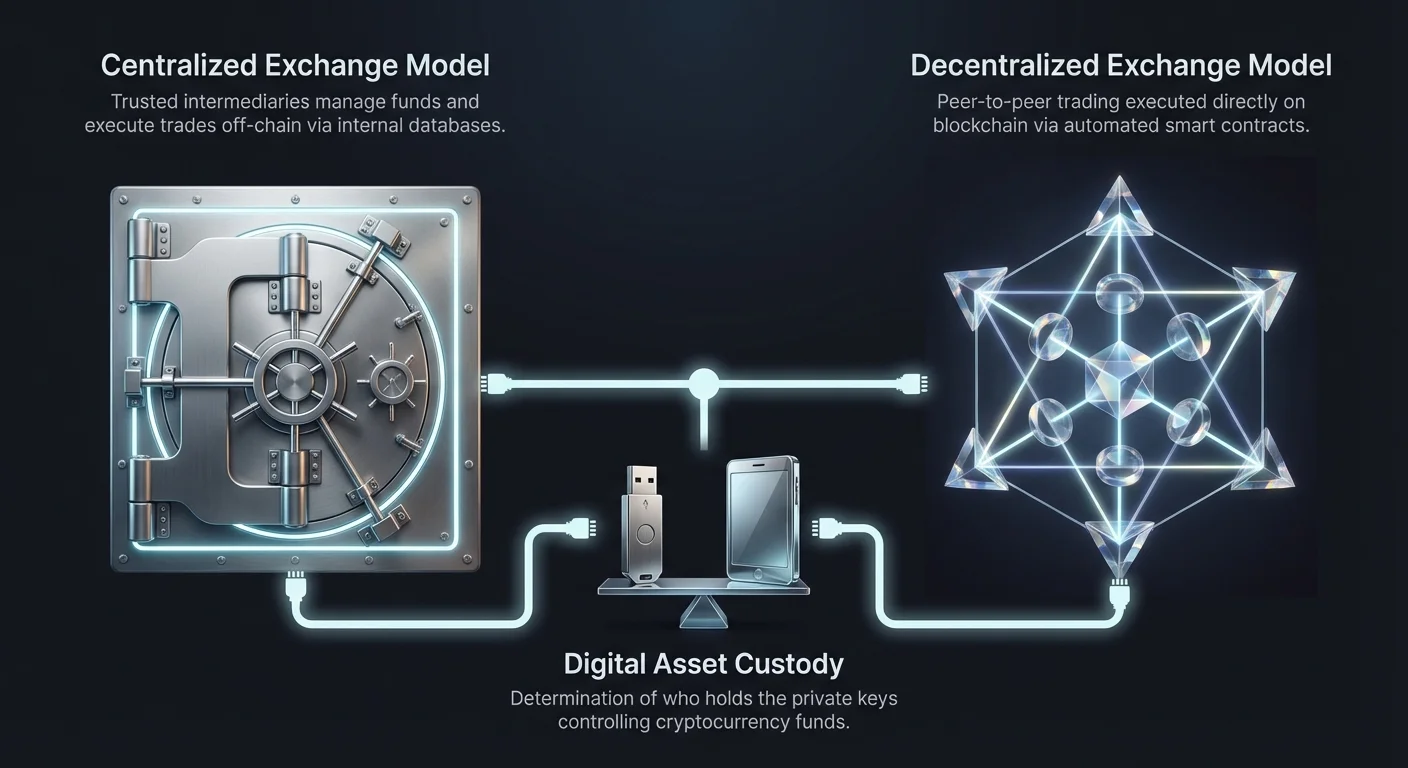
A Centralized Exchange (CEX) acts as a trusted intermediary between buyers and sellers. In this model, a private company operates the platform and facilitates transactions. When you use a CEX, you are essentially trusting a third party to manage your funds and execute your trades fairly. This structure mirrors traditional financial systems where banks or brokers handle assets on behalf of their clients.
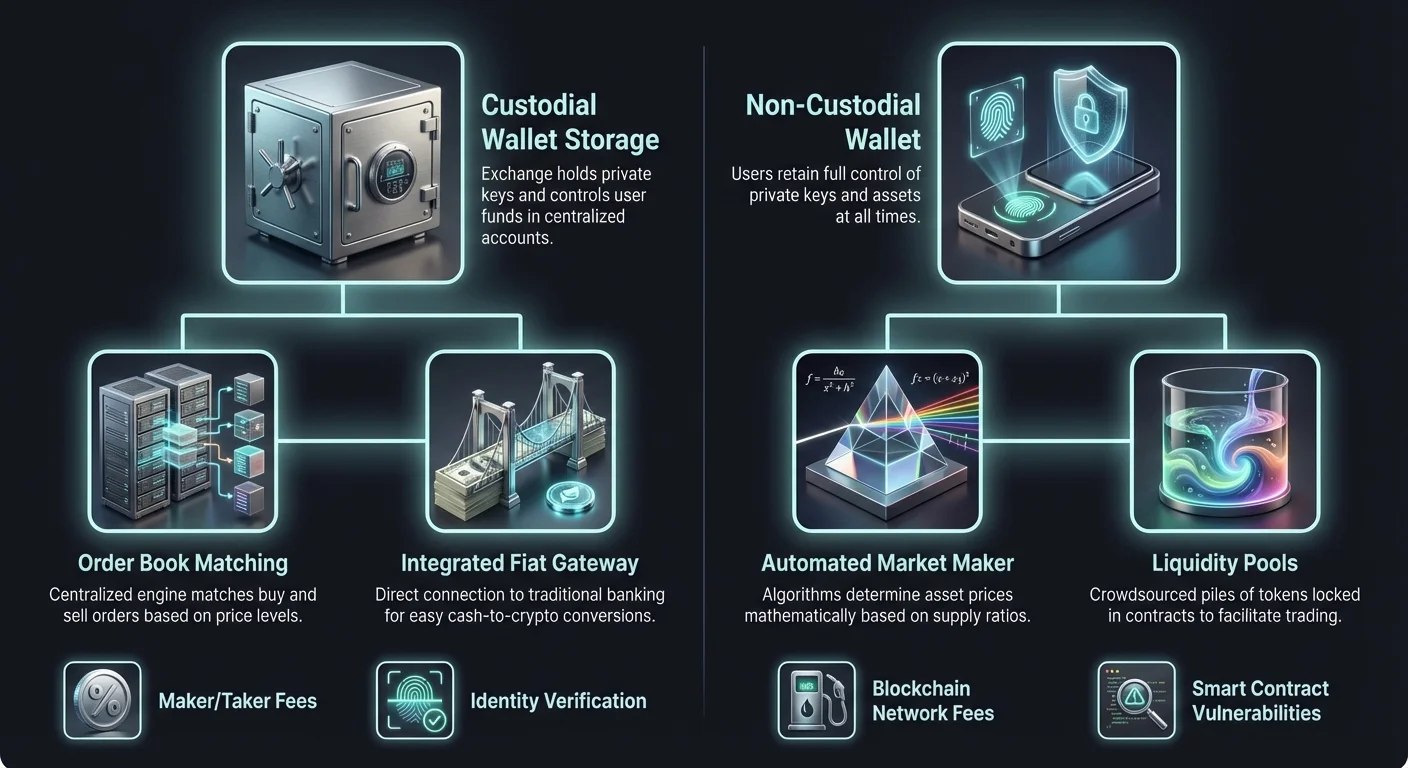
The primary function of a CEX is to match orders using an "order book." This is a digital list of buy and sell orders organized by price levels. When a user places a "market buy" order, the exchange’s engine automatically matches it with the lowest available sell order. This process is incredibly fast and efficient, allowing for high-volume trading with minimal latency.
Because these platforms are run by centralized entities, they often provide a polished user experience. They typically offer customer support, password recovery options, and integrated fiat gateways. This means you can link a bank account or credit card directly to the platform to buy crypto, a feature known as being a "banked exchange."
Custodial Risks and Convenience
The most defining characteristic of a CEX is custody. When you deposit funds into a CEX, you are transferring control of those assets to the exchange’s wallet. The exchange records your balance in their internal database, but the actual crypto is held in their possession. This arrangement is convenient because it allows for instant trades off-chain without waiting for blockchain confirmations.
However, this convenience comes with significant trade-offs regarding security and ownership. Since the exchange holds the private keys to the wallets, users do not have true autonomy over their funds. If the exchange halts withdrawals, faces insolvency, or suffers a security breach, users may lose access to their assets. This risk is summarized by the popular crypto adage: "Not your keys, not your coins."
Despite the custodial risk, CEXs remain the most popular entry point for beginners. The ability to reset passwords and the presence of regulatory compliance measures, such as Know Your Customer (KYC) verification, provide a sense of safety for those accustomed to traditional finance. These platforms often act as bridges between the fiat world and the digital asset economy.
Operational Mechanics of DEXs
Decentralized Exchanges (DEXs) represent a shift toward disintermediation. A DEX operates without a central authority or company managing the trades. Instead, it functions as a set of smart contracts deployed on a blockchain. These smart contracts are self-executing programs that automatically facilitate trades when specific conditions are met.
Unlike CEXs, DEXs do not require users to create accounts or deposit funds into a centralized wallet. Trading is non-custodial, meaning users trade directly from their own private wallets. You simply connect a Web3 wallet to the DEX interface, approve a transaction, and the trade settles directly on the blockchain. This ensures that you maintain full control of your assets at all times until the trade is executed.
This architecture eliminates the need for identity verification. Since there is no central entity to enforce regulations, anyone with an internet connection and a compatible wallet can access a DEX. This global, permissionless nature makes DEXs a vital tool for financial inclusion, particularly for individuals in regions with limited banking infrastructure or strict capital controls.
Automated Market Makers (AMMs)
While some DEXs use order books, the majority utilize a mechanism called an Automated Market Maker (AMM). An AMM replaces the traditional buy and sell orders with liquidity pools. A liquidity pool is a crowdsourced pile of two or more tokens locked in a smart contract. Traders swap tokens against this pool rather than trading directly with another person.
Prices in an AMM are determined mathematically. A constant product formula, often expressed as x * y = k, governs the balance between the assets in the pool. In this equation, x and y represent the quantities of the two tokens, and k is a fixed constant. When a trader buys token X from the pool, the supply of X decreases while the supply of Y increases.
To maintain the constant k, the price of token X must rise as it becomes scarcer in the pool. This algorithmic pricing mechanism allows trades to occur 24/7 without the need for a specific counterparty to be online. It ensures that there is always a price for an asset, as long as there is liquidity in the pool.
Financial and Market Liquidity
Liquidity is the lifeblood of any exchange, determining how easily an asset can be bought or sold without causing drastic price changes. In the context of exchanges, we look at market liquidity. High liquidity means a market can absorb large buy or sell orders with minimal impact on the asset's price.
CEXs typically rely on professional market makers to provide liquidity. These are institutional traders who place large orders on the books to ensure smooth trading. As a result, top-tier CEXs often have very deep liquidity for major assets like Bitcoin and Ethereum. This makes them ideal for executing large trades quickly at predictable prices.
DEXs crowdsource their liquidity from users. Anyone can become a "liquidity provider" (LP) by depositing assets into a pool. In return, LPs earn a share of the trading fees generated by the pool. While this model effectively bootstraps liquidity for new or smaller tokens, popular trading pairs on DEXs can still suffer from lower liquidity compared to giant CEXs, leading to potential price slippage on large orders.
Comparing Fee Structures
Costs vary significantly between exchange types and are influenced by different factors.
| Fee Type | Centralized Exchange (CEX) | Decentralized Exchange (DEX) |
|---|---|---|
| Trading Fee | Percentage of trade (0.1% - 0.5%) | Protocol fee (0.01% - 0.3%) |
| Network Cost | Usually absorbed or flat withdrawal fee | Gas fees paid per transaction |
| Structure | Maker/Taker model | Flat rate + Blockchain gas |
On a CEX, fees are often categorized by "maker" and "taker" roles. Makers, who place limit orders that add liquidity to the book, often pay lower fees. Takers, who execute market orders that remove liquidity, pay higher fees. Additionally, CEXs charge fees for withdrawing crypto to an external wallet, which can sometimes be high depending on the asset.
DEX costs are twofold. First, there is a trading fee paid to the liquidity providers and sometimes the protocol treasury. Second, and often more significant, is the "gas fee". Every action on a DEX, such as approving a token for trade or executing a swap, is a blockchain transaction that requires a network fee. During times of high network congestion, gas fees on popular chains like Ethereum can skyrocket, making small trades economically unviable.
Security Risks and Attack Vectors
Security is a paramount concern in crypto, but the nature of the risk differs between platforms. Centralized exchanges are massive targets for hackers because they hold billions of dollars in user funds in custodial wallets. History is replete with examples of exchange hacks where user funds were stolen. While reputable CEXs now use cold storage (offline wallets) and insurance funds to mitigate this, the risk of platform insolvency remains.
DEXs remove the risk of a central entity stealing or losing your funds, but they introduce "smart contract risk." Since a DEX is essentially code, any bug or vulnerability in the software can be exploited by malicious actors. If a hacker finds a flaw in the smart contract, they might be able to drain the liquidity pools.
Furthermore, the open nature of DEXs means scams are more prevalent. Anyone can list a token on a DEX. Scammers often create fake tokens that mimic legitimate projects to trick users into swapping their valuable assets for worthless coins. Users must exercise extreme diligence, verifying contract addresses before trading to ensure they are interacting with the genuine asset.
Slippage and Impermanent Loss
Traders on DEXs must be familiar with specific technical risks that are less common on CEXs. One such risk is slippage. Slippage occurs when the final price of a trade differs from the expected price. This happens frequently in AMMs with low liquidity. If a trader tries to buy a large amount of a token from a small pool, the algorithmic pricing pushes the cost up significantly during the transaction.
Liquidity providers face a unique risk called impermanent loss (IL). This occurs when the price of the deposited tokens changes compared to when they were deposited. Because the AMM rebalances the ratio of assets, an LP might end up with less value than if they had simply held the tokens in a wallet.
Impermanent loss is termed "impermanent" because the loss is only realized if the liquidity is withdrawn while the price ratio differs from the deposit time. If prices return to their original state, the loss disappears. However, in volatile markets, this loss often becomes permanent upon withdrawal, eating into the profits earned from trading fees.
The Day Trading Perspective
For day traders, speed and precision are critical. Strategies that rely on capturing small price movements over minutes or hours require an environment with instant execution and advanced tools.
Why CEXs favor Day Traders:
- Execution Speed: Centralized matching engines process thousands of transactions per second. Trades are instant and do not depend on block times.
- Advanced Orders: CEXs offer complex order types like stop-loss, take-profit, and bracket orders which are essential for risk management.
- Charting Tools: Integrated professional charting software allows for in-depth technical analysis directly on the trading interface.
- High Leverage: Many CEXs offer margin and futures trading, allowing traders to borrow funds to amplify their positions.
DEXs are generally less suitable for high-frequency day trading due to network latency. Waiting for a blockchain confirmation (which can take from seconds to minutes) allows market conditions to change, leading to failed trades or bad prices. While some high-performance blockchains are narrowing this gap, the CEX experience remains superior for this specific style.
The Long-Term Investor Perspective
Investors who practice a "buy and hold" strategy, often called HODLing, have different priorities. They are less concerned with split-second execution and more focused on security, asset ownership, and access to a wide variety of assets.
Why DEXs favor Investors:
- Self-Custody: Buying on a DEX places the asset directly into your personal wallet. There is no risk of an exchange freezing your account or blocking withdrawals.
- Early Access: New tokens often launch on DEXs long before they are listed on major CEXs. Investors looking for early opportunities in "gems" often find them here first.
- Privacy: Investors who wish to keep their financial activities private prefer DEXs because there is no requirement to submit personal identification documents.
For these users, the slightly higher complexity of using a DEX is a worthy trade-off for the autonomy it provides. They can buy their assets and immediately secure them in a hardware wallet, adhering to the highest standards of crypto security.
The User Experience Curve
The barrier to entry varies significantly between the two platforms. CEXs are designed to be user-friendly. The interface is intuitive, often resembling standard banking apps. If you forget your password, you can reset it via email. If you make a mistake, there is a support team to contact. This familiarity makes CEXs the logical starting point for most newcomers.
DEXs present a steeper learning curve. A user must first understand how to set up and secure a Web3 wallet, manage private keys, and handle "gas" for transaction fees. There is no customer support to call if a transaction fails or if funds are sent to the wrong address. Transactions on the blockchain are irreversible.
This "unforgiving" nature of DEXs requires a higher level of technical literacy. Users must be comfortable managing their own security. Losing your private key or seed phrase means losing access to your funds permanently, with no recourse for recovery. This responsibility is the price of total financial sovereignty.
Regulatory and Compliance Landscape
The regulatory environment for crypto exchanges is evolving rapidly. CEXs are increasingly becoming compliant with local laws. They are required to follow strict Anti-Money Laundering (AML) and Counter-Terrorism Financing (CTF) regulations. This is why users must complete identity verification processes involving government IDs and facial recognition.
While this compliance can feel invasive to privacy advocates, it brings legitimacy and legal protection. It also enables CEXs to offer seamless connections to the traditional banking system. Bank transfers and card payments are only possible because these exchanges play by the rules of the traditional financial world.
DEXs operate in a regulatory gray area. Because they are software protocols rather than companies with headquarters, it is difficult for regulators to enforce rules upon them. They do not collect user data, making them resistant to censorship. However, this also means that if a user interacts with tainted funds or illicit actors, there are no safeguards in place.
Conclusion
The choice between a Centralized Exchange and a Decentralized Exchange ultimately depends on what you value most in your financial journey. Centralized exchanges offer speed, convenience, and a safety net that appeals to beginners and active traders who need advanced tools. They bridge the gap between traditional money and digital currency, providing a familiar environment for managing assets.
Decentralized exchanges, conversely, offer the true promise of cryptocurrency: financial sovereignty. They provide privacy, self-custody, and access to a borderless market for those willing to manage their own security. For many experienced crypto users, the ideal approach involves using both—leveraging CEXs for onboarding and liquidity, while using DEXs for accessing new assets and maintaining long-term control.
The best strategy often combines both: use centralized exchanges to convert cash into crypto, then move your assets to a personal wallet to trade on decentralized platforms.