
Generating passive income from digital assets has become a primary objective for many investors in the cryptocurrency ecosystem. While the early days of the industry were defined by high-risk speculation and extreme price volatility, the market has matured to offer more stable, yield-generating opportunities. Strategies involving stablecoins and insured savings mechanisms allow participants to earn consistent returns while mitigating the wild price swings often associated with assets like Bitcoin or Ethereum.
This shift towards yield generation mirrors traditional finance but often comes with higher potential rewards due to the unique mechanics of blockchain technology. By utilizing lending platforms, savings accounts, and strategic accumulation methods, investors can put their idle assets to work. This approach transforms a portfolio from a static collection of coins into a dynamic engine for wealth accumulation.
Understanding Market Volatility
Volatility refers to the frequency and magnitude of price movements in a market. In traditional finance, this applies to stocks or bonds, but in the cryptocurrency sector, volatility is significantly more pronounced. Prices can change rapidly and unpredictably based on news cycles, economic events, or shifts in market sentiment. For investors seeking passive yield, understanding this volatility is the first step in managing risk. When volatility is high, the potential for capital loss increases, making stability a prized attribute for those focused on income preservation. For investors seeking passive yield, understanding this volatility is the first step in managing risk. When volatility is high, the potential for capital loss increases, making stability a prized attribute for those focused on income preservation.
Market Maturity Factors
One primary reason for the heightened volatility in crypto is the relative youth of the asset class. Compared to traditional financial markets that have existed for centuries, the cryptocurrency market is still in its developmental stages. It is growing and evolving at a pace that far exceeds traditional assets, leading to periods of rapid price discovery. Because market participants lack decades of historical data or comparable assets for pricing, uncertainty often drives valuation swings. As the market matures, this volatility is expected to dampen, but it currently remains a defining characteristic that yield-seekers must navigate carefully.
Liquidity and Market Size
The size of the cryptocurrency market also contributes to its volatile nature. Although it has grown substantially, it remains smaller than global equity or forex markets. In a smaller market, trades that would be considered insignificant in traditional finance can have a disproportionate impact on prices. Large buy or sell orders can trigger significant price swings, creating a ripple effect throughout the ecosystem. This liquidity dynamic underscores the importance of using stable assets, such as stablecoins, which are designed to maintain a peg to a fiat currency and avoid these liquidity-induced price fluctuations.
Dollar-Cost Averaging as a Foundation
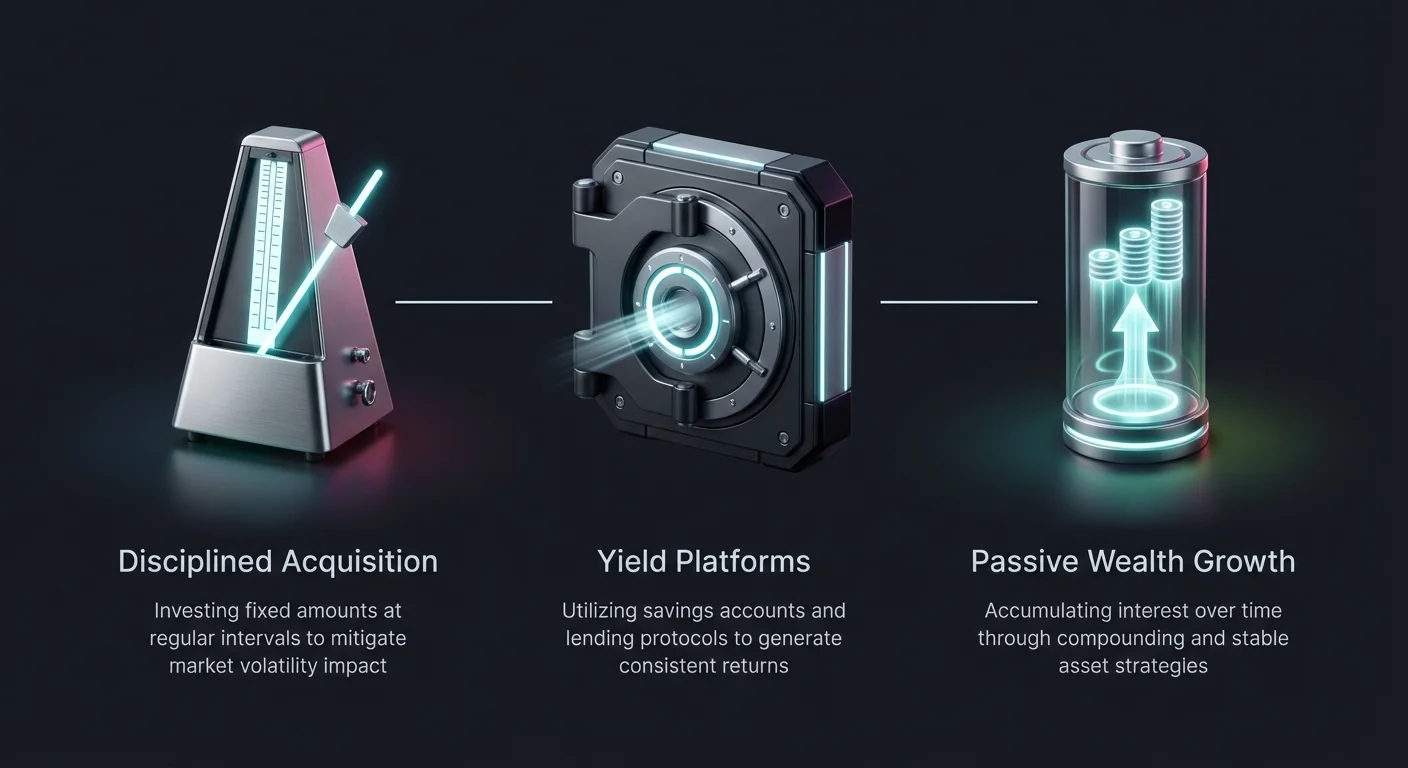
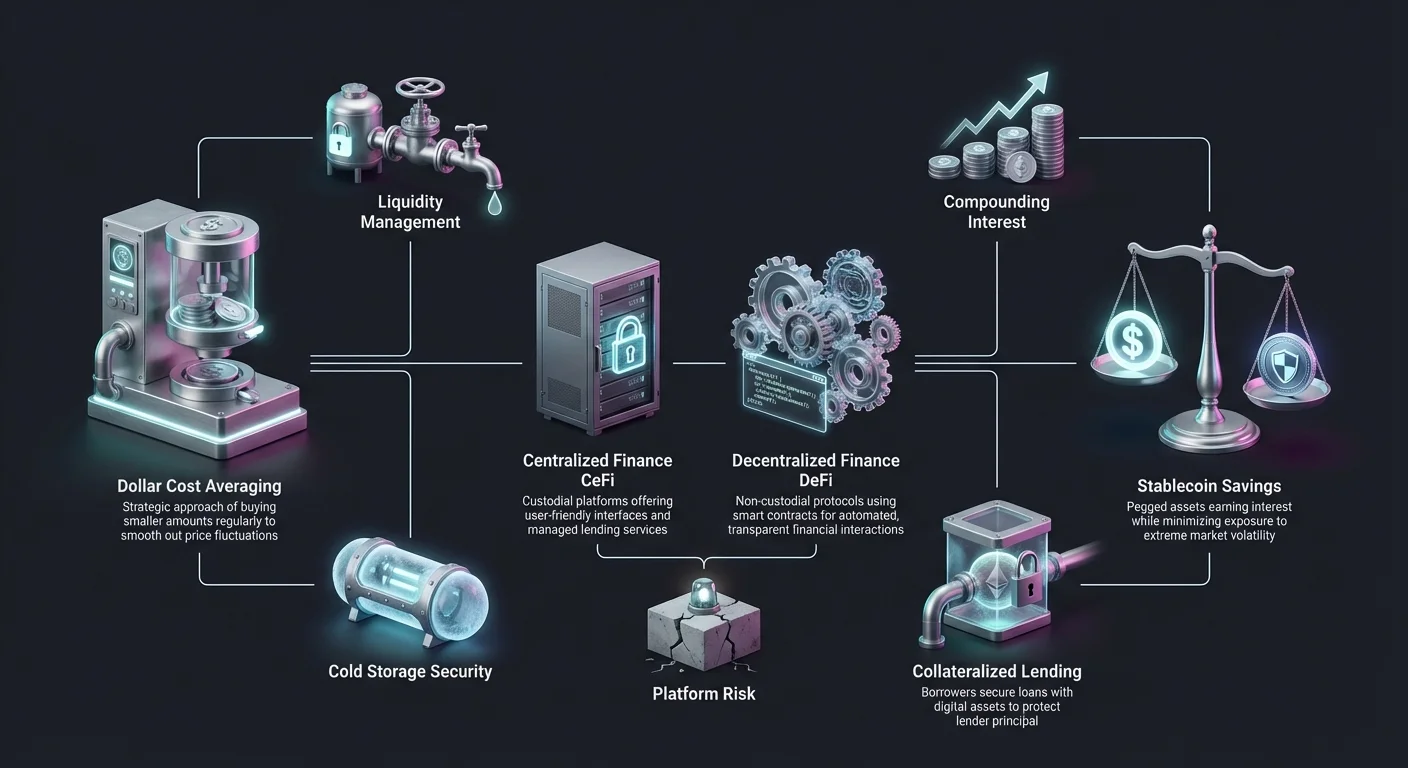
Before entering lending or savings protocols, an investor must acquire assets. Dollar-cost averaging (DCA) serves as a foundational strategy for low-risk entry. This method involves investing a fixed amount of money at regular intervals, regardless of the asset's price at that moment. The primary philosophy behind DCA is to remove the emotional stress of trying to time the market. Instead of waiting for the "perfect" entry point, which is notoriously difficult even for professional traders, the investor spreads their capital deployment over a long period.
Reducing Price Impact
By purchasing smaller amounts over time, DCA reduces the impact of dramatic price swings on the average cost basis of the portfolio. If the market drops significantly, the fixed investment amount purchases more units of the asset. Conversely, if the market rises, that same amount purchases fewer units. Over time, this smooths out the average purchase price. This is particularly valuable in crypto, where a lump-sum investment made at a market peak could take years to recover. DCA ensures that investors are not over-exposed to a single price point.
Discipline and Psychology
Beyond the mathematical advantage, DCA enforces financial discipline. It encourages a habit of regular investing, which is crucial for long-term wealth accumulation. By automating the decision-making process, investors avoid the psychological pitfalls of fear and greed. They do not panic-sell during downturns or fomo-buy (fear of missing out) during rallies. This steady approach preserves optionality, allowing the investor to adapt to changing market conditions without being overly committed to a single course of action or specific timeframe.
Automated Investment Strategies
Modern crypto exchanges have integrated automation to make dollar-cost averaging more accessible. Auto DCA features allow users to set up recurring purchases for Bitcoin, stablecoins, or other assets on a daily, weekly, or monthly basis. This "set it and forget it" approach eliminates the need for manual execution and ensures that the strategy is followed consistently. Automated systems remove the friction of logging in to make trades, which can often lead to hesitation during volatile market periods.
Passive interval-based buying is the most common form of this strategy. However, more advanced investors might employ rules-based elements. For example, a strategy might dictate that purchases should be reduced if the price is above a certain technical indicator, such as the 34-day Exponential Moving Average. While these advanced rules can potentially optimize returns, they introduce complexity and require a deeper understanding of technical analysis. For the majority of passive investors, a simple, time-based interval remains the most effective tool for risk management.
Crypto Savings Accounts Explained
Once assets are acquired, they can be deposited into crypto savings accounts to earn interest. These accounts function similarly to traditional bank savings accounts but typically offer significantly higher Annual Percentage Yields (APY). The interest is generated because the platform lends the deposited funds to borrowers, such as institutional traders or other users seeking liquidity. The platform then shares a portion of the interest collected from borrowers with the depositor.
Interest Generation Mechanisms
The mechanics of yield generation in these accounts rely on supply and demand. When demand for borrowing a specific asset is high, the interest rates offered to depositors usually increase. In the crypto market, borrowing demand is often driven by traders looking for leverage or market makers requiring liquidity. This structural demand allows platforms to offer yields that far exceed those found in traditional finance. However, it is important to note that these rates are variable and can fluctuate based on market conditions.
The Power of Compounding
Crypto savings accounts often benefit from the power of compound interest. APY calculations include the effects of compounding, where the interest earned is reinvested to generate its own interest. Over time, this can lead to exponential growth of the principal balance. Some platforms pay out interest daily or weekly, accelerating the compounding effect compared to traditional accounts that might credit interest monthly or quarterly. This feature is a key driver for wealth accumulation in passive yield strategies.
Stablecoins in Savings Portfolios
For investors prioritizing low risk, stablecoins are the preferred asset for savings accounts. Cryptocurrencies like USDT (Tether) and USDC (USD Coin) are pegged to the US dollar, theoretically eliminating the price volatility associated with standard crypto assets. While Bitcoin might earn interest, its underlying value can drop by 10% in a week, negating any yield earned. Stablecoins aim to hold a steady value of $1.00, meaning the yield earned is true profit rather than a buffer against depreciation.
There are different types of stablecoins available for yield generation. Fiat-collateralized stablecoins, like USDC and USDT, are backed by reserves of fiat currency or cash equivalents held by the issuer. These are generally considered the safest and most liquid options. Decentralized stablecoins, like DAI, maintain their peg through over-collateralization of crypto assets and smart contract algorithms. Understanding the differences is vital, as each carries a unique risk profile regarding collateralization models and how the peg is maintained.
Yield Opportunities
Interest rates for stablecoins are often higher than those for volatile assets. Rates for USDT and USDC can commonly range between 5% and 12% APY, depending on the platform and market conditions. This disparity exists because stablecoins are highly useful for traders who need to move in and out of positions quickly without converting to fiat. This constant utility creates a steady demand for stablecoin borrowing, sustaining the attractive yield rates for depositors who provide the necessary liquidity.
Centralized vs. Decentralized Savings
Investors can choose between Centralized Finance (CeFi) and Decentralized Finance (DeFi) platforms for their savings activities. CeFi platforms are managed by companies that act as custodians. Users deposit funds into a wallet controlled by the exchange, and the company manages the lending and payout processes. These platforms often provide customer support, user-friendly interfaces, and sometimes insurance protections. However, they introduce counterparty risk, meaning the user must trust the company to manage funds responsibly and remain solvent.
Trust and Custody in CeFi
In a centralized model, the user relinquishes control of their private keys. The platform operates much like a bank, and if the platform fails or halts withdrawals, the user may lose access to their assets. Despite this risk, CeFi platforms are popular due to their simplicity and the ability to recover accounts if passwords are lost. They often conduct regulatory compliance checks, which can add a layer of legitimacy and security for institutional or cautious retail investors.
DeFi platforms operate using smart contracts on a blockchain, removing the middleman. Users retain control of their assets and interact directly with the protocol via a non-custodial wallet. Yields in DeFi are determined algorithmically by the protocol. While this eliminates the risk of a company mismanaging funds, it introduces smart contract risk. If the code governing the protocol contains a bug or vulnerability, it can be exploited by hackers. DeFi offers transparency and autonomy but requires a higher level of technical proficiency.
Flexible vs. Fixed-Term Accounts
Crypto savings products generally fall into two categories regarding accessibility: flexible and fixed-term. Flexible accounts allow users to withdraw their funds at any time without penalty. These accounts offer the highest level of liquidity, making them suitable for funds that might be needed on short notice. However, the trade-off for this liquidity is typically a lower interest rate. The platform cannot guarantee long-term lending capital, so the yield offered to the depositor is reduced.
Fixed-term accounts require the user to lock their assets for a predetermined period, such as 30, 60, or 90 days. In exchange for committing capital for a longer duration, the platform offers higher interest rates. This stability allows the platform to lend out funds for longer terms with more certainty. Investors must carefully weigh their need for liquidity against the desire for higher returns. Using a "laddering" strategy, where different portions of capital unlock at different times, can help balance these needs.
The Mechanics of Lending Platforms
Crypto lending platforms serve as the marketplace connecting lenders and borrowers. Lenders deposit their crypto assets into a pool, which effectively supplies the liquidity for the market. Borrowers then access these pools to take out loans. The platform facilitates this exchange, ensuring that the terms are met and that interest is collected and distributed. This system democratizes access to yield, allowing any individual with crypto assets to act as a lender, a role traditionally reserved for financial institutions.
The Lending Pool
When a user deposits funds, they are typically commingled with funds from other users in a liquidity pool or lending pool. This aggregation ensures that there is always sufficient capital available to meet borrowing demand. It also diversifies the risk for the lender; rather than lending to a single borrower who might default, the lender's funds are spread across the entire activity of the pool. The interest earned is a share of the total fees generated by the pool's lending activities.
Collateralization Requirements
To protect the lender, borrowers are required to provide collateral. This is a critical safety mechanism in the crypto lending space. Unlike traditional personal loans which might be based on credit scores, crypto loans are secured by digital assets. If a borrower wants to borrow stablecoins, they might deposit Bitcoin as collateral. The value of the collateral usually exceeds the value of the borrowed amount, ensuring that the lender can be repaid even if the borrower defaults.
Loan-to-Value Ratios and Safety
The Loan-to-Value (LTV) ratio is a key metric in securing crypto loans. It represents the percentage of the collateral's value that can be borrowed. For instance, a 50% LTV means that for every $10,000 of Bitcoin deposited as collateral, the borrower can take out a $5,000 loan. Lower LTV ratios are safer for the platform and the lender because they provide a larger buffer against price drops in the collateral asset.
Margin Calls and Monitoring
If the value of the collateral drops due to market volatility, the LTV ratio increases. If it reaches a critical threshold, the borrower receives a margin call. This is a notification requiring the borrower to deposit more collateral or repay part of the loan to bring the LTV back down to a safe level. This mechanism is automated in many smart contract protocols and rigorously enforced by centralized desks to prevent bad debt from accumulating in the system.
If a borrower fails to meet a margin call, or if the price drops too rapidly, the platform initiates the liquidation process. The collateral is sold on the open market to repay the loan and any accrued interest. This process is designed to ensure that lenders—the people who deposited savings—do not lose their principal. While liquidation is harsh for the borrower, it is the primary safeguard that preserves the solvency of the lending pool and protects the passive income of the yield earners.
Risks of Passive Yield Strategies
Despite the safeguards, passive yield strategies are not risk-free. Platform risk is a significant concern. If a centralized exchange becomes insolvent or is managed fraudulently, depositors can face total loss. In the DeFi space, "rug pulls" or protocol exploits can drain liquidity pools instantly. Users must understand that high yields often correlate with higher risks, and "guaranteed" returns do not exist in the same way they might in government-backed securities.
Counterparty and Regulatory Risk
Counterparty risk involves the other side of the trade failing to fulfill their obligations. In savings accounts, the platform is the counterparty. Regulatory risk is also prevalent; governments worldwide are still establishing frameworks for crypto lending. Sudden changes in law could affect a platform's ability to operate, freeze assets, or change the tax treatment of earnings. Investors need to stay informed about the legal landscape in their jurisdiction to avoid unexpected complications.
It is crucial to reiterate that crypto savings accounts typically lack government-backed insurance like the FDIC in the United States. If a bank fails, the government guarantees deposits up to a certain limit. If a crypto platform fails, there is rarely such a safety net. While some platforms claim to have private insurance funds or insurance policies, these are often limited in scope and may not cover all types of loss, such as those resulting from a hack of a user's personal account credentials.
Selecting a Safe Platform
Choosing the right platform is the most critical decision for a passive investor. Security features should be the top priority. Prospective users should look for platforms that employ cold storage, where the majority of assets are kept offline and away from potential hackers. Two-factor authentication (2FA) should be mandatory. Additionally, transparency regarding the platform's reserves and security audit provides insight into its financial health.
| Feature | Description | Importance |
|---|---|---|
| Cold Storage | Assets kept offline | Prevents remote hacking |
| Proof of Reserves | Verifiable asset backing | Ensures solvency |
| Insurance Fund | Private protection pool | Buffer against loss |
Reputation and Track Record
A platform’s reputation within the community is a strong indicator of reliability. Long-standing exchanges that have survived multiple market cycles without major security breaches are generally safer bets. User reviews, forum discussions, and independent security rankings can help gauge trustworthiness. Investors should be wary of new platforms offering unrealistically high interest rates, as these are often unsustainable and may indicate a high-risk or fraudulent operation.
Liquidity Management
Liquidity refers to the ability to access and use funds when needed. In the context of savings strategies, managing liquidity is about balancing the portion of the portfolio that is locked for higher yield against the portion that is available for emergencies or opportunities. High liquidity ensures that an investor can withdraw assets to sell or use without delay. This is vital during periods of extreme market volatility where rapid decisions might be necessary to preserve capital.
Market vs. Financial Liquidity
Market liquidity refers to the health of the trading environment—how easily an asset can be sold without crashing the price. Financial liquidity refers to the investor's personal access to cash. Stablecoin savings accounts generally offer high market liquidity for the underlying asset. However, if the investor chooses a fixed-term product, they sacrifice their personal financial liquidity. A prudent strategy involves keeping a percentage of funds in flexible accounts to maintain access while locking the rest for yield.
Tokenized Assets and Diversification
Tokenized stocks represent another avenue for passive involvement in the market, allowing for diversification beyond standard cryptocurrencies. These are digital tokens that track the price of publicly traded equity shares, like Apple or Tesla. By investing in tokenized stocks, crypto investors can gain exposure to traditional markets without needing a separate brokerage account. This allows for a unified portfolio where gains from crypto yield farming can be easily rotated into stable blue-chip equities.
These tokens often allow for fractional ownership, meaning investors can buy a fraction of a high-priced stock with a small amount of capital. This lowers the barrier to entry for building a diversified portfolio. Furthermore, tokenized stocks can sometimes be traded 24/7, unlike the traditional stock market which has set operating hours. This flexibility aligns with the always-on nature of the crypto economy, providing seamless integration for global investors.
Tax Implications of Yield
Earning passive income through crypto lending and savings accounts triggers tax events in most jurisdictions. The interest earned is typically treated as ordinary income, similar to interest from a bank account or salary payments. The value of the interest is calculated based on the market price of the asset at the time it is received. This applies even if the investor does not convert the crypto into fiat currency.
It is essential to keep detailed records of all interest payments. If the asset earned as interest increases in value and is later sold, capital gains tax may also apply to the appreciation. Because tax laws vary significantly by country and are subject to change, consulting with a qualified tax professional is highly recommended. Proper tax planning ensures that the net yield remains positive after all obligations are met, preventing unexpected liabilities from eroding profits.
Maximizing Returns Safely
To maximize returns without taking on excessive risk, investors should employ a strategy of diversification across platforms and assets. Never keep all eggs in one basket. By spreading funds across multiple reputable lending platforms, the impact of a single platform failure is minimized. Additionally, reinvesting earnings—either manually or through automated compounding features—can significantly boost long-term growth.
Portfolio Allocation
A balanced portfolio might allocate a significant portion to stablecoin savings for consistent, low-volatility income, while keeping a smaller percentage in blue-chip crypto assets like Bitcoin for potential appreciation. Monitoring the portfolio regularly is necessary to adjust to changing interest rates and market conditions. However, the goal of passive yield is to minimize active management, so establishing a robust setup initially allows for a hands-off approach most of the time.
Conclusion
The landscape of cryptocurrency offers diverse opportunities for generating passive yield that go far beyond simple speculation. By leveraging stablecoins, investors can neutralize the notorious volatility of the crypto market while securing interest rates that frequently outperform traditional financial products. Strategies such as Dollar-Cost Averaging provide a disciplined entry point, ensuring that capital is deployed efficiently over time. When combined with high-yield savings accounts and lending protocols, these tools create a powerful framework for wealth preservation and growth.
However, the pursuit of yield must always be tempered with a clear understanding of the risks. The distinction between centralized and decentralized platforms, the importance of collateralization, and the reality of platform risk are concepts that every investor must master. While the lack of government insurance requires a higher degree of personal due diligence, the transparency and control offered by blockchain technology provide a unique counter-balance. By choosing reputable platforms, diversifying holdings, and maintaining a long-term perspective, investors can build a resilient income stream.
Consistency, security, and patience are the true drivers of sustainable wealth in the crypto economy.