
Day trading in the cryptocurrency market involves frequent buying and selling of digital assets within a single day. The primary goal is to capitalize on short-term price movements. Unlike traditional stock markets that operate during fixed hours, the crypto market is open 24 hours a day, seven days a week. This continuous operation provides traders with constant opportunities but also demands constant vigilance.
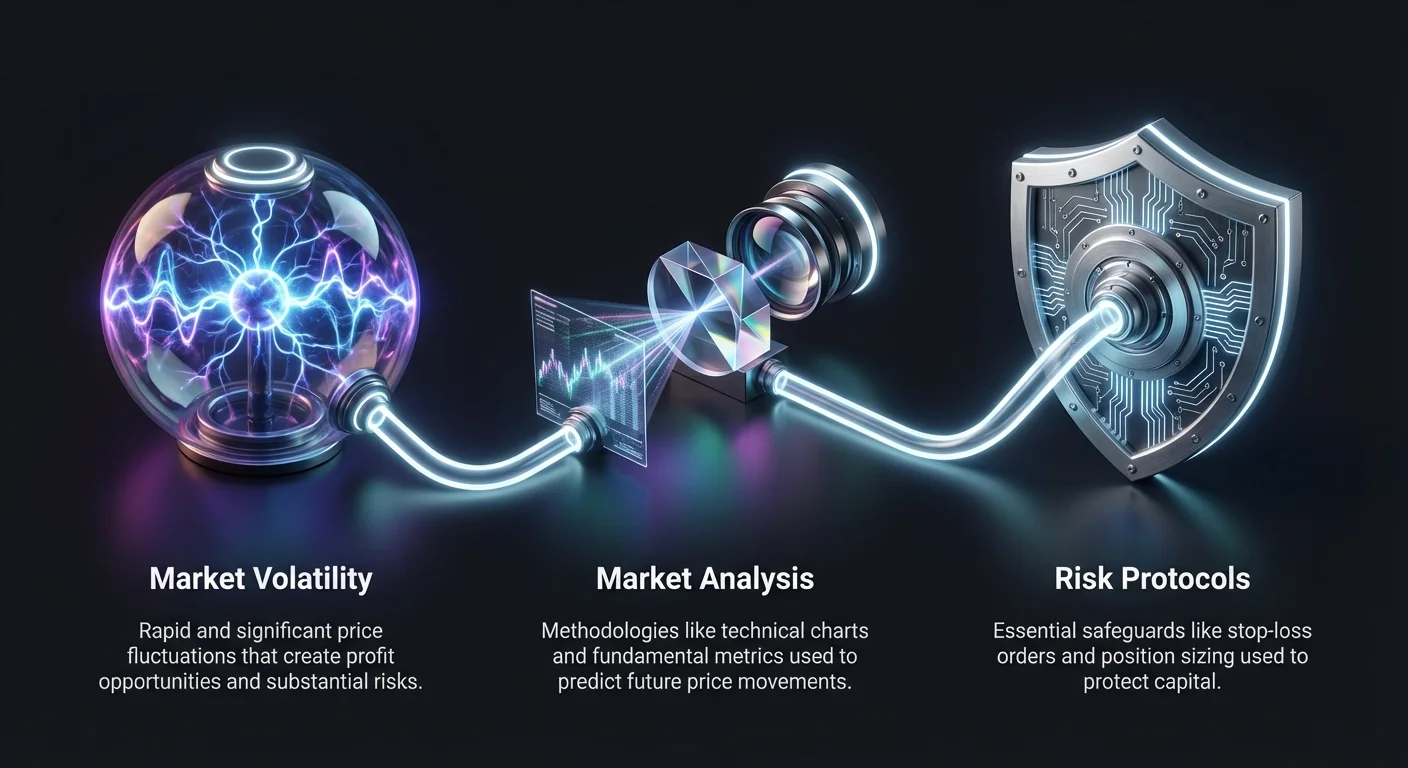
Strategies for day trading rely heavily on exploiting volatility. Cryptocurrency prices can fluctuate rapidly, swinging by significant percentages in short periods. While this volatility presents the potential for profit, it simultaneously introduces substantial risk. Traders must understand that prices are influenced by a complex mix of market sentiment, global economic factors, and technological developments.
Success in this environment requires more than just luck or intuition. It necessitates a deep understanding of market mechanics, technical analysis, and strict risk management protocols. Traders must choose the right platforms, understand fee structures, and know how to execute trades efficiently to preserve their margins. Without a clear plan, the fast-paced nature of the market can lead to rapid capital depletion.
Analyzing Market Movements
To make informed trading decisions, participants must analyze the market using specific methodologies. Analysis is generally categorized into technical and fundamental approaches, though day traders often prioritize the former. Understanding what drives price action is the first step toward developing a profitable strategy.
Technical Analysis Fundamentals
Technical analysis involves studying charts, indicators, and price patterns to predict future movements. Traders look for trends and potential entry or exit points based on historical data. This method assumes that past trading activity and price changes can be valuable indicators of the asset's future price movements.
Common tools include chart patterns that signal reversals or continuations of a trend. Traders also use volume indicators to gauge the strength of a price move. High trading volume during a price increase suggests strong conviction among buyers, while low volume might indicate a weak trend that is liable to reverse.
By identifying support and resistance levels, traders can set orders at prices where the asset has historically struggled to fall below or rise above. These technical levels act as psychological barriers for the market. Mastering these charts is essential for timing trades effectively in a high-speed environment.
Fundamental Analysis and Sentiment
While day traders focus on charts, fundamental analysis remains relevant. This involves assessing an asset's intrinsic value, network activity, and adoption rates. For Bitcoin and other cryptocurrencies, this might include analyzing on-chain metrics such as the number of active addresses or total transaction volume.
Market sentiment plays a massive role in short-term price action. News events, regulatory developments, or macroeconomic shifts can cause immediate and sharp reactions in the market. Traders monitor news feeds and social media to gauge whether the general mood is bullish or bearish.
For instance, news of institutional adoption can trigger a buying frenzy, while regulatory crackdowns can lead to panic selling. A comprehensive strategy combines technical signals with an awareness of broader market conditions. Ignorance of major news events can leave a technical trader exposed to sudden, news-driven volatility.
Exchange Infrastructure Types
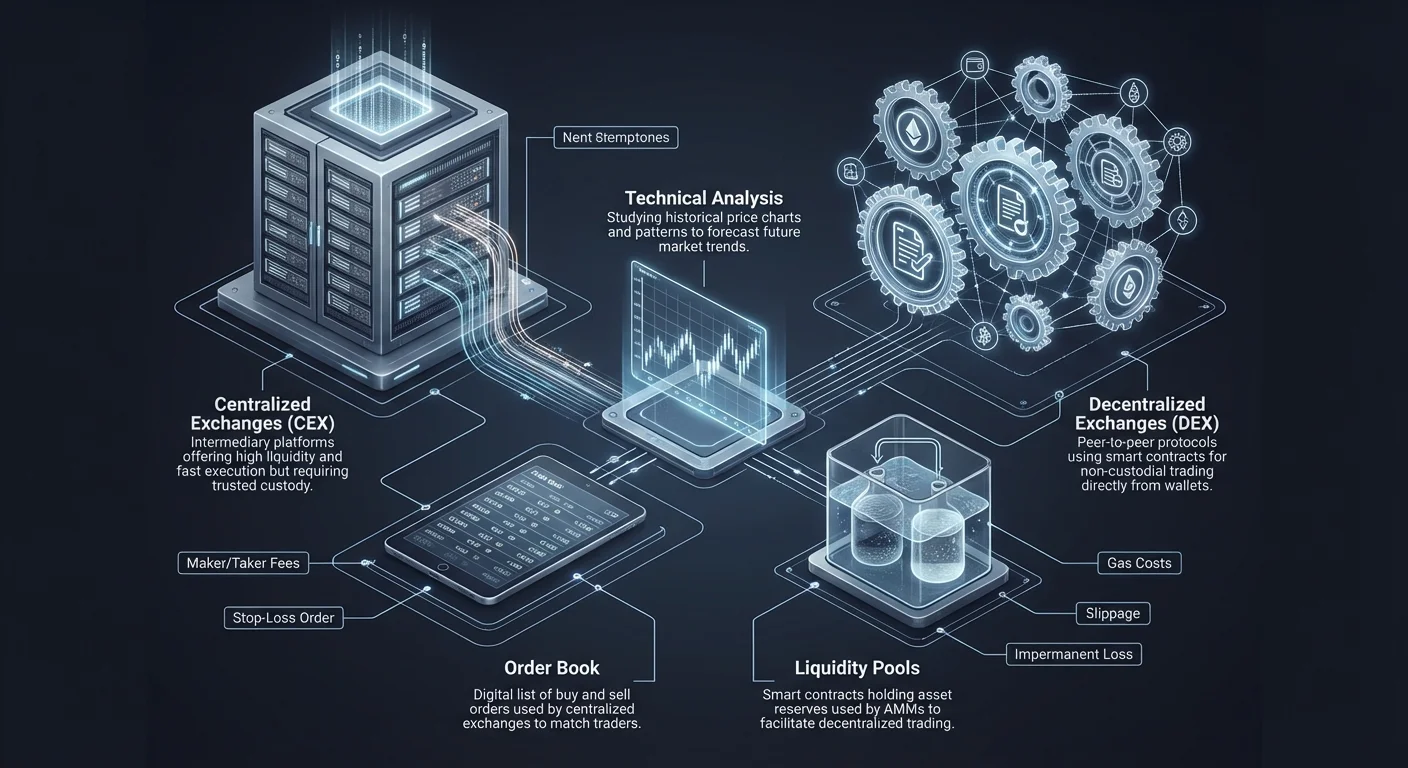
The platform used for trading significantly impacts strategy execution, fees, and security. The crypto ecosystem offers two primary types of exchanges: Centralized Exchanges (CEXs) and Decentralized Exchanges (DEXs). Each has distinct operational models and risk profiles that traders must navigate.
Centralized Exchanges (CEX)
A Centralized Exchange operates similarly to a traditional stock brokerage or bank. It acts as a trusted intermediary that matches buyers and sellers. Users must create accounts, verify their identity through Know Your Customer (KYC) processes, and deposit funds into a wallet controlled by the exchange.
CEXs typically offer high liquidity, which enables quick trade execution at stable prices. They maintain order books where buy and sell orders are listed and matched. This structure allows for advanced order types and high-speed transactions, which are crucial for day trading strategies that rely on split-second timing.
However, using a CEX requires trusting a third party with the custody of funds. The exchange holds the private keys to the deposited assets. If the exchange faces insolvency or security breaches, user funds can be at risk. History contains several examples of centralized platforms failing, emphasizing the importance of moving significant holdings to self-custody when not actively trading.
Decentralized Exchanges (DEX)
Decentralized Exchanges operate without a central authority or intermediary. They function through smart contracts on a blockchain, allowing users to trade directly with one another. This peer-to-peer model creates a permissionless environment where anyone with a crypto wallet can participate without account registration or identity verification.
DEXs prioritize privacy and self-custody. Users retain full control of their private keys and funds throughout the trading process. Trades are executed directly from the user's wallet, reducing the risk of losing assets to a platform hack or bankruptcy.
The trade-off often involves complexity and speed. Early DEXs were slower than their centralized counterparts, though modern Automated Market Makers (AMMs) have improved efficiency. DEXs also require users to pay network gas fees for every transaction, which can become expensive during periods of network congestion.
Order Execution and Types
Executing a trade involves more than simply clicking a button. Traders must understand the different types of orders available and how they interact with the market's liquidity. The two primary roles in any trade are the "maker" and the "taker," and understanding this distinction is vital for managing costs.
A "maker" is a trader who provides liquidity to the order book. They place a limit order that does not execute immediately because the price is set away from the current market value. These orders sit in the order book, waiting for another trader to accept the price. By adding volume to the book, makers help stabilize the market and facilitate trading for others.
A "taker" is a trader who removes liquidity from the order book. They place market orders that execute immediately against existing limit orders. Takers prioritize speed over price precision, accepting the current market rate to enter or exit a position instantly. Because they remove liquidity, takers often pay higher trading fees than makers.
Market vs. Limit Orders
Market orders are designed for immediate execution. A trader specifies the amount of crypto they wish to buy or sell, and the exchange matches it with the best available prices in the order book. This is useful when speed is the priority, such as during a breakout or panic sell-off.
The downside of market orders is the lack of price control. In volatile markets, the final execution price may drift significantly from the price seen on the screen when the button was pressed. This discrepancy is known as slippage and can eat into profits. Traders must achieve liquidity and slippage mastery to preserve margins.
Limit orders allow traders to set a specific price at which they are willing to buy or sell. The trade will only execute if the market reaches that price. This grants precise control over entry and exit points but carries the risk that the order may never be filled if the market moves away from the target price.
Automated Market Makers (AMMs)
In the decentralized finance (DeFi) space, trading often occurs without traditional order books. Instead, protocols use Automated Market Makers (AMMs). These systems allow digital assets to be traded automatically by using liquidity pools rather than matching a buyer directly with a seller.
Mechanics of Liquidity Pools
Liquidity pools are smart contracts that hold reserves of two or more tokens. Users, known as Liquidity Providers (LPs), deposit these assets into the pool. For example, a pool might contain equal values of Ethereum (ETH) and a stablecoin like USDC.
When a trader wants to swap ETH for USDC, they trade against the pool rather than another person. They send ETH to the contract and receive USDC in return. The AMM uses a mathematical formula to determine the exchange rate based on the ratio of assets in the pool.
The most common formula is the constant product formula, often expressed as x * y = k. Here, x and y represent the quantities of the two tokens, and k is a constant value. This mechanism ensures that there is always liquidity available, as the price adjusts automatically as the ratio of tokens changes. This is the core of Automated Market Makers explained.
Arbitrage and Pricing
AMMs rely on arbitrage traders to keep their prices in line with the broader market. If the price of an asset on an AMM deviates from its price on a centralized exchange, an opportunity arises. Traders can buy the asset where it is cheaper and sell it where it is more expensive.
For instance, if extensive buying in an ETH/USDC pool pushes the price of ETH higher than the market average, arbitrageurs will sell ETH into the pool. This selling pressure increases the supply of ETH in the pool and lowers the price until it matches the global market rate.
This self-regulating mechanism ensures that AMMs remain functional and accurate without a central authority setting prices. However, for the day trader using a DEX, understanding this dynamic is crucial, as low liquidity in a pool can lead to significant price impact on large orders.
The Critical Role of Liquidity
Liquidity is a fundamental concept that determines how easily an asset can be bought or sold without affecting its price. In the context of day trading, liquidity is arguably the most important metric to monitor aside from price itself. Without sufficient liquidity, entering and exiting positions becomes difficult and costly.
Financial liquidity refers to the ease of converting an asset into cash. In traditional markets, cash is the most liquid asset. In crypto, major assets like Bitcoin and stablecoins act as the liquid base. Traders need to ensure they are trading pairs that have high volume to facilitate quick conversion back to a stable asset.
Market liquidity refers to the stability of a market. A liquid market has a high volume of buy and sell orders, creating a "deep" order book. This depth absorbs large trades without causing drastic price spikes or crashes. Conversely, an illiquid market is shallow; a single large order can shift the price significantly.
Day traders must avoid illiquid markets unless they have a specific, high-risk strategy. Trading low-volume altcoins carries the risk of getting "stuck" in a position. If a trader buys a large amount of an illiquid coin, they may find no buyers when they attempt to sell, forcing them to lower their asking price and accept a loss.
Risk Management Techniques
Protecting capital is the primary objective of any trading strategy. The volatile nature of crypto means that losses can accumulate rapidly if proper safeguards are not in place. Risk management involves a set of rules and tools designed to limit downside exposure while allowing for upside potential.
Position Sizing and Stops
Position sizing involves determining what percentage of total capital to allocate to a specific trade. A common rule of thumb is to risk only a small fraction of the portfolio on a single position. This ensures that a string of bad trades does not wipe out the entire account.
Stop-loss orders are critical tools for enforcing risk limits. A stop-loss is a pre-set order that automatically sells the asset if the price drops to a certain level. This effectively caps the maximum loss a trader can sustain on a trade.
Traders must place stop-losses strategically. Placing them too close to the entry price can result in being stopped out by normal market noise. Placing them too far away increases the potential loss. Technical analysis often guides the placement of these orders, usually below key support levels.
Dealing with Volatility
Volatility is a double-edged sword. While it provides the price movement needed for profit, it also creates emotional stress and financial risk. Traders must be mentally prepared for rapid swings. Panic selling during a dip or "FOMO" (Fear Of Missing Out) buying during a rally are common pitfalls caused by volatility.
Diversification can help mitigate this risk. Rather than putting all capital into one volatile asset, traders might spread exposure across Bitcoin, Ethereum, and other altcoins. However, since the crypto market is highly correlated, diversification offers less protection than in traditional markets.
Managing volatility also involves understanding the asset being traded. Bitcoin is generally less volatile than smaller altcoins. A trader might take larger positions in Bitcoin and smaller, more cautious positions in speculative tokens to balance the overall risk profile of their day trading activities.
Transaction Costs and Fees
Every trade incurs a cost, and for high-frequency traders, these costs accumulate quickly. Understanding the fee structure of an exchange is essential for maintaining profitability. Even a profitable strategy can turn into a losing one if fees consume the margins.
Trading fees are typically charged as a percentage of the trade value. As mentioned, maker fees are often lower than taker fees. Some exchanges offer tiered fee structures, reducing costs for high-volume traders. Comparing these rates across platforms is a necessary step for any serious trader.
Network fees, or gas fees, are specific to on-chain transactions. When trading on a DEX or withdrawing funds from a CEX, users must pay miners or validators to process the transaction. On networks like Ethereum, these fees can skyrocket during periods of high demand, sometimes costing more than the profit potential of a small trade. Traders should focus on Mastering Gas Fees to maintain profitability.
| Fee Type | Description | Impact on Strategy |
|---|---|---|
| Trading Fee | % charged by exchange per trade | Reduces profit on every transaction |
| Withdrawal Fee | Cost to move assets off exchange | discourages frequent wallet transfers |
| Gas Fee | Network cost for blockchain actions | Can make small DEX trades unprofitable |
Execution Risks and Slippage
Beyond market price movements, traders face risks related to the execution of the trade itself. Slippage occurs when the final execution price differs from the expected price. This is common in fast-moving markets or when trading large sizes in illiquid pools.
On a DEX, slippage is influenced by the AMM formula. The larger the trade relative to the pool size, the more the price moves against the trader. Most DEX interfaces allow users to set a "slippage tolerance," which cancels the transaction if the price changes by more than a specified percentage.
Front-running is another execution risk, particularly on public blockchains. Bots can monitor the network for pending transactions. If a bot sees a large buy order, it can pay a higher gas fee to insert its own buy order first, pushing the price up before the original trader's order executes. The bot then sells immediately for a profit.
For liquidity providers on AMMs, there is the risk of impermanent loss. This happens when the value of the deposited assets changes relative to each other. If the price of one asset rises significantly, the AMM sells it to maintain the pool ratio. This often results in the provider having less value than if they had simply held the assets in a wallet.
Conclusion
Day trading in the cryptocurrency ecosystem offers a high-velocity environment for those looking to capitalize on digital asset volatility. It requires a synthesis of technical skill, market knowledge, and emotional discipline. Traders must navigate a landscape that includes both centralized order books and decentralized algorithmic protocols, each with unique advantages and risks.
Success relies heavily on rigorous risk management. By utilizing tools like stop-loss orders, understanding liquidity constraints, and managing position sizes, traders can protect their capital from the market's inherent unpredictability. The ability to analyze charts and interpret market sentiment provides the roadmap, while a solid grasp of exchange mechanics ensures efficient execution.
Ultimately, profitability in crypto day trading is not about winning every trade but about managing losses and maximizing gains over time. It is a discipline that rewards patience, continuous learning, and a respect for the complexities of the market structure.
Effective trading requires protecting your capital first so you can survive long enough to profit later.