
Bitcoin (BTC), designed fundamentally as a secure, decentralized store of value, operates on its own robust, isolated blockchain. While this isolation is key to its security and reliability—often referred to as Layer 1—it presents a significant challenge in the context of the modern decentralized finance (DeFi) ecosystem, which primarily runs on smart-contract platforms like Ethereum. To participate in lending, borrowing, or complex trading on these platforms, Bitcoin needs to be able to "cross the chain."
This necessity led to the creation of "wrapped" versions of Bitcoin. The most prevalent method involves centralized custodians, who hold your native BTC in reserve and issue an equivalent token on another chain, such as Wrapped Bitcoin (wBTC). While efficient, this approach fundamentally compromises the core value proposition of crypto: trustlessness. It reintroduces a centralized third party (the custodian) whose solvency and honesty must be trusted, creating a single point of failure and censorship risk.
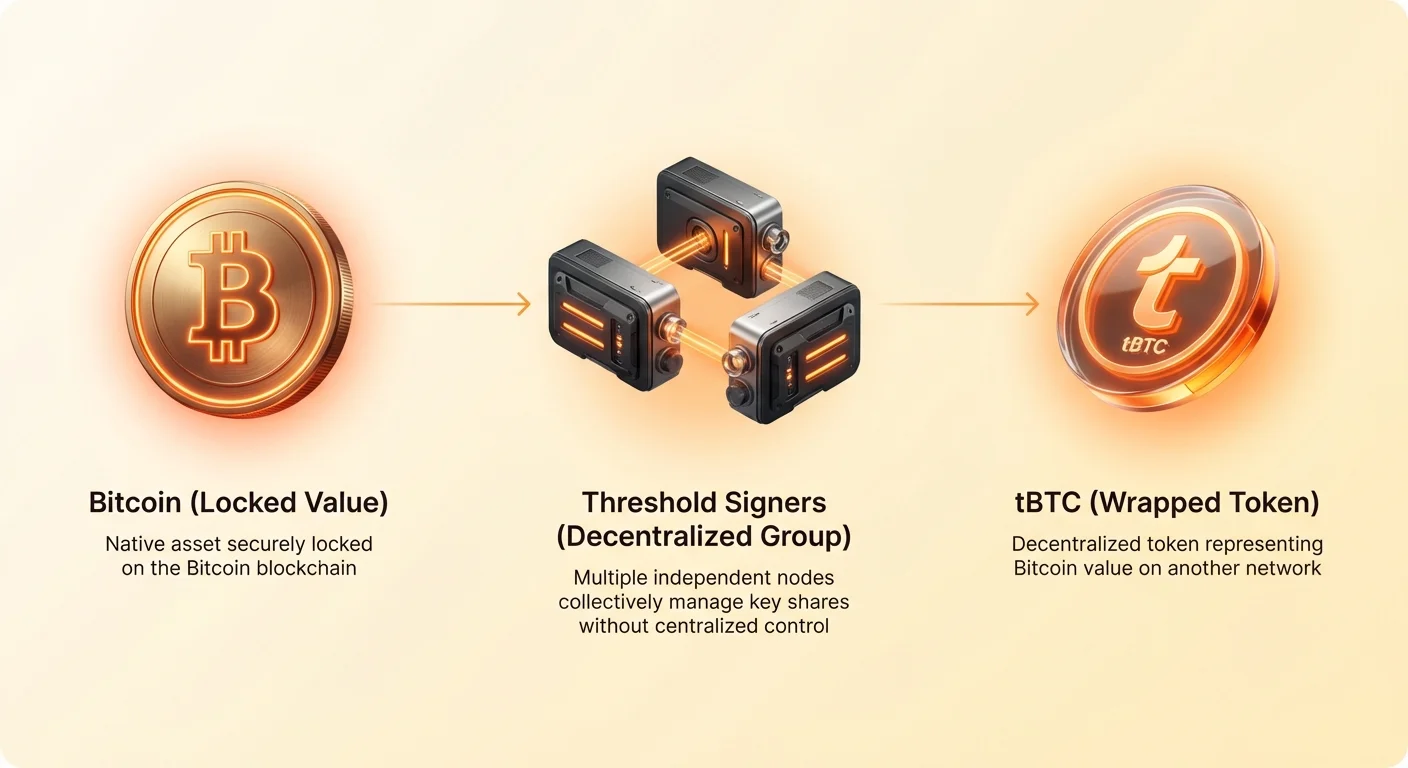
tBTC (Threshold Bitcoin) emerged as a cryptographic solution to this problem. It is designed to be a trust-minimized, decentralized alternative to custodial wrapping. By replacing human custodians with complex mathematics and economic incentives—specifically using Threshold Signature Schemes (TSS)—tBTC allows users to safely port their Bitcoin value across chains without handing over control to any single entity. This guide explores the foundational technology of TSS and the staking mechanisms that secure tBTC, demonstrating how it achieves true decentralized interoperability.
The Interoperability Challenge: Why Bitcoin Needs to Cross Chains
The world of blockchain technology is not a single, unified network; rather, it is a landscape of distinct ecosystems, each optimized for different functions. Bitcoin is optimized for security and value transfer, while chains like Ethereum are optimized for programmable money and complex applications via smart contracts. Interoperability—the ability for these distinct systems to communicate and exchange assets—is crucial for the growth of the overall digital economy.
The Limitations of Native Bitcoin
Bitcoin’s original architecture prioritizes security and immutability above all else. Its scripting language, intentionally simple and limited, ensures that transactions are highly predictable and resistant to exploits. However, this design choice means that Bitcoin’s native Layer 1 cannot easily support the advanced smart contracts required for modern DeFi activities (like automated market making or complex derivatives).
To utilize Bitcoin’s vast liquidity and store-of-value capabilities within these advanced DeFi environments, the value must be represented as a token (an asset) on the destination chain. This transfer is called "bridging" and it requires a mechanism to prove that the underlying Bitcoin has been locked away securely on its native chain, thus preventing double-spending.
Centralized Wrapping (wBTC) Risks
The most common solution, exemplified by wBTC, is centralized custody. When a user wants wBTC, they send their native BTC to a central custodian (a specific company or group of companies). That custodian locks the BTC and then mints the corresponding wBTC token on the destination chain (e.g., Ethereum).
This process is straightforward and fast, but it carries significant counterparty risk:
- Custodial Risk: The user must trust the custodian not to steal the funds or become insolvent. If the custodian fails, the wBTC tokens become worthless, even if the underlying Bitcoin is technically still on the Bitcoin blockchain.
- Censorship Risk: A centralized entity is susceptible to regulation and potential government pressure, meaning they could be forced to freeze or blacklist certain addresses.
- Audit Dependency: The solvency of the wrapped token relies entirely on regular, accurate audits proving the 1:1 ratio between the wrapped token and the reserve BTC.
tBTC addresses these risks by replacing the centralized custodian with a decentralized network of stakers and a mathematically guaranteed signing process: Threshold Signature Schemes.
Understanding Threshold Signature Schemes (TSS): The Core Technology
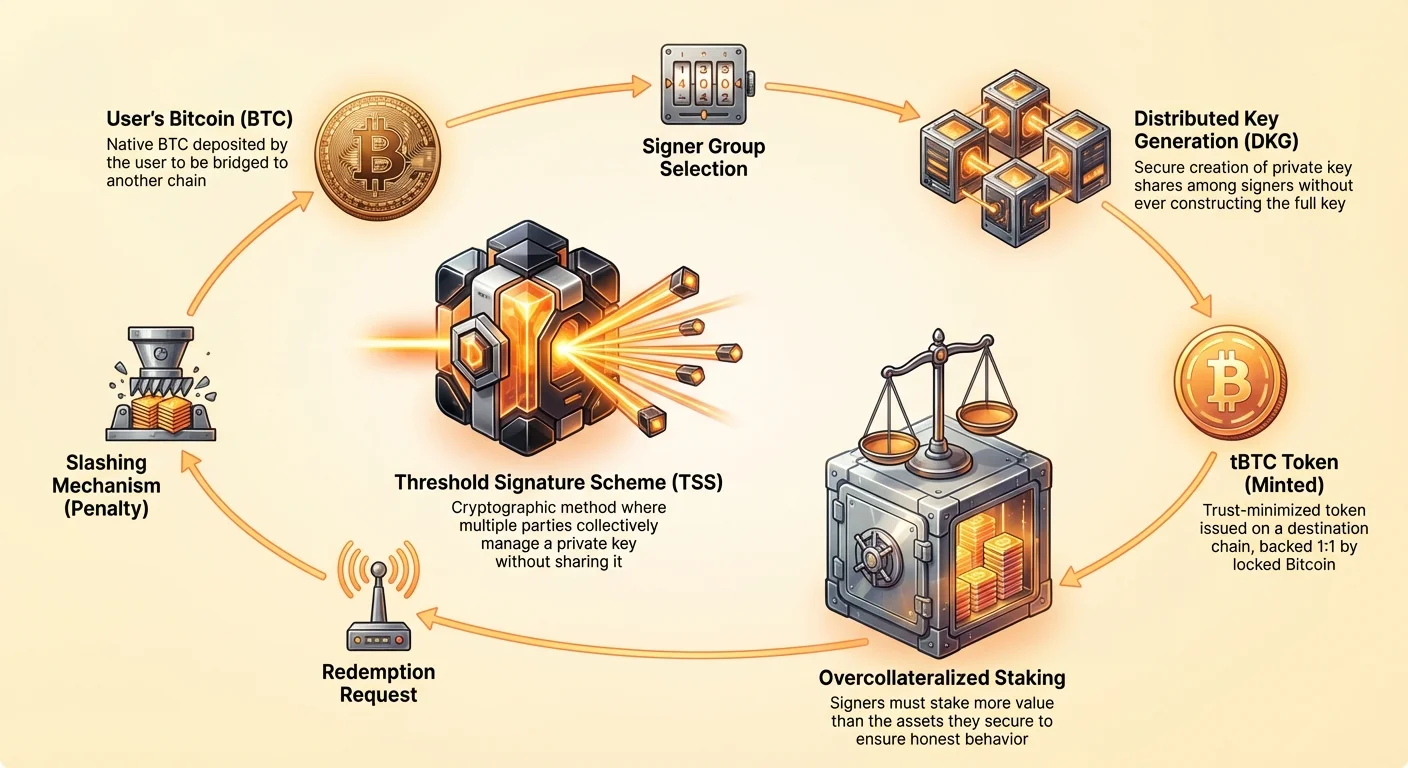
Threshold Signature Schemes (TSS) are the cryptographic backbone of tBTC. They allow a group of participants to collectively control a single cryptographic key—in this case, the private key of a Bitcoin address—without any single participant ever having access to the entire key.
To understand TSS, it helps to first recall how a standard Bitcoin transaction works. A transaction requires a digital signature, which is generated using a single private key. If that key is lost or compromised, the funds are gone.
From Single Key to Shared Security (M-of-N)
TSS utilizes a process called distributed key generation (DKG) and a "threshold" system, typically referred to as M-of-N.
- N: Represents the total number of participants (Signers) in the group responsible for securing the funds.
- M: Represents the minimum number of participants required to cooperate and generate a valid signature. M is usually a supermajority (e.g., 2/3rds or 3/4ths of N).
In a TSS setup, the private key is never constructed in one piece. Instead, each Signer holds only a share of the key. Critically, these shares are generated securely in a way that prevents any single Signer from reconstructing the full key on their own, even if they conspire.
When a tBTC redemption request is made (i.e., when a user wants their native BTC back), the M-of-N requirement kicks in. The M required Signers must collaborate to collectively produce the valid signature that unlocks the BTC from the deposit address. Because no single entity knows the key, the system is fundamentally more secure and censorship-resistant than a single custodian.
Key Generation and Signing in Practice
The process is broken down into two trust-minimized phases:
1. Distributed Key Generation (DKG)
When a new tBTC deposit group is formed, the Signers follow a cryptographic protocol to create a shared Bitcoin address. Crucially, during this process:
- The Bitcoin public key (the address where the BTC will be sent) is derived and made public.
- The corresponding private key shares are distributed secretly among the Signers.
- The actual complete private key is never mathematically constructed or visible to anyone, even temporarily.
This DKG phase ensures that the custody of the funds is decentralized from the very beginning.
2. Threshold Signing
When a user initiates the withdrawal (redemption) of native BTC, the Signers receive the request. They execute a multi-party computation (MPC) protocol where:
- Each Signer uses their secret key share and the transaction details to generate a partial signature.
- The individual partial signatures are combined (by the network, not by one person) to form the single, valid signature required by the Bitcoin network.
If fewer than M Signers participate, the signature cannot be generated, and the funds remain locked. This ensures the security of the funds but requires active cooperation from the majority of the decentralized group.
How tBTC Enables Decentralized Bitcoin Bridging
tBTC is not just the threshold signature protocol; it is a full ecosystem that utilizes TSS within a smart-contract framework to manage deposits, minting, and redemption. The system is designed to provide a trust-minimized guarantee that every tBTC token on the destination chain (e.g., Ethereum) is backed 1:1 by native BTC locked on the Bitcoin blockchain.
Minting and Redemption: The Deposit and Withdrawal Process
The lifecycle of a tBTC token involves two key processes that rely heavily on the decentralized Signer group.
Minting (Creating tBTC)
- Request and Group Selection: A user initiates a request to mint tBTC. The protocol randomly selects a decentralized group of Signers (the M-of-N group) that have staked collateral and are ready to participate.
- Key and Deposit: The selected Signer group collaboratively generates the unique public Bitcoin address using DKG. The user sends their native BTC to this address.
- Proof of Deposit: Once the deposit transaction achieves the required number of Bitcoin confirmations, the Signers provide cryptographic proof to the destination chain’s smart contract that the BTC is locked.
- Token Issuance: The smart contract on the destination chain verifies the proof and issues (mints) an equivalent amount of tBTC to the user's wallet.
Redemption (Retrieving BTC)
- Burn Request: A user sends their tBTC back to the smart contract, which immediately burns the tokens, removing them from circulation.
- Signature Request: The smart contract signals the Signer group associated with the deposit that the user is requesting withdrawal.
- Threshold Signing: The M-of-N Signer group collaboratively performs the threshold signature computation, generating the valid signature needed to spend the original locked BTC.
- Release: The signed transaction is broadcast to the Bitcoin network, releasing the native BTC back to the user’s specified address.
This full cycle ensures that no centralized entity ever touches both the native BTC and the wrapped token, maintaining trustlessness.
The Role of Signers and Staking
The Signers are the critical human component that ensures the system functions. They are node operators who dedicate computing resources and, more importantly, economic capital to the protocol.
Signers are responsible for maintaining their systems, participating promptly in DKG and signing ceremonies, and honestly reporting transaction details to the smart contract. Their willingness to execute these duties is enforced not by legal agreements, but by cryptography and economic incentive mechanisms.
To ensure honest behavior and the safety of the user’s funds, Signers are required to post collateral (stake) that is worth more than the amount of Bitcoin they are collectively responsible for securing. This collateral acts as an economic guarantee, providing financial security to the user in the event of failure or malice.
Economic Guarantees: Staking and Collateralization
The core difference between tBTC and centralized wrapped solutions is the nature of the guarantee. wBTC is guaranteed by the trustworthiness and reserves of a company; tBTC is guaranteed by verifiable cryptographic proof and substantial economic collateral staked by a decentralized network.
Overcollateralization as the Trust Mechanism
The tBTC protocol requires Signers to be overcollateralized. This means the value of the collateral they stake (often in the native token of the staking network or a stablecoin) must significantly exceed the value of the Bitcoin they are securing in the deposit address.
For instance, if a Signer group is responsible for holding 1 BTC (worth, hypothetically, $70,000), they might be required to stake collateral worth 150% or more of that value (e.g., $105,000).
This ratio serves two primary purposes:
- Price Volatility Buffer: The value of BTC can fluctuate rapidly. Overcollateralization ensures that even if BTC spikes in value, the staked collateral remains sufficient to cover the full value of the deposit.
- Disincentive for Malice: The potential profit from stealing the secured BTC is always less than the penalty (slashing) incurred by losing the staked collateral. This creates a strong financial incentive for Signers to perform their duties honestly.
The overcollateralization model creates a dynamic shield against both price fluctuations and malicious behavior, making the system economically robust.
Incentive Alignment and Slashing
The security model of tBTC is built on two concepts that align the Signers’ incentives with the users’ safety: rewards and penalties.
Rewards
Signers receive fees for every tBTC minting and redemption request they successfully process. These fees compensate them for the risk they take (by staking collateral) and the computational resources they expend (by running DKG and MPC processes). These rewards incentivize continuous, prompt, and accurate participation in the protocol.
Slashing
Slashing is the critical penalty mechanism. If a Signer group attempts to defraud the system—for example, by refusing to sign a valid redemption request, attempting to double-spend the locked BTC, or becoming unresponsive—they are penalized. The protocol detects this misbehavior through cryptographic proofs and instantly liquidates (slashes) the Signers’ staked collateral.
The liquidated collateral is then used to refund the user whose BTC was compromised or delayed. This mechanism ensures that if a technical or malicious failure occurs, the user is economically protected by the Signers’ staked assets.
Example Scenario: A user deposits 1 BTC. The Signers responsible for this deposit have staked 1.5 BTC worth of collateral. If 40% of the Signers become malicious and refuse to sign the redemption transaction, the failure is registered by the smart contract. The contract slashes the entirety of the $105,000 collateral, and the user is immediately reimbursed $70,000 worth of stablecoins or the staking asset, guaranteeing their capital is safe.
This system effectively makes the staked collateral the primary assurance of safety, rather than reliance on a company’s integrity.
The tBTC v2 Upgrade and Decentralization Evolution
The original tBTC protocol laid the groundwork, but as decentralized technology matured, updates were necessary to enhance efficiency and decentralization. tBTC v2 introduced several improvements, particularly concerning the mechanism of staking and managing collateral.
In tBTC v2, the protocol moved towards a more generalized and scalable approach to staking, often utilizing an integrated network like the Threshold Network (T), which provides the core cryptographical primitives (like DKG and TSS) as a service to various decentralized applications.
Staking Management and Governance
Instead of requiring Signers to stake only collateral specific to a single deposit, tBTC v2 often uses a continuous staking pool. Signers stake T tokens (or other assets) into this pool, and the protocol automatically assigns them to secure various deposit addresses based on their staked amount and reputation.
Key aspects of modern tBTC staking include:
- Pooled Security: Large pools of staked collateral secure multiple deposits simultaneously, increasing efficiency and liquidity.
- Dynamic Group Formation: The randomness of Signer selection is crucial to prevent collusion. The protocol dynamically shuffles groups and assigns them randomly to new deposits, making it impossible for a malicious actor to consistently target specific addresses or pre-select their co-conspirators.
- Protocol Governance: The governance layer ensures that changes to the collateral requirements, slashing rules, and fee structures are made transparently and democratically by the community of token holders, further reinforcing decentralization.
This evolution ensures that tBTC remains scalable while maintaining its fundamental commitment to trustlessness and decentralization.
Comparing Interoperability Models: Trust vs. Efficiency
When choosing how to wrap Bitcoin for DeFi, users face a fundamental trade-off between speed and cost (efficiency) versus reliance on cryptography (trust minimization). Understanding this trade-off is essential for assessing risk.
| Feature | tBTC (Threshold Signatures) | wBTC (Centralized Custody) |
|---|---|---|
| Custody Model | Decentralized M-of-N Signer Group | Centralized Custodian (Company) |
| Trust Reliance | Cryptography & Economic Guarantees (Slashing) | Third-Party Audit & Regulatory Compliance |
| Security Mechanism | Overcollateralized Staking | Custodial Reserves (Off-chain) |
| Censorship Resistance | High (No single point of control) | Low (Custodian can freeze funds) |
| Transaction Speed | Slower (Requires multi-party computation and Bitcoin confirmations) | Faster (Token minting is immediate after verification) |
| Fees & Cost | Generally Higher (due to rewarding Signers and managing collateral) | Generally Lower/Fixed (custodian service fees) |
Decentralization vs. Speed/Cost Trade-offs
Centralized solutions like wBTC are often preferred by institutional users or high-frequency traders due to their near-instantaneous minting/redemption process and lower transaction overhead. Since a single entity handles the locking and issuing, the process is streamlined and highly efficient.
However, tBTC prioritizes trust minimization over speed. The need for Signers to perform DKG, wait for Bitcoin confirmations, and then perform the complex threshold signing process introduces inherent latency. Furthermore, the need to incentivize Signers and manage the high capital requirements for overcollateralization means that transaction fees are often higher than in centralized systems.
For users prioritizing self-sovereignty and the absolute minimization of counterparty risk, these higher costs and longer wait times are acceptable trade-offs for mathematical certainty. They view the cost difference as the price paid for genuine trustlessness.
Assessing Counterparty Risk
The ultimate divergence between these models lies in counterparty risk:
- wBTC Risk: If the central custodian goes bankrupt, is hacked, or is censored by a government, the wrapped tokens become unbacked and potentially worthless. The user’s recourse is legal, centralized, and slow.
- tBTC Risk: If a majority of Signers become malicious, the protocol's economic guarantees kick in. The loss is covered by the collateral immediately slashed by the smart contract. The risk is managed mathematically and automatically, adhering to the principle of "code is law."
For the self-custody adopter, tBTC represents a philosophical necessity. It allows Bitcoin to participate in DeFi ecosystems without forcing the user to surrender the fundamental control and censorship resistance that makes Bitcoin unique.
Actionable Tips for Using tBTC
While tBTC is designed to be trust-minimized, understanding how to interact with it safely remains paramount.
1. Verify the Official Contracts
Always ensure you are interacting with the official, audited smart contracts for the tBTC bridge. Decentralized ecosystems are prone to scams and phishing. Use verified links from the official Threshold Network or tBTC documentation. Never rely on links provided via unsolicited messages or social media.
2. Understand the Redemption Queue and Fees
Redemption (converting tBTC back to native BTC) often involves a queuing system, especially during times of high network congestion. Be aware that the process is not instant, and ensure you factor in the current fee structure, which covers the Signers' services and the gas costs of the underlying chain.
3. Maintain Self-Custody of tBTC
Once you have received your tBTC tokens on the destination chain (e.g., Ethereum), keep them in a secure self-custody wallet (like a hardware wallet or secure software wallet). While tBTC removes custodial risk from the wrapping process, the token itself is only as secure as the wallet holding it. Losing control of your wallet means losing control of your tBTC.
4. Monitor Collateralization Ratio
While the protocol is designed to automate collateral maintenance, users should understand the economic health of the system. Resources are available (usually on the Threshold Network dashboard) to verify the current overall collateralization ratio of the Signer pool. A healthy, well-overcollateralized system provides the strongest possible guarantee.
Conclusion
The need for Bitcoin interoperability is undeniable, but achieving it without sacrificing trustlessness is a complex cryptographic challenge. tBTC and the underlying Threshold Signature Schemes (TSS) represent the cutting edge of decentralized bridging technology. By replacing singular, centralized custodians with distributed, economically incentivized Signer groups, tBTC delivers a truly trust-minimized wrapped asset.
For those committed to the ethos of self-sovereignty and decentralization, tBTC offers the crucial ability to deploy Bitcoin’s value within the dynamic DeFi landscape without having to rely on the integrity of a company or the oversight of traditional financial structures. While it requires technical sophistication and entails trade-offs in speed and cost compared to centralized alternatives, tBTC provides the mathematical and economic guarantees necessary for Bitcoin to securely participate in the future of the digital economy.