
The journey into cryptocurrency often begins with a simple act: purchasing Bitcoin or Ethereum and holding it. While the "HODL" strategy is effective for long-term speculation, true financial sophistication requires moving beyond passive accumulation into active, strategic asset management. In traditional finance, success is determined not just by what you buy, but how you manage the allocations, risk exposures, and capital efficiency of your holdings.
In the fast-moving world of digital assets, strategic management is even more crucial. Market volatility can rapidly skew your initial investment targets, turning a carefully planned 60/40 portfolio into an accidental 90/10 allocation overnight. Furthermore, the inherent programmability of crypto allows assets to generate returns through yield mechanisms like staking and lending—a powerful optimization tool if leveraged correctly, and a significant risk if managed poorly.
This guide serves as the intermediate practitioner’s roadmap for transitioning from basic crypto ownership to optimized asset control. We will explore methods for defining and maintaining optimal portfolio ratios, integrating reliable yield generation, and navigating the complex tax and security risks associated with advanced asset deployment.
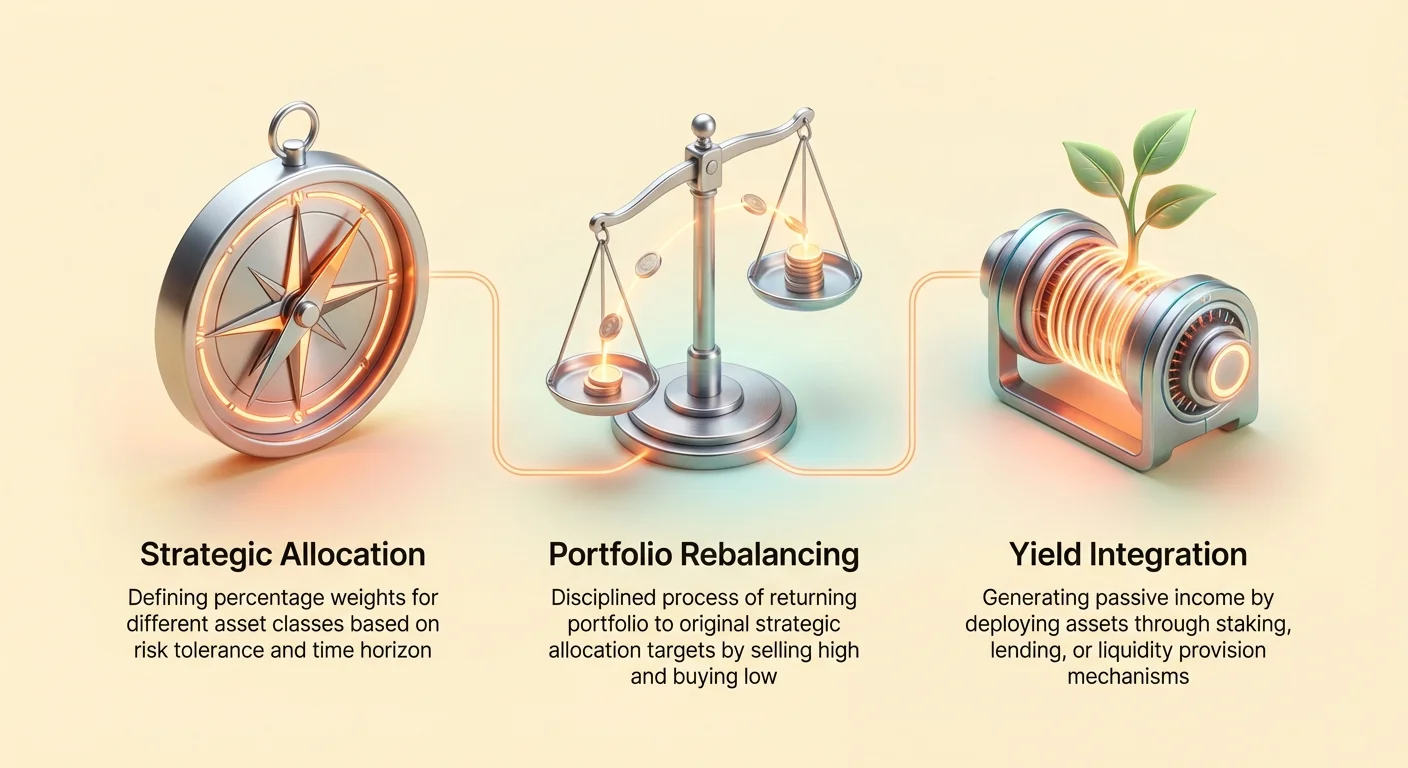
The Foundation of Strategic Allocation
Strategic asset management begins not with predicting market movements, but with defining clear, structural rules for your portfolio. These rules dictate the percentage weight given to different asset classes (e.g., Bitcoin, stablecoins, DeFi tokens, NFTs) and create the framework for all future buying, selling, and yield integration decisions.
Defining Risk Tolerance and Time Horizon
Before setting any specific token targets, an investor must objectively assess their fundamental investment parameters. These parameters govern how aggressive or conservative the portfolio should be.
Risk Tolerance Mapping
Risk tolerance refers to an investor’s emotional and financial ability to withstand losses. In crypto, where 50% drawdowns are common, understanding this threshold is vital. A high-risk investor might allocate heavily to volatile mid-cap tokens, while a low-risk investor might stick exclusively to Bitcoin and regulated stablecoins.
We can map risk tolerance across three key dimensions:
- Capacity for Loss: How much money can you afford to lose without impacting your lifestyle?
- Psychological Comfort: How likely are you to panic sell during a significant market crash?
- Liquidity Needs: Do you need access to this capital in the short term (under 2 years)?
If liquidity needs are high or psychological comfort is low, the portfolio must be skewed heavily towards low-volatility assets like stablecoins or highly established assets like Bitcoin (BTC).
The Influence of Time Horizon
Your time horizon—how long you intend to hold the assets—dictates the necessity of immediate yield or capital preservation. Younger investors with decades until retirement can afford to hold highly volatile, non-yielding assets for maximum capital appreciation. Investors nearing retirement, however, should prioritize capital preservation and reliable yield (e.g., through low-risk staking or lending) to supplement income.
Establishing Target Ratios: Core vs. Satellite
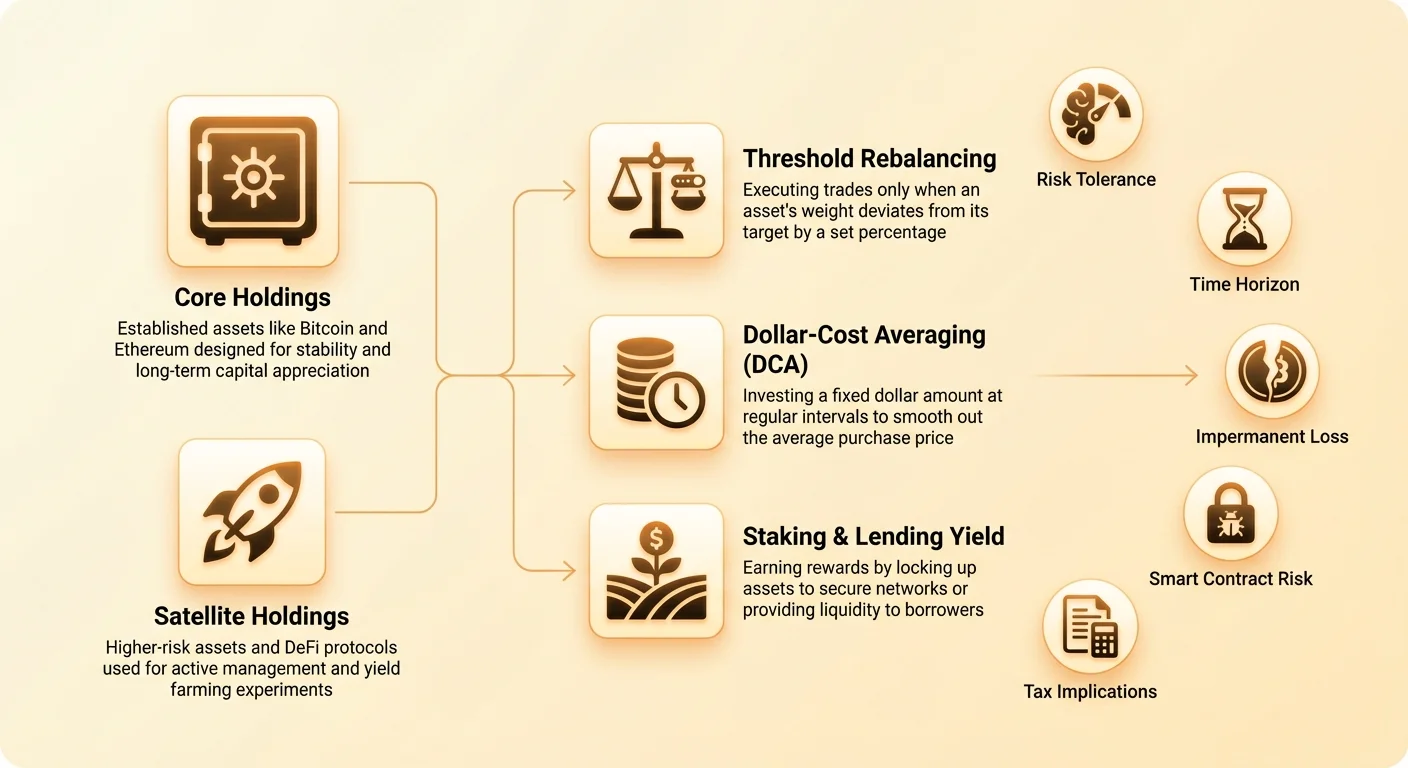
A common method for building a resilient portfolio is the Core-Satellite approach. This framework divides your total investment into two distinct parts, each with a different risk mandate.
The Core Holdings
The Core is the largest component of your portfolio (often 60–80%). It is designed for stability and long-term capital appreciation, holding the most established assets with the highest adoption and security. The goal of the Core is preservation and steady growth, minimizing the impact of speculation.
- Typical Core Assets: Bitcoin (BTC), Ethereum (ETH), and potentially highly regulated, fully collateralized stablecoins (e.g., USDC).
The Satellite Holdings
The Satellite portion (20–40%) is dedicated to higher-risk, higher-reward opportunities. These assets often include emerging DeFi protocols, specific sector tokens (e.g., Layer 2 solutions, RWA tokens), or small-cap cryptocurrencies. The Satellite portion is where active management and yield farming experiments often occur, but its failure should never jeopardize the Core.
A common beginner allocation might look like this:
- Core (75%): 50% BTC, 25% ETH
- Satellite (25%): 10% Blue Chip DeFi (e.g., protocol tokens), 10% Emerging L2s, 5% Stablecoin Yield.
Implementing Portfolio Rebalancing Strategies
Once target ratios are set, the portfolio immediately begins to drift. If Ethereum performs extremely well over a quarter, its percentage weight may swell from 25% to 40% of the total portfolio value. This growth is fantastic, but it fundamentally alters the risk profile, making the investor overly exposed to Ethereum’s specific market risks.
Portfolio rebalancing is the disciplined act of returning the portfolio to its original, strategic allocation targets by selling high-performing assets and buying low-performing ones. This process enforces risk management and the core financial principle of "selling high and buying low."
Manual Rebalancing: Trigger Points and Execution
Manual rebalancing requires the investor to actively monitor the portfolio and execute trades. This method offers the highest level of control and tax efficiency but demands constant vigilance and strict emotional discipline.
Time-Based Rebalancing
The simplest approach is to set a fixed schedule for review, regardless of market conditions. Common schedules include quarterly or semi-annually. On the review date, the investor analyzes current allocations against targets and executes the necessary trades.
- Example: On January 1st, a $100,000 portfolio is 50% BTC ($50k) and 50% ETH ($50k). By April 1st, BTC has lagged, but ETH surged, making the portfolio $120,000, with $40,000 in BTC (33%) and $80,000 in ETH (67%).
- Action: The investor must sell $10,000 worth of ETH and use those funds to buy $10,000 worth of BTC to reset the target 50/50 allocation ($50k/$50k reset).
Threshold-Based Rebalancing
A more dynamic and efficient method is threshold rebalancing, where trades are only executed if an asset deviates from its target weight by a specific percentage (e.g., 5% or 10%).
- Tip for Beginners: Set wider thresholds (e.g., 10%) when starting, as frequent trading in a volatile market generates excessive transaction fees and complex tax events. For example, if your BTC target is 50%, you would only rebalance if BTC falls below 45% or rises above 55%.
Automated Rebalancing Tools and Protocols
For investors who prefer a "set it and forget it" approach or who lack the discipline for manual trading, automated tools and decentralized finance (DeFi) protocols offer compelling solutions.
Centralized Exchange (CEX) Tools
Many sophisticated centralized exchanges (CEXs) now offer features that automatically execute recurring buys or systematic rebalancing based on pre-set ratios. These tools monitor the portfolio and execute trades when drift occurs, often optimizing for the lowest possible trading fees within their ecosystem.
Advantages: User-friendly interface, deep liquidity, and integration with fiat on/off-ramps. Disadvantages: Requires ceding custody of funds to the CEX (custodial risk).
Decentralized Finance (DeFi) Index and Basket Tokens
In DeFi, the rebalancing mechanism is often embedded into smart contracts, typically through index funds or automated vaults. These products allow users to deposit assets into a tokenized basket (e.g., an index tracking the top 10 DeFi governance tokens).
The protocol’s smart contract is responsible for maintaining the weights by systematically buying and selling the underlying assets as prices change. The user simply holds the single basket token.
- Mechanism: If Asset A in the basket surges, the contract executes a swap, reducing the allocation to Asset A and distributing the proceeds to underperforming assets. This typically incurs a small fee which covers the gas costs and incentives for the rebalancing agent.
- Security Note: While non-custodial (you control your keys), these solutions introduce smart contract risk. Due diligence on the protocol's audit history is mandatory.
Accumulation Methods: DCA and Reverse DCA
Rebalancing manages the existing capital pool, but strategic asset management also requires careful planning for new capital deployment and eventual profit-taking. Dollar-Cost Averaging (DCA) and its inverse, Reverse Dollar-Cost Averaging (RDCA), are the core strategies for managing capital flow over time.
Dollar-Cost Averaging (DCA) for Entry
DCA is the strategy of investing a fixed dollar amount into a specific asset at regular intervals, regardless of the asset's current price. This removes the emotional pressure of "timing the market."
Mitigating Volatility Risk
The primary benefit of DCA is that it smooths out the average purchase price. When prices are high, your fixed dollar amount buys fewer units; when prices are low (during a crash), it buys significantly more. Over a long time horizon, DCA consistently outperforms attempting to buy only at the perceived market bottom.
- Practical Use: DCA is best used for steady, ongoing accumulation of Core holdings (BTC/ETH) using disposable monthly income. Automated trading features on exchanges or wallets facilitate this by setting up recurring purchases.
Reverse Dollar-Cost Averaging (RDCA) for Exit/Profit Taking
RDCA (sometimes called Distribution Strategy) is the mirror image of DCA. Instead of trying to pick the perfect time to sell everything at the peak, RDCA involves systematically selling a fixed dollar amount (or fixed percentage of holdings) at regular intervals or when specific price targets are hit.
Disciplined Profit Realization
RDCA ensures that investors lock in profits over the life cycle of a bull market, preventing the psychological trap of watching paper gains evaporate during a rapid market correction.
- Scenario: An investor decides that once their BTC holdings cross $100,000, they will sell $5,000 worth every month for the next six months. If the price continues to rise, they capture more profit; if the price falls, they have already secured some gains.
Integrating RDCA with rebalancing is powerful:
- Price Surges: An asset surges past its rebalancing threshold (e.g., BTC goes from 50% target to 60%).
- Strategic Action: Instead of simply selling BTC and buying ETH (rebalancing), the investor may decide to sell the excess BTC (the 10% drift) directly into a stablecoin or fiat (RDCA). This locks in profit and reduces overall portfolio risk before resetting the target allocation.
Integrating Yield: Safely Generating Passive Income
Once capital is strategically allocated and maintained, the next step in advanced asset management is ensuring that assets are not idle. Yield integration is the process of putting assets to work through staking, lending, or liquidity provision to generate ongoing returns.
Understanding Core Yield Mechanisms
The three primary methods for generating yield in the crypto space are conceptually simple, though technically distinct.
1. Staking (Proof-of-Stake Rewards)
Staking involves locking up assets to support the security and operations of a Proof-of-Stake (PoS) blockchain (e.g., Ethereum, Solana, Cardano). In return for validating transactions and securing the network, stakers receive rewards in the form of newly minted tokens and transaction fees.
- Risk Profile: Generally considered lower risk than lending or farming, provided the chosen network is secure. The primary risk is slashing (losing staked funds due to validator misconduct, though this is often protected against by staking providers) and liquidity risk (funds may be locked for a specific period).
2. Lending (Centralized and Decentralized)
Lending involves depositing assets into a protocol or platform, making them available for borrowers.
- Centralized Lending (CeFi): Funds are lent to an intermediary (a centralized exchange or lending platform) who manages the risk and provides fixed interest rates. This introduces counterparty risk—if the platform mismanages funds or goes bankrupt, the user’s assets are at risk (as seen in major events in 2022).
- Decentralized Lending (DeFi): Funds are deposited into non-custodial smart contract protocols (e.g., Aave, Compound) where interest rates float dynamically based on supply and demand. Risk is centered on smart contract security and liquidation failure, not counterparty default.
3. Liquidity Provision (Yield Farming)
Yield farming or liquidity provision (LP) involves depositing two assets (often a token pair like ETH/USDC) into a Decentralized Exchange (DEX) liquidity pool. This allows other users to trade between the two assets. LPs earn trading fees and often receive additional tokens (LP rewards or governance tokens) as an incentive.
- Risk Profile: Highest risk. Exposure to Impermanent Loss (IL), smart contract failure, and potential exploit of the incentivized reward tokens. IL is the potential divergence in value between holding the assets in the pool versus holding them outside the pool.
Centralized vs. Decentralized Yield: A Security Perspective
The strategic choice between CEX (Centralized) and DeFi (Decentralized) yield dictates the type of risk you assume.
| Feature | Centralized Yield (CeFi) | Decentralized Yield (DeFi) |
|---|---|---|
| Custody | Custodial (Exchange holds private keys) | Non-Custodial (User holds private keys) |
| Primary Risk | Counterparty risk, Platform insolvency, Regulatory risk | Smart Contract risk, Impermanent Loss, Governance exploits |
| Interest Rate | Usually fixed or predictable | Variable, often high but volatile |
| Accessibility | Very beginner-friendly, high liquidity | Requires self-custody setup (wallet), complex UI |
Strategic Alignment: For Core holdings (capital preservation focused), CeFi staking or low-risk DeFi lending on audited stablecoin pools might be appropriate. For Satellite holdings, higher-risk, higher-reward strategies like yield farming on newer protocols might be used, reflecting the increased risk tolerance for that segment of the portfolio.
Assessing and Mitigating Yield Aggregator Risk
For the intermediate practitioner, actively generating yield often involves using yield aggregators or vaults. These tools automatically move capital between various lending protocols, liquidity pools, and staking opportunities to capture the highest possible return (APY), often compounding rewards automatically. While highly efficient, they dramatically increase the surface area for risk.
Technical Risks: Smart Contract Audits and Exploits
Yield aggregators rely on layers of interlocking smart contracts. A single vulnerability in any contract along the chain—the underlying DEX, the lending protocol, or the aggregator vault itself—can lead to total loss of funds.
Due Diligence Checklist for Vaults
- Independent Audits: Always verify that the protocol has undergone multiple, public audits by reputable security firms (e.g., CertiK, Trail of Bits). The audits should be recent, and the team should have addressed all critical findings.
- Time in Market: Newer protocols (those less than 6 months old) carry inherently higher, unknown risk. Deploy significant capital only into battle-tested protocols that have operated successfully through multiple market cycles.
- Code Transparency (Open Source): Ensure the contract code is publicly available. Proprietary, closed-source contracts should be avoided entirely, as they prevent independent community vetting.
Economic Risks: Impermanent Loss and Protocol Failure
Economic risks relate to the financial viability and stability of the assets and incentives within the yield strategy.
Impermanent Loss (IL) Mitigation
Impermanent Loss occurs when assets are deposited into a liquidity pool and the price ratio of the paired assets changes dramatically. While LPs earn trading fees, a large price divergence can make the total dollar value of the LPs share less than if they had simply held the two tokens separately (HODLed).
- Mitigation Strategy: Focus on stablecoin pairings (e.g., USDC/DAI). Since the price ratio is designed to remain 1:1, IL is minimized, allowing the LP to capture trading fees and incentives with minimal price divergence risk. Alternatively, pair assets expected to move similarly (e.g., ETH/Lido staked ETH).
Oracle and Governance Risks
Many yield strategies rely on price feeds (oracles) or governance proposals to execute operations (e.g., liquidations, rate adjustments). If an oracle is manipulated (a "flash loan attack") or if governance voting is centralized (a "rug pull"), the vault can be drained. Investors must verify that the protocol uses robust, decentralized oracles (like Chainlink) and has a distributed governance structure.
Custodial Risks and Counterparty Exposure
While DeFi is non-custodial in the traditional sense, using a yield aggregator means giving a smart contract permission to manage and move your funds.
Understanding Protocol Withdrawal Mechanisms
A robust protocol will always allow users to withdraw their original capital and earned yield at any time. Protocols that impose excessive lock-up periods or withdrawal limits should be treated with extreme caution, as these mechanisms can prevent access to funds during a crisis.
Safety Net: Insurance Protocols
Advanced practitioners often utilize DeFi insurance protocols (like Nexus Mutual) to hedge against specific smart contract risks. These protocols allow users to pay a premium to insure their deposited capital against losses resulting from specific smart contract exploits, adding a layer of risk mitigation to the yield strategy.
The Complexities of Yield and Rebalancing Taxes
Strategic asset management is incomplete without understanding the tax implications of active trading and yield generation. In most major jurisdictions (US, EU, Canada), every transaction that moves crypto between different types of assets (a swap or a trade) or generates new tokens (yield) is a taxable event.
Tax Implications of Yield Generation (Income vs. Capital Gain)
Yield generated from crypto assets is typically treated as ordinary income upon receipt, much like interest earned in a savings account or a dividend.
When is Yield Taxable?
- Staking Rewards: Rewards received for validating transactions are generally taxed as ordinary income at the asset’s fair market value (FMV) on the day they are received.
- Lending Interest: Interest earned from CeFi or DeFi lending is taxed as ordinary income upon receipt.
- Liquidity Mining/Airdrops: New governance tokens received as incentive rewards (e.g., from yield farming) are also taxed as ordinary income at their FMV when received.
Crucially, the investor’s tax basis (cost) for that newly received yield asset is set at its FMV on the receipt date. If the investor later sells that earned asset for a higher or lower price, the difference is taxed as a capital gain or loss.
- Action Tip: Utilizing specialized crypto tax software (as mentioned in the source material inspiration) is essential for automatically calculating the FMV and creating the income record for thousands of small yield transactions. Manual tracking is nearly impossible for active yield farmers.
Tracking Rebalancing Transactions and Tax Lot Identification
Rebalancing involves frequent selling and swapping, which generates numerous capital gains or losses. The specific tax method used to calculate the cost basis of the assets being sold has massive implications for tax efficiency.
FIFO, LIFO, and Specific Identification
When you sell assets, tax authorities require you to identify which "lot" (i.e., which specific purchase) the assets came from.
- First-In, First-Out (FIFO): Assumes the first coins purchased are the first ones sold. This is the default method in many jurisdictions and often leads to higher capital gains if the investor has been holding appreciating assets long-term.
- Last-In, First-Out (LIFO): Assumes the last coins purchased are the first ones sold. This can be useful for reducing current gains during a market surge.
- Specific Identification (Specific ID): Allows the investor to choose the specific, highest-cost basis lot to sell first. This is the most tax-efficient method, as it maximizes tax losses and minimizes immediate gains.
Strategic Rebalancing for Tax Efficiency
During rebalancing, the goal is often Tax Loss Harvesting—the intentional sale of an asset at a loss to offset capital gains realized elsewhere in the portfolio.
- Example: If you need to sell some of your excess ETH to buy BTC (rebalance), look for the specific ETH purchase lot that is currently trading below its cost basis. By selling this specific loss-making lot, you execute the rebalance and generate a capital loss that can offset gains from other parts of the portfolio or from realized yield income.
(Note: This concept links directly to the deeper discussion in the related guide: Advanced Tax Optimization Strategies: FIFO/LIFO/Specific ID and Loss Harvesting)
Best Practices for Advanced Crypto Asset Management
Successfully implementing strategic allocation, rebalancing, and yield generation requires discipline and a commitment to security.
1. Separate Capital Pools and Wallets
Never use the same wallet for high-risk yield farming (Satellite) as you do for your long-term Core holdings.
- Core Assets: Should reside primarily in a hardware wallet (cold storage) and only connect to the most audited, low-risk platforms (like centralized staking or established L1 network staking).
- Satellite Assets: Should reside in a hot wallet specifically dedicated to interacting with new DeFi protocols. If the hot wallet is compromised, the majority of the portfolio (the Core) remains secure.
2. Set Realistic Yield Targets
The crypto space often promotes unsustainable triple-digit APYs. Strategic managers understand that incredibly high yield usually indicates proportional risk.
- Best Practice: Aim for sustainable, moderate yield (e.g., 5-15% on stable assets) rather than chasing the latest 500% farm. Integrate yield that aligns with your asset’s primary risk mandate. A 6% return on BTC staking is valuable; a 100% return on a newly launched, unaudited token pair carries severe risk of loss.
3. Maintain an Active Emergency Fund
Keep sufficient stablecoins liquid and easily accessible on a reputable exchange or lending protocol. This buffer serves two purposes:
- Gas/Transaction Fees: Ensures you always have funds ready to pay network fees, crucial for moving assets or executing rebalances quickly during market volatility.
- Collateralization: Acts as a safety net if you use any form of margin or collateralized lending, ensuring you can meet margin calls instantly.
4. Systematically Document All Activity
Whether for tax compliance or security auditing, every strategic move—every rebalance, every yield deposit, every withdrawal—must be logged.
- Tools: Use integrated crypto portfolio trackers that connect to your wallets and exchanges to provide a unified view of your net worth, allocation, and transaction history. Good record-keeping is the single most important habit for efficient crypto tax and risk management.
Conclusion
Strategic asset management in cryptocurrency is the pivot point where passive holding transforms into active, risk-controlled investing. By establishing clear allocation targets (Core/Satellite), enforcing disciplined rebalancing, and selectively integrating secure yield mechanisms, investors can maximize capital efficiency while minimizing exposure to unnecessary technical and economic risks.
Moving into the intermediate phase of crypto practice requires accepting complexity: the systems are interconnected, the risks are multi-layered, and the compliance requirements are demanding. However, mastering these processes—from automated rebalancing to advanced yield risk assessment—is essential for building true self-sovereignty and achieving optimized long-term results in the decentralized financial landscape.