
The Foundation of the World Computer
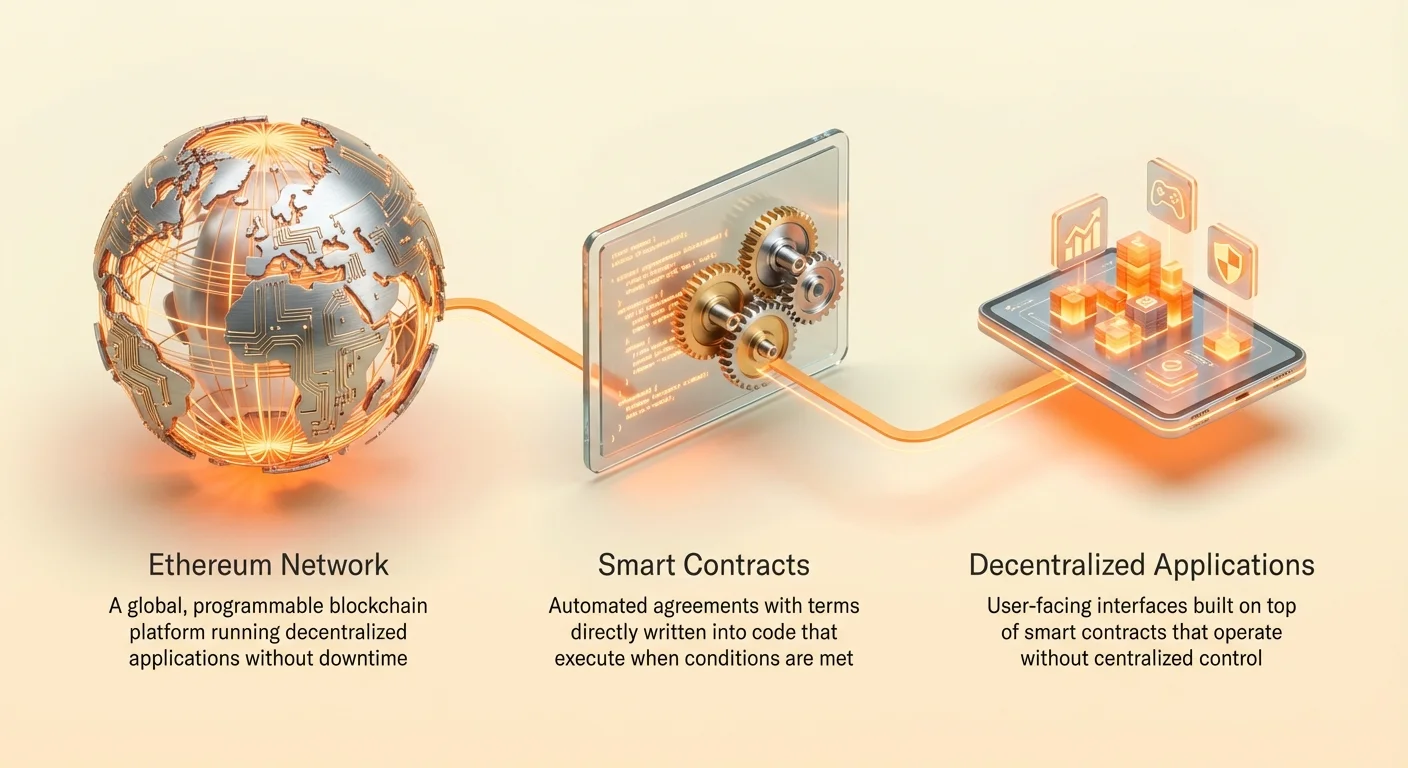
Ethereum represents a fundamental shift in how blockchain technology is utilized. While Bitcoin introduced the concept of decentralized, peer-to-peer digital currency, Ethereum expanded this premise into a fully programmable ecosystem. The Genesis and Initial Distribution. It is often described as a "World Computer" because it allows developers to build and deploy decentralized applications (dApps) that run exactly as programmed without any possibility of downtime, censorship, fraud, or third-party interference. This capability transforms the blockchain from a simple ledger of transactions into a robust platform for global computation.
The core innovation that separates Ethereum from its predecessors is its flexibility. Bitcoin was designed primarily to track the ownership of digital currency. Ethereum, conversely, was built to execute complex logic. This allows for the creation of financial instruments, digital property registries, and governance systems that operate autonomously. The network does not just track who owns what. It tracks the state of computer programs and updates that state as users interact with them.
This programmability has given rise to entire industries that exist solely on-chain. From decentralized finance (DeFi) to non-fungible tokens (NFTs), the utility of the network is derived from its ability to process arbitrary code. As the network has matured, its underlying economic and security models have evolved significantly. The transition from Proof of Work to Proof of Stake, known as "The Merge," fundamentally altered how the network reaches consensus and issues new assets.
Smart Contracts: The Building Blocks
At the heart of this ecosystem lies the smart contract. A smart contract is self-executing code where the terms of the agreement are directly written into lines of code. The code and the agreements contained therein exist across the distributed, decentralized blockchain network. The code controls the execution, and transactions are trackable and irreversible. This eliminates the need for trusted intermediaries. Immutability, Finality, and Smart Contracts.
You can think of a smart contract like a digital vending machine. In a traditional transaction, you might need a lawyer or a notary to ensure that a deal is honored. With a vending machine, the logic is hard-coded: if you input a specific amount of money and make a selection, the machine releases the item. No clerk is required to verify the payment or hand over the goods. Smart contracts apply this logic to complex digital interactions.
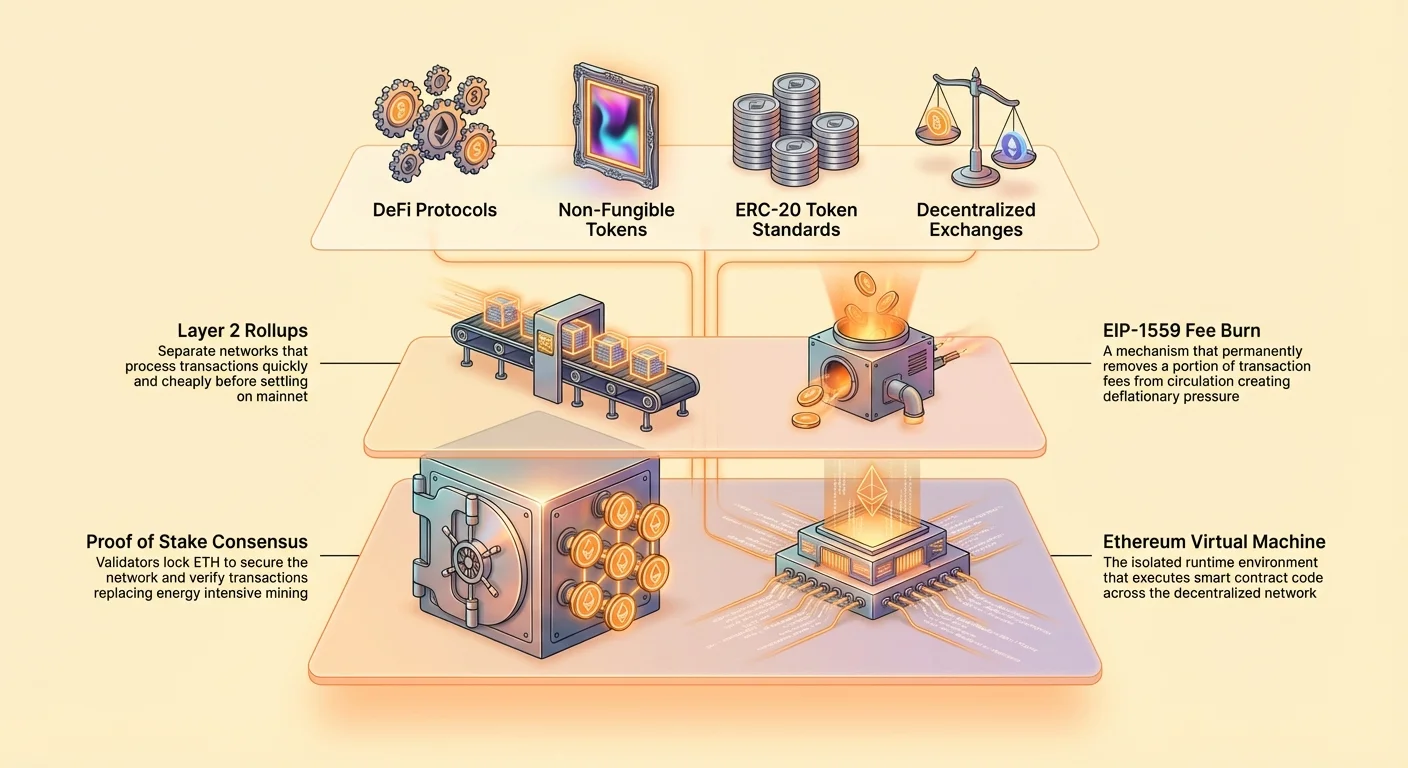
These contracts run on the Ethereum Virtual Machine (EVM). The EVM is the runtime environment for smart contracts in Ethereum. EVM execution layer deep dive. It is completely isolated, meaning the code running inside the EVM has no access to network, filesystem, or other processes. This isolation ensures that a failed or malicious smart contract cannot compromise the rest of the protocol. Every node in the network runs a local copy of the EVM to verify the execution of these contracts.
Decentralized Applications (dApps)
When you combine multiple smart contracts with a user interface, you get a decentralized application, or dApp. To the end-user, a dApp might look and feel like a standard website or mobile app. However, the backend is not hosted on a centralized server run by a corporation like Google or Amazon. Instead, the backend logic runs on the blockchain. This structure provides censorship resistance, as there is no central point of failure that can be shut down by an authority.
dApps are open source by nature. This creates a collaborative environment where developers can copy and modify existing code to create new applications. This "composability" allows projects to plug into one another like LEGO bricks. A lending protocol can integrate with a decentralized exchange, which can in turn integrate with a yield farming dashboard. This interconnectedness accelerates innovation but also introduces risks, as a bug in one contract can impact others connected to it.
Economic Mechanics and Incentives
The Ethereum network requires a mechanism to allocate computational resources efficiently. Because every node must process every transaction and execute every smart contract, computation is expensive. To manage this, the network uses a system called "Gas." Gas is the unit that measures the amount of computational effort required to execute specific operations on the network. Every action, from a simple transfer of ETH to a complex smart contract interaction, costs a certain amount of gas.
Users pay for this gas using ETH, the native cryptocurrency of the network. This creates a direct link between the utility of the network and the value of the asset. If you want to use the computer, you must pay for the electricity. The gas fee is determined by supply and demand for block space. When many users want to transact simultaneously, the price of gas rises, prioritizing those willing to pay more for faster inclusion in a block.
The Evolution of Fee Markets
Historically, fee markets were unpredictable. However, the implementation of EIP-1559 introduced a major overhaul to how transaction fees work. Instead of a simple auction system, the network now utilizes a "base fee" that adjusts automatically based on network congestion. Users pay this base fee to get their transaction included. They can also add a "priority fee" or tip to incentivize validators to process their transaction faster during periods of high demand.
The most significant economic change introduced by EIP-1559 is the burning of the base fee. Previously, all fees went to miners. Now, the base fee is permanently removed from circulation (burned). This mechanism introduces a deflationary pressure on the supply of ETH. The ETH Supply Schedule. If the network sees high usage, more ETH is burned than is created through new issuance. This dynamic connects the usage of the platform directly to the scarcity of the asset.
Monetary Policy and Issuance
Ethereum does not have a hard cap on its total supply like Bitcoin's 21 million limit. Instead, its monetary policy is defined by a balance between issuance and burning. New ETH is issued to validators as a reward for securing the network. This issuance acts as an incentive to maintain the infrastructure. The rate of issuance is determined by the total amount of ETH staked in the network.
When network activity is high, the burn rate from transaction fees can exceed the issuance rate. This state is often referred to as "ultrasound money" by proponents, suggesting that the asset becomes more scarce over time as utility increases. Conversely, during periods of low activity, the supply may inflate slightly. This flexible monetary policy is designed to ensure security is always funded while capturing value during periods of high demand.
Consensus, Security, and Staking
The security model of Ethereum shifted dramatically with the move to Proof of Stake (PoS). Under the previous Proof of Work system, miners used energy-intensive hardware to solve puzzles and secure the chain. Proof of Stake replaces physical energy with economic value. Proof-of-Work vs. Proof-of-Stake. Security is provided by "validators" who lock up, or stake, 32 ETH into a smart contract. These validators are responsible for proposing new blocks and verifying the work of others.
This shift eliminated the massive energy consumption associated with mining, reducing the network's environmental footprint by over 99%. It also changed the economics of attacking the network. To attack a PoS chain, an adversary must control a majority of the staked ETH. This would require acquiring billions of dollars worth of the asset, which would likely destroy the value of the investment they are trying to capture.
The Mechanics of Staking
Staking serves as the crypto-economic security layer. Validators run software that checks transactions and blocks. If a validator acts honestly and maintains high uptime, they receive rewards in the form of new ETH issuance and priority fees. This provides a yield on the asset, incentivizing long-term holding and participation in network security. The more ETH that is staked, the more secure the network becomes against attacks.
However, staking carries risks. The protocol includes a mechanism called "slashing." If a validator acts maliciously—for example, by trying to validate two conflicting blocks at the same time—a portion of their staked ETH is destroyed, and they are ejected from the network. This economic penalty ensures that validators have a strong financial incentive to follow the rules. Even unintentional downtime results in minor penalties, ensuring the network remains reliable.
Liquid Staking and Accessibility
Running a validator node requires technical expertise and a minimum of 32 ETH, which is a high barrier for many users. This led to the rise of pooled staking and liquid staking solutions. Services allow users to deposit smaller amounts of ETH, which are then bundled to run validators. In return, users often receive a "receipt" token representing their staked position.
These receipt tokens, often called Liquid Staking Derivatives (LSDs), remain liquid and can be traded or used in DeFi applications while the underlying ETH earns rewards. This innovation unlocks capital efficiency. A user can stake their ETH to secure the network and simultaneously use the derivative token as collateral for a loan or to provide liquidity on a decentralized exchange.
Scaling Solutions: Layers and Rollups
As the popularity of Ethereum grew, the network faced a "scalability trilemma." It is difficult to achieve decentralization, security, and scalability simultaneously. The mainnet (Layer 1) prioritizes security and decentralization, which leads to congestion and high fees during peak times. To solve this, the ecosystem adopted a layered approach, moving transaction execution off the main chain while keeping settlement on Layer 1.
Layer 2 solutions are separate networks that operate on top of Ethereum. They process transactions quickly and cheaply, then bundle or "roll up" the data to settle it on the main Ethereum blockchain. This allows users to enjoy the security guarantees of Ethereum without paying the high costs of mainnet congestion. Layer 2s are considered the primary method for scaling the network to support millions of users. Ethereum's modular scaling strategy.
| Feature | Layer 1 (Mainnet) | Layer 2 (Rollups) |
|---|---|---|
| Security | Highest (Consensus) | Derived from L1 |
| Cost | High (Auction market) | Low (Shared costs) |
| Speed | Limited (~15 TPS) | High (Thousands TPS) |
Optimistic and ZK Rollups
There are two primary types of rollups: Optimistic Rollups and Zero-Knowledge (ZK) Rollups. Optimistic Rollups assume that transactions are valid by default. They process transactions off-chain and post the data to Layer 1. There is a "challenge period" (usually seven days) during which anyone can dispute a transaction if they believe it is fraudulent. If no fraud proof is submitted, the transactions are finalized. This method is computationally cheaper but requires a delay for withdrawals.
ZK Rollups use complex cryptography to generate a validity proof for every batch of transactions. This proof is submitted to Layer 1, mathematically proving that the transactions are correct. Because the proof is verified instantly by the smart contract on Ethereum, there is no need for a challenge period. ZK Rollups offer immediate finality and higher potential throughput, though they are more technically complex to build.
Sidechains and Bridges
Sidechains offer another path to scalability. Unlike Layer 2s, sidechains are independent blockchains with their own consensus mechanisms and validators. They run in parallel to Ethereum and connect via "bridges." A bridge allows users to lock assets on one chain and mint a representation of them on another.
Because sidechains do not rely on Ethereum for security, they can optimize for extreme speed and low cost. However, this comes with a trade-off: they are generally less secure and more centralized than Layer 2 rollups. If a sidechain's validator set is compromised, user funds can be lost. Bridges themselves are also frequent targets for hackers, making the transfer of assets between chains a critical point of risk management.
The Financial Utility: DeFi
Decentralized Finance, or DeFi, is the most prominent utility layer built on Ethereum. It recreates traditional financial services—trading, lending, borrowing, and earning interest—without banks or brokers. The infrastructure relies entirely on smart contracts. This creates an open, permissionless system where anyone with an internet connection and a wallet can participate.
The core of DeFi is the Decentralized Exchange (DEX). Unlike centralized exchanges that use order books to match buyers and sellers, most DEXs use a model called Automated Market Makers (AMMs). In an AMM, users trade against a pool of tokens rather than a specific counterparty. The price is determined algorithmically based on the ratio of assets in the pool. This ensures liquidity is always available, even for rarely traded assets.
Liquidity Pools and Yield Farming
To function, AMMs need liquidity. They incentivize users to become "Liquidity Providers" (LPs). An LP deposits pairs of tokens (e.g., ETH and USDC) into a smart contract pool. In return, they earn a portion of the trading fees generated by that pool. This democratizes market making, allowing individuals to earn passive income on their holdings.
This concept evolved into "yield farming," where protocols offer additional rewards in the form of their own tokens to attract liquidity. A user might deposit assets into a lending protocol to earn interest, then take the token they receive as a receipt and stake it in another pool to earn a governance token. These layered strategies can generate high returns but carry significant risks, including smart contract bugs and impermanent loss.
Stablecoins: The Utility Layer
Stablecoins are a vital component of the DeFi ecosystem. These are tokens designed to maintain a stable value, usually pegged 1:1 to a fiat currency like the US Dollar. They allow users to hold value on the blockchain without being exposed to the volatility of assets like ETH or Bitcoin. Stablecoins serve as the medium of exchange for trading and the unit of account for lending protocols.
There are different types of stablecoins. Centralized stablecoins like USDC or USDT are backed by fiat reserves held in a bank. Decentralized stablecoins operate differently. They are often over-collateralized by crypto assets. For example, a user might lock up $150 worth of ETH in a smart contract to mint $100 worth of a stablecoin. If the value of the ETH drops too low, the protocol automatically sells the collateral to cover the debt, ensuring the stablecoin remains solvent.
Tokens and Asset Standards
Ethereum introduced the concept of standardizing digital assets. The most famous standard is ERC-20. Before this standard, every token had to be custom-built, making it difficult for wallets and exchanges to support them. Understanding Ethereum Token Standards. ERC-20 defined a common set of rules that all tokens must follow. This meant that any new token created using this standard was instantly compatible with existing infrastructure.
This standardization enabled the creation of thousands of different tokens on the Ethereum network. These include governance tokens (which give holders voting rights in a DAO), utility tokens (used to pay for services within a dApp), and wrapped assets. Wrapped assets, like Wrapped Bitcoin (WBTC), allow coins from other blockchains to be used within the Ethereum DeFi ecosystem.
Non-Fungible Tokens (NFTs)
While ERC-20 tokens are fungible—meaning one token is identical to another, like a dollar bill—Ethereum also introduced non-fungible tokens using the ERC-721 standard. An NFT represents a unique asset that cannot be swapped one-for-one with another. Each token has a distinct identifier and metadata associated with it.
While early use cases focused on digital art and collectibles, the utility of NFTs extends far beyond that. They can represent ownership of real-world assets like real estate, verify digital identity, or serve as access keys for software and events. In gaming, NFTs allow players to truly own their in-game items, enabling them to sell or trade them on open markets independent of the game developer.
Distinguishing Coins from Tokens
It is important to clarify the difference between a "coin" and a "token" within this ecosystem. A coin, such as ETH, is the native currency of the blockchain. It is used to pay for gas fees and secure the network. It exists at the protocol level. A token, on the other hand, is created by a smart contract on top of the blockchain.
Tokens rely on the underlying blockchain for security and transaction processing. If the Ethereum network were to go down, ERC-20 tokens would stop working. However, if a specific token project fails, the Ethereum network continues to operate unaffected. This distinction is crucial for understanding the risk profile of different digital assets. Coins represent the value of the network infrastructure, while tokens represent the value of a specific application or project built upon it.
Conclusion
The Ethereum ecosystem has evolved from a theoretical whitepaper into a global settlement layer for digital value. By introducing programmability to blockchain technology, it paved the way for decentralized finance, unique digital assets, and autonomous organizations. The transition to Proof of Stake and the implementation of deflationary fee mechanics have solidified its economic model, aligning network security with asset value.
As the network continues to scale through Layer 2 solutions and rollups, the cost of interaction is decreasing, making the "World Computer" accessible to a broader user base. The separation of the consensus layer from the execution layer allows Ethereum to maintain high security while processing an increasing volume of data. This modular architecture ensures the network can adapt to future demands without compromising its core principles.
Ethereum is no longer just a cryptocurrency; it is the foundational software layer for a new, decentralized internet economy.