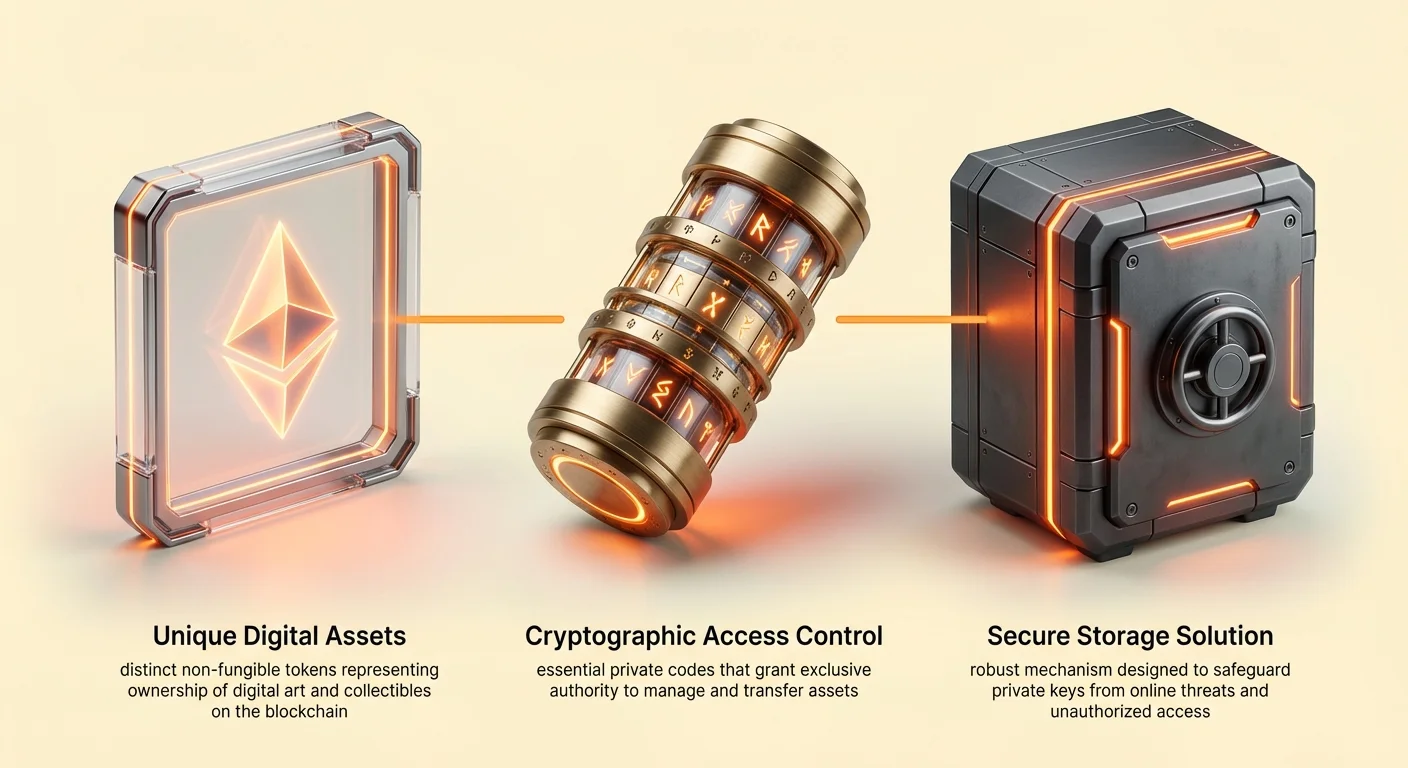
When entering the world of cryptocurrency, the initial focus is often on fungible assets—Bitcoin, Ethereum, stablecoins—which are interchangeable units of value. However, Non-Fungible Tokens (NFTs) represent a completely different asset class: digital collectibles, art, domain names, or gaming items, each possessing a unique identifier and verifiable scarcity.
For crypto newcomers and established collectors alike, treating NFTs merely as "crypto" is a serious security error. Unlike managing cash in a bank account, managing unique digital property requires a specialized security strategy. If your private keys are compromised, you lose your entire unique asset, not just a portion of your liquid funds.
This guide provides a comprehensive framework for securing, displaying, and safely interacting with your digital collectibles. We move beyond basic software wallet usage to detail the strategic deployment of hardware wallets, asset separation, and safe signing practices necessary to protect a valuable NFT collection.

The Unique Security Challenges of Digital Collectibles
NFTs introduce specific risks that standard fungible token wallets are not always optimized to handle. The methods we use to store and transact highly liquid currency must be fundamentally adjusted when dealing with unique, irreplaceable digital items.
The Difference Between Fungible Tokens and NFTs
The foundational difference between standard crypto assets (like ETH or BTC) and NFTs lies in their technical specifications.
Fungible Tokens (e.g., ERC-20): These are interchangeable. If you hold 1 ETH, it has the exact same value and characteristics as any other 1 ETH. Wallets designed primarily for fungible tokens focus on speed and ease of transaction for quantities of coins.
Non-Fungible Tokens (e.g., ERC-721 and ERC-1155): Each NFT has a unique identifier (a token ID). Even if two assets look identical (like two pieces from the same PFP collection), they are technically distinct. This distinction creates a major security implication: if you lose the key protecting that single, unique token, the entire asset is gone forever. There is no replacement.
The Critical Risk: Blind Signing and Approvals
The most frequent way collectors lose their NFTs is not through simple brute-force hacking, but through malicious "blind signing."
What is Blind Signing? When you interact with a decentralized application (dApp) or an NFT marketplace, your wallet asks you to sign a transaction. If your wallet cannot clearly translate the complex code into plain English ("You are sending 0.5 ETH to this address"), you are forced to blindly sign the transaction data.
For NFT collectors, blind signing is especially dangerous because many interactions—such as listing an NFT for sale or staking it—require granting the dApp deep, often unlimited, access to your assets. A common mistake is signing a malicious transaction that looks like a simple "connect wallet" request but is actually transferring ownership of your valuable NFTs to the attacker’s address.
Metadata Dependency and Display Issues
NFT value is often tied to its metadata—the data that dictates the name, description, image link, and rarity traits of the asset. This metadata is often stored off-chain (on centralized servers or decentralized file storage like IPFS).
A quality NFT collector wallet must be able to securely fetch, verify, and display this metadata accurately. If the wallet doesn't handle metadata fetching correctly, you might be looking at a placeholder image (or nothing at all), making it difficult to verify what you own and potentially hiding malicious changes or "rug pulls."
Choosing the Right Wallet Architecture for NFT Collectors
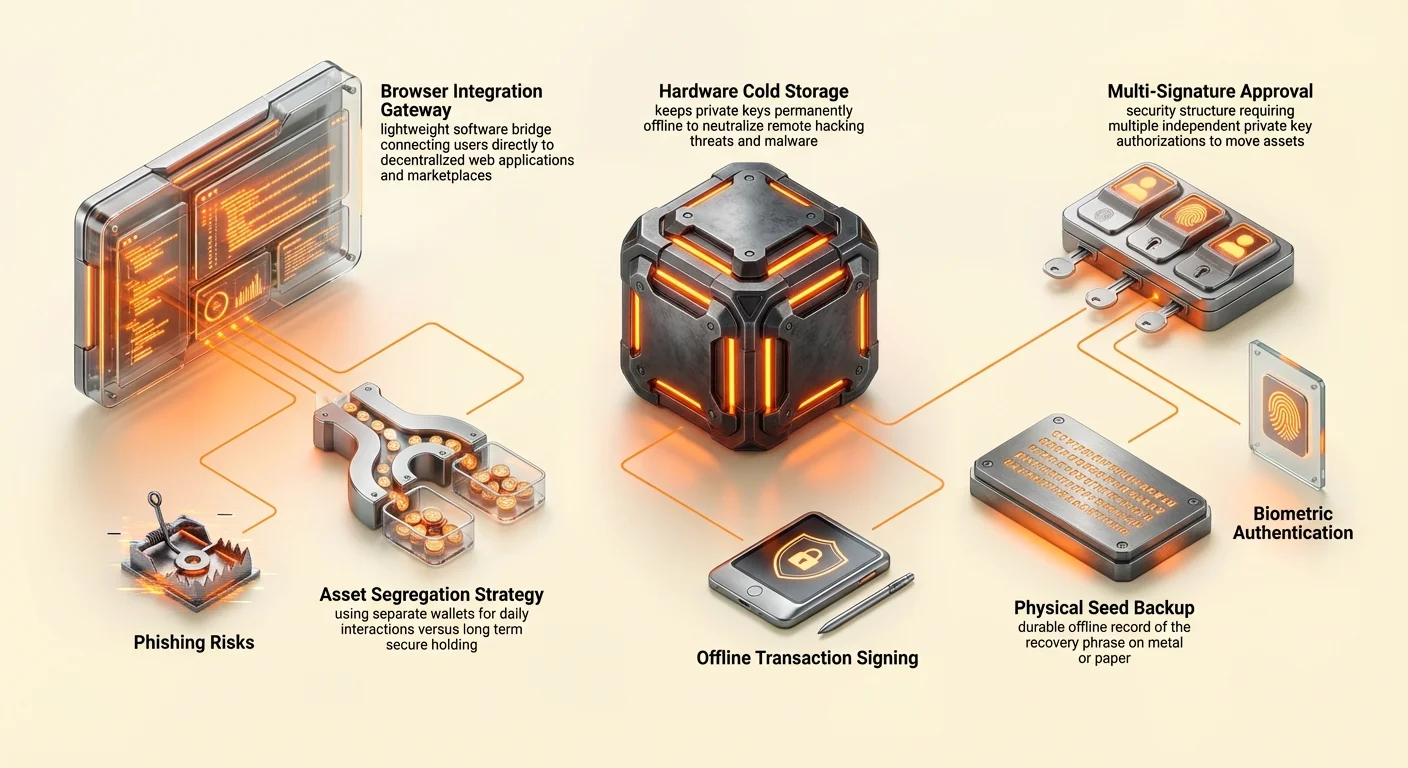
The fundamental principle for securing valuable collectibles is asset separation. A sophisticated collector uses at least two distinct wallets, each serving a specific security purpose. This strategy compartmentalizes risk: if your active trading wallet is compromised, your high-value assets remain protected in cold storage.
The Daily Driver Wallet (Hot Wallet)
This is the wallet you use for day-to-day web interactions. It needs to be fast, integrated, and accessible.
- Format: Typically a browser extension (like MetaMask or Phantom) or a robust mobile application.
- Purpose:
- Interacting with NFT marketplaces (OpenSea, Magic Eden, Blur).
- Paying transaction fees (gas).
- Holding low-value, frequently traded NFTs or fungible tokens used for daily transactions.
- Connecting to new, experimental decentralized finance (DeFi) protocols.
- Risk Profile: High. Since this wallet constantly interacts with the internet and signs many transactions, it is the primary target for phishing and exploits. Therefore, it should never hold your most valuable digital assets.
The Vault Wallet (Cold Storage)
The Vault Wallet is the designated storage facility for high-value collectibles. It prioritizes security and isolation over convenience.
- Format: A dedicated hardware wallet (e.g., Trezor, Ledger) or a software wallet that has never been connected to the internet (an "air-gapped" computer).
- Purpose:
- Storing 90% or more of your NFT collection.
- Holding long-term investments that are not actively traded.
- Acting as the final destination for verified, secured assets.
- Risk Profile: Extremely low. The private keys are kept offline, making them immune to online threats like malware, browser exploits, and phishing attempts aimed at draining hot wallets.
Actionable Tip: Even when listing an NFT held in cold storage, the hardware device must physically verify the transaction. This manual step—pressing a button on the device—is the critical layer of protection that prevents remote hacking of your most important assets.
Multi-Chain Compatibility
The NFT ecosystem is highly fractured, spreading across multiple blockchains (Ethereum, Solana, Polygon, Arbitrum, Tezos, etc.). A premium collector wallet must offer seamless, secure support for this multi-chain environment.
Collectors often need a unified dashboard to manage assets across these disparate networks. The challenge is ensuring that the same seed phrase or hardware device can safely manage assets governed by fundamentally different technical standards (e.g., Ethereum’s ERC standards vs. Solana’s SPL tokens). Look for wallets that are natively built to handle these diverse architectures securely, rather than relying solely on third-party integrations.
Implementing a Secure NFT Vault Strategy
A robust vault strategy ensures that while you remain active in the NFT market, your core investment is insulated from operational risks. This involves a planned migration path for assets from acquisition to long-term storage.
Rule of Separation: Staging vs. Storage
The core strategy is to separate the keys used for interaction (Staging Wallet) from the keys used for storage (Vault Wallet).
- Acquisition (Staging): When you buy a new NFT (mint, auction win, or marketplace purchase), you use your Daily Driver Wallet (Hot Wallet). This is necessary because the acquisition process often involves immediate, complex transaction signing (like bidding or minting).
- Quarantine (Verification): After acquisition, allow a short quarantine period. Verify the NFT metadata, confirm its display characteristics, and ensure the transaction settled correctly.
- Transfer (Storage): Once verified, immediately transfer the NFT from the Daily Driver Wallet address to the Vault Wallet address (secured by your cold storage device). This transfer should be a standard, one-time transaction.
Once an NFT is in the Vault, the private key associated with that Vault should never be exposed to new dApps, sign a listing transaction, or interact with any smart contract other than a simple transfer back out to the Staging Wallet for sale.
The Hardware Wallet Imperative
For high-value NFT collectors, hardware wallets are not optional; they are mandatory. They embody the principle of "cold storage security"—keeping private keys physically isolated from the internet.
When you use a hardware wallet to sign a transaction:
- The transaction data is generated on your computer (Hot Environment).
- The data is securely passed to the hardware wallet via USB or Bluetooth.
- The private key (which never leaves the hardware device) signs the transaction internally.
- The signed transaction is returned to the computer for broadcasting.
This physical isolation ensures that even if your computer is riddled with malware, the attacker cannot steal the key necessary to drain your vault.
Utilizing Multi-Signature (Multisig) for Advanced Collections
For institutions, DAOs, or individuals holding exceptionally valuable collections, a Multi-Signature (Multisig) wallet provides the highest level of security and redundancy.
What is Multisig? A standard wallet requires one signature (your private key) to authorize a transaction. A Multisig wallet requires a predefined number of signatures (M of N) from a group of keys to authorize the transaction. For example, a "2 of 3" setup requires signatures from any two of three designated hardware wallets.
Benefits for NFT Collectors:
- Preventing Single Point of Failure: If one hardware wallet is lost or compromised, the assets remain safe because the attacker cannot reach the required signature threshold.
- Shared Ownership: Ideal for managing a collection owned by multiple partners or family members.
- Enhanced Audit Trail: Every withdrawal or transfer requires consensus, adding a layer of deliberate friction that slows down impulse decisions and malicious attacks.
While setting up a Multisig wallet (using tools like Gnosis Safe) is more complex and involves higher initial gas costs, it is the gold standard for protecting multi-million dollar digital asset portfolios.
Navigating Marketplace Integration and Asset Display
A collector’s wallet must do more than just secure assets; it must allow for seamless interaction with the ecosystem while providing a visually rich, accurate inventory of holdings.
Visual Confirmation and Asset Display
When dealing with fungible tokens, all that matters is the balance number. When dealing with NFTs, the aesthetic and unique traits matter greatly. A top-tier collector wallet provides a clear, high-resolution display of your assets.
Key Display Features:
- Trait Filtering: The ability to filter and sort collections based on rarity traits (e.g., sorting all assets with the "Gold Background" trait).
- Integrated Valuation: Showing the floor price or estimated value of the collection directly in the wallet interface, drawing data from reliable marketplace APIs.
- High-Quality Image Rendering: Automatically adjusting image size and resolution without blurring or distortion, crucial for viewing high-end digital art.
This visual confirmation is also a security feature. When transferring an NFT, a good wallet will display the actual image of the collectible you are moving, reducing the risk of accidentally transferring the wrong token ID.
Managing Metadata and Off-Chain Data Risks
As mentioned, NFT metadata is often hosted off-chain. This introduces a risk: if the hosting provider goes down, or if the creator maliciously changes the metadata, the image or traits of your NFT can disappear or change (a phenomenon known as "rug pulling" the artwork).
A specialized collector wallet offers features to mitigate this risk:
- IPFS Pinning Integration: If your NFT metadata is stored on the InterPlanetary File System (IPFS), the wallet might provide tools or clear instructions on how to "pin" that data locally or through a reliable third-party service, ensuring the image data remains available even if the original creator’s pinning service fails.
- Metadata Cache: Storing a local, verified copy of the metadata upon acquisition, so the wallet can still display the art correctly even if the external source is slow or temporarily unavailable.
In-App Swapping and Listing Features
The convenience of a modern collector wallet lies in its ability to facilitate transactions without forcing the user to leave the app and connect to a third-party marketplace.
Wallets with built-in marketplace integration allow users to:
- List and Delist Assets: Connect directly to major exchanges (like OpenSea or Blur) to list NFTs for sale without needing to use the marketplace website.
- Instant Swapping: Execute peer-to-peer swaps or bundle deals for NFTs within the secure wallet environment.
- Gas Fee Optimization: Display real-time gas prices specific to NFT transactions, which often require higher limits than standard token transfers.
Minimizing Transaction Risk: Safe Signing Practices
The greatest danger to an NFT collection comes not from external hackers, but from the user granting excessive permissions via transaction signing. Understanding how permissions work is the single most important security lesson for any collector.
Understanding Token Approvals (SetApprovalForAll)
When you list an NFT on a major marketplace, you are often asked to sign a transaction that grants the marketplace (the smart contract) the right to manage or transfer all the NFTs in that specific collection held by your wallet. This is known as the setApprovalForAll function.
- The Utility: This function is necessary for convenience. It means you only have to sign one transaction to list multiple items from the same collection over time.
- The Danger: If that marketplace’s smart contract is hacked, or if you accidentally sign a fraudulent
setApprovalForAlltransaction on a phishing site, the malicious entity gains the ability to transfer every NFT in that collection from your wallet without requiring any further signature.
Vetting Marketplace URLs and Avoiding Phishing
Phishing attacks remain the leading threat to hot wallets. Attackers create exact replicas of legitimate marketplace sites (e.g., opensea.io vs. open-sea.com).
Best Practices for Interaction:
- Always Bookmark: Only access major marketplaces through pre-verified bookmarks, never through links in emails, Discord, or Twitter.
- Inspect the URL: Before connecting your wallet or signing any transaction, double-check the URL bar for spelling errors or extra characters.
- Confirm on Hardware: If listing from your hardware wallet, ensure the details displayed on the physical device screen precisely match the transaction you intend to authorize. If the device asks you to sign a data hash rather than a clear transaction description, abort the transaction.
Revoking Permissions and Draining Attack Prevention
Because setApprovalForAll is a persistent security risk, proactive permission management is essential. You must regularly review and revoke unnecessary contract approvals.
How to Practice Permission Hygiene:
- Use Revoke Tools: Utilize trusted permission management tools (like Etherscan’s Token Approval tool or similar tools provided by major wallets like MetaMask or Phantom).
- Regular Audits: Schedule a quarterly "security audit" where you check which smart contracts have unlimited access to your ERC-721 and ERC-1155 tokens.
- Revoke Unused Approvals: If you sold an item on a marketplace six months ago and have no intention of listing more items soon, revoke the approval granted to that marketplace’s contract. While this costs a small gas fee, the cost is insignificant compared to the potential loss of a valuable NFT.
Expert Insight: When listing a high-value NFT, many experienced collectors use the "Vault Strategy" combined with a temporary transfer. They move the NFT from the cold Vault to a clean, temporary hot wallet for the sole purpose of listing and selling it. Once the sale is complete, they transfer any remaining assets (or the unsuccessful NFT) back to the cold Vault and abandon the temporary key. This keeps the main Vault keys completely clean of any marketplace contract approvals.
Conclusion
Securing an NFT collection requires a strategic mindset that treats digital collectibles as high-value, unique property, distinct from standard crypto assets. The transition from merely using a basic software wallet to implementing a multi-tiered security architecture—separating a hot 'Daily Driver' from a cold 'Vault'—is the defining feature of a serious collector.
By prioritizing the use of hardware wallets, understanding the deep risks associated with blanket token approvals (setApprovalForAll), and developing rigorous transaction signing habits, you ensure that your investment in the burgeoning world of digital ownership is protected by best-in-class security practices. The collector’s wallet is not just a storage device; it is a critical interface that bridges the security of cold storage with the necessary functionality of the decentralized web.