
To understand Bitcoin, one must first abandon the idea of digital coins sitting in a virtual vault. In the traditional banking world, money is defined by account balances. If you have money in a bank, a central database holds a specific number next to your name. Bitcoin operates entirely differently. There are no physical coins, nor are there digital files that represent individual coins. There are also no accounts in the protocol layer that simply list a user's balance.
Instead, the entire system relies on a history of transactions. What we call a "bitcoin" is essentially a chain of digital signatures reflecting a history of value transfer. Ownership is established not by holding a static object, but by having the ability to create a new entry in this ledger. When a user checks their wallet balance, the software is actually scanning the entire blockchain to calculate the sum of all unspent transactions accessible by their keys.
This architectural difference is fundamental to how the network remains decentralized. Without a central bank to update a master ledger of balances, the network relies on a transparent, verifiable chain of custody. Every transaction points back to a previous one, linking all the way back to the moment the coins were first minted by a miner. This structure ensures that value cannot be created out of thin air and that the history of every fraction of a bitcoin is traceable and immutable.
The Foundation of Ownership: Public Key Cryptography
Understanding Key Pairs
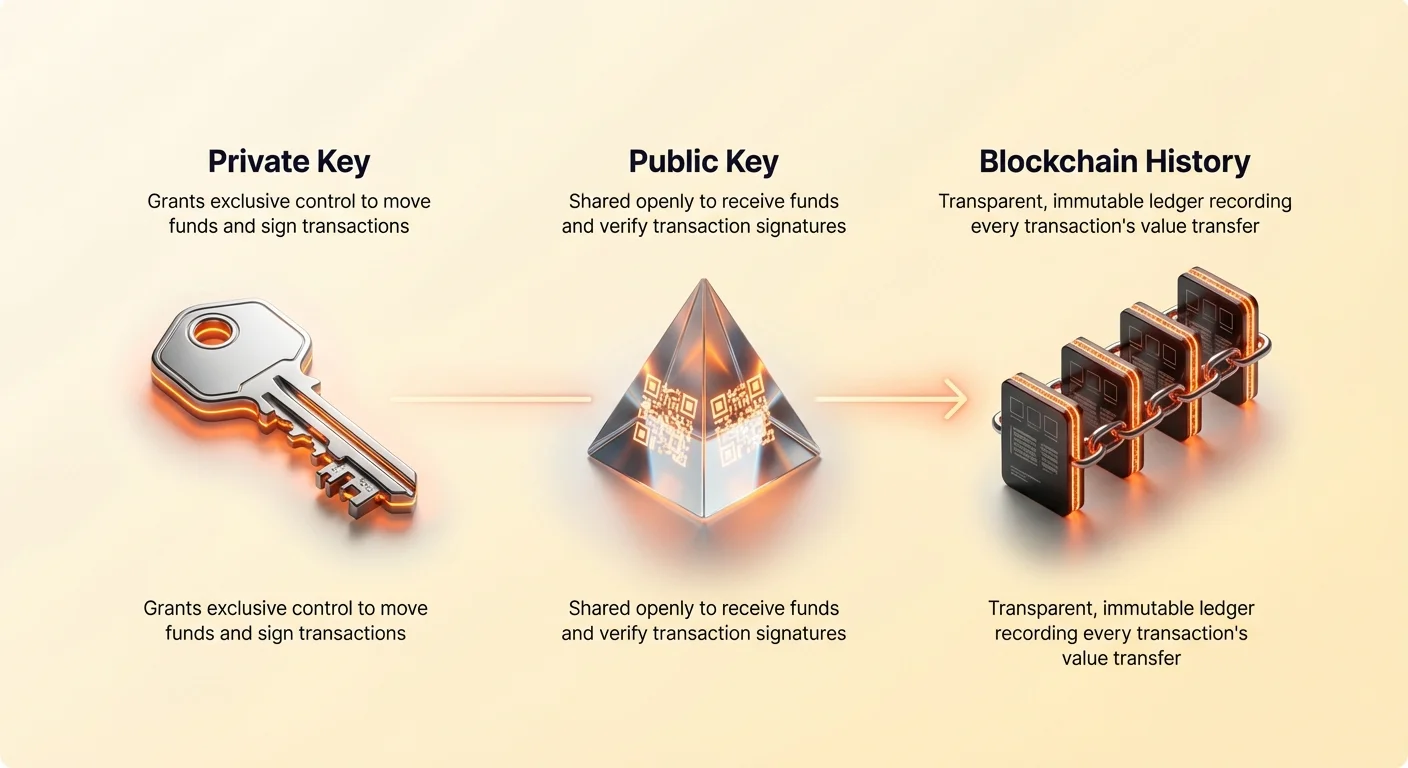
At the heart of Bitcoin transaction mechanics lies public key cryptography. This mathematical framework allows users to generate a secure digital identity without registering with a central authority. Ownership is defined by the possession of a key pair: a private key and a public key. The private key is a randomly generated secret, similar to a password, but far more complex. It grants the authority to move funds. The Private Key Primer details the mechanics of this critical component.
The public key is derived mathematically from the private key. It can be shared openly without compromising security. From this public key, the network generates a Bitcoin address, which acts as the destination for funds. This one-way street is crucial. You can easily generate a public key from a private key, but it is impossible to reverse the process and derive the private key from the public key.
This asymmetry allows the network to function without trust. When a user wants to receive funds, they share their address. When they want to spend funds, they use their private key to cryptographically sign a message. This signature proves they own the private key associated with the address holding the funds, without ever revealing the private key itself to the network or the recipient.
The Role of Digital Signatures
A Bitcoin transaction is effectively a message that states, "I am moving these specific bitcoins to this new address." To make this message valid, it must be digitally signed. The digital signature is created by applying the sender's private key to the transaction data. This process generates a unique string of data that is specific to that exact transaction.
If any part of the transaction details were changed—such as the amount or the destination address—the signature would no longer match. This ensures that once a transaction is signed and broadcast, it cannot be tampered with by third parties. Network participants, or nodes, can use the sender's public key to mathematically verify the signature.
If the math aligns, the network knows the transaction is legitimate and authorized by the true owner. If it fails, the transaction is rejected immediately. This verification happens automatically across thousands of computers globally, securing the network without human intervention.
| Component | Function | Visibility |
|---|---|---|
| Private Key | Signs transactions to prove ownership | Secret (Owner only) |
| Public Key | Verifies signatures against the address | Public (Network) |
| Address | Destination for receiving funds | Public (Anyone) |
The Unspent Transaction Output (UTXO) Model
How Bitcoin Handles Value
Most people are accustomed to the "account-based" model used by banks and credit cards. In that system, if you have $100 and spend $20, the bank simply updates your database entry to read $80. Bitcoin uses a different logic known as the Unspent Transaction Output (UTXO) model. In this system, there are no persistent balances, only chunks of bitcoin that have been received but not yet spent. For a comparison, see UTXO vs. Account Models.
Imagine these UTXOs as digital cash or gold nuggets of varying sizes. If you receive a transaction for 0.5 BTC and another for 0.3 BTC, you hold two distinct UTXOs in your wallet. They do not merge into a single 0.8 BTC "coin" on the blockchain, even if your wallet software displays the total sum for convenience. They remain separate distinct records of value waiting to be used.
When you initiate a transaction, your wallet selects enough of these UTXOs to cover the amount you wish to send. You cannot break a UTXO in half without spending it entirely. This is similar to how physical cash works. You cannot tear a $20 bill to pay for a $10 item. You must hand over the entire bill and receive change in return.
Inputs, Outputs, and Change
Every Bitcoin transaction consists of inputs and outputs. Inputs are references to previous UTXOs that you are now spending. Outputs are the new destinations for that value. When you construct a transaction, you consume existing UTXOs as inputs and create new UTXOs as outputs.
For example, if a miner earns a block reward of 6.25 BTC, that is a single UTXO. If the miner wants to send 1 BTC to Alice, they cannot simply send 1 BTC. They must construct a transaction that takes the 6.25 BTC UTXO as an input. The transaction will then have two outputs.
The first output sends 1 BTC to Alice. The second output sends the remaining 5.25 BTC back to the miner's own address. This second output is known as the "change output." On the blockchain, the original 6.25 BTC UTXO is marked as spent and is no longer valid for future transactions. In its place, two new UTXOs (1 BTC and 5.25 BTC) are created and recorded. This chain of inputs and outputs creates the unbreakable history of the currency.
Bitcoin Script: The Language of Transactions
Stack-Based Execution
Bitcoin transactions are not just simple value transfers; they are programmable instructions. These instructions are written in a language called Bitcoin Script. Unlike complex programming languages used for general software development, Script is intentionally simple. It is "stack-based," meaning it processes data by pushing items onto a list (the stack) and performing operations on the top items.
Script is also not Turing-complete. This means it lacks the ability to create loops or complex logic that could run indefinitely. This design choice is a deliberate security feature. By limiting the complexity of the language, the network prevents infinite loops that could crash nodes or allow attackers to jam the system with computationally expensive commands.
The script dictates the conditions that must be met for a UTXO to be spent. When a transaction is created, the sender attaches a "Locking Script" (ScriptPubKey) to the output. This script essentially says, "These funds can only be moved by someone who can provide a signature matching this specific public key hash." This ability enables advanced Bitcoin scripting.
Unlocking and Validation
To spend those funds later, the owner creates a new transaction containing an "Unlocking Script" (ScriptSig). This script contains the digital signature and the public key. When a node validates a transaction, it runs the two scripts together. It places the unlocking script on the stack followed by the locking script from the previous transaction.
The node executes the instructions sequentially. If the final result is "True," the transaction is valid, and the funds can be moved. If the result is "False," the transaction is invalid. This mechanism allows for conditions more complex than simple ownership.
For instance, scripts can be written to require multiple signatures (Multi-Sig), where two out of three designated keys must sign before funds move. Scripts can also enforce time locks, preventing funds from being spent until a certain block height is reached. This programmability is the foundation for advanced features like the Lightning Network and sidechains, which use complex scripts to enable faster, cheaper off-chain settlements.
The Transaction Lifecycle: From Wallet to Blockchain
Creation and Broadcasting
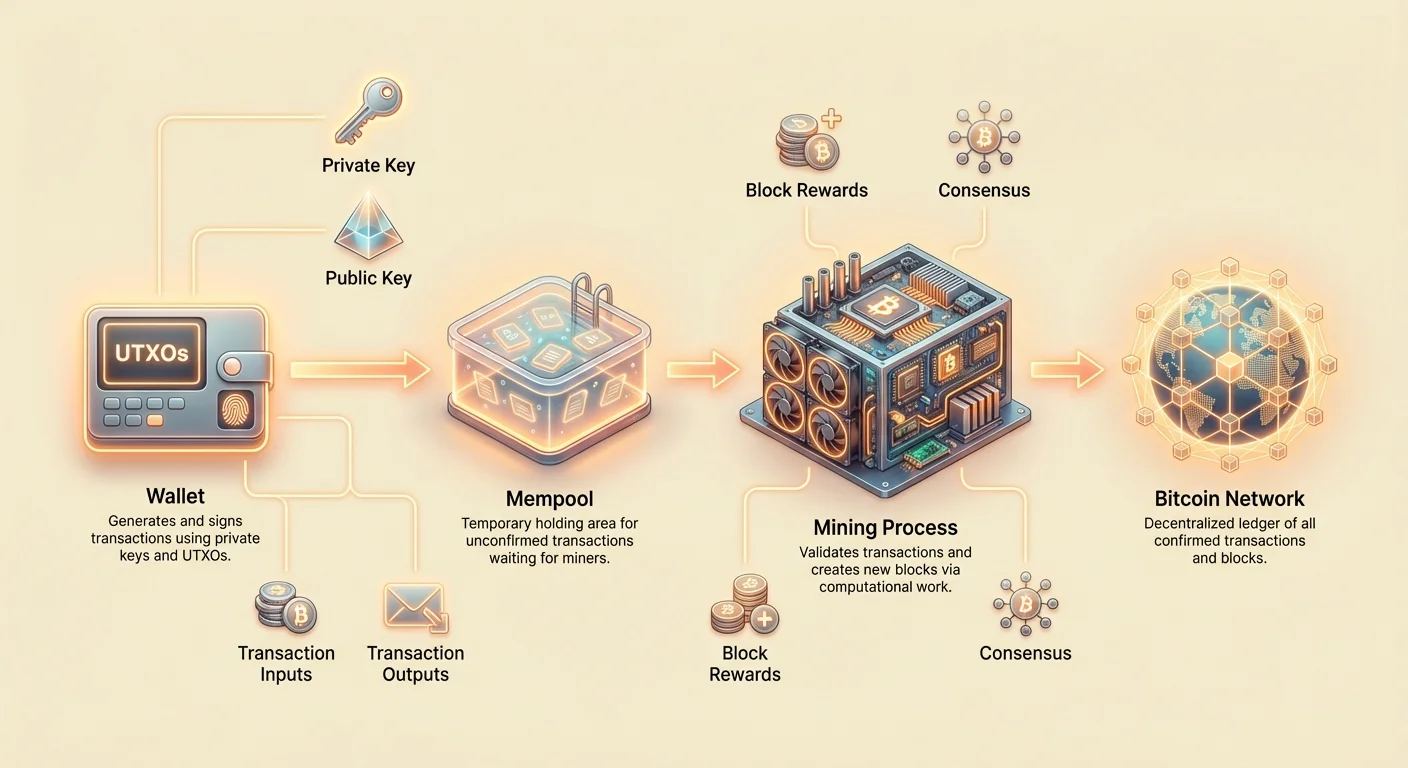
The journey of a Bitcoin transaction begins in the user's wallet software. The wallet gathers the necessary inputs from the user's available UTXOs and defines the outputs. It calculates the difference between the inputs and the outputs, which becomes the transaction fee. Once the details are set, the wallet uses the private key to generate the digital signature.
This signed data packet is then broadcast to the network. The user's node sends the message to its peers, which in turn propagate it across the globe. Each node that receives the transaction performs an initial check. They verify that the digital signature is valid, that the inputs have not already been spent, and that the transaction values are non-negative.
If the transaction passes these checks, the node adds it to its own temporary holding area known as the "mempool" (memory pool). The mempool is not a singular central queue but rather a local collection of valid, unconfirmed transactions stored by each individual node. At this stage, the transaction is known to the network but is not yet part of the permanent blockchain history.
The Fee Market and Prioritization
Because blocks on the Bitcoin blockchain have a limited size capacity, not every transaction in the mempool can fit into the next block. This scarcity creates a fee market. Miners, who construct the blocks, are financially motivated to include transactions that pay the highest fees per byte of data. The behavior of this market is tied to Mempool Dynamics.
Fees are not determined by the value of the bitcoin being sent but by the data size of the transaction. A transaction moving $10 million might be very small in data size if it uses only one input and one output. Conversely, a transaction moving $100 might be large in data size if it gathers dust from fifty tiny inputs to make the payment.
Users who want their transactions confirmed quickly must attach a fee competitive enough to entice miners. During periods of high network congestion, the mempool fills up with unconfirmed transactions. Miners naturally pick the highest bidders. Transactions with low fees may sit in the mempool for hours or days until traffic subsides or the sender bumps the fee.
Mining and Consensus
Miners play the final role in solidifying the transaction mechanics. A miner selects a batch of transactions from their mempool to form a candidate block. They then engage in Proof of Work (PoW), a computationally intensive process where they compete to solve a mathematical puzzle based on the data in that block.
This process requires hashing the block header repeatedly with a random number called a nonce until the resulting hash falls below a specific target difficulty. The difficulty adjusts automatically every 2,016 blocks to ensure new blocks are found approximately every 10 minutes, regardless of how much computing power joins the network.
Once a miner finds a valid solution, they broadcast the new block to the network. Other nodes receive the block and verify the solution. They also re-verify every transaction included in that block to ensure no rules were broken. Once validated, nodes update their local copy of the blockchain, removing the included transactions from their mempool. The transaction is now confirmed.
Addressing the Double-Spend Problem
The Challenge of Digital Duplication
In the digital realm, information is easily copied. If you send a photo via email, you still retain the original file. For digital currency, this presents a critical vulnerability known as the double-spend problem. Without a mechanism to prevent it, a malicious actor could sign a transaction sending 1 BTC to a merchant and simultaneously sign another transaction sending that same 1 BTC to themselves or another party.
In a centralized system, a bank prevents this by maintaining a master ledger. In a decentralized network, there is no central authority to say which transaction came first. Bitcoin solves this through the combination of the public blockchain ledger and Proof of Work, which establishes decentralized trust.
Because every full node maintains a complete copy of the blockchain, the entire network has a consensus on which UTXOs are currently valid. If a user tries to broadcast two conflicting transactions, nodes will accept the first one they see and reject the second as an attempt to spend already-referenced inputs.
Irreversibility Through Proof of Work
However, timing differences could lead to different nodes accepting different versions of the truth temporarily. This is where mining becomes decisive. The "truth" in Bitcoin is defined by the longest chain with the most accumulated Proof of Work. Once a transaction is included in a block, it becomes part of this official history.
To reverse or double-spend a transaction that has already been confirmed in a block, an attacker would need to re-mine that block and all subsequent blocks faster than the rest of the network combined. This is known as a 51% attack. The immense energy and hardware cost required to achieve this makes the ledger practically immutable.
As more blocks are added on top of the block containing a specific transaction, the security increases exponentially. A transaction with one confirmation is generally secure, but one with six confirmations is considered mathematically impossible to reverse under normal network conditions. This mechanism turns digital data, which is normally easy to copy, into a unique, finite digital asset.
The Role of Nodes in Network Integrity
Validation vs. Mining
It is a common misconception that only miners secure the network. While miners order transactions and produce blocks, "nodes" are the auditors that enforce the rules. A node is any computer running the Bitcoin software that stores the blockchain and validates traffic.
Full nodes download every block and transaction. They check the digital signatures, verify that the input amounts cover the output amounts, and ensure no coins are being double-spent. Importantly, nodes also verify the work done by miners. If a miner produces a block that violates any protocol rule—such as awarding themselves too much bitcoin or including an invalid transaction—nodes will reject the block immediately, upholding protocol rules.
This rejection happens regardless of how much energy the miner expended to create the block. This balance of power ensures that miners cannot change the rules of the system or print extra money. They are servants to the protocol, kept in check by the decentralized network of nodes run by individuals and businesses around the world.
Decentralization and Reliability
The robustness of Bitcoin transaction mechanics relies on the diversity and count of these nodes. The more distributed the nodes are, the harder it is for any entity to censor transactions or shut down the network. Nodes communicate peer-to-peer, propagating transaction data like a rumor spreading through a crowd.
There is no central server to hack. If a section of the internet goes offline, the remaining nodes continue to operate. When the disconnected nodes return, they sync up with the network to download the missing history. This architecture ensures that the ledger remains consistent and available globally, 24/7, without downtime.
Users can run their own nodes to gain financial sovereignty. By verifying their own transactions rather than relying on a third-party wallet service, they eliminate the need to trust anyone else about the state of their finances. This aligns with the core ethos of Bitcoin: "Don't trust, verify."
Network Fees and Data Weight
Calculating Costs
The cost of a Bitcoin transaction is often misunderstood. It is not a percentage of the amount sent, like a credit card processing fee. Instead, it is strictly a payment for block space. Block space is a scarce commodity, limited to a specific capacity per block (conceptually 1MB, though advanced by SegWit weighting).
Because the system uses the UTXO model, the data size of a transaction depends on the complexity of its inputs and outputs. A transaction that consolidates ten small inputs into one output contains more digital signature data than a transaction using one input. Consequently, it consumes more bytes in the block.
Miners charge per unit of data, typically measured in satoshis per byte (sat/vB). A "satoshi" is the smallest unit of Bitcoin (0.00000001 BTC). If the current market rate is 50 sats/byte, a simple transaction might cost $2, while a complex one might cost $10, even if they are transferring the same value.
| Factor | Impact on Fee | Reason |
|---|---|---|
| Input Count | Increases Fee | Each input requires a digital signature script |
| Output Count | Increases Fee | Each output adds data for the new address |
| Congestion | Increases Rate | High demand drives up the sat/byte market price |
Managing Congestion
Network fees fluctuate wildly based on demand. When the mempool is empty, users can pay the minimum fee and still get confirmed in the next block. When the network is busy, users must compete. Wallets typically estimate the required fee by looking at the current backlog in the mempool.
For users who set a fee too low, the transaction isn't lost; it simply hangs in the mempool. Eventually, if it is never picked up by a miner, it will be dropped from the nodes' memory, and the funds will effectively remain in the sender's wallet. In urgent situations, users can utilize transaction accelerators or "Replace-by-Fee" (RBF) protocols to boost the fee of a stuck transaction, effectively rebroadcasting it with a higher incentive for miners.
Conclusion
The mechanics of Bitcoin transactions represent a shift from trust-based financial systems to verification-based cryptographic systems. By replacing account balances with the UTXO model, Bitcoin treats value as a chain of digital custody that can be audited by anyone. Public key cryptography ensures that only the owner of the private key can initiate these transfers, providing a level of security that does not rely on bank vaults or identity checks.
This system is held together by the interplay of nodes, miners, and the specific rules of Bitcoin Script. The scripting language, while intentionally limited in scope, provides the necessary logic to validate ownership and enable complex spending conditions without compromising network stability. The competitive fee market and the mempool ensure that the limited resource of block space is allocated efficiently, while Proof of Work provides the thermodynamic security that makes the ledger immutable.
Understanding these mechanics reveals why Bitcoin is described as a decentralized ledger. It is not merely a currency but a rigorous, automated accounting system maintained by a global consensus. Every aspect, from the math of the keys to the inputs of the UTXO set, is designed to allow strangers to exchange value without intermediaries, solving the double-spend problem through code rather than authority.
Bitcoin replaces trust in institutions with cryptographic proof, ensuring value transfer is verified, immutable, and strictly owned by the key holder.