
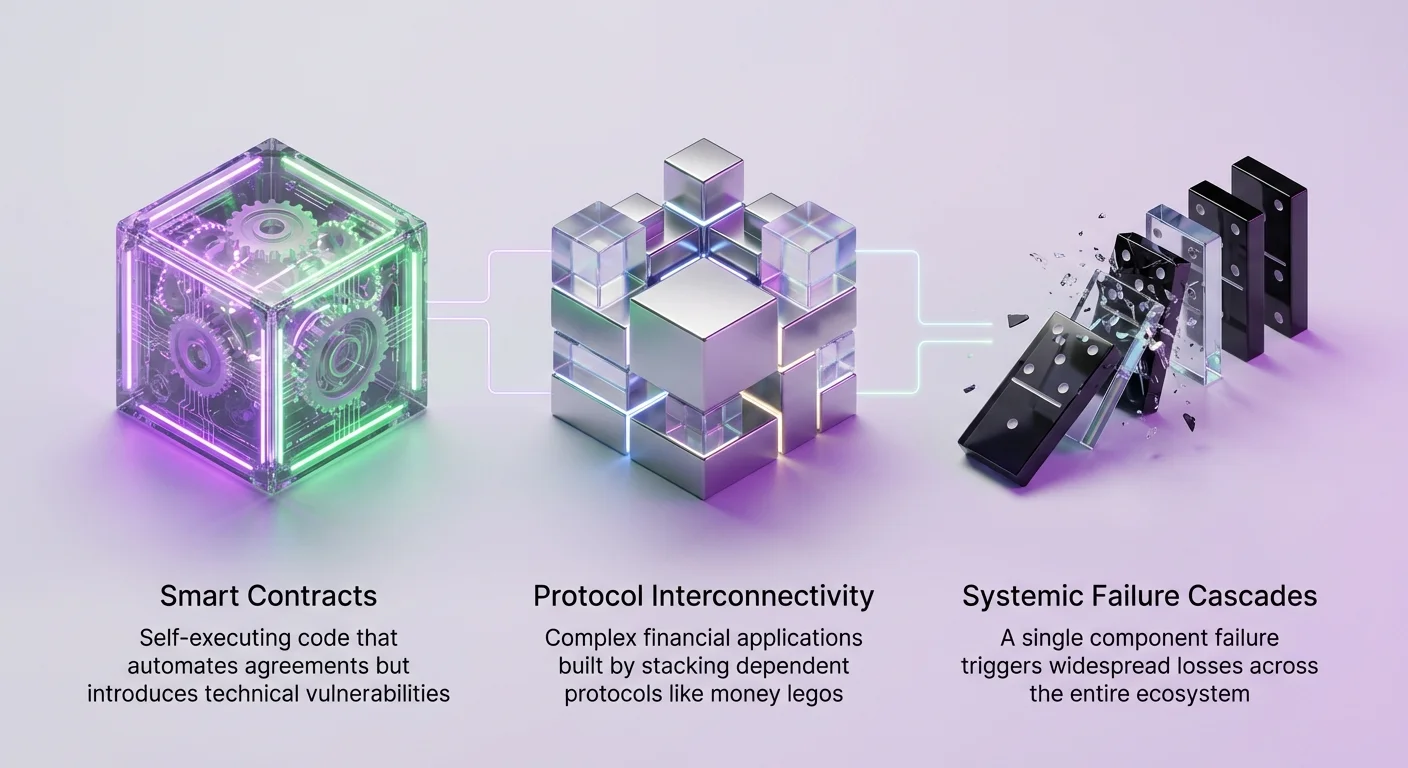
Decentralized finance represents a fundamental shift in how value is exchanged, stored, and managed. Unlike traditional banking where risk is opaque and centralized within institutions, DeFi risk is transparent but highly interconnected. The ecosystem is built on the concept of composability, often referred to as "money legos." This allows developers to build complex financial applications by stacking different protocols on top of one another.
While this enables rapid innovation, it creates a web of dependencies where the failure of a single component can trigger a cascade of losses across the entire system. A lending protocol might rely on a decentralized exchange for liquidation liquidity. That exchange might rely on a bridge to move assets between chains. All of them rely on oracles for price data. Understanding systemic risk requires mapping these critical dependencies and identifying where the points of failure lie.
The Foundation of Programmable Trust
At the core of this ecosystem are smart contracts. These are self-executing agreements written in code that run on blockchain networks like Ethereum. They automate functions that would normally require a middleman, such as matching a borrower with a lender or executing a trade. However, this automation introduces significant technical risk.
If a smart contract contains a bug or a logical error, it can be exploited by malicious actors. Unlike traditional finance where transactions can be reversed, blockchain transactions are generally immutable. An exploit in a widely used protocol can drain funds not just from that specific application, but from any other application that interacts with it.
The Aggregation of Risk Vectors
Risk in DeFi is rarely isolated. When a user deposits assets into a protocol, they are exposing themselves to the risks of that specific protocol as well as the risks of every underlying asset and dependency. For example, if a protocol accepts a specific stablecoin as collateral, and that stablecoin loses its peg to the dollar, the protocol may become insolvent.
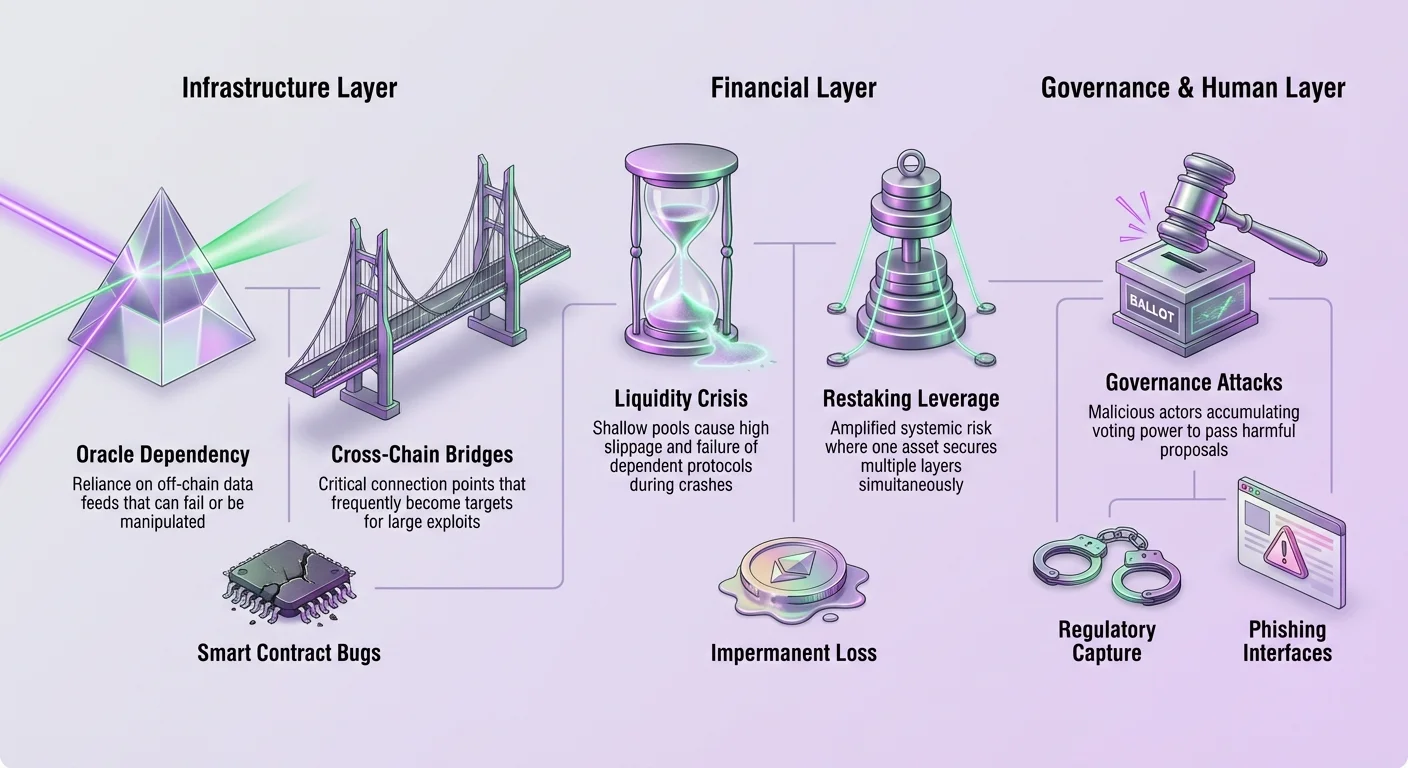
This interconnectedness means that due diligence cannot stop at the surface level. Investors and participants must understand the architectural layers that support the applications they use. This includes the blockchain layer, the smart contract layer, the oracle layer, and the governance layer. Each of these presents a unique set of vulnerabilities that can contribute to systemic failure.
The Oracle Problem and Data Dependency
Smart contracts operate in a silo. They can access data that exists on the blockchain, such as token balances and transaction history, but they cannot natively access data from the real world. They do not know the price of gold, the winner of a sports match, or the current exchange rate of the US dollar. This limitation is known as the "oracle problem."
Bridging Off-Chain Data
To function, DeFi protocols rely on oracles. These are middleware services that fetch data from off-chain sources and deliver it on-chain in a format that smart contracts can understand. Chainlink is the most prominent example of a decentralized oracle network. It connects smart contracts to real-world data, APIs, and payment systems.
Chainlink addresses the centralization risk by using a network of independent node operators. When a smart contract requests data, multiple nodes retrieve that data from different sources. The network aggregates these responses to form a single, validated data point. This aggregation process ensures that a single compromised node or data source cannot corrupt the feed.
Systemic Reliance on Accurate Feeds
Despite the decentralized architecture of networks like Chainlink, the reliance on oracles introduces a critical dependency. If an oracle network fails to update prices during a period of high market volatility, lending protocols may fail to liquidate under-collateralized positions. This can leave the protocol with bad debt and result in losses for depositors.
Conversely, if an oracle is manipulated to report an incorrect price, it can trigger false liquidations. Malicious actors can exploit this by manipulating the spot price of an asset on a low-liquidity exchange that feeds into the oracle. This causes the smart contract to believe the asset's value has crashed or skyrocketed, allowing the attacker to profit at the expense of honest users.
Liquidity Dependencies and AMM Mechanics
Liquidity is the lifeblood of financial markets. in DeFi, this liquidity is often provided by Automated Market Makers (AMMs) like Uniswap. Unlike traditional exchanges that use an order book to match buyers and sellers, AMMs use liquidity pools. Users deposit pairs of tokens into these pools, and trades are executed against the pool rather than a counterparty.
The Automated Market Maker Model
Uniswap popularized the constant product formula to determine prices. This mathematical model ensures that the product of the two token reserves in a pool remains constant. When a trader buys one token from the pool, the supply of that token decreases and the supply of the other token increases. This automatically adjusts the price to reflect the change in scarcity.
This model allows for permissionless trading and liquidity provision. Anyone can create a market for any token pair. However, it also introduces the risk of impermanent loss for liquidity providers. If the price of the deposited assets changes significantly compared to when they were deposited, the provider may end up with less value than if they had simply held the tokens in a wallet.
Liquidity as a Systemic Constraint
Systemic risk arises when other protocols build on top of this liquidity. Lending platforms, yield aggregators, and derivatives markets often assume that deep liquidity will always be available for liquidations or rebalancing. If liquidity dries up during a market crash, these dependent protocols can fail.
For example, a lending protocol relies on being able to sell a borrower's collateral quickly if its value drops. If the AMM pool for that collateral is shallow, the large sell order will crash the price further. This results in high slippage and potentially fails to cover the debt. The health of the entire DeFi stack is therefore directly correlated to the depth and stability of DEX liquidity.
Layer 2 Scaling and Infrastructure Risks
As Ethereum gained popularity, network congestion led to high transaction fees and slow processing times. This scalability limit necessitated the development of Layer 2 solutions. Platforms like Polygon emerged to offer faster and cheaper transactions while maintaining a connection to Ethereum.
The Complexity of Scaling Solutions
Polygon has evolved from a simple sidechain into a comprehensive ecosystem of scaling infrastructure. This includes Proof-of-Stake chains and Zero-Knowledge (ZK) Rollups. These solutions process transactions off the main Ethereum chain and then post proofs or data back to Ethereum. This increases throughput but introduces new architectural risks.
The primary risk lies in the bridges that connect these layers. To use a Layer 2, users must bridge their assets from Ethereum. This usually involves locking the asset in a smart contract on Ethereum and minting a representation of it on the Layer 2. If the bridge contract on Ethereum is exploited, the backing assets are drained, rendering the tokens on the Layer 2 worthless.
Fragmentation of Liquidity and Security
The proliferation of Layer 2s and sidechains fragments liquidity across different networks. A specific asset might exist on Ethereum, Polygon, Arbitrum, and Optimism. Each version of the asset relies on the security of the specific bridge and network it resides on.
Furthermore, different scaling solutions have different security models. A sidechain is responsible for its own security via its own validator set. If those validators collude, they can censor transactions or steal funds. Rollups derive their security from Ethereum, but they rely on "sequencers" to order transactions. If a sequencer goes offline, the network may experience downtime, halting DeFi activity.
The Leverage of Restaking Protocols
A newer development in the DeFi space is the concept of restaking. This mechanism allows validators to use their staked assets to secure multiple protocols simultaneously. While this increases capital efficiency and potential rewards, it significantly amplifies systemic risk through the correlation of slashing events.
Mechanics of Shared Security
In a Proof-of-Stake system, validators lock up capital to secure the network. Restaking protocols allow this same capital to be "re-staked" to secure other services, such as data availability layers, oracle networks, or bridges. This is achieved either through native restaking, where a validator runs additional software, or liquid restaking, where users deposit liquid staking tokens into a restaking protocol.
This creates a system where a single dollar of capital is backing multiple layers of risk. If the validator misbehaves or fails in its duties for any one of the secured services, a portion of the stake can be slashed. This loss of capital impacts the security of all other services relying on that same stake.
The Risks of Liquid Restaking Tokens
Liquid restaking creates complex derivatives of staked assets. Users receive a token representing their restaked position, which can then be used in DeFi for further yield. This creates a leverage tower where the underlying asset supports a vast amount of synthetic value.
| Risk Category | Description | Systemic Implication |
|---|---|---|
| Slashing Propagation | One service penalizes a validator. | Security weakens for all other shared services. |
| Token De-pegging | Liquid token loses value vs. asset. | Cascading liquidations in lending markets. |
| Operator Centralization | Few entities manage most restaked value. | Single point of failure for multiple networks. |
If a major slashing event occurs or a smart contract vulnerability is exploited in the restaking layer, the value of the liquid token could collapse. Since these tokens are often used as collateral in lending markets, a price collapse would trigger widespread liquidations, potentially overwhelming the available liquidity in DEXs.
Governance and Regulatory Capture
Decentralized governance is a defining feature of DeFi. Protocols are often managed by Distributed Autonomous Organizations (DAOs), where token holders vote on changes to the code, fee structures, and treasury allocations. Tokens like UNI (Uniswap) and YFI (Yearn Finance) grant these voting rights. However, governance introduces human vectors of risk.
The Vulnerability of Voting Power
In many DAOs, one token equals one vote. This means that entities with large capital reserves can accumulate enough tokens to dominate the decision-making process. This can lead to governance attacks, where a malicious actor passes proposals that benefit themselves at the expense of the protocol's health or other users.
Centralized exchanges or custodial services holding large amounts of user tokens can also exert undue influence. While they may not malicious intent, their participation centralizes control in a way that contradicts the ethos of decentralization. This concentration of power creates a single point of pressure that regulators can target.
Compliance and the Erosion of Permissionlessness
Regulatory pressure is increasingly shaping the DeFi landscape. Projects like World Liberty Financial illustrate the intersection of DeFi and regulatory compliance. Backed by high-profile political figures, such platforms emphasize strict Know Your Customer (KYC) and Anti-Money Laundering (AML) protocols.
While this may drive adoption among institutional investors, it introduces a form of regulatory capture. By enforcing permissioned access at the protocol level, these projects create a bifurcated system. Compliant, "whitelisted" liquidity pools may become segregated from permissionless pools.
If regulators mandate that all major DeFi front-ends or protocols must implement such checks, the fundamental value proposition of open access is compromised. This shift could force privacy-centric users into darker, less liquid corners of the market, reducing the overall resilience and efficiency of the ecosystem.
Smart Contract Vulnerabilities and Exploits
Regardless of the economic design, every DeFi protocol relies on the integrity of its code. Smart contracts are written by humans and are susceptible to errors. A single bug can be catastrophic. Common vulnerabilities include re-entrancy attacks, integer overflows, and logic errors that allow attackers to bypass security checks.
The Reality of Audit Limitations
Most reputable projects undergo security audits by third-party firms. However, an audit is not a guarantee of security. It is merely a check for known vulnerabilities at a specific point in time. Complex interactions between different protocols often create edge cases that auditors may miss.
Upgradable contracts introduce another layer of risk. While they allow developers to fix bugs, they also allow them to change the rules of the game. If the administrative keys controlling the upgrade process are compromised, an attacker can inject malicious code into an otherwise secure protocol.
Malicious Interfaces and Phishing
Risk also exists at the user interface level. Users typically interact with DeFi protocols through web-based front-ends. These websites can be compromised or spoofed. A phishing attack might direct a user to a fake website that looks identical to the real one but executes a transaction that drains the user's wallet instead of swapping tokens.
Even if the smart contracts are secure, the connection between the user and the blockchain is vulnerable. This highlights the importance of verifying contract addresses and using tools that simulate transaction outcomes before signing them.
Conclusion
Systemic risk in decentralized finance is a product of its success. The ability to compose different protocols into complex financial structures creates efficiency and value, but it also creates a web of hidden dependencies. A failure in an oracle, a bridge, or a governance process can propagate shockwaves through the entire ecosystem. The "money legos" that build wealth can just as easily tumble down if the foundation is unstable.
Managing this risk requires a shift in perspective. Participants must look beyond the yields and features of individual protocols and assess the structural integrity of the stack they rely on. It involves understanding where data comes from, how liquidity is sourced, and who holds the keys to the upgrades. As the industry matures, resilience must be prioritized alongside innovation.
True risk management in DeFi demands verifying the code, the data sources, and the governance of every protocol you touch.