
Welcome to the world of crypto cashback—a sophisticated evolution of traditional credit card rewards. If you are new to digital assets, you might think crypto is just about volatile trading, but for millions of everyday consumers, it’s a powerful tool for generating passive income simply by spending money.
This guide moves beyond simply comparing the "best crypto cards." Instead, we will teach you the strategy of "stacking." Stacking is the process of layering multiple reward mechanisms—from fiat credit cards and merchant portals to crypto exchange loyalty tiers and gift card programs—to maximize your cashback return on every purchase using a precise crypto spending matrix.
By the end of this comprehensive guide, you will be equipped with the knowledge of a crypto power user, ready to turn mundane purchases like groceries and utility bills into a highly efficient, multi-layered rewards engine, potentially reaching returns far exceeding what any single traditional program can offer. Let’s start transforming your everyday spending into a steady flow of digital assets.

Layer 1: The Foundation of Crypto Cashback (The Tools)
The first step in building your rewards stack is understanding the core instruments that generate the initial cashback. These are typically associated with major cryptocurrency exchanges that issue branded debit or credit cards.
Understanding Crypto Debit/Credit Cards
Most crypto cashback is earned through specialized crypto-linked cards. While they function much like traditional payment cards (Visa or Mastercard), the mechanics of how the rewards are paid out differ significantly.
1. Crypto Debit Cards: These are the most common entry point. They require you to pre-fund them, either with fiat currency (USD, EUR) or directly with crypto assets (like Bitcoin or stablecoins). When you make a purchase, the card draws from your balance. The cashback (e.g., 1% to 5%) is then immediately paid back to your linked exchange wallet, often in the exchange’s native token.
- Pro: Low risk, as you are only spending funds you already own.
- Con: Requires pre-loading and offers lower average cashback rates at the base tier.
2. Secured Crypto Credit Cards: Less common but growing, these operate more like traditional credit cards, offering a credit line. However, this line is typically secured by collateral (crypto assets) locked in a wallet managed by the issuer. They often require you to maintain a portfolio with the provider.
- Pro: Higher potential rewards rates and helps build credit history.
- Con: Higher risk due to potential liquidation if the collateralized crypto asset drops sharply in value.
Practical Tip: For beginners focused purely on stacking rewards without taking on debt or high volatility risk, start with a crypto debit card and fund it primarily with a secure stablecoin like USDC or USDT. This ensures that the spending balance itself doesn't fluctuate while you earn volatile crypto as a reward.
Exchange Loyalty Tiers (Staking Requirements vs. Rewards)
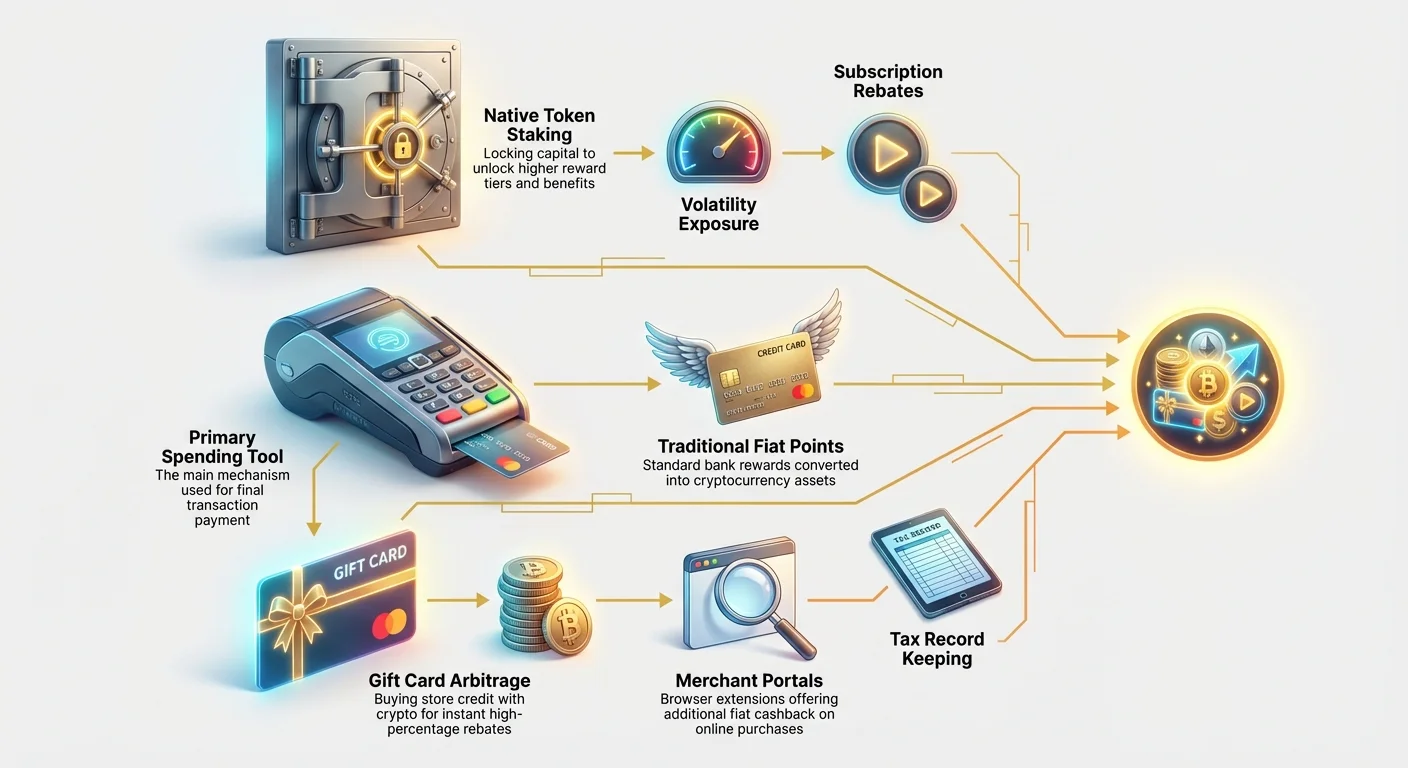
The key distinction between crypto cashback and traditional cashback is the concept of staking. To unlock higher reward percentages (often 3% to 8%), crypto card issuers require users to "stake" or lock up a significant amount of their native utility token for a specified period (e.g., 6 months, 1 year).
What is Staking?
Staking means committing your cryptocurrency to support the operations of a blockchain network or, in this context, the operations and liquidity of the exchange’s platform. In return for locking up your tokens, the exchange grants you enhanced benefits, like higher cashback tiers, better interest rates, and fee reductions, which aligns with advanced staking strategies.
| Tier Example | Required Staked Value (Approx.) | Base Cashback Rate | Additional Benefits |
|---|---|---|---|
| Basic (No Stake) | $0 | 1% | None |
| Silver | $400 | 2% | Spotify subscription rebate |
| Gold | $4,000 | 4% | Netflix + Spotify rebate, Airport Lounge Access |
| Diamond (Power User) | $40,000+ | 8% | All rebates + premium travel benefits |
Calculating the Risk/Reward of Staking
Before committing funds to a staking tier, a beginner must weigh the potential cashback return against two primary risks:
- Volatility Risk: If you stake $4,000 worth of Token X, and Token X drops 50% in value during your lock-up period, your $4,000 investment is now worth $2,000. The cashback earned might not offset this loss.
- Opportunity Cost: The staked funds are locked. You cannot use them for other investments, trading, or emergency expenses during the lock-up period.
Actionable Insight: Do not chase the highest tier with money you cannot afford to lose or tie up. Calculate your realistic monthly spending. If you spend $2,000/month, the jump from a 2% tier to a 4% tier yields an extra $40/month. If the staking requirement is $4,000, it would take 100 months just to earn back the value lost if the token drops 10%. Only stake for tiers if you are confident in the token’s long-term viability and the capital is fully disposable.
Layer 2: Integrating Fiat Rewards (The Bridge Strategy)
The first step in true stacking is recognizing that traditional fiat rewards and crypto rewards are not mutually exclusive. A strategic user leverages both systems to optimize their overall return. This is the "bridge strategy."
Converting Traditional Rewards to Crypto
Many mainstream consumers already earn rewards through established bank credit cards, airline miles, or points programs (e.g., Chase Ultimate Rewards, American Express Membership Rewards). These points are typically used for travel or gift cards, but savvy users can often find a route to convert them into cryptocurrency.
- Gift Card Redemption Bridge: If your bank rewards program allows you to redeem points for gift cards to major retailers (like Amazon or Starbucks), those gift cards can often be sold or traded on secondary platforms that pay out in crypto or stablecoins.
- Cash-Out Bridge: Many points programs allow for direct statement credits or bank account deposits. While this is less efficient than travel redemption, once the points are converted to fiat cash, you can immediately use that cash to buy cryptocurrency, effectively converting your traditional points into crypto assets.
Example Use Case (Indirect Conversion):
- Traditional Earnings: You earn 10,000 travel points (worth $100 cash back).
- Conversion: You redeem the points for $100 deposited into your bank account.
- Crypto Integration: You use the $100 to purchase $100 worth of Bitcoin on your favorite exchange.
- Result: You have successfully converted airline points into a digital asset.
The Double Dip: Using Fiat Cards for Crypto Purchases
This technique is for advanced users comfortable with generating rewards through manufactured spending, although its viability is constantly changing due to issuer rules. The goal is to earn traditional fiat rewards while funding your crypto lifestyle.
Some credit card companies offer high reward rates (e.g., 3x or 4x points) on specific categories like "digital services" or "utility bills." In some limited scenarios, purchasing cryptocurrency directly through a high-rewards card if allowed by the issuer can trigger high points earnings.
More commonly, the Double Dip involves using a high-rewards fiat card to pay for services that accept crypto (like VPNs, certain software, or even some utility bills if the processor allows it).
The Wallet Top-Up Strategy: Many major crypto debit cards allow you to top up your balance using a linked bank account or debit card. If you use a high-rewards debit card linked to a rewards checking account, you might earn rewards on the transfer itself, before you even spend the funds via the crypto card.
- Goal: Earn Bank Reward + Crypto Cashback.
- Step 1: Use your Bank X Debit Card (earns 1% cash back on all transactions) to top up your Crypto Exchange Debit Card. (You earn 1% cashback from Bank X.)
- Step 2: Spend the newly loaded funds using your Crypto Exchange Debit Card (earns 4% crypto cashback).
- Total Stacked Reward: 5% return on that single transaction.
Layer 3: Advanced Stacking Techniques (The Arbitrage)
This is where the true power of stacking lies. Reward arbitrage involves strategically positioning multiple programs—card rewards, merchant portals, and gift card discounts—to ensure every dollar spent triggers returns from two, three, or even four different sources.
Merchant Rebate Portals and Browser Extensions
The simplest form of stacking Layer 3 involves using cashback portals—websites or browser extensions (like Rakuten, Honey, or exchange-specific portals)—that offer rebates when you click through their links to shop online.
These portals operate based on affiliate marketing; they receive a commission from the merchant and share a percentage of that commission with you.
The Cashback Portal Stack:
- Foundation (Crypto Card): You use your 4% crypto cashback card for the final purchase.
- Layer 1 (Portal): You activate a merchant portal (e.g., through your browser extension) that offers an additional 5% cash back.
- Total Stack: 9% return, consisting of crypto assets and fiat cash (or points) from the portal.
Example Scenario (Buying Home Goods):
- Merchant: Home Depot (online order).
- Portal Offer: 5% back via the merchant portal (paid in fiat).
- Crypto Card Tier: Gold Tier (4% back in exchange tokens).
- Action: Click the portal link, place the order, and pay with the crypto debit card.
- Result: You earn two separate, cumulative rewards on the same transaction.
The Gift Card Arbitrage Loop
The gift card arbitrage loop is the most effective way for power users to maximize their immediate, guaranteed returns, often before the actual spending even happens. This loop takes advantage of the fact that many crypto platforms offer instant, high-percentage cashback on gift card purchases.
Platforms (often linked to crypto wallets or exchanges) sell gift cards digitally, incentivized by high merchant affiliate rates.
The Ultimate Rewards Stack Breakdown:
Let’s imagine you need to spend $500 at a specific clothing retailer.
| Stack Layer | Mechanism | Reward Rate | Reward Type | Value Earned ($500) |
|---|---|---|---|---|
| Layer 1: Gift Card Purchase | Buy the $500 retailer gift card via a crypto app offering 7% instant crypto rebate. | 7% | Crypto (Instantly) | $35.00 |
| Layer 2: Payment Method | Pay for the $500 gift card using a high-yield Fiat Credit Card (e.g., a 2% category spender). | 2% | Fiat Points/Miles | $10.00 |
| Layer 3: Merchant Loyalty | The retailer has a loyalty program that grants 1 point for every $1 spent, even via gift card. | 1% equivalent | Merchant Credit | $5.00 |
| Total Stacked Return | 10% Total | Mixed Assets | $50.00 |
By executing this loop, you earned $50 in combined crypto, points, and store credit before you even used the gift card to purchase the items you needed. This strategy is highly effective because the high-yield gift card rebate is immediate and guaranteed.
Combining Cashback with Affiliate Links
If you manage a small blog, social media presence, or have a significant personal network, you can layer a fourth dimension onto your spending: affiliate income.
If you are going to buy a major item (e.g., a new gaming console or a specific software license), you can potentially set up your own affiliate link with the retailer (or use a generic network like ShareASale or Commission Junction if available).
- Generate Link: Obtain your personal affiliate link for the product.
- Click-Through: Click your own link.
- Purchase: Pay using the gift card (Layer 1) that was purchased with the fiat card (Layer 2) through the merchant portal (Layer 3).
- Reward 4: The retailer pays you a commission (e.g., 3-5%) for the "referral."
While this takes more effort and is not applicable to every purchase, for large, strategic spending, it represents the ultimate rewards optimization.
Maximizing Loyalty Programs: The Staking Requirement Deep Dive
We touched on staking earlier, but for a true power user focused on maximizing returns, the long-term commitment required by tiered crypto cards demands a deeper strategic analysis. The goal is to determine if the rewards rate justifies the risk of locking up your capital.
Analyzing Total Value Locked (TVL) vs. Rewards Rate
Every crypto exchange tier has a Total Value Locked (TVL) requirement—the dollar value of the native token you must stake. To assess whether staking is worthwhile, you must perform a break-even analysis.
The Break-Even Formula:
While volatility is hard to predict, a simpler approach is comparing the required stake against your guaranteed rewards and the value of any locked-in rebates (like Netflix or Spotify).
Example: The $4,000 Gold Tier Analysis
- Tier Upgrade: Moving from the 2% Silver Tier (free) to the 4% Gold Tier.
- Staking Requirement: $4,000 worth of Token X, locked for 6 months.
- Monthly Rebates: $15 Netflix + $10 Spotify = $25/month ($300/year guaranteed value).
- Target Annual Spending: $15,000.
| Scenario | Calculation | Annual Value |
|---|---|---|
| Silver Tier (2% Cashback) | $15,000 * 0.02 | $300 |
| Gold Tier (4% Cashback) | $15,000 * 0.04 | $600 |
| Rebates (Gold Tier Only) | $25/month * 12 months | $300 |
| Net Gain from Upgrade | ($600 + $300) - $300 | $600 |
In this scenario, staking $4,000 yields a guaranteed minimum of $600 in extra rewards and rebates annually. If you believe the staked token is stable or will appreciate, this is an excellent return (15% APY on the staked capital, not factoring in potential token appreciation).
Crucial Consideration: Token Dumping Be aware that the value of rebates (like the Netflix reimbursement) is often paid out in the native token. If you immediately sell this reward token to fiat or stablecoin (a practice known as "dumping"), you realize the full value. If you hold the reward token, its value is subject to volatility. For maximum optimization, rewards should be sold instantly if your primary goal is generating fiat cash flow.
Navigating Lock-up Periods and Volatility Risk
Crypto rewards programs inherently introduce risks absent in traditional finance. A major component of strategic rewards stacking is managing these risks effectively.
- Hedging the Stake: If you commit $4,000 to a token for staking, you are exposed to its price fluctuation. A sophisticated strategy is to hedge this risk by shorting or buying a put option on the native token in a separate transaction. This neutralizes the price risk, allowing you to focus purely on the guaranteed rewards rate, but this is complex and costly (in fees and premiums) and generally not recommended for beginners.
- Dollar-Cost Averaging (DCA) the Stake: Instead of buying the entire staking requirement in one lump sum (risking buying at a local high), you can use DCA principles. Buy small amounts of the required token over several months. While this delays reaching the higher reward tier, it mitigates the risk of a severe market downturn immediately following your purchase.
- Timing the Market: If you are determined to stake, aim to purchase the native token when the overall crypto market sentiment is low, or when the token price has recently corrected significantly. This lowers your cost basis and increases the potential for appreciation during your lock-up period.
Strategic Spending: Optimization and Best Practices
A rewards stack is only as good as the strategy behind its application. Power users meticulously categorize their spending to ensure the right card and the right portal are used for every single purchase.
Categorizing Spending for Maximum Return
Not all crypto cards or fiat cards offer the same rates across all categories. Optimization involves matching high-yield spending categories to the appropriate card.
The Category Matrix:
| Spending Category | High-Yield Stack Strategy | Card Type Priority |
|---|---|---|
| Groceries/Dining | Use a fiat card with 4-5% cash back if the purchase is not available via a gift card rebate. | Fiat Credit Card (Category Bonus) |
| Online Retail (Amazon, etc.) | Mandatory Gift Card Arbitrage Loop. Use a crypto platform for 5-7% rebate + fiat card for payment. | Crypto Gift Card Rebate |
| Utility Bills/Subscriptions (Netflix, Spotify) | Use the crypto card that offers a 100% monthly rebate for that specific service, regardless of base cashback rate. | High-Tier Crypto Debit Card |
| Travel/Flights | Use a high-end fiat card for travel points (often 5x points or more) and cash those points out later. Crypto cards rarely compete with travel points value. | Fiat Credit Card (Travel Bonus) |
| Everything Else (General Spending) | Use the highest-tier crypto debit card (3-4% base rate) as the default option. | High-Tier Crypto Debit Card |
Rule of Thumb: Always prioritize guaranteed rebates (like utility subsidies) and Gift Card Arbitrage (Layer 3 stacking) first. Only resort to single-layer credit card spending (Layer 1 or 2) when no better stacking option exists.
Tracking and Tax Implications of Crypto Rewards
One significant difference between crypto rewards and traditional fiat cashback is how they are treated for tax purposes. This is a critical step in becoming a rewards power user.
Rewards are Generally Taxable
In most major jurisdictions (including the US and EU), crypto earned as a reward (cashback, staking interest, or rebates) is generally treated as ordinary income based on the fair market value of the token at the time it was received, according to standard crypto accounting standards.
- Example: You buy $100 in groceries and receive 4% back in Token Y. If Token Y is valued at $1.00 when you receive it, you have $4.00 of taxable income.
Capital Gains Tax
When you eventually sell or exchange those reward tokens, you may incur capital gains or losses.
- Scenario: You receive $4.00 worth of Token Y. Six months later, you sell it when it is valued at $6.00.
- Taxable Event 1 (Income): $4.00 (received as income).
- Taxable Event 2 (Gain): $2.00 (capital gain, since the value appreciated from $4.00 to $6.00).
Best Practices for Tracking
Failure to accurately track crypto rewards can lead to significant headaches during tax season.
- Use Dedicated Tax Software: Integrate your crypto exchange wallets with specialized crypto tax software. These programs automatically track every transaction, calculate the fiat value at the time of receipt, and track capital gains/losses.
- Keep Meticulous Records: If you are performing advanced stacking (mixing fiat points, gift card rebates, and crypto cashback), keep a spreadsheet. Track the initial fiat card transaction, the gift card platform reward, and the final crypto card reward.
- Separate Wallets: If possible, use a separate, dedicated wallet address or sub-account just for receiving rewards. This makes tracking your income stream much cleaner than mixing rewards with actively traded assets.
By establishing robust tracking from day one, you ensure that the rewards you stack are net positive after accounting for your tax liability, maintaining the integrity of your overall rewards strategy.
Conclusion
Earning crypto cashback is far more strategic than simply swiping a card. By moving from the single-layer cashback model to a multi-layered stacking strategy, you are utilizing the principles of rewards arbitrage to maximize your return on every dollar spent.
We have detailed how to build this stack: starting with the fundamental crypto debit card (Layer 1), integrating traditional points systems (Layer 2), and finally mastering advanced techniques like merchant portals and the Gift Card Arbitrage Loop (Layer 3) before optimizing your crypto off-ramp.
The modern financial landscape rewards diligence. By prioritizing staking analysis, understanding volatility risks, and meticulously tracking your varied streams of income for tax purposes, you move from being a casual user to a crypto power consumer—transforming routine transactions into an optimized, continuous source of passive digital wealth. Start stacking today.