
Decentralized Finance (DeFi) offers powerful opportunities to generate passive income, transforming idle crypto assets into capital that works for you. However, unlike traditional savings accounts, DeFi operates with elevated and complex risks, including smart contract failures, regulatory uncertainty, and extreme market volatility. Simply chasing the highest advertised Annual Percentage Yield (APY) is a recipe for disaster. DeFi risk types
To succeed in DeFi, you must shift your perspective from a casual participant to a disciplined portfolio manager. This guide provides a framework for applying time-tested financial portfolio theory—concepts like risk parity, allocation limits, and diversification—to the unique mechanics of the DeFi landscape. Our goal is not just to maximize gains, but to structure a resilient portfolio that can weather severe market downturns and withstand protocol-specific failures. resilient portfolio framework
Building a resilient DeFi portfolio requires a comprehensive strategy that balances stability (through stablecoins) against high-growth potential (through volatile assets), while meticulously diversifying across protocols and blockchains to minimize catastrophic single points of failure. We will break down how to assess risk, set actionable allocation limits, and calculate a realistic targeted APY for sustainable passive income.

The Foundation: Applying Traditional Portfolio Theory to DeFi
In traditional finance, portfolio management begins with defining two core elements: your risk tolerance and your investment time horizon. While these hold true in crypto, DeFi adds a critical layer of risk complexity that demands a structured approach.
1. Understanding the Dual Nature of DeFi Risk
Before allocating a single dollar, it is crucial to understand that DeFi exposes you to two distinct categories of risk that must be managed independently:
Market Risk (Volatility Risk)
This is the risk that the price of the underlying asset (like Bitcoin, Ethereum, or Solana) will drop. Market risk is unavoidable in crypto, and it is generally managed through diversification across assets (e.g., balancing volatile holdings with stablecoins) and careful position sizing. If you stake 10 ETH, and the price of ETH falls by 50%, the value of your staked position has fallen by 50%, regardless of the yield generated.
Protocol Risk (Smart Contract/Counterparty Risk)
This is the risk specific to the platform or service you are using. This includes:
- Smart Contract Bugs: Flaws in the code that allow hackers to drain funds (the most common source of major losses).
- Oracle Failure: The mechanism that feeds real-world data (like asset prices) to the smart contract fails or is manipulated.
- Governance Attacks: Malicious actors gain control of the protocol’s governance structure.
- Improper Custody: If you use a centralized intermediary, the risk that they mismanage or lose your funds.
A resilient portfolio prioritizes minimizing Protocol Risk, as this can lead to the complete and permanent loss of capital, even if the overall crypto market is performing well. minimizing Protocol Risk
2. Defining Your DeFi Risk Profile
Your risk profile dictates the allocation mix between the "safe harbor" (stablecoins) and the "growth engine" (volatile assets).
| Profile | Definition | Stablecoin Allocation Target | Primary Strategy Focus |
|---|---|---|---|
| Conservative | Prioritizes capital preservation. Yield should minimally outpace inflation. | 70% - 90% | Low-risk lending, single-sided stablecoin staking on audited protocols. |
| Moderate | Seeks high single-digit or low double-digit APY. Willing to accept some volatility. | 40% - 60% | Balanced yield farming (stablecoin pairs), diversified staking on blue-chip protocols. |
| Aggressive | Seeks maximum APY. Accepts significant volatility and protocol risk for high potential returns. | 10% - 30% | Leveraged strategies, complex yield farming, early-stage restaking, and new protocols. |
The key takeaway is that even in an Aggressive portfolio, a baseline allocation to stablecoins provides liquidity and acts as a war chest for buying opportunities during market crashes.
The Core Balancing Act: Stablecoins vs. Volatile Asset Yield
The foundation of portfolio resilience in DeFi is the strategic allocation between stablecoins (pegged 1:1 to the US Dollar or another fiat currency) and volatile assets (like ETH, BTC, or native chain tokens). This strategic balancing act is the DeFi equivalent of achieving portfolio risk parity.
Defining Portfolio Risk Parity in DeFi
Risk parity is an investment approach that focuses on allocating capital so that each asset or strategy contributes equally to the total portfolio risk. In traditional finance, this often means lower volatility assets receive higher capital allocation.
In DeFi, true risk parity means ensuring that Protocol Risk is balanced:
- Stablecoin Allocation: Provides low Market Risk but still carries Protocol Risk (e.g., if the stablecoin lending platform gets hacked, you lose dollars).
- Volatile Asset Allocation: Carries high Market Risk and Protocol Risk (e.g., if your staked ETH drops in price and the staking platform gets hacked).
Therefore, allocating capital to achieve DeFi risk parity demands higher capital dedicated to stablecoin yield generation, where the primary uncertainty is protocol integrity, not price movement.
Setting the Stablecoin Anchor
Stablecoin yield generation should form the anchor of your portfolio. When you participate in stablecoin lending or staking, your primary goal is safe, reliable cash flow denominated in a familiar unit of account (USD).
Why Stablecoins are Essential for Resilience:
- Decoupled Income: Your yield is generated regardless of whether the crypto market is up or down. If Bitcoin crashes, your stablecoin lending platform continues to pay 5-8% interest.
- Liquidity: Stablecoins often serve as the most liquid assets for repositioning, reinvesting, or paying necessary expenses.
- Simpler Risk Profile: You only worry about the Protocol Risk and the risk of the stablecoin losing its peg (de-pegging), which is generally a lower probability event for highly capitalized stablecoins (USDC, USDT, etc.) than a 50% drop in a volatile token.
A conservative investor might target a high yield (e.g., 8-10%) on 75% of their capital, knowing they prioritize stability over maximum returns.
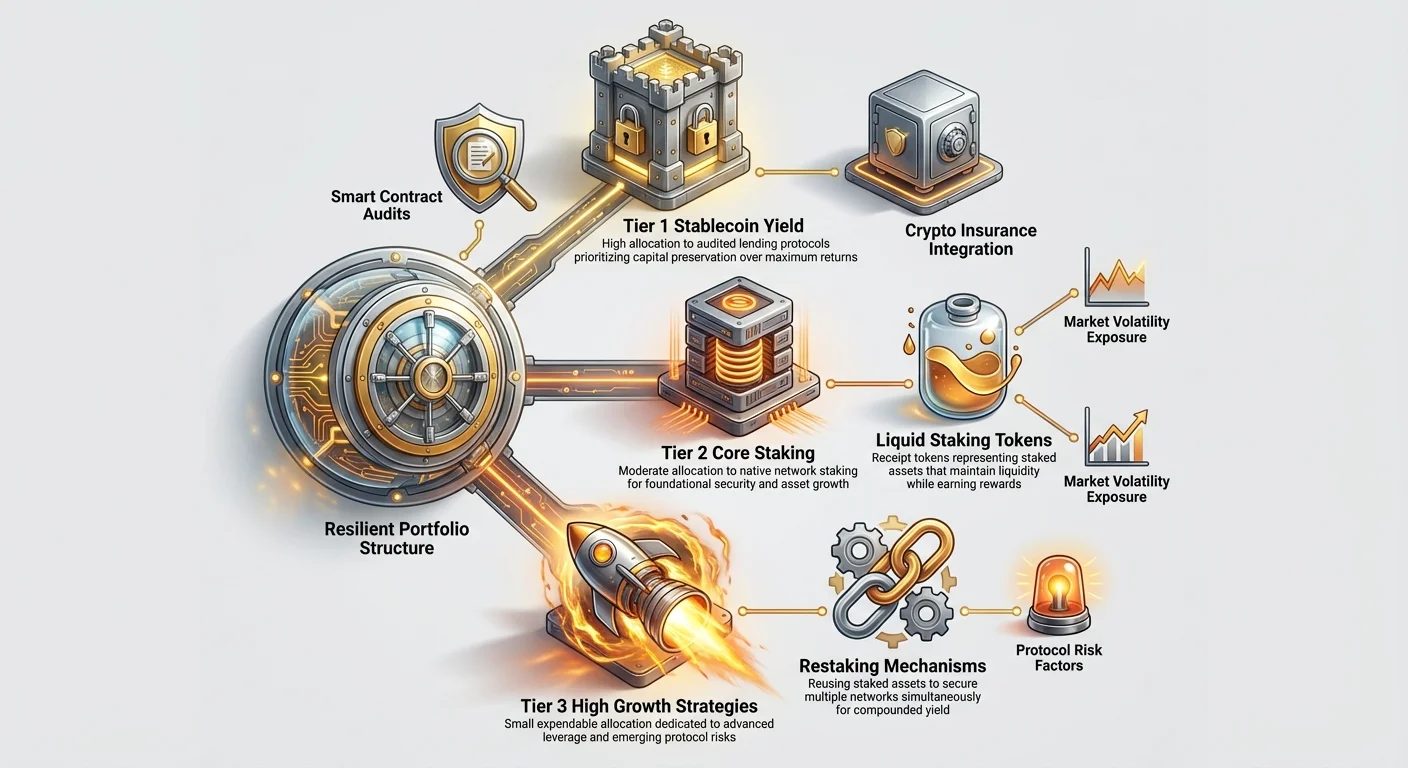
Allocation Strategy Example: The 60/25/15 Rule
A practical way for a moderate investor to allocate funds is to use a tiered structure that manages both risk types:
- Tier 1: Stablecoin Yield (60% Allocation): Dedicated to highly audited, blue-chip stablecoin lending protocols (e.g., Aave, Compound, or major decentralized exchanges). Risk is confined primarily to smart contract failure. Target APY: 5% - 10%.
- Tier 2: Core Volatile Staking (25% Allocation): Dedicated to staking core volatile assets (e.g., ETH, SOL) using battle-tested methods (native staking or liquid staking through top providers like Lido). This is where you maximize asset appreciation alongside basic yield. Target APY: 3% - 6% (plus asset price upside).
- Tier 3: High-Growth/High-Risk Strategies (15% Allocation): Dedicated to advanced strategies like leveraged yield farming, restaking, or investing in new, high-APY protocols. This capital should be considered expendable, but provides the potential for outsized returns. Target APY: 15% - 40%+.
By limiting high-risk strategies to a small percentage, a total failure in Tier 3 results in a maximum 15% portfolio loss, while the stable income (Tier 1) keeps generating cash flow.
Deep Dive into Yield Generation Mechanics and Portfolio Risk
As you move beyond basic lending, the yield mechanisms become more complex, and managing their specific risks is crucial for long-term survival. The following strategies, inspired by advanced staking concepts, demonstrate how yield can be "stacked" with corresponding risk.
Traditional Staking (The Baseline)
Mechanism: Locking up a native network token (e.g., ETH, SOL) to participate in the Proof-of-Stake (PoS) consensus mechanism. Validators use these tokens to verify transactions and secure the network, earning rewards (yield) in return. Portfolio Role: Long-term capital appreciation and foundational network security. Specific Risk:
- Illiquidity: Your assets are often locked for a defined period (sometimes years), meaning you cannot sell quickly if the market crashes.
- Slashing Risk: If the validator you delegate to performs maliciously or goes offline, a portion of your staked capital can be penalized (slashed).
Liquid Staking Tokens (LSTs)
Mechanism: LST protocols (like Lido or Rocket Pool) allow users to stake their tokens but receive a tokenized receipt (an LST, such as stETH or rETH) in return. This LST represents the staked capital plus accrued rewards. Portfolio Role: Solves the illiquidity problem of traditional staking, turning a locked asset into a usable token that can be immediately sold, traded, or used as collateral elsewhere in DeFi. Specific Risk Added:
- Smart Contract Risk: You are now exposed to the smart contract risk of the LST provider. If the protocol containing the staked ETH is exploited, the LST could lose its backing value, even if the underlying asset (ETH) is safe.
- De-pegging Risk: The LST may temporarily trade below the value of the underlying asset if there is a severe liquidity crisis or market fear.
Portfolio Management Tip: LSTs are a powerful component, but treat the LST's Protocol Risk as an additional layer of risk on top of the base asset's Market Risk. Diversify your LST exposure across several providers.
Restaking (Advanced Yield Stacking)
Mechanism: Restaking is the practice of reusing already-staked assets (usually LSTs) to secure other decentralized protocols, services, or middleware (known as Actively Validated Services or AVSs). Essentially, you are putting the same capital to work protecting multiple systems simultaneously. Portfolio Role: Maximizing capital efficiency and generating highly competitive APYs by earning rewards from two sources (the base chain and the AVS). Specific Risk Multiplier:
- Exponential Slashing Risk: By restaking your LST, you are now subject to the slashing rules of the base network and the slashing rules of the AVS you are securing. A failure or malicious act on the AVS means you could lose your underlying capital.
- Complexity: Restaking involves interacting with nascent protocols, which often have less audited code and shorter operational histories.
Portfolio Management Tip: Restaking falls firmly into the "High-Growth/High-Risk" tier (Tier 3). Due to the increased slashing potential, conservative investors should avoid restaking entirely, and moderate investors should limit exposure to a very small, well-defined percentage of their portfolio.
Diversification Strategies for Maximum Resilience
True portfolio resilience goes beyond simply balancing stablecoins and volatile assets; it requires diversification across three critical vectors: assets, protocols, and chains.
1. Cross-Chain Diversification
Placing all your capital on a single blockchain (e.g., Ethereum) exposes you to single-chain risks—a chain-halting bug, a catastrophic gas fee spike, or a major infrastructure outage.
Strategy: Spread assets across multiple, non-correlated Layer 1 (L1) and Layer 2 (L2) networks.
| Chain Category | Example Networks | Risk Mitigated | Portfolio Rationale |
|---|---|---|---|
| Blue-Chip L1 | Ethereum, Solana | Infrastructure failure, censorship risk. | Core security and primary capital storage. |
| Scalable L2 | Arbitrum, Optimism | High transaction costs (gas fees). | Efficient yield farming and frequent repositioning. |
| Alternate L1s | Avalanche, Polkadot | Economic correlation, geographic/regulatory risk. | Non-ETH correlated yield sources. |
If you have 40% of your volatile staking allocation in Ethereum, consider putting 10% in a robust L1 like Solana and 10% in a cost-effective L2 like Arbitrum. If Ethereum experiences a technical glitch, the rest of your portfolio remains operational.
2. Multi-Protocol Diversification
The cardinal rule of DeFi is: Never put all your capital into a single smart contract. Even the most heavily audited protocol could fail.
Strategy: Use different protocols to achieve the same yield goal.
- Example (Stablecoin Lending): Instead of lending 100% of your USDC on Protocol A, split it: 50% on Protocol A (high yield), 30% on Protocol B (moderate yield), and 20% on Protocol C (very low yield/maximum security).
- Example (Liquid Staking): If you are staking ETH, use different LST providers (Lido, Rocket Pool, Frax) rather than one, mitigating the risk of a single LST contract exploit.
3. Asset and Yield Type Diversification
Ensure your portfolio is generating income through various methods, not just various tokens.
| Yield Method | Example Activity | Portfolio Role | Associated Risk Type |
|---|---|---|---|
| Lending | Supplying stablecoins to Aave. | Low-risk cash flow. | Protocol, de-pegging. |
| Staking/LSTs | Staking ETH or SOL. | Core asset appreciation + basic yield. | Market, Slashing, Protocol (for LSTs). |
| Liquidity Providing | Farming USDC-ETH pair. | Balanced yield/exposure. | Impermanent Loss, Protocol. |
| Treasury Bonds/RWAs | Tokenized real-world assets. | Highly decoupled income source. | Counterparty, regulatory. |
By diversifying yield types, you hedge against a systemic failure in one sector (e.g., if a major oracle network fails, it might affect liquidity farming, but not basic LST staking).
Protocol Risk Assessment: The Due Diligence Checklist
When deciding where to allocate capital, high APY should never be the primary factor. Thorough due diligence regarding protocol integrity is the true measure of resilience. This involves moving beyond superficial reviews and looking into the protocol’s history, code, and economic structure.
The Smart Contract Audit Checklist
Audits are external reviews of a protocol’s code, performed by specialized security firms. They are non-negotiable proof points.
Existence and Quality of Audits:
- Check for Multiple Audits: Has the protocol been audited by reputable firms (e.g., Certik, Consensys Diligence, Halborn)? One audit is good; two or more is better, especially if major updates have occurred.
- Read the Summary: Did the audit find major vulnerabilities? Were all critical and high-severity issues resolved before launch? Don't just check if it was audited; check what the audit found.
Operational History and Total Value Locked (TVL):
- Time-Tested Protocols: A protocol that has operated flawlessly for two years with billions in TVL is generally safer than a protocol launched last week. Resilience is proven through exposure to multiple market cycles.
- Analyze TVL: Total Value Locked (TVL) indicates the capital commitment the community has in the protocol. High TVL suggests higher community trust, but also makes the protocol a bigger target for attackers. Use TVL as a proxy for trust, not necessarily safety.
Transparency and Open Source:
- Is the protocol’s code open-source? If the code is available on platforms like GitHub, the community (including security researchers) can review it, which provides a layer of decentralized accountability.
- Is the team behind the protocol transparent (not fully anonymous)? While many great projects start with anonymity, core DeFi infrastructure often benefits from identifiable teams who are publicly accountable.
Governance and Upgradeability Risk
Protocols that are fully decentralized (DAO-governed) and have slow, transparent upgrade mechanisms are generally safer than protocols controlled by a small team (centralized custody).
- Check for Administrative Keys: Does a single multi-signature wallet (or even a single person) have the power to instantly upgrade the smart contract or withdraw funds? This creates a massive centralized attack vector. Look for protocols where upgrades require lengthy governance proposals and public voting.
- Time Locks: A time lock is a feature that delays the execution of a governance decision (like a code upgrade or a parameter change). This allows the community to review the change and react if something malicious is attempted. Protocols with active, lengthy time locks are safer.
Integrating Risk Transfer (Crypto Insurance)
For the most resilient portfolios, Protocol Risk should be transferred where possible. This is where crypto insurance comes into play.
- Definition: Crypto insurance protocols (like Nexus Mutual or InsurAce) allow users to purchase coverage against specific Protocol Risks (e.g., smart contract failure on Aave).
- Operationalizing the Cost: Treat the insurance premium as a necessary cost of doing business, similar to paying a bank fee. If you target 8% APY on a stablecoin farm, and the insurance premium is 1.5% APY, your net yield is 6.5%. This is a crucial step in formalizing risk management and is always preferable to 100% capital exposure.
Calculating Your Target APY and Execution
The final stage of portfolio structuring is transitioning from theoretical allocations to realistic expectations, specifically by calculating the true, net returns of your chosen strategies.
From Gross APY to Net APY
Advertised APYs (Gross APY) are often misleading because they rarely account for hidden costs that erode returns. A resilient strategy focuses on maximizing Net APY—the actual return you take home after all expenses.
Key Deductions from Gross APY:
- Transaction Fees (Gas): Especially relevant on high-cost chains like Ethereum Layer 1. If you frequently compound (reinvest your rewards), high gas fees can negate daily returns. Factor in compounding costs when comparing a 10% APY platform that requires daily compounding versus an 8% APY platform that compounds automatically.
- Impermanent Loss (IL) Cost: If you participate in liquidity provision (Yield Farming), you must subtract the expected cost of Impermanent Loss (the divergence in price between the two farmed assets). A high APY often exists to compensate the user for very high expected IL. If the Net APY (after IL) is low, the farm is not worth the risk.
- Insurance Premiums: As discussed above, deduct any costs associated with transferring smart contract risk.
- Taxes (Jurisdiction Dependent): While complex, future resilience requires considering the taxable events (swapping tokens, claiming rewards).
Calculating Weighted Average Portfolio APY
Once you have established your allocation limits and determined the Net APY for each specific strategy, you can calculate the weighted average expected return for your entire portfolio. This metric provides a holistic view of portfolio performance aligned with your risk profile.
Formula:
Example: Moderate Portfolio (Using the 60/25/15 Rule)
| Strategy Tier | Allocation % | Expected Net APY | Weighted Contribution |
|---|---|---|---|
| Tier 1 (Stablecoin Lending) | 60% | 7.0% | |
| Tier 2 (Core LST Staking) | 25% | 4.5% | |
| Tier 3 (Restaking/Farming) | 15% | 18.0% | |
| Total Portfolio Weighted APY | 100% | 8.03% |
In this scenario, the investor targets an 8.03% annual return across their entire portfolio. Importantly, while the aggressive Tier 3 strategy provides a significant yield boost (2.70% of the total 8.03%), the stable Tier 1 strategy remains the largest contributor to the overall return (4.20%), ensuring resilience and stability.
This mathematical discipline forces you to acknowledge that maximizing small allocations to risky strategies (15% at 18% APY) contributes less to the overall portfolio health than securing a reliable, lower yield on the majority of your capital (60% at 7% APY).
Active Monitoring and Rebalancing
A resilient portfolio is not static. It requires ongoing management and adaptation.
- Monitor Protocol Health: Regularly check for governance votes, major updates, or security alerts related to the protocols you use. Be prepared to withdraw funds immediately if a critical vulnerability is exposed.
- Rebalance Quarterly: Price fluctuations will naturally shift your allocations. If your volatile assets (ETH) double in price, your portfolio might shift from 40% volatile to 60% volatile. Rebalancing involves selling some of the profitable volatile assets and moving them back into stablecoins to restore your original risk profile (e.g., selling the ETH gains to buy more USDC for stablecoin yield). This practice locks in profits and maintains the intended risk parity.
Conclusion
Structuring a resilient DeFi passive income portfolio is an exercise in applied risk management, not a quest for the highest number on a dashboard. By adopting the principles of traditional finance—defining risk tolerance, establishing clear allocation limits, and prioritizing diversification—you build a defense against the unique and severe threats posed by smart contract failure and market volatility.
True resilience comes from acknowledging that while the rewards in DeFi can be transformative, the risks are complex. Focus on building a strong, stable base with audited stablecoin yield, diversify across chains and protocols to eliminate single points of failure, and treat high-yield strategies as small, calculated bets. By focusing on your Net APY and consistently rebalancing back to your established risk limits, you secure a path toward sustainable, passive income in the decentralized ecosystem.