
Introduction: Moving Crypto from Investment to Utility
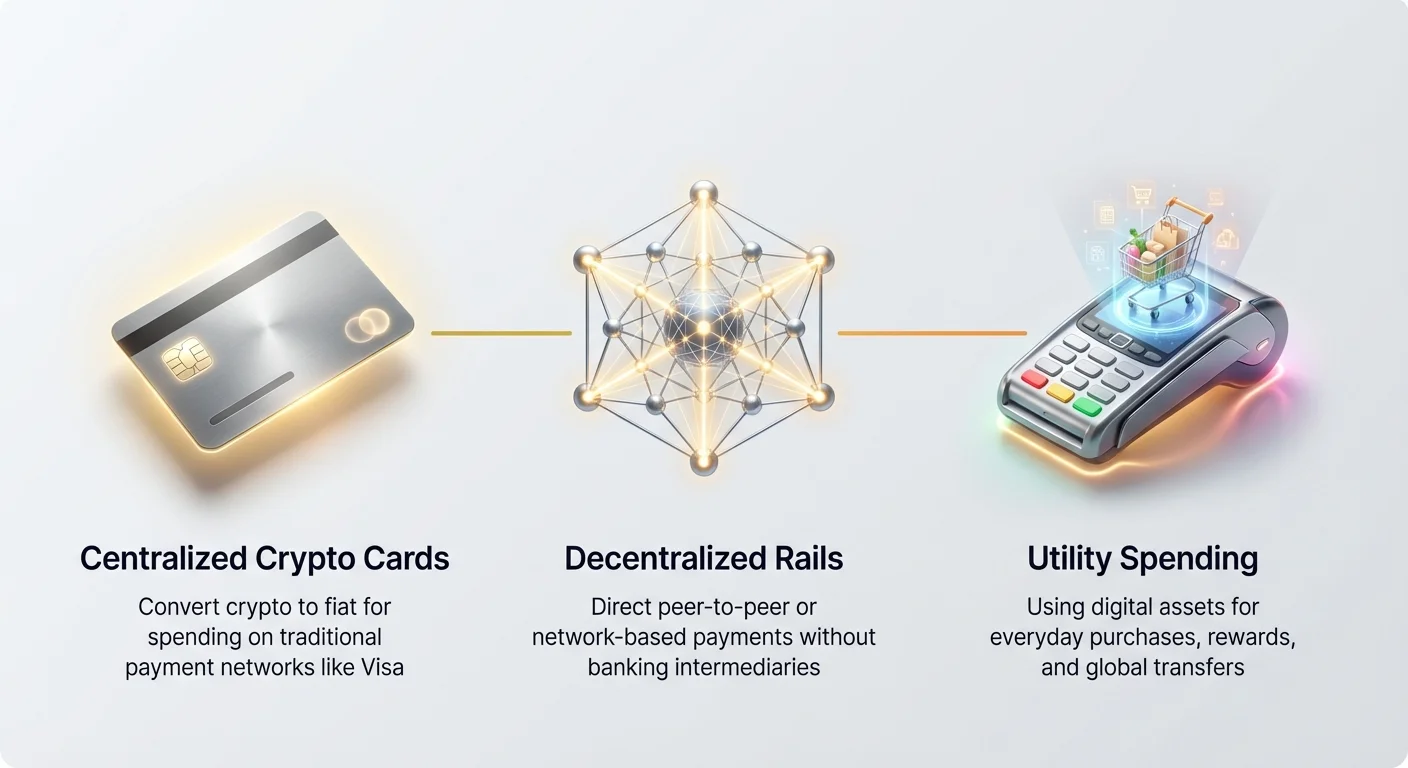
For years, cryptocurrency was seen primarily as a speculative investment—an asset you held onto, hoping its value would increase. Today, the landscape has fundamentally shifted. Digital assets are rapidly becoming a powerful tool for everyday spending, offering benefits like superior cashback rewards, instant global transfers, and greater control over your funds.
However, navigating the array of options—from prepaid debit cards offered by centralized exchanges to direct spending via decentralized wallets and the Lightning Network—can be confusing. The market is saturated with platforms promising the “best” rewards, but often concealing complex fee structures or high barriers to entry (like requiring massive token staking).
This guide introduces the Crypto Spending Matrix: a strategic framework designed to help novices and experienced users alike cut through the noise. We will categorize and compare crypto spending solutions based not just on their features, but on your specific financial goals—whether that’s maximizing cashback, minimizing foreign transaction fees, or prioritizing self-custody and privacy. By understanding the underlying mechanisms of each solution, you can stop leaving rewards on the table and strategically integrate digital assets into your daily financial life.
The Foundations of Crypto Spending: Centralized vs. Decentralized Rails
Before optimizing your spending, it is crucial to understand the two fundamental types of financial "rails" that enable you to use crypto in the real world. These rails determine acceptance, security, and the level of control you maintain over your assets.
Centralized Crypto Cards: The Familiar Pathway
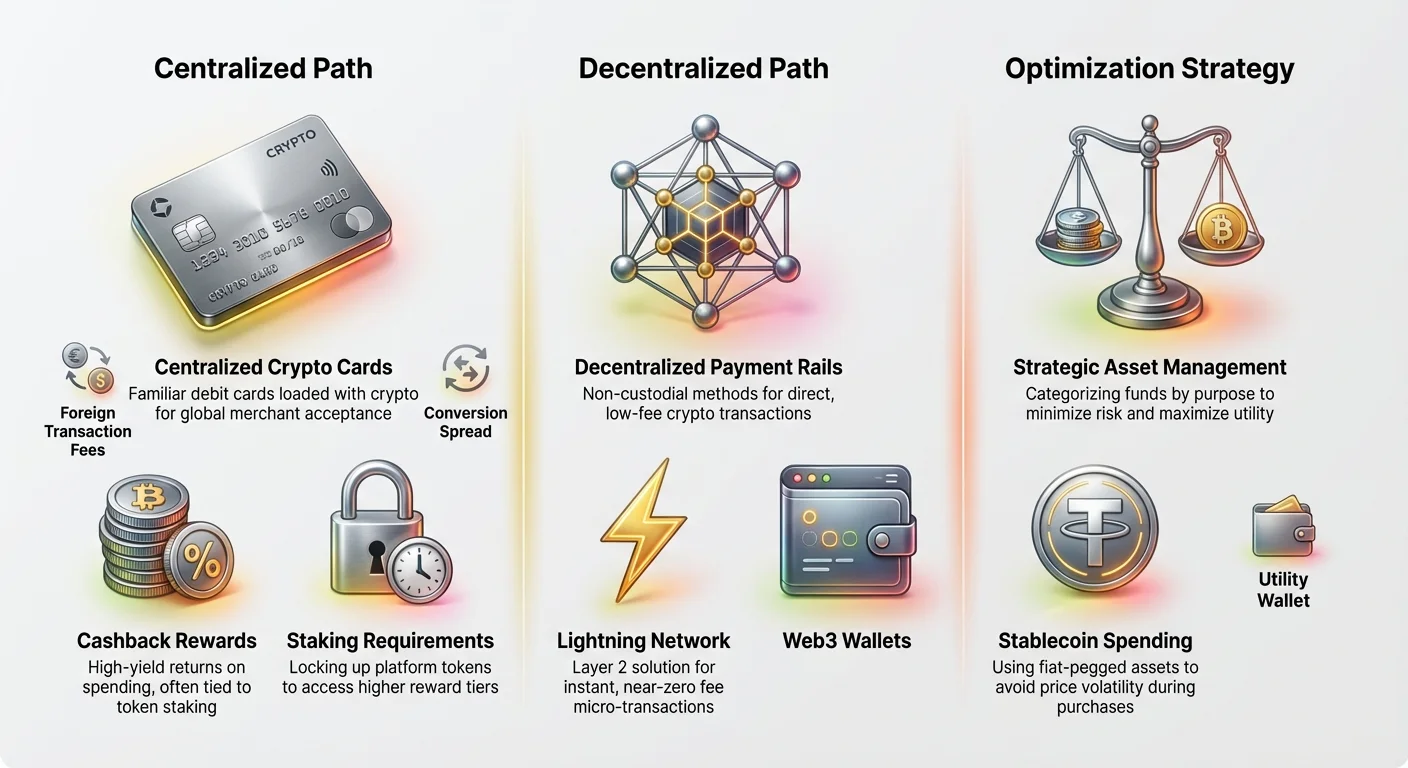
Centralized Crypto Cards (often branded as Visa or Mastercard debit cards) are the most beginner-friendly solution because they blend the familiarity of traditional banking with the benefits of digital assets. These cards are offered by major crypto exchanges or dedicated financial technology (FinTech) companies.
How Centralized Cards Work
The process is straightforward:
- Depositing: You transfer Bitcoin, Ethereum, or stablecoins (like USDC or USDT) from your personal wallet into your account on the centralized platform (the exchange).
- Loading: You instruct the platform to convert your crypto into a spending currency (e.g., USD, EUR, or GBP) and load it onto the physical or virtual card balance.
- Spending: When you swipe the card, the merchant receives fiat currency just like any regular debit card transaction. The exchange handles the conversion and settlement instantly.
Pros and Cons
Pros:
- Widespread Acceptance: Usable anywhere Visa or Mastercard is accepted globally.
- Familiar Experience: Works exactly like a traditional bank card, requiring no change in consumer behavior.
- High Reward Potential: Often provide structured cashback programs (3% to 8%) tied to staking requirements.
Cons:
- Custody Risk: The exchange holds your funds. If the platform fails or is hacked, your assets could be at risk (counterparty risk).
- KYC Required: You must complete full Know Your Customer (KYC) verification, forfeiting privacy.
- Fees and Spreads: Conversions from crypto to fiat often involve a ‘spread’ (the difference between the price the exchange buys/sells at) and sometimes a conversion fee.
Decentralized Payment Rails: The Future of Instant Utility
Decentralized payment rails bypass traditional banking infrastructure entirely, allowing for peer-to-peer (P2P) transfers, or utilizing specialized networks that enable instant, near-zero-fee transactions.
The Role of Web3 Wallets and Lightning
Instead of using a plastic card linked to an exchange account, decentralized spending uses a non-custodial wallet (like a Bitcoin wallet or MetaMask).
- Direct P2P: You scan a QR code or use a wallet address to send crypto directly to a merchant who accepts it (e.g., a service that accepts Bitcoin over the Lightning Network).
- DeFi Integration: Some advanced services allow you to collateralize your crypto or access crypto-backed loans for spending, though this is complex for beginners.
- Lightning Network: This is a “Layer 2” solution built on top of the Bitcoin network, specifically designed to process very small transactions ($0.01 to $500) instantly and cheaply. This is the primary decentralized tool for everyday utility spending.
Pros and Cons
Pros:
- Self-Custody: You retain full control of your private keys; the funds are yours until spent.
- Privacy: Transactions are often pseudo-anonymous or require minimal personal data (especially Lightning).
- Low Fees: Transaction fees are minimal, often fractions of a penny.
Cons:
- Limited Acceptance: Far fewer merchants accept direct crypto payments than centralized cards.
- Complexity: Requires a higher degree of technical knowledge and wallet management.
- Volatility Risk: If the merchant does not instantly convert the crypto, they absorb the volatility risk (though this is mitigated by instant settlement on Lightning).
The High-Reward Spender: Cashback Optimization Strategies
The single biggest draw for many users entering the crypto spending ecosystem is the unprecedented cashback potential. While traditional credit cards might cap rewards at 1% or 2%, certain crypto cards offer rates as high as 8% back on all purchases. However, these high rewards come with significant strategic hurdles related to staking and asset volatility.
Tiers, Staking, and Lockup Requirements
High-yield crypto rewards are not free; they are typically gated behind a tiered system that requires the user to stake (lock up) a substantial amount of the platform’s native token.
Understanding Staking Risk
- Mechanism: To access the top reward tiers (e.g., 5% cashback), you might be required to purchase and lock up $5,000, $50,000, or even $500,000 worth of the exchange’s proprietary token for a fixed period (e.g., 6 to 12 months).
- The Volatility Trade-off: The real risk lies in the volatility of the staked token itself. If you stake $5,000 to earn 4% cashback, but the native token’s value drops by 30% during the staking period, your net financial position is significantly negative, completely negating the cashback benefits.
- Actionable Tip: Always calculate the Cashback Yield vs. Staking Volatility Risk. For beginners, it is often safer to choose a lower-tier card (0-2% rewards) that requires minimal or zero staking, or one that allows staking highly stable assets like USDC.
Reward Payouts: Fungible Crypto vs. Stablecoins
How your cashback is paid out matters immensely for realizing actual value.
Payout Asset Volatility
- Earning Volatile Rewards (e.g., BTC or the Native Token): Many cards pay rewards in Bitcoin or their own utility token. While exciting during bull markets, if the reward token declines 10% before you sell it, your 4% cashback is effectively reduced to 3.6%.
- Earning Stablecoin Rewards (e.g., USDC, USDT): Some platforms offer the option to receive cashback in stablecoins. This is the optimal choice for utility spending and maximizing realized cashback, as the value of the reward is locked immediately and does not decay due to market swings.
Stacking and Maximizing Reward Tiers
The highest-level strategy involves stacking rewards across multiple platforms and incorporating existing loyalty programs.
The Strategic Card Allocation
Instead of trying to achieve the highest reward tier on one platform, consider using a combination of cards optimized for specific spending categories:
- Groceries/Gas (High Volume): Use Card A, which offers 4% on everyday spending but requires a small stake.
- Travel/Hotels (Luxury Spend): Use Card B, which offers specific travel perks (lounge access, travel insurance) and 2% rewards, paid in a stable asset.
- Online Purchases (Minimal Stake): Use Card C, which offers 1% flat cashback with no staking requirement, minimizing risk.
By strategically allocating which card is used for which category, the power user can maintain a diversified staking portfolio (reducing exposure to any single native token) while maximizing cashback across all expenditures.
The Cost-Conscious Spender: Minimizing Fees and Friction
High rewards mean little if they are eaten away by hidden charges, foreign transaction fees, or expensive conversions. The cost-conscious spender prioritizes tight spreads and transparent fee structures over astronomical reward rates.
Deciphering Hidden Fee Structures
Centralized crypto cards operate much like traditional prepaid debit cards, which means they are subject to various fees that can significantly erode your savings.
1. Foreign Transaction Fees (FTFs)
This is arguably the most critical fee for global users or travelers.
- Traditional Burden: Most traditional credit cards charge 2.5% to 3.5% for purchases made outside the card’s base currency (e.g., using a USD card in Japan).
- Crypto Card Advantage: Many top-tier crypto cards advertise 0% Foreign Transaction Fees. This single feature can make them significantly more cost-effective for international travel than standard bank cards.
2. Activation, Inactivity, and Maintenance Fees
- Activation: Some cards charge a small fee ($5–$25) to issue the physical card.
- Inactivity: If you do not use the card for 3–6 months, some platforms levy an "inactivity fee." This punishes users who only load and use the card sporadically. The best crypto cards offer $0 inactivity fees.
- Maintenance: Generally rare among competitive crypto cards, but essential to check the fine print.
Load and Conversion Costs (The Spread)
Before you can spend your Bitcoin, it must be converted to the local currency for the card’s balance. This conversion process is where exchanges often make their money, even if they advertise "free" transactions.
Understanding the Spread
When you exchange BTC for USD on an exchange, you are buying at one price (the ask) and selling at another (the bid). The difference between these prices is the spread.
- Wide Spreads: If an exchange has a wide spread, they are essentially taking an extra percentage (e.g., 0.5% to 1.5%) during your conversion. This acts exactly like a conversion fee.
- Tight Spreads: Look for platforms that guarantee competitive, institutional-grade spreads, particularly when converting stablecoins (which should have a spread close to zero).
Best Practice: To minimize load costs, load your card primarily with stablecoins (USDC/USDT). Since stablecoins are designed to track $1.00, the conversion spread between stablecoin and fiat (like USD or EUR) should be negligible, minimizing the effective cost of loading the card.
ATM Withdrawal Optimization
While crypto cards are designed for purchases, the ability to withdraw local fiat currency from ATMs is a necessity.
Fee-Free Limits and Reimbursement
Most platforms impose a daily or monthly limit on fee-free ATM withdrawals (e.g., the first $200 per month is free).
- Platform Fees: The card issuer charges a fee (typically 1-3%) once you exceed the monthly limit.
- ATM Operator Fees: The physical ATM machine owner charges a separate “surcharge.”
Optimization Strategy: Choose platforms with high fee-free withdrawal limits (e.g., $1,000+ per month for high-tier users) and always check if the platform offers reimbursement for the ATM Operator’s surcharge—a feature common among top-tier travel cards.
The Traveler’s Toolkit: Global Utility and FX Management
For individuals who travel frequently or conduct transactions in multiple currencies, crypto spending solutions offer unique advantages over traditional banks, particularly concerning exchange rates and access to funds.
Multi-Currency Wallet Management
The most advanced crypto spending platforms integrate a multi-currency wallet directly with the spending card.
Locking in Favorable Rates
Imagine you are traveling from the US to Europe. If the USD/EUR exchange rate is favorable today, a smart multi-currency platform allows you to convert USD into EUR inside your account and hold that balance until you arrive.
- Strategic Advantage: When you swipe your card in Europe, the funds are debited directly from your pre-purchased EUR balance, bypassing any live, potentially unfavorable, exchange rate conversions at the time of purchase.
- Eliminating Volatility: This separates the volatility of the crypto asset (BTC) from the stability of the foreign fiat currency (EUR). You only risk BTC volatility when you first convert BTC to EUR, not during daily spending.
Privacy and High Utility Cards
While most high-reward cards require strict KYC, there are utility solutions favored by travelers and privacy-conscious users.
Anonymous and Virtual Cards
- Virtual Cards: These are instantly generated card numbers, ideal for one-time online purchases or services. They offer enhanced security because they can be locked or deleted instantly, limiting exposure if compromised.
- Anonymous (No-KYC) Cards: Historically, some services offered prepaid crypto cards with extremely low limits (e.g., $250 daily spend) that did not require full identity verification. While increasingly rare and heavily restricted due to regulatory pressure (especially in major jurisdictions), their niche is focused on minimal-transaction privacy, often relying on alternative jurisdictions or virtual card services. Note: For high-volume spending or large purchases, KYC is unavoidable.
Case Study: Emergency Funds and Global Access
One of the greatest utilities of crypto cards for travelers is immediate access to emergency funds. If a traditional bank freezes your account due to suspected fraud while abroad, retrieving funds can take days or weeks.
With a crypto card:
- Your primary funds remain safe in a non-custodial wallet (offline).
- In an emergency, you can instantly transfer volatile crypto (BTC, ETH) or stablecoins from your self-custody wallet to the centralized exchange/card platform.
- The funds are loaded onto the card and available for fiat withdrawal or spending in minutes, entirely bypassing traditional banking bureaucracy.
Strategic Asset Management: Fungible vs. Stablecoin Spending
A common mistake among beginners is using Bitcoin or Ethereum as the primary funding source for their debit card. While possible, this introduces unnecessary risk. The "Matrix" approach dictates that assets should be categorized by purpose: Store of Value (HODLing) vs. Utility (Spending).
The Case for Stablecoins in Utility Spending
Stablecoins (USDC, USDT, DAI) are digital currencies pegged 1:1 to a stable asset, usually the US dollar. They are the ideal choice for crypto spending utility.
Minimizing the Volatility Drain
If you load $1,000 worth of Bitcoin onto your card on Monday, and the price of BTC drops 5% by Wednesday, the fiat spending power of that balance is now only $950. You’ve lost $50 before you even made a purchase.
When you load $1,000 worth of USDC, the balance remains $1,000 regardless of what Bitcoin or Ethereum is doing.
Key Rule for the Matrix: Treat stablecoins as your digital checking account. Use them exclusively for card loads and daily utility spending to maintain purchasing power stability.
Managing Volatile Assets (BTC, ETH) for Spending
If you only hold volatile assets, a strategy must be employed to minimize conversion exposure.
The "Just-In-Time" Conversion Strategy
Never load your entire BTC savings onto the card platform. Instead:
- Monitor the Card Balance: Only load the minimum necessary to cover expected monthly expenses (e.g., $1,000).
- Convert Immediately: When you decide to load the card, transfer the required amount of BTC to the exchange and convert it instantly into the local fiat or stablecoin currency used by the card. Do not hold BTC on the platform’s exchange wallet.
- HODL Offline: Keep the vast majority of your volatile assets secured in a cold storage or non-custodial wallet, completely separate from your spending platform.
This strategy ensures that your volatile assets are only exposed to market swings for the few seconds required for the conversion transaction, protecting your capital from accidental spending power decay.
Advanced Integration: Beyond the Card (Wallets & Lightning)
While centralized crypto cards offer ease of use, the ultimate goal of crypto is decentralized control. The most advanced tier of the Spending Matrix involves leveraging non-custodial wallets and specialized payment networks that offer superior speed, lower fees, and greater privacy.
The Power of the Lightning Network
The Lightning Network (LN) is a crucial advancement for truly integrating crypto into daily micro-transactions.
Why Lightning is Superior for Small Payments
Traditional Bitcoin transactions (Layer 1) are slow (10 minutes minimum confirmation time) and expensive (fees can range from $1 to $50 depending on network congestion). This makes them useless for buying coffee or paying a small bill.
Lightning solves this by opening private "payment channels" between users. Transactions are settled off-chain, resulting in:
- Instant Confirmation: Transactions confirm in milliseconds.
- Near-Zero Fees: Costs are typically less than $0.01.
Practical Use Cases for Lightning
While cards handle major retail purchases, Lightning excels at utility payments:
- Tipping and Donations: Sending small, instant payments online without bank intermediaries.
- Streaming Services: Paying for services that accept Lightning directly.
- P2P Transfers: Instantly sending money to a friend anywhere in the world who also has a Lightning wallet.
DeFi Payment Rails: Web3 Wallets vs. Centralized Crypto Cards
Decentralized Finance (DeFi) offers alternative payment rails that operate directly on blockchain networks (like Ethereum or Solana), often leveraging non-custodial Web3 wallets.
The Role of the Web3 Wallet (e.g., MetaMask)
A Web3 wallet is your key to the decentralized economy. While you can’t swipe MetaMask at a grocery store yet, you can use it for:
- NFT Purchases: Buying digital collectibles or accessing token-gated events.
- DApp Interaction: Paying fees (gas) to interact with Decentralized Applications (DApps), such as borrowing, lending, or decentralized exchange (DEX) swaps.
- Emerging Retail Solutions: Some advanced merchants (especially in the digital goods space) are starting to accept direct payment links from Web3 wallets, bypassing the need for a card.
The key difference remains: Centralized Cards convert crypto to fiat for mass acceptance; Decentralized Wallets pay crypto-to-crypto, requiring the merchant to accept the digital asset directly.
Security and Best Practices for Utility Spending
Integrating crypto into daily life introduces new security considerations. Because centralized cards link your crypto assets to a third-party account that can be accessed online, rigorous security protocols are essential.
The Dedicated "Utility Wallet" Strategy
Never link your primary long-term investment wallet (the "HODL Wallet") to a centralized exchange or spending card.
Segregating Funds for Safety
- Cold Storage (The Vault): All significant crypto holdings should reside offline in a hardware wallet or deep cold storage, completely inaccessible by online exchanges or hot wallets. This is your savings.
- Spending Wallet (The Utility Account): Set up a dedicated "hot wallet" or exchange account solely for funding your spending card. This account should only hold the exact amount of crypto or stablecoins required for the next 1-2 months of spending.
If your card provider or exchange account is ever compromised, the maximum loss is limited to the small amount held in the utility wallet, leaving your main assets secure.
Authentication and Account Protection
Centralized spending platforms are attractive targets for hackers. Treat access to your crypto card account with the same level of security as your main bank account—or higher.
- Mandatory Two-Factor Authentication (2FA): Always enable 2FA using an authenticator app (like Google Authenticator or Authy) rather than SMS, which can be vulnerable to SIM-swapping attacks.
- Strong, Unique Passwords: Use a password manager to generate complex passwords unique to the crypto platform.
- Transaction Alerts: Enable instant email and push notifications for every transaction, deposit, and withdrawal. This allows you to immediately detect and freeze unauthorized activity.
Managing Privacy with Centralized Cards
While KYC is mandatory for high-utility cards, you can manage the privacy of your actual crypto transactions.
- Avoid On-Chain Analysis: When funding your card, transfer stablecoins or crypto from a non-KYC decentralized wallet, rather than directly from a major exchange where your transaction history is linked to your identity.
- Limit Data Sharing: Only use your crypto card for essential retail spending. For highly private or anonymous transactions (like certain online services or international peer-to-peer transfers), utilize the Lightning Network or other decentralized payment rails where possible.
Conclusion: Mastering the Spending Matrix
The shift toward integrating crypto into daily spending represents one of the most exciting phases of digital asset adoption. The Crypto Spending Matrix provides the framework necessary to move beyond simple comparison and into strategic optimization.
By understanding the key trade-offs—staking requirements versus realized cashback, centralized convenience versus decentralized control, and volatility risk versus stability—novice users can effectively tailor their approach. Whether your goal is the highest possible cashback yield, global fee minimization, or prioritizing self-custody via the Lightning Network, the tools exist to turn crypto into a powerful, rewarding, and deeply integrated utility within your modern financial toolkit.
The future of payments is one where the lines between traditional finance and decentralized systems blur. Mastering this matrix ensures you are positioned to capture the rewards and utility offered by this financial evolution while maintaining security and control over your digital wealth.