
Cryptocurrency ownership represents a fundamental shift in how individuals interact with value. Unlike traditional banking systems where a third party manages funds, digital assets empower users with complete financial sovereignty. This freedom comes with a significant responsibility: the management of cryptographic keys.
If you lose a credit card, a bank can issue a new one. If you lose the private keys to your digital assets, the funds are inaccessible forever. Mastering key management is not merely a technical skill but a prerequisite for financial independence in the decentralized economy.
Securely generating and storing seed phrases forms the bedrock of asset protection. Whether you hold Bitcoin, Ethereum, or other digital currencies, the safety of your portfolio depends entirely on how you handle the secret information that grants access to the blockchain.
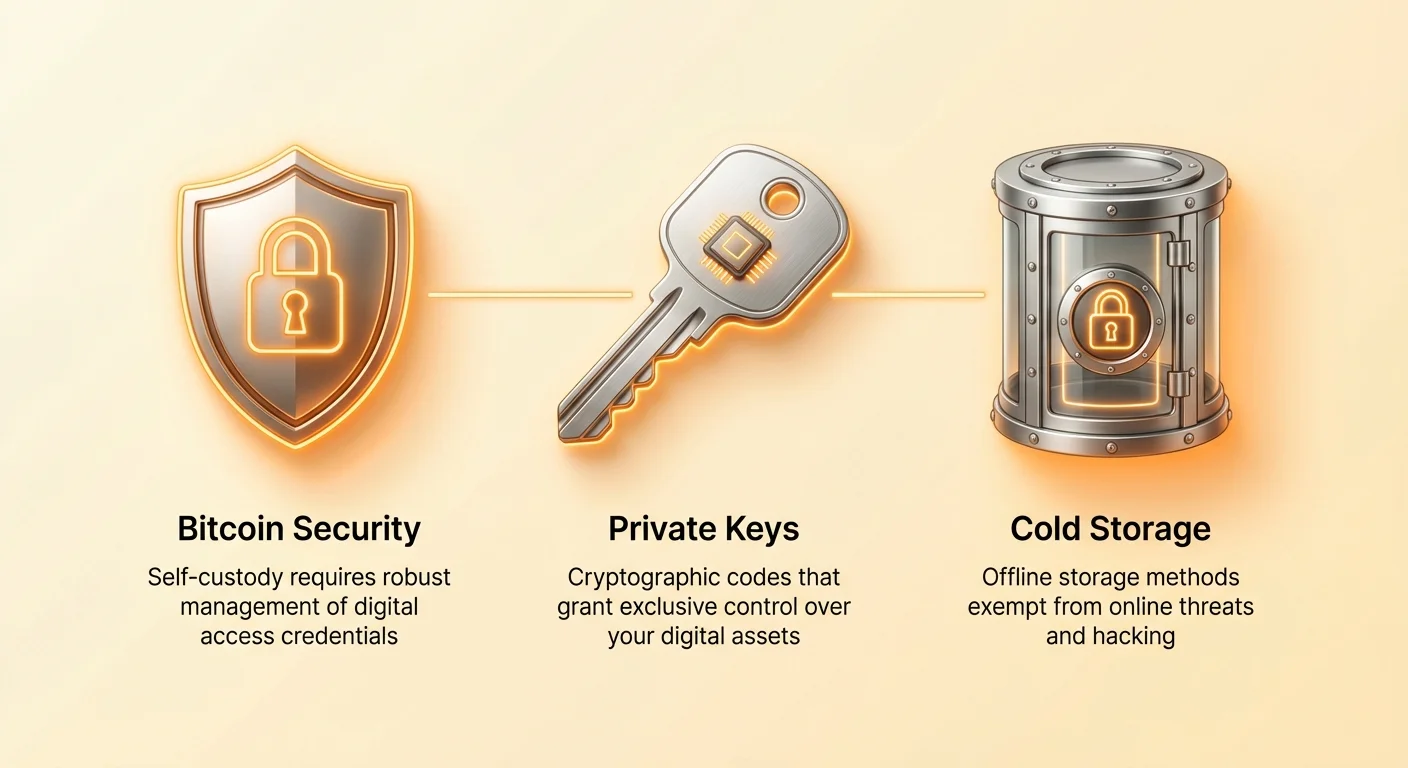
The Hierarchy of Keys
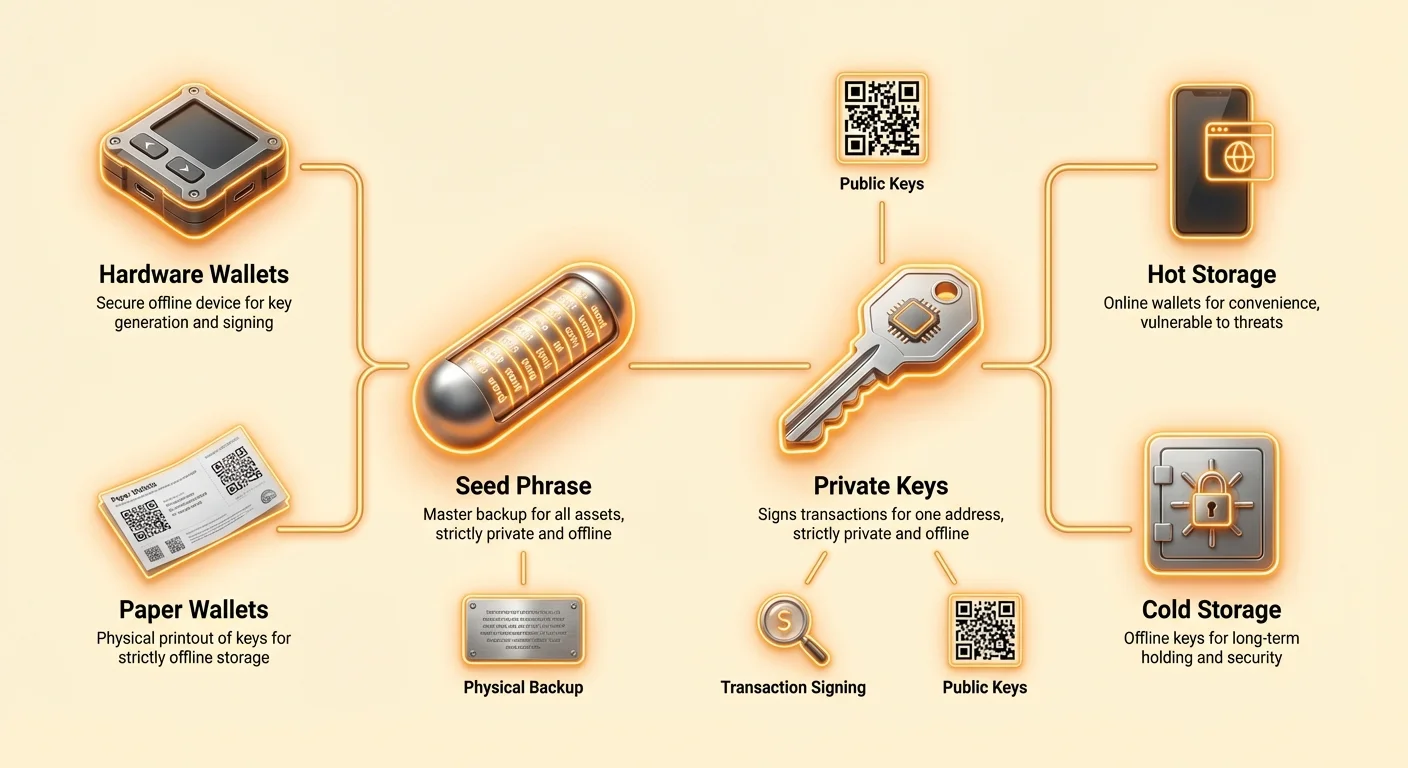
Understanding the relationship between different types of keys is essential for secure management. At the top of the hierarchy sits the seed phrase, often called a recovery phrase. This is typically a sequence of 12 to 24 random words generated when you first set up a wallet.
The seed phrase acts as a master key. From this single sequence of words, the wallet software mathematically derives the private keys for multiple cryptocurrencies and addresses. If you have the seed phrase, you can restore access to your entire portfolio on any compatible device.
Below the seed phrase are the private keys. A private key is a long alphanumeric string that authorizes outgoing transactions for a specific address. It functions like a digital signature, proving ownership without revealing the key itself.
Finally, the public key is derived from the private key. This is the address you share with others to receive funds. While the public key is visible to the world, it is mathematically impossible to reverse-engineer the private key or seed phrase from it.
| Key Type | Function | Visibility |
|---|---|---|
| Seed Phrase | Master backup for all assets | Strictly Private |
| Private Key | Signs transactions for one address | Strictly Private |
| Public Key | Receives funds | Public |
Hot Versus Cold Storage
The distinction between hot and cold storage is the most critical concept in key management. Hot storage refers to any wallet that is connected to the internet. This includes mobile apps, desktop software, browser extensions, and exchange accounts.
Hot wallets are designed for convenience. They allow for quick transactions, easy interaction with decentralized applications (dApps), and immediate access to trading markets. However, their constant connectivity makes them vulnerable to online threats such as malware, phishing attacks, and remote hacking.
Cold storage refers to keeping private keys completely offline. Because these keys never touch the internet, they are immune to online attack vectors. Cold storage is the preferred method for long-term holding, often referred to as "HODLing," where security takes precedence over convenience.
Examples of cold storage include hardware wallets and paper wallets. These methods ensure that the generation and storage of keys occur in an air-gapped environment, isolating the sensitive data from potentially compromised devices.
The Role of Hardware Wallets
Hardware wallets are physical devices engineered specifically to generate and store private keys offline. They are widely considered the most secure balance between usability and safety for most users.
When you set up a hardware device, it generates the seed phrase on its own screen. This information is never displayed on your computer or smartphone, ensuring that even if your computer is infected with a virus, the seed phrase remains unexposed.
To send a transaction, the wallet software on your computer constructs the transaction details and sends them to the hardware device. You confirm the details on the device's physical screen, and the device signs the transaction internally. Only the signed transaction data—not the private key—is sent back to the computer to be broadcast to the network.
Many modern hardware wallets also support advanced features like passphrases. This allows you to create a hidden wallet behind a secondary password. If someone forces you to unlock your device, you can reveal a decoy wallet with a small balance while the main funds remain hidden.
Creating a Bitcoin Paper Wallet
For those seeking a cost-effective and strictly offline storage method, paper wallets are a powerful solution. A paper wallet is simply a physical printout of a public and private key pair.
The process begins with generating the keys. To do this securely, you must use a client-side address generator. This tool runs locally on your browser rather than on a remote server. To ensure absolute security, you should download the generator's webpage and save it to a USB drive.
Next, boot up a computer that is not connected to the internet. Ideally, this should be a clean operating system to minimize malware risks. Open the saved webpage on this offline machine. The generator will ask for "entropy," which usually involves moving your mouse randomly or typing random keys to ensure the generated keys are truly unpredictable.
Once the keys are generated, print the page using a printer that is directly connected to the computer via USB. Avoid wireless printers, as the data could be intercepted over the network.
After printing, it is crucial to clear the printer's memory cache if possible, or turn it off and on again, to ensure no digital trace remains. The resulting piece of paper is now your bearer instrument; whoever holds the paper controls the Bitcoin.
Physical Storage Strategies
Generating secure keys is only half the battle. Storing the physical record of those keys requires a robust strategy to protect against environmental damage, theft, and loss.
Paper degrades over time. Ink can fade, and paper is susceptible to water and fire damage. To mitigate this, many users laminate their paper wallets or seed phrase backups. However, lamination can sometimes damage thermal prints, so ensure you are using high-quality paper and ink.
For superior durability, consider engraving your seed phrase or private key onto a steel plate. Metal backups are fireproof, waterproof, and resistant to corrosion. They can survive disasters that would destroy paper or electronic devices.
Redundancy is also vital. Storing a single copy of your seed phrase creates a single point of failure. If that location is compromised or destroyed, the funds are lost. Best practices suggest creating multiple copies and storing them in geographically separate, secure locations, such as a home safe and a bank deposit box.
Splitting and Sharing Keys
For institutional-grade security or high-net-worth individuals, simple redundancy might be too risky. If you store three full copies of a seed phrase, you have three locations that a thief could target.
Advanced security protocols often utilize methods like Shamir's Secret Sharing. This cryptographic technique splits a seed phrase into multiple unique parts, or "shares." To reconstruct the wallet, a specific subset of these shares is required.
For example, you might create a "2-of-3" setup. You generate three shares and store them in different locations. To access the funds, you need any two of the three shares. If a thief steals one share, they cannot access the funds. If you lose one share, you can still recover your wallet using the other two.
This method distributes trust and risk. It ensures that no single location holds the complete key to your wealth, significantly raising the bar for an attacker while providing a safety net against loss.
The Risks of Browser Extension Wallets
Browser extension wallets have become the standard for interacting with Web3 applications, DeFi platforms, and NFT marketplaces. They bridge the gap between traditional browsing and blockchain networks, allowing for seamless transactions.
However, because these wallets operate within a web browser, they are more exposed than cold storage solutions. They are "hot" wallets, meaning the private keys are encrypted but stored on an internet-connected device.
Phishing is a primary threat to browser wallet users. Malicious websites can mimic legitimate dApps, tricking users into signing transactions that drain their wallets. Additionally, if a computer is compromised by malware, the attacker may be able to log keystrokes to capture the wallet password or access the encrypted vault file.
To secure browser wallets, users should use a strong, unique password and enable auto-lock features that require a password after a short period of inactivity. For significant amounts of value, it is highly recommended to connect a hardware wallet to the browser extension. This allows the interface of the browser wallet to be used while keeping the private keys securely offline.
Redeeming Funds from Cold Storage
When the time comes to spend Bitcoin or other assets stored in cold storage, the process requires care to maintain security. You must move the funds from the offline environment to an online wallet.
To do this, you import the private key into a software wallet. This is often called "sweeping" the wallet. Sweeping sends the entire balance of the paper wallet to a new address in your software wallet. This is the preferred method because it empties the cold storage wallet completely.
Importing the key without sweeping allows you to spend a portion of the funds, but it creates a complex security situation regarding "change addresses." In Bitcoin transactions, if you spend less than the total unspent output, the network sends the remainder (the change) to a new address.
If you are using a paper wallet and do not understand how the software handles change, you might accidentally send the remainder of your funds to an address you do not control or back to the paper wallet which is now considered "used" and potentially exposed.
Therefore, the golden rule of cold storage redemption is to never reuse a cold wallet. Once you expose the private key to an online device, consider that wallet compromised. Sweep the full balance, and if you need cold storage again, generate a brand new paper wallet or offline address.
Mobile Wallets for Daily Use
While cold storage is essential for savings, mobile wallets provide the utility needed for daily transactions. They function like a physical wallet in your pocket, carrying a small amount of cash for immediate spending.
Mobile wallets offer features like biometric authentication (fingerprint or face ID) to add a layer of security on top of the standard PIN. They are convenient for scanning QR codes at merchants or sending funds to friends on the go.
However, because mobile phones are frequently connected to public Wi-Fi and can be lost or stolen, they should not be used to store life savings. The best practice is to keep the majority of assets in cold storage and transfer only what is needed for the short term to a mobile wallet.
If a mobile device is lost, the funds can be recovered on a new device using the seed phrase. This highlights the importance of never storing the seed phrase on the phone itself (e.g., in a notes app or photo gallery). If the phone is compromised, the digital record of the seed phrase allows an attacker to steal the funds immediately.
Environmental Risks and Material Degradation
When planning for long-term storage, one must consider the longevity of the materials used. Inkjet prints can bleed if they get wet. Thermal paper, often used for receipts, fades quickly when exposed to heat or light and is unsuitable for long-term crypto storage.
Laser printers are generally preferred for paper wallets because the toner is fused to the paper and is more resistant to water and fading than inkjet ink. However, high-quality bond paper is still recommended over standard copy paper.
For metal backups, the type of metal matters. Stainless steel or titanium are industry standards because they have high melting points and resist rust. Aluminum, while cheaper, has a lower melting point and may not survive a severe house fire.
The Human Factor in Key Management
Technology can provide robust tools, but human error remains the most significant vulnerability in key management. The most sophisticated hardware wallet cannot protect you if you voluntarily give your seed phrase to a scammer.
Phishing attacks often take the form of fake support emails or websites asking you to "verify" your wallet to prevent it from being locked. Legitimate wallet providers and support teams will never ask for your seed phrase.
Another common error is digital complacency. Taking a photo of a seed phrase to "keep it safe" uploads that image to cloud storage services like Google Photos or iCloud. If those cloud accounts are hacked, the seed phrase is exposed.
Secure key management requires a mindset of paranoia regarding the seed phrase. It must exist only in the physical world, written on durable materials, and never entered into a computer unless explicitly restoring a wallet during a recovery process.
Conclusion
Mastering key management is a journey of understanding trade-offs between security and convenience. There is no one-size-fits-all solution; a trader needs rapid access to funds via hot wallets, while a long-term investor requires the impenetrable security of cold storage.
By utilizing hardware wallets for significant holdings and paper wallets for deep offline storage, users can build a fortress around their assets. The integration of proper physical storage—using fireproof materials and redundant locations—ensures that digital wealth survives physical disasters.
Ultimately, the power of cryptocurrency lies in self-custody. By following rigorous generation protocols and adhering to strict storage disciplines, you ensure that your digital sovereignty remains intact for the future.
Your seed phrase is the only thing that truly matters; protect it offline, never share it, and secure it physically.