
The cryptocurrency market distinguishes itself from traditional finance through the transparency of its underlying technology. While stock exchanges often operate with opaque order books and dark pools, the blockchain provides a public ledger where every transaction is recorded and visible. This transparency has given rise to a specific method of market analysis known as on-chain analysis. By examining the raw data from the blockchain, investors can identify trends, track the movement of funds, and gauge the sentiment of significant market participants.
This analytical approach focuses less on price charts and more on the behavior of the capital itself. Investors look at where coins are moving, how long they have been dormant, and the size of the transactions occurring on the network. These metrics serve as vital health indicators for the network and can signal potential shifts in market direction before they are reflected in the price. Understanding these flows allows for a deeper comprehension of supply and demand dynamics in real-time.
One of the most critical aspects of on-chain analysis involves tracking the largest holders and the movement of funds into and out of exchanges. These metrics provide a window into the strategic decisions of the market's most influential players. By monitoring these indicators, retail investors can attempt to align their strategies with the "smart money" rather than reacting to volatility after it has already occurred.

The Whale Phenomenon in Crypto Markets
Defining Market Whales
In the cryptocurrency ecosystem, a "whale" is an individual or entity that controls a substantial amount of a specific digital asset. While there is no strict threshold, an entity holding thousands of Bitcoin is generally considered a whale. These participants possess enough capital to influence market prices significantly through their trading activities. Their holdings give them the power to create buy or sell walls, which can act as psychological barriers for other traders.
Whales are not monolithic; they fall into several categories. Some are early adopters who mined or purchased Bitcoin when it was valued at pennies. Others are institutional investors, hedge funds, or corporate treasuries that have entered the market more recently with massive capital allocations. Understanding who these whales are helps in interpreting their movements. An early adopter moving coins after ten years of dormancy sends a different signal than a hedge fund rebalancing its portfolio.
Influence on Price and Liquidity
The primary reason investors track whales is their disproportionate impact on liquidity and volatility. When a whale executes a large sell order, it can absorb all available buy orders at a specific price level, causing the price to dip rapidly. Conversely, a large buy order can clear out the sell side of the order book, driving prices upward. This influence is particularly pronounced during periods of low trading volume when the market is thinner and more susceptible to manipulation or large swings.
Whales often employ specific strategies to manage this impact. They may use accumulation techniques, slowly buying small amounts over time to avoid spiking the price. Alternatively, they might engage in distribution, slowly selling off holdings during a bull run. Observing these patterns on-chain can reveal whether the largest players are bullish or bearish. If whale wallets are consistently increasing their balances, it suggests a period of accumulation and confidence in future price appreciation.
Analyzing Exchange Flows
Interpreting Inflows and Outflows
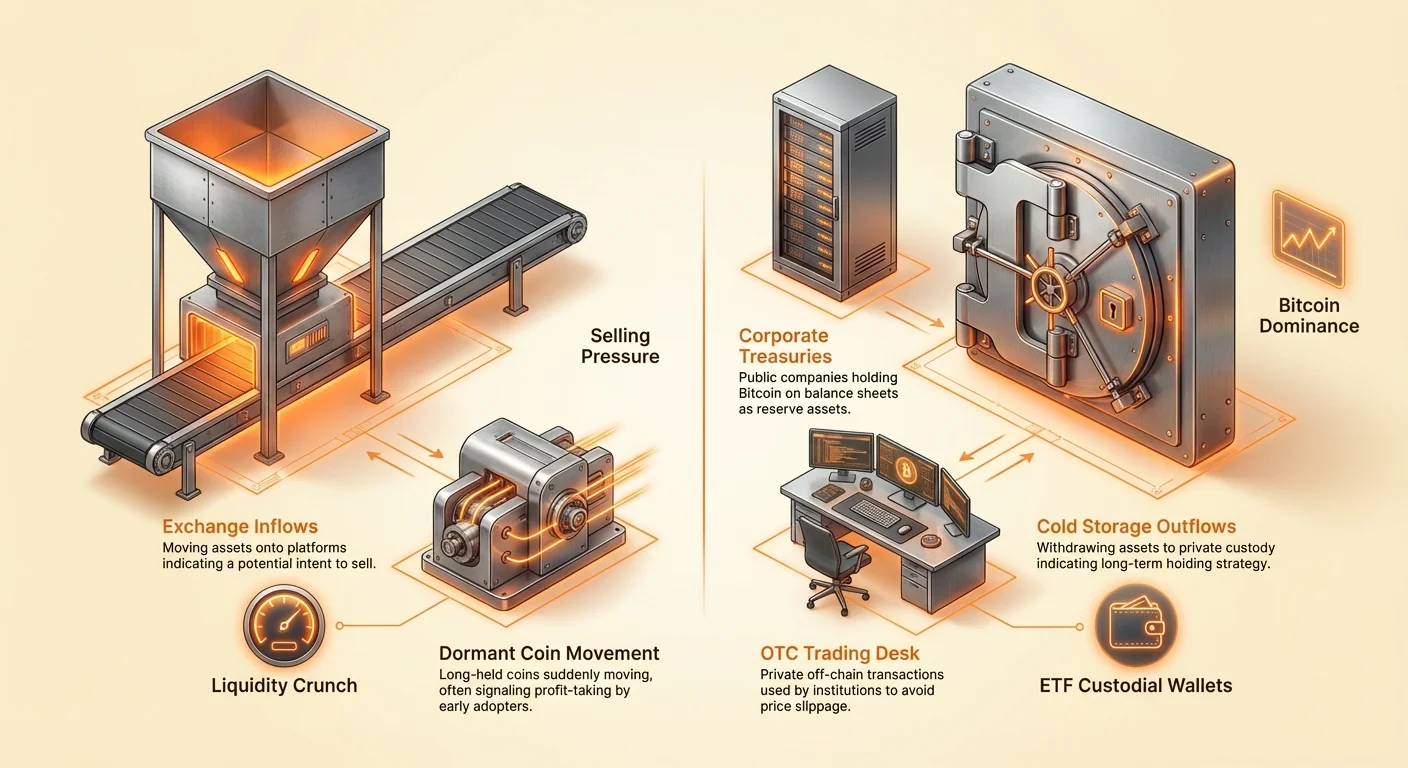
Exchange flows are among the most reliable on-chain indicators for short-to-medium-term price action. These metrics track the net movement of coins between private wallets and exchange wallets. When investors send cryptocurrency to a centralized exchange, it is typically a sign of intent to sell or trade. A spike in exchange inflows often precedes increased selling pressure, which can lead to price corrections. It suggests that holders are moving assets into a position where they can be liquidated quickly.
Conversely, exchange outflows are generally viewed as a bullish signal. When coins are withdrawn from exchanges and moved to private self-custody wallets or cold storage, it indicates that the owner has no immediate intention to sell. This reduces the circulating supply available for purchase on the open market. If demand remains constant or increases while supply on exchanges dwindles, the resulting scarcity can drive prices higher. This creates a supply shock scenario that often underpins major bull markets.
The Role of Exchange Reserves
Exchange reserves refer to the total amount of a specific cryptocurrency held in wallets controlled by exchanges. Tracking the trend of these reserves provides a macro view of market sentiment. A long-term downtrend in exchange reserves suggests a broad accumulation phase where investors are treating the asset as a store of value rather than a speculative instrument. This trend has been notably observed in Bitcoin over recent years, aligning with the narrative of it being "digital gold."
However, investors must also be aware of internal transfers. Sometimes, exchanges move funds between their own cold and hot wallets for security or liquidity management. On-chain analysis tools often attempt to label these wallets to distinguish them from genuine user deposits or withdrawals. Misinterpreting an internal housekeeping transfer as a massive sell-off can lead to incorrect investment decisions. Therefore, looking at the net flow over a period is often more useful than reacting to a single large transaction.
The Hidden World of OTC Trading
Mechanics of Over-The-Counter Trades
Not all large transactions occur on public order books. Bitcoin OTC (Over-The-Counter) trading involves direct transactions between two parties, often facilitated by a broker or a specialized trading desk. This method is favored by high-net-worth individuals and institutions who need to move millions of dollars worth of crypto without causing immediate price slippage on public exchanges. In an OTC trade, the price is negotiated privately, and the transaction is settled directly on the blockchain.
Because these trades bypass the public order books, they do not immediately affect the spot price listed on exchanges. However, they still leave an on-chain footprint. Analysts look for large transfers between non-exchange wallets to identify potential OTC deals. While the price impact is not instant, the eventual effect is significant. If a whale buys a large block of Bitcoin OTC, that supply is removed from the market, eventually tightening liquidity and creating upward pressure on the price over the long term.
Why Institutions Prefer OTC
Institutional investors prioritize discretion and price stability. If a corporation decided to buy $50 million of Bitcoin on a standard exchange, the sheer size of the order would drive the price up as it was being filled, resulting in a higher average cost basis. OTC desks provide a way to lock in a set price for the entire block. This mechanism is essential for the entry of corporate treasuries and large funds into the ecosystem.
The rise of OTC trading also signals the maturation of the asset class. It mirrors the structure of traditional financial markets where large block trades are handled separately from retail flow. For the retail investor, a sudden lack of volatility despite high on-chain volume can sometimes indicate that significant accumulation or distribution is happening behind the scenes via OTC channels.
Institutional Adoption and Corporate Treasuries
Public Companies as Whales
A relatively new dynamic in on-chain analysis is the emergence of the "corporate whale." This refers to public companies that hold Bitcoin on their balance sheets as a reserve asset. Unlike private whales who may remain anonymous, these entities often disclose their holdings in financial filings. This transparency allows on-chain sleuths to identify and tag their wallets, monitoring them for any signs of movement.
When a company adds Bitcoin to its corporate treasury, it is typically a long-term play, often viewed as a hedge against inflation or currency debasement. These coins effectively exit the circulating supply for extended periods. The behavior of corporate treasuries differs from trading firms; they are less likely to swing trade and more likely to hold through volatility. Consequently, the accumulation of Bitcoin by corporations acts as a stabilizing force, creating a higher floor for the market price.
The ETF Effect
The approval and launch of Bitcoin Exchange-Traded Funds (ETFs) have introduced a bridge between traditional finance and the on-chain world. An ETF allows investors to gain exposure to Bitcoin's price movements without managing private keys. However, the ETF provider must hold the underlying asset to back the shares. This results in massive inflows into custodial wallets associated with these funds.
Tracking the wallet addresses of ETF providers has become a key component of modern on-chain analysis. Inflows into these specific wallets represent fresh capital entering from the traditional stock market. Because ETF managers charge fees based on assets under management, they are incentivized to market the asset, potentially driving further adoption. The flow of funds into ETFs is a clear indicator of mainstream institutional demand and can often dictate short-term market trends.
Market Sentiment Indicators
Bitcoin Dominance
Bitcoin dominance is a metric that measures Bitcoin's market capitalization relative to the entire cryptocurrency market. While not strictly a transactional on-chain metric, it is derived from on-chain supply data and price. Dominance is a powerful gauge of risk sentiment. In uncertain economic times or early bear markets, investors often flock to the relative safety of Bitcoin, causing its dominance to rise. This is known as a "flight to quality" within the crypto ecosystem.
Conversely, during aggressive bull markets, risk appetite increases. Investors may rotate profits from Bitcoin into altcoins (alternative cryptocurrencies) in search of higher returns. This causes Bitcoin dominance to fall. Analyzing this cycle helps investors determine whether the market is in a "Bitcoin season" or an "altcoin season." A falling dominance combined with rising prices often signals a speculative frenzy, whereas rising dominance suggests a consolidation of capital back into the market leader.
Dormancy and Coin Age
On-chain analysis also evaluates the "age" of the coins being moved. Metrics like "Coin Days Destroyed" or the behavior of "Long-Term Holders" track how long coins have been sitting in a wallet before moving. When coins that have been dormant for years suddenly move, it can be a significant bearish signal. It suggests that long-term conviction holders are deciding to take profits or exit the market.
On the other hand, if the majority of transaction volume is coming from "young" coins (coins that moved recently), it indicates that short-term traders are driving the price action. A healthy bull market is often supported by long-term holders refusing to sell, leading to a supply squeeze. Monitoring the ratio of short-term to long-term holder activity provides insight into the conviction of the market base.
Comparison of Market Participants
The following table outlines the key differences between retail traders and whales regarding their on-chain behavior and market impact.
| Feature | Retail Traders | Whales/Institutions |
|---|---|---|
| Transaction Size | Small, frequent | Large, infrequent |
| Execution Venue | Public Exchanges | OTC Desks, Dark Pools |
| Market Impact | Low individually | High (can move price) |
Historical Context and Price Cycles
Learning from Past Cycles
Bitcoin's price history is characterized by distinct cycles of boom and bust, often centered around the four-year halving event. On-chain indicators have historically provided clues about the stage of the cycle. For instance, in previous cycle tops, a sharp spike in inflows to exchanges from long-term holder wallets often marked the peak. Whales, recognizing the euphoria, would begin distributing their holdings to late-arriving retail investors.
Conversely, market bottoms are often characterized by high exchange outflows and a flattening of realized losses. This "capitulation" phase sees weak hands selling at a loss, while smart money steps in to accumulate. By studying these historical patterns, investors can avoid the emotional pitfalls of buying the top or panic selling the bottom. The data on the blockchain remains immutable, serving as a permanent record of human psychology and market mechanics.
The Role of Volatility
Volatility is an inherent characteristic of the crypto market, driven by its relatively small size compared to traditional asset classes. Whales often exploit this volatility. By executing large orders during illiquid times, they can trigger cascades of liquidations in the derivatives market. On-chain data can sometimes predict these volatility spikes. A sudden buildup of stablecoins on exchanges, for example, is often "dry powder" waiting to be deployed, signaling potential upward volatility.
However, as the market matures and liquidity deepens with institutional entry, the effectiveness of simple manipulation tactics may diminish. The distribution of Bitcoin is becoming more dispersed over time, reducing the power of any single entity. Nevertheless, for the foreseeable future, monitoring volatility through on-chain lens remains a prudent strategy for risk management.
Conclusion
On-chain indicators provide a sophisticated toolkit for understanding the underlying currents of the cryptocurrency market. By tracking exchange flows, whale activity, and the movement of dormant coins, investors gain a level of transparency unavailable in traditional finance. This data strips away the noise of social media hype and news cycles, focusing entirely on where the capital is actually flowing. Whether it is identifying a massive accumulation phase by corporate treasuries or spotting a potential sell-off by early adopters, the blockchain offers the clues needed to make informed decisions.
However, reliance on a single metric can be misleading. The most effective analysis comes from synthesizing various data points—combining exchange reserves with whale wallet tracking and broader market dominance trends. As the ecosystem evolves with the introduction of ETFs and increased institutional participation, on-chain signals will continue to increase in complexity. Investors who take the time to understand these mechanics place themselves in a better position to interpret market behavior rationally.
The blockchain does not lie; follow the movement of the money to understand the true intent of the market.