The financial landscape underwent a seismic shift in 2009. Amidst a global economic crisis fueled by banking failures and credit collapses, a new form of value emerged. This digital asset was not issued by a central bank, nor was it controlled by any government. It was designed as a response to the inherent vulnerabilities of the traditional financial system.
For decades, the global economy has relied on fiat currencies. These are forms of money that derive their value from government regulation and public trust rather than physical commodities like gold or silver. While this system offers flexibility for policymakers, it introduces significant risks regarding inflation and purchasing power.
Bitcoin entered the scene as a challenger to this established order. It proposed a system based on mathematical proof rather than political trust. By removing intermediaries and establishing a fixed supply cap, it offered an alternative to the inflationary mechanics of modern central banking.
To understand the significance of this shift, one must look beyond the price charts. The core of the debate between Bitcoin and the "money printer" lies in the fundamental definition of money itself. It is a clash between centralized flexibility and decentralized scarcity.
The Nature of Fiat Currency
Fiat currency is the standard form of money in the modern world. The US dollar, the Euro, and the Yen are all examples of fiat. These currencies are not backed by physical assets. Their value is maintained through government decree and the stability of the issuing nation's economy.
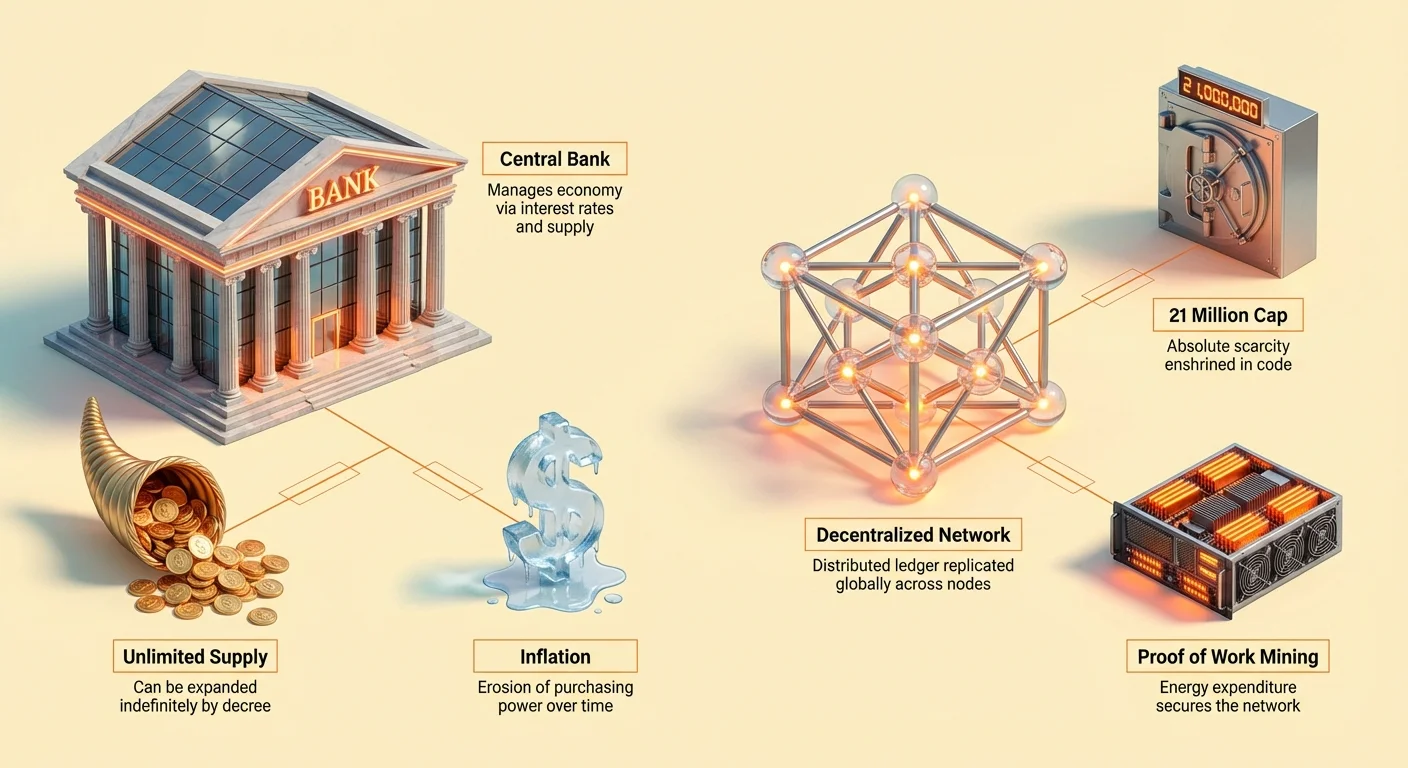
The primary characteristic of fiat money is the ability of central authorities to control its supply. Central banks manage the economy by adjusting interest rates and increasing or decreasing the money supply. This flexibility allows governments to respond to economic crises by injecting liquidity into the system.
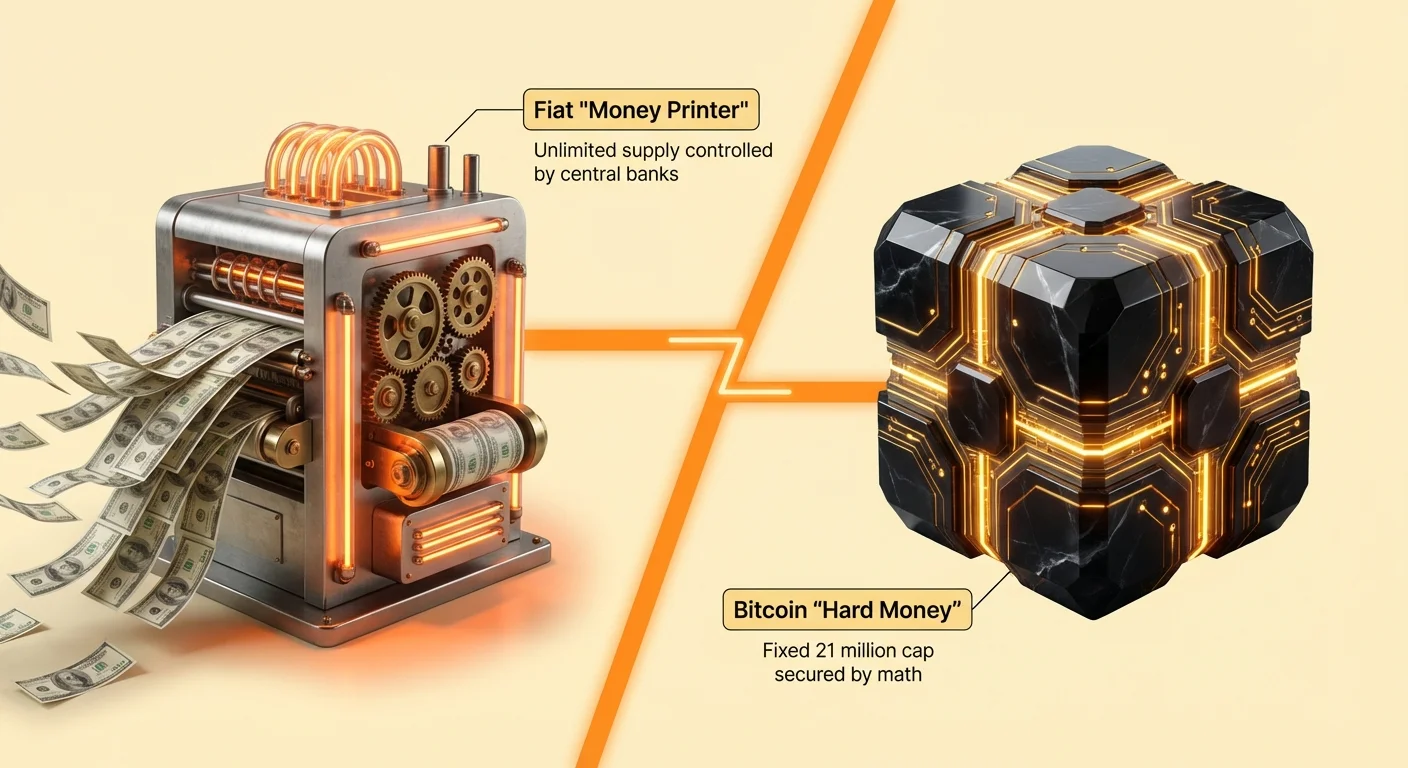
However, this power comes with a trade-off. Because there is no hard limit on how much money can be created, the supply can expand indefinitely. When the supply of money increases significantly faster than the production of goods and services, the result is often inflation.
The Mechanics of the Money Printer
The term "money printer" is often used to describe quantitative easing and other expansionary monetary policies. When central banks purchase government bonds or other financial assets, they effectively create new money to pay for them. This injection of cash aims to lower interest rates and stimulate borrowing.
While this can provide short-term economic relief, it dilutes the value of the existing currency in circulation. If you hold a savings account in a fiat currency, the purchasing power of that money tends to decrease over time.
This erosion is often referred to as a hidden tax. The nominal amount of money in a bank account might remain the same, but the amount of goods and services that money can buy diminishes. This dynamic forces individuals to seek investment vehicles that can outpace inflation, rather than simply saving their earnings.
Bitcoin as Digital Hard Money
Bitcoin represents a fundamental departure from the fiat model. It is often described as "hard money" because it is difficult to produce and impossible to inflate beyond its programmed limits. Unlike fiat currencies, which have an elastic supply, Bitcoin has a rigid, unchangeable monetary policy enshrined in code.
The creation of new Bitcoin is not decided by a committee or a bank governor. It occurs programmatically through a process known as mining. This process is transparent, predictable, and open to anyone with the necessary hardware.
The 21 Million Cap
The most critical feature of Bitcoin's "hard money" status is its absolute scarcity. The network protocol dictates that there will only ever be 21 million bitcoins. This number cannot be changed.
Once this limit is reached, no new bitcoins will ever be created. This scarcity stands in stark contrast to fiat currencies, which have theoretically unlimited supplies. In a world where central banks can print trillions of dollars in response to economic downturns, a strictly capped asset offers a unique value proposition.
Scarcity is a primary driver of value for any store of wealth. Historically, rare items like gold, seashells, or specific stones served as money because they were hard to find or create. Bitcoin replicates this digital scarcity through mathematics.
Predictable Issuance
In addition to the total cap, the rate at which new bitcoins enter circulation is fixed. Approximately every four years, an event known as the "halving" occurs. This event cuts the reward for mining new blocks in half, effectively reducing the inflation rate of the asset by 50 percent.
This predictable disinflationary schedule allows market participants to know exactly what the future supply will be at any given time. There are no surprise announcements or policy shifts.
This predictability fosters a different kind of trust. Users do not need to trust a central authority to manage the currency responsibly. Instead, they trust the open-source code and the consensus of the network.
Understanding Inflation and Purchasing Power
Inflation is defined as the rate at which the general level of prices for goods and services is rising. Consequently, it is also the rate at which purchasing power is falling. Central banks typically aim for a low, steady rate of inflation, often around 2 percent.
Even at this low rate, the value of money halves roughly every 35 years. In periods of high inflation, this erosion happens much faster. Savings held in cash lose their ability to sustain a lifestyle or purchase assets.
The impact of inflation is not felt evenly. Those with access to financial assets like stocks and real estate often see their wealth grow as asset prices rise with inflation. Those who rely primarily on wages and cash savings often find themselves falling behind as their money buys less.
The Silent Tax
Inflation acts as a silent tax on holders of currency. It transfers value from those who hold money to those who create it and receive it first. This phenomenon is known as the Cantillon Effect.
When new money enters the economy, it does not reach everyone at the same time. The institutions that receive the new money first—usually banks and large corporations—can spend it before prices have adjusted. By the time the money circulates down to the average consumer, prices have typically risen.
Bitcoin offers a hedge against this dynamic. Because no central entity can create more Bitcoin to pay off debts or stimulate the economy, holders are protected from this form of debasement. The purchasing power of a fixed-supply asset generally increases over time relative to a depreciating currency.
Preserving Wealth
Historically, people turned to gold to preserve wealth during times of monetary expansion. Gold is durable, scarce, and maintains its purchasing power over centuries. Bitcoin is frequently compared to gold for these reasons, often earning the moniker "digital gold."
Like gold, Bitcoin is distinct from the financial system that issues fiat currency. It creates a way for individuals to opt out of the inflationary pressures of their local economy.
However, Bitcoin improves upon gold in several ways. It is far more portable. Millions of dollars in value can be transported on a USB drive or even memorized as a seed phrase. It is also easily divisible and verifiable, solving the physical limitations of heavy metal bars.
The Mechanics of Decentralized Trust
Trust is the cornerstone of any monetary system. In traditional finance, this trust is placed in intermediaries. When you deposit money at a bank, you trust the bank to safeguard the funds. When you use a credit card, you trust the payment processor to execute the transaction.
This model relies on centralized ledgers. The bank keeps the record of who owns what. If the bank makes an error, or if the bank fails, that record is at risk. History is replete with examples of bank failures and frozen accounts.
Bitcoin replaces this centralized trust with a decentralized architecture. It utilizes a distributed ledger known as a blockchain. This ledger is not held by one company but is replicated across thousands of computers, or nodes, around the world.
The Ledger and Nodes
The Bitcoin ledger is a public record of every transaction that has ever occurred on the network. It is an append-only database, meaning data can only be added, never removed or altered.
Nodes are the computers that run the Bitcoin software. They constantly communicate with each other to verify new transactions and blocks. Anyone can run a node. There is no permission required.
This decentralization ensures that there is no single point of failure. If one node goes offline, thousands of others continue to operate. To shut down the network, one would effectively need to shut down the entire global internet.
Removing Intermediaries
By using a peer-to-peer network, Bitcoin eliminates the need for middlemen. Transactions occur directly between the sender and the receiver. This "trustless" model means that participants do not need to know or trust each other to transact. They only need to trust the underlying mathematics of the protocol.
This removal of intermediaries reduces friction. In the traditional system, a single transfer might pass through multiple correspondent banks, each taking a fee and adding a delay. Bitcoin transactions operate globally, 24/7, without banking hours or holidays.
It also fundamentally changes the power dynamic. In a centralized system, the intermediary has the power to allow or deny a transaction. In a decentralized system, the network simply verifies that the sender has the funds and follows the rules.
Censorship Resistance and Financial Freedom
Censorship resistance is a defining characteristic of Bitcoin. It refers to the inability of any third party to prevent a valid transaction from being processed. In an era of increasing financial surveillance and control, this feature has become a primary driver of adoption.
Financial censorship can take many forms. It can be as simple as a bank declining a purchase from a specific merchant. It can be as severe as a government freezing the assets of political dissidents.
In traditional finance, your money is essentially a liability of the bank. You have a claim on the funds, but the bank has custody. If the bank or a regulator decides to freeze your account, you lose access to your wealth immediately.
Permissionless Transactions
Bitcoin operates on a permissionless basis. You do not need to create an account with a company or provide identification to the network to receive or send funds. You simply generate a wallet and interact with the blockchain.
This openness ensures that the network is neutral. It does not care who the sender is, who the receiver is, or what the purpose of the transaction is. It only cares if the transaction is valid according to the protocol rules.
This neutrality is crucial for financial inclusion. Billions of people worldwide lack access to basic banking services. They may lack the necessary documentation or live in regions with underdeveloped financial infrastructure. Bitcoin allows anyone with an internet connection to participate in the global economy.
Protection Against Seizure
Asset seizure is a tool used by regimes to silence opposition or control capital. If wealth is stored in a physical location or a centralized database, it is vulnerable to confiscation.
Bitcoin, when held in a self-custodial wallet, is incredibly difficult to seize. The funds are secured by a private key—a cryptographic password known only to the owner. Without this key, the funds cannot be moved.
This property makes Bitcoin a form of "sovereign money." The individual retains absolute control. While this responsibility requires careful security practices, it provides a level of financial autonomy that is impossible within the legacy banking system.
Bitcoin as a Store of Value
A store of value is an asset that retains its purchasing power over time. Ideally, it should be scarce, durable, and liquid. While fiat currency functions well as a medium of exchange, its poor performance as a store of value is well-documented due to inflation.
Bitcoin is increasingly viewed as a contender in the store of value market, competing with real estate, bonds, and precious metals. Its deflationary supply schedule positions it as a long-term vehicle for wealth preservation.
Critics often point to Bitcoin's price volatility as a disqualifying factor. Indeed, Bitcoin has experienced significant drawdowns throughout its history. However, looking at long-term trends, it has been one of the best-performing assets of the last decade.
Comparison to Traditional Assets
Comparing Bitcoin to other stores of value highlights its unique profile. Real estate is scarce but highly illiquid; selling a house takes months. It is also impossible to move.
Gold is liquid and scarce but difficult to verify and transport in large quantities. Custodying physical gold requires secure vaults and physical protection.
Fiat currency is highly liquid and easy to transport digitally but lacks scarcity. It is guaranteed to lose value over the long term.
Bitcoin combines the scarcity of gold, the portability of fiat, and the liquidity of global markets. It trades continuously, 365 days a year, and can be liquidated into any local currency almost instantly.
Volatility vs. Growth
The argument for Bitcoin as a store of value relies on a long time horizon. In the short term, price swings can be dramatic. This volatility is largely due to the fact that Bitcoin is still a nascent asset class undergoing price discovery.
As the market capitalization of Bitcoin grows and ownership becomes more widespread, volatility is expected to decrease. For investors, the volatility is the price paid for the potential of high returns compared to mature, stabilized assets.
The trend of adoption by institutional investors and corporations suggests a growing acceptance of the store of value thesis. Companies are beginning to hold Bitcoin on their balance sheets as a hedge against the devaluation of their cash reserves.
| Feature | Bitcoin | Fiat Currency | Gold |
|---|---|---|---|
| Supply | Fixed (21 Million) | Unlimited | Scarce (Natural) |
| Control | Decentralized | Central Bank | Natural/Physical |
| Portability | High (Digital) | High (Digital/Cash) | Low (Physical) |
| Verifiability | Easy (Nodes) | Difficult (Counterfeit) | Difficult (Assay) |
| Censorship | Resistant | Susceptible | Resistant (Physical) |
The Security Model and Energy Usage
The security of the Bitcoin network is maintained through a consensus mechanism called Proof of Work (PoW). This system requires miners to expend energy to solve complex mathematical problems. The first miner to solve the problem gets to add the next block of transactions to the blockchain and claims the block reward.
This energy expenditure is often criticized for its environmental impact. However, it is essential to understand that this energy usage is what secures the network. It bridges the digital world with the physical world, giving the asset tangible cost and value.
By requiring real-world work, Bitcoin makes it prohibitively expensive to attack the network. To alter the ledger, an attacker would need to control more than half of the global computing power dedicated to mining. This creates a formidable economic barrier known as the "51% attack" threshold.
Energy as a Security Feature
The energy consumed by Bitcoin is not wasted; it is used to purchase global financial security without a central authority. Critics often compare Bitcoin's energy use to that of a single transaction on a credit card network, but this is a false equivalence.
Bitcoin's energy usage should be compared to the cost of maintaining the entire traditional banking system. This includes the power for bank branches, data centers, ATMs, corporate offices, and the military might often required to back fiat currencies.
Furthermore, Bitcoin mining is becoming increasingly efficient. Miners are incentivized to seek out the cheapest sources of electricity. This often leads them to renewable energy sources like hydro, wind, or solar, as well as "stranded" energy sources that would otherwise be wasted, such as flared natural gas.
Privacy and Sovereignty
While often cited as anonymous, Bitcoin is technically pseudonymous. Transactions are recorded publicly, but they are linked to cryptographic addresses rather than real-world identities.
This distinction is important. If an identity is linked to an address—for example, through a regulated exchange that requires ID verification—the entire transaction history of that address can be traced.
However, Bitcoin still offers a higher degree of privacy than traditional digital payments. In the banking system, the bank sees every merchant you interact with. With Bitcoin, you can generate a new address for every transaction, complicating efforts to track your spending habits.
Self-Custody and Control
The ultimate expression of financial sovereignty in Bitcoin is self-custody. This involves holding your own private keys using a digital wallet, rather than leaving funds on an exchange.
When users hold their own keys, they become their own bank. They have full control over their assets. There is no customer service to call if a password is lost, but there is also no manager who can deny access to the funds.
This model puts the responsibility entirely on the user. It protects against third-party risks such as exchange bankruptcies or mismanagement. In a world of fragile financial institutions, the ability to hold a bearer asset digitally is a revolutionary capability.
Beyond Money: The Ethereum Contrast
While Bitcoin focuses primarily on being "hard money" and a store of value, other cryptocurrencies have different goals. Ethereum, the second-largest cryptocurrency, was designed with a broader purpose.
Ethereum is a platform for decentralized applications. It enables "smart contracts," which are self-executing contracts with the terms directly written into code. This allows for complex financial interactions like lending, borrowing, and trading to occur without intermediaries.
While Bitcoin is often compared to digital gold, Ethereum is likened to digital oil—a fuel for a decentralized internet. Ethereum has transitioned to a Proof of Stake consensus mechanism, which uses significantly less energy than Bitcoin but introduces different trade-offs regarding centralization and security.
Understanding the difference helps clarify Bitcoin's specific value proposition. Bitcoin does not attempt to be a "world computer." It optimizes for security, scarcity, and immutability to serve as the most robust form of money possible.
The Future of Monetary Systems
The rise of Bitcoin forces a re-evaluation of what money is and who should control it. We are likely moving toward a world where fiat currencies and decentralized digital assets coexist.
Fiat currencies will likely remain the dominant medium of exchange for daily purchases and tax payments due to their stability and government mandate. Governments are also exploring Central Bank Digital Currencies (CBDCs), which would digitize fiat but retain central control.
Bitcoin, conversely, serves as a check on monetary expansion. It provides an opt-out mechanism for those wishing to preserve purchasing power. Its existence exerts pressure on central banks to manage their currencies more responsibly, as citizens now have a viable alternative.
As digital adoption grows, the properties of hard money—scarcity, censorship resistance, and decentralization—may become increasingly valued. The competition between the "money printer" and the fixed supply of Bitcoin is not just an economic experiment; it is a redefining of value for the digital age.
Conclusion
Bitcoin emerged from the wreckage of a financial crisis to offer a distinct alternative to the fiat monetary system. By replacing centralized trust with decentralized proof, it created a form of money that is immune to inflationary printing and political interference. Its fixed supply of 21 million units ensures scarcity, positioning it as a hedge against the erosion of purchasing power that plagues traditional currencies.
While fiat currencies rely on the flexibility of the money printer to manage economies, Bitcoin offers the stability of code. The trade-offs involve volatility and the responsibility of self-custody, but the benefits include censorship resistance and financial sovereignty. As the global economy grapples with debt and inflation, the contrast between government-issued fiat and mathematically secured Bitcoin becomes increasingly relevant.
Bitcoin offers a mathematical shield against inflation, providing a decentralized alternative to the unlimited supply of government-issued money.