
The evolution of the digital asset landscape has moved far beyond the simple transfer of value initiated by Bitcoin in 2009. While the first generation of cryptocurrency focused on establishing a decentralized alternative to fiat currency, the introduction of smart contracts introduced a new paradigm. This shift allowed for the creation of programmable money and decentralized applications (dApps). Within this expanded ecosystem, a crucial distinction emerged between native coins and tokens. Understanding this difference is essential for analyzing how value is captured, managed, and distributed across various blockchain protocols.
At the core of this ecosystem lies the concept of decentralized finance, or DeFi. This sector aims to replicate and improve upon traditional financial services such as lending, borrowing, and trading without intermediaries. However, unlike centralized banking systems where a single entity controls the ledger, DeFi relies on distributed networks secured by incentives. These incentives are primarily delivered through digital assets that serve specific functions within their respective protocols.
The mechanics of value capture in crypto are tied directly to the architecture of the underlying asset. Investors and participants must discern whether an asset is a foundational coin securing a network or a token designed to utilize that security for application-level utility. This analysis requires a deep dive into technical structures, governance models, and economic designs that dictate how a protocol functions and sustains itself over time.
The Structural Distinction: Coins Versus Tokens
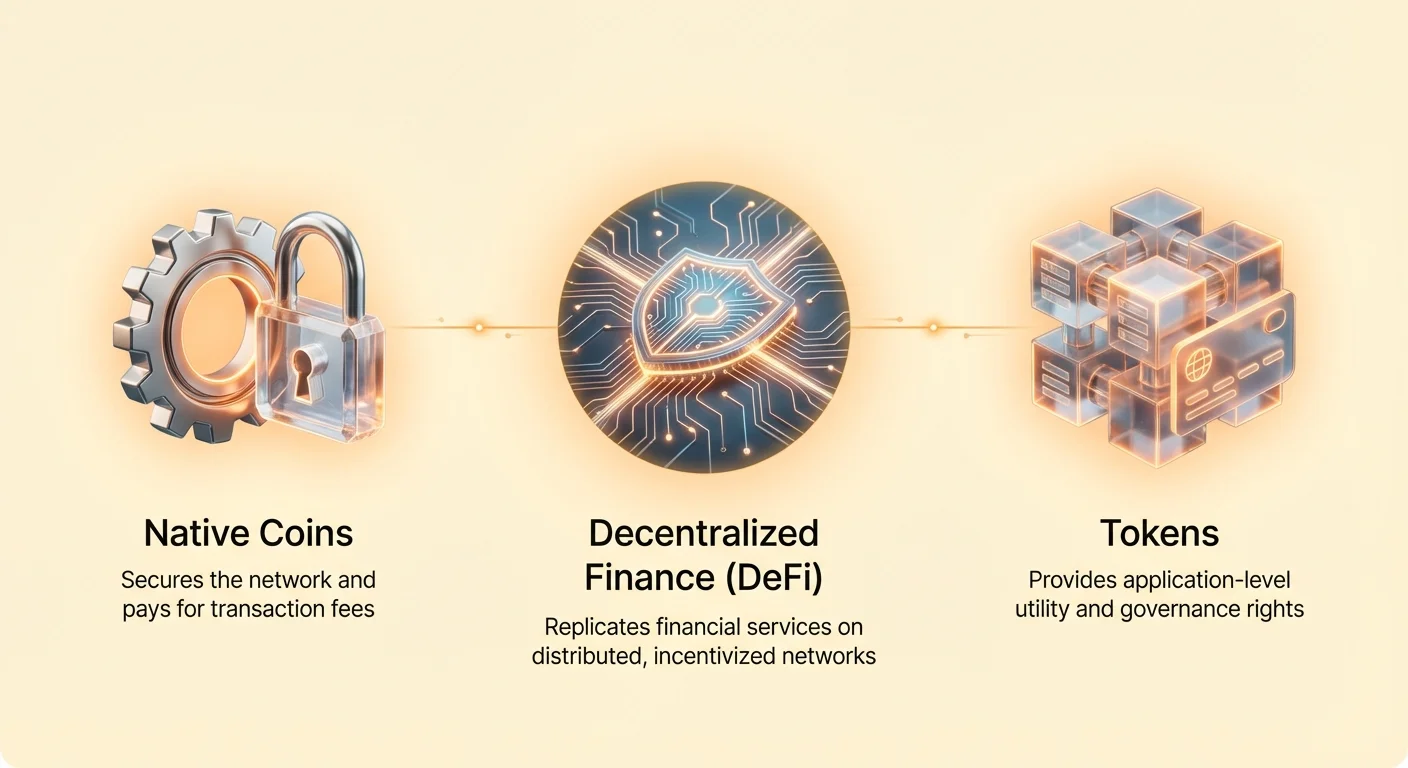
To understand value capture, one must first grasp the architectural difference between coins and tokens. While these terms are often used interchangeably in casual conversation, they represent distinct technical entities with different roles in the crypto economy. A clear understanding of this hierarchy is necessary for evaluating the long-term viability of any digital asset.
Native Layer 1 Assets
A "coin" is defined by its existence on its own independent blockchain. Examples include Bitcoin (BTC) and Ethereum (ETH). These assets are native to the protocol and are essential for its operation. Their primary function is to incentivize the network participants—miners or validators—who secure the ledger. Without the native coin, there is no economic reason for participants to expend energy or stake capital to process transactions.
Native coins capture value at the base layer. As usage of the blockchain grows, demand for the coin increases because it is required to pay for transaction fees, often referred to as "gas." This creates a direct correlation between the adoption of the network infrastructure and the value of the native asset. The security of the entire ecosystem rests on the value of these coins, as a low-value coin makes the network cheaper to attack.
Application Layer Tokens
In contrast, a "token" does not have its own blockchain. Instead, it is built on top of an existing smart contract platform, such as Ethereum or Solana. Tokens leverage the security and consensus mechanism of the host chain, allowing developers to focus on application logic rather than infrastructure security. These assets are created using specific standards, such as the ERC-20 standard on Ethereum, which ensures they can interact seamlessly with decentralized exchanges and wallets.
Tokens capture value based on the success of the specific application or project they represent rather than the underlying blockchain. For example, a token might represent voting rights in a protocol, a claim on fees generated by a decentralized exchange, or a stable value pegged to a fiat currency. The value of a token is driven by the utility it provides within its specific dApp, independent of the gas fees paid to the underlying network.
Utility Mechanisms and Ecosystem Integration
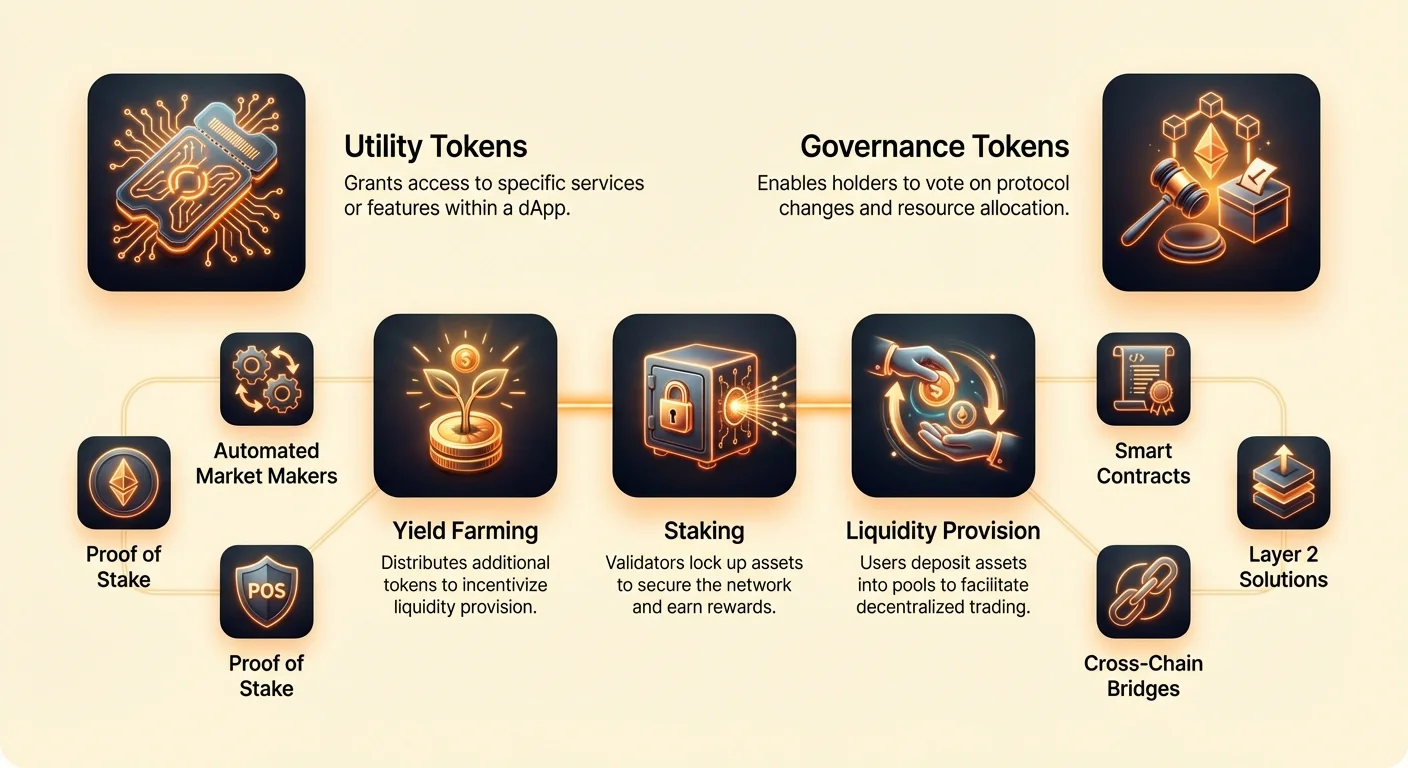
Utility tokens are designed to provide specific functions within a blockchain ecosystem. Unlike coins which act as general-purpose currency for a network, utility tokens function more like digital coupons or access keys. They grant the holder access to services, discounts, or enhanced features within a specific platform. This utility creates a closed-loop economy where the token is necessary to interact with the application fully.
One common utility mechanism involves incentivizing user behavior that benefits the protocol. For instance, decentralized exchanges may reward users with tokens for providing liquidity. This distribution method encourages participants to deposit their assets into smart contracts, ensuring there is enough capital for others to trade. The utility token acts as a reward mechanism, distributing ownership of the network to the people who provide the service.
Another form of utility is payment for services within a dApp. A decentralized cloud computing network might require users to pay for processing power using its native token. Similarly, an ecosystem token might offer fee reductions for traders who hold a certain amount of the asset in their connected wallet. In these scenarios, the demand for the service directly drives the demand for the token, creating a tangible link between platform usage and asset value.
| Feature | Native Coin | Utility Token |
|---|---|---|
| Infrastructure | Runs own blockchain | Built on existing chain |
| Security | Secures the network | Inherits chain security |
| Primary Use | Gas fees, consensus | App access, governance |
Governance and Decentralized Decision Making
As protocols matured, the need for decentralized management became apparent. This led to the rise of governance tokens, which grant holders the right to propose and vote on changes to the protocol. This mechanism effectively transforms a software protocol into a Decentralized Autonomous Organization (DAO), where the community of token holders steers the project's direction.
The Power of the Vote
Governance tokens represent a shift from passive ownership to active participation. Holders can vote on critical issues such as fee structures, software upgrades, and the allocation of treasury funds. For example, a decentralized lending protocol might need to decide whether to add a new asset as collateral. Token holders would cast votes to approve or reject this addition based on their risk assessment.
The value of a governance token is often derived from the power it confers. In protocols with large treasuries or significant revenue streams, the ability to influence how those resources are used commands a market premium. This aligns the interests of the stakeholders with the long-term health of the protocol, as bad decisions could devalue their holdings.
Treasury Management and Sustainability
A critical aspect of governance is the management of the protocol's treasury. Many DeFi projects accumulate fees from users, which are deposited into a shared community wallet. Governance token holders decide how to deploy these funds. They might vote to burn tokens to reduce supply, distribute dividends to stakers, or fund development grants to build new features.
This economic feedback loop is central to the "value capture" thesis of governance tokens. If a protocol generates significant revenue and the governance mechanism directs that value back to token holders, the asset functions similarly to a dividend-paying equity. However, distinct from traditional equities, these rights are enforced by code and smart contracts rather than corporate law.
Mechanics of Liquidity and Yield
DeFi protocols rely heavily on liquidity to function. Without a central bank or market maker, these systems use automated mechanisms to facilitate trading and lending. The tokenization of liquidity is a fundamental innovation that allows these markets to operate autonomously 24/7.
Automated Market Makers (AMMs)
An Automated Market Maker is a smart contract that holds liquidity reserves. Users trade against these reserves rather than trading directly with another person. To ensure there are reserves to trade against, the protocol issues "liquidity provider" (LP) tokens to anyone who deposits assets into the pool. These LP tokens represent a claim on the deposited assets plus a portion of the trading fees generated by the pool.
This mechanism captures value by generating yield for asset holders. Instead of letting assets sit idle in a wallet, users can deposit them into an AMM to earn passive income. The yield acts as an interest rate paid by traders to liquidity providers for the service of facilitating efficient swaps.
Yield Farming and Incentives
To attract liquidity to new or smaller pools, protocols often employ "yield farming." This involves distributing additional governance or utility tokens to liquidity providers on top of the standard trading fees. This strategy subsidizes the cost of capital for the protocol and rapidly bootstraps liquidity.
However, yield farming introduces complex dynamics regarding token supply. The continuous emission of new tokens to pay rewards increases the circulating supply, which can lead to inflationary pressure. Participants must weigh the value of the rewards against the potential depreciation of the token price due to dilution. Successful protocols eventually transition from high inflationary emissions to sustainable models where trading fees alone are sufficient to retain liquidity.
Staking and Consensus Security
While tokens use staking for liquidity or governance, native coins use staking to secure the blockchain itself. In Proof of Stake (PoS) networks like Ethereum, validators must lock up a certain amount of the native coin to participate in the consensus process. This lock-up acts as a security bond. If a validator attempts to cheat or attack the network, their staked coins can be "slashed" or destroyed.
Staking creates a natural demand for the native coin while simultaneously reducing the circulating supply. As more coins are staked to secure the network, fewer are available on the open market, potentially stabilizing price volatility. In return for bonding their capital and performing computational work, validators receive rewards in the form of new issuance and transaction fees.
The concept of "Restaking" has recently emerged as an extension of this model. Restaking allows validators to use their staked assets to secure multiple protocols simultaneously. This increases the capital efficiency of the staked asset, allowing it to earn rewards from multiple sources. However, it also compounds the risk, as a fault in one protocol could theoretically impact the stake used for others.
Interoperability and Layer 2 Scaling
As main blockchains like Ethereum became congested, high transaction fees threatened to price out smaller users. This led to the development of Layer 2 solutions, which process transactions off-chain while relying on the main chain (Layer 1) for security and final settlement. These scaling solutions utilize their own tokenomics and value capture mechanisms.
Rollup Economics
Rollups are a specific type of Layer 2 solution that bundles hundreds of transactions into a single batch. This batch is then posted to the main blockchain. By splitting the cost of the single Layer 1 transaction across many users, fees are drastically reduced. Tokens associated with Layer 2 networks often serve governance roles or are used to decentralize the "sequencer," the entity responsible for ordering transactions.
Value capture in Layer 2s is complex. They must generate enough revenue from transaction fees to pay the costs of posting data to Layer 1, while retaining a margin for the protocol. As these networks grow, they develop their own DeFi ecosystems, creating a demand for their native tokens to participate in their specific governance and incentive programs.
Cross-Chain Bridging
With the proliferation of different blockchains and Layer 2s, the ability to move assets between them became critical. Bridges are protocols that lock assets on one chain and issue a representative token on another. For example, Wrapped Bitcoin (WBTC) is a token on Ethereum that represents Bitcoin held in custody. This allows Bitcoin to be used within Ethereum's DeFi ecosystem.
Bridges introduce significant utility but also centralization and security risks. The "wrapped" token is only as valuable as the underlying asset and the security of the bridge holding it. If the bridge is hacked or the custodian fails, the token on the secondary chain loses its peg and its value. Despite these risks, bridging is essential for a fluid, interconnected crypto economy.
Bitcoin's Expanding Role in DeFi
Historically, Bitcoin was viewed primarily as a store of value or a medium of exchange, separate from the complex DeFi ecosystems on smart contract platforms. However, technical upgrades and innovations have begun to integrate Bitcoin more deeply into the world of decentralized finance. This evolution challenges the notion that Bitcoin is a static asset.
Layer 2 and Sidechains
Innovations like the Lightning Network have brought faster, cheaper payments to Bitcoin, functioning as a Layer 2 solution. Beyond payments, sidechains—independent blockchains that are pegged to Bitcoin—allow for smart contract functionality using Bitcoin as the native asset. These sidechains enable users to engage in DeFi activities like lending and trading without converting their Bitcoin into a different currency.
Tokenization on Bitcoin
Recent developments such as the Ordinals protocol have enabled the creation of unique digital assets directly on the Bitcoin blockchain. Unlike NFTs on Ethereum which point to off-chain data, Ordinals inscribe data directly onto individual satoshis (the smallest unit of Bitcoin). This brings the concept of non-fungible tokens and digital collectibles to the most secure blockchain network.
Furthermore, new token standards are being explored to allow for fungible tokens to be issued on Bitcoin. These developments aim to capture the utility and flexibility of Ethereum-style tokens while leveraging Bitcoin's unparalleled security and decentralization. This expansion of utility suggests that value capture mechanisms are becoming increasingly cross-chain and agnostic to the underlying protocol.
Risks and Smart Contract Vulnerabilities
The mechanisms that allow for DeFi and token utility rely entirely on code. Smart contracts are self-executing programs, and like any software, they are prone to bugs and vulnerabilities. A flaw in the code of a liquidity pool or a governance contract can lead to the loss of user funds. Unlike traditional finance, there is no customer support or fraud reversal in a decentralized network.
Centralization remains a hidden risk in many "decentralized" projects. While a token may offer governance rights, if the initial team or venture capital investors hold a majority of the supply, they retain effective control. This can lead to decisions that prioritize short-term profit over long-term protocol health. Users must analyze token distribution schedules to understand the true power dynamics of a DAO.
Regulatory uncertainty also poses a challenge to value capture. Tokens that function too similarly to corporate securities may face strict legal requirements. If a governance token is deemed an unregistered security, the protocol could face penalties or be forced to restrict access, impacting the token's utility and value.
The Future of Programmable Value
The distinction between coins and tokens will likely continue to blur as technology advances. Layer 2 networks are becoming as robust as some Layer 1 blockchains, and cross-chain messaging allows assets to flow seamlessly between ecosystems. However, the fundamental principles of value capture remain: value accrues to assets that provide genuine utility, secure critical infrastructure, or grant governance over productive resources.
As the industry matures, the focus is shifting from simple speculation to sustainable economic models. Protocols are increasingly designing tokenomics that reward long-term participation and align incentives between developers, users, and investors. Whether through burning mechanisms that reduce supply or revenue-sharing models that distribute fees, the next generation of digital assets will likely focus on creating tangible, recurring value.
The integration of real-world assets into these protocols represents the next frontier. By tokenizing stocks, real estate, or commodities, DeFi mechanisms can be applied to traditional markets. This expands the scope of utility tokens from purely digital ecosystems to the broader global economy, potentially unlocking trillions of dollars in value and reshaping how ownership is defined and transferred.
Conclusion
The landscape of cryptocurrency is built upon a diverse array of assets, each serving a distinct purpose within the digital economy. Native coins form the bedrock of security and settlement, incentivizing the decentralized infrastructure that makes permissionless transacting possible. Built upon this foundation, tokens introduce flexibility, enabling governance, utility, and complex financial applications without the need to bootstrap a new network from scratch.
Analyzing these assets requires looking beyond price action to the underlying mechanics of the protocol. Value capture is driven by specific design choices: how liquidity is incentivized, how governance manages treasuries, and how the asset integrates with the broader DeFi ecosystem. From the automated markets of DEXs to the security bonding of Proof of Stake, every mechanism is an attempt to create a sustainable economic loop that aligns the interests of all participants.
As the technology evolves with Layer 2 scaling and cross-chain interoperability, the utility of these assets will only deepen. The most successful protocols will be those that effectively balance security, decentralization, and economic efficiency. For participants, success lies in understanding these technical nuances and recognizing the difference between a speculative instrument and a fundamental component of the decentralized web.
Value in crypto accrues to assets that solve specific problems, secure networks, or grant ownership over productive decentralized economies.