
When most people enter the world of cryptocurrency, they start by using a retail platform like Coinbase or Kraken. They deposit a few hundred or thousand dollars, buy Bitcoin or Ethereum, and securely store it in their exchange account or a simple personal wallet.
This process works well for the average individual investor.
However, the world changes dramatically when the investor is a large hedge fund, a pension fund, or a corporate treasury looking to trade $100 million in a single transaction. Retail exchanges are simply not built to handle this volume, speed, security, and complexity. Executing a massive trade on a public retail platform would instantly move the market against the trader, costing millions in fees and poor execution—a phenomenon known as "slippage."
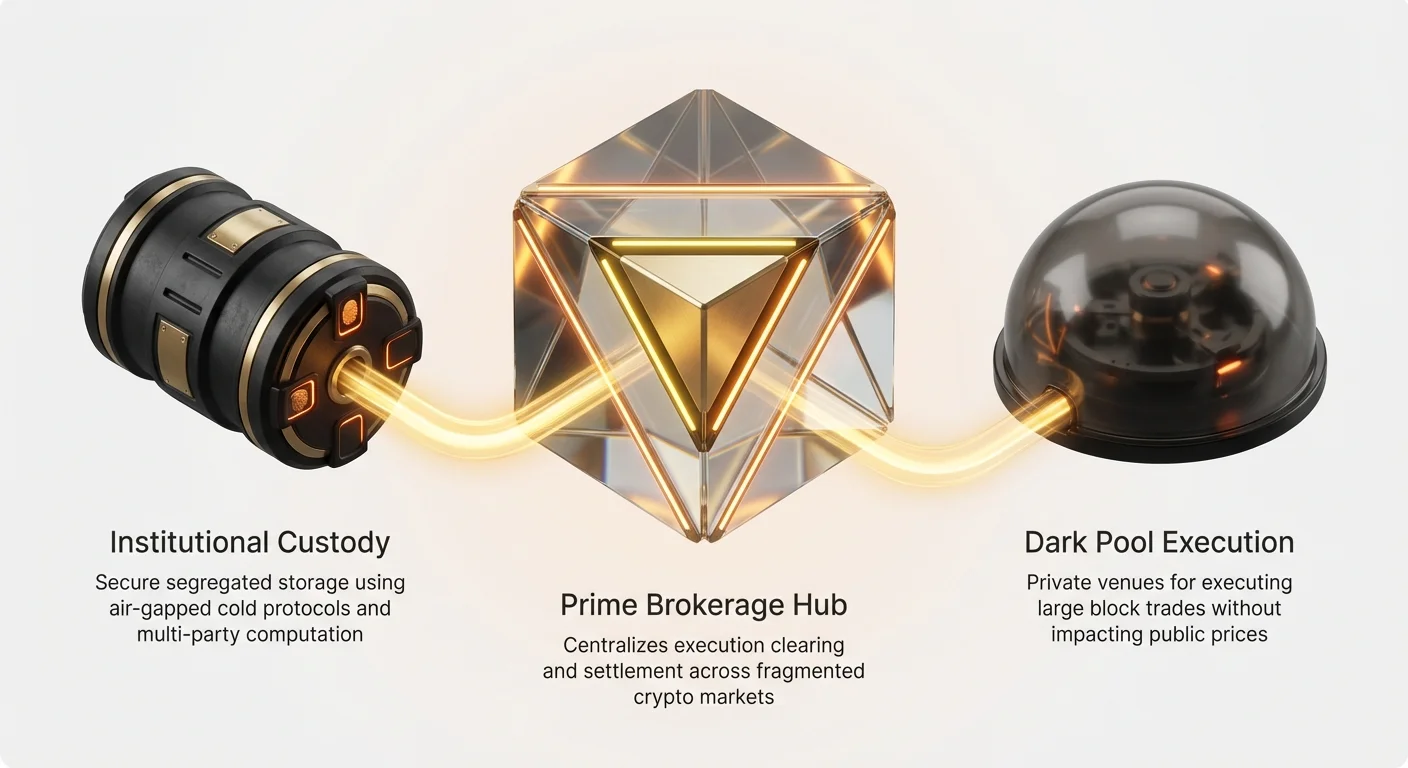
Institutional crypto trading relies on a highly specialized, tightly integrated, and heavily regulated infrastructure. This article will define the specialized tools and services—including crypto prime brokerage, institutional custody, and dark pools—that professional funds rely on to execute massive, complex trades while maintaining security and minimizing market impact. Understanding this professional infrastructure provides essential context for how high-volume trading actually happens behind the scenes.
The Scale Problem: Why Institutions Need Specialized Tools
The primary difference between retail and institutional trading is scale. A trade of $10,000 affects virtually nothing; a trade of $100 million affects everything. Institutions have three core needs that standard retail platforms cannot meet: security, capital efficiency, and superior execution quality.
Security and Fiduciary Duty
Retail investors are primarily concerned with keeping their private keys safe. Institutional investors, especially those handling client money, have a fiduciary duty—a legal obligation to act in the best financial interest of their clients. This requires a much higher standard of security and accountability.
For a fund to hold hundreds of millions or billions in crypto, they cannot simply rely on a standard exchange wallet. They require highly sophisticated custody solutions that include legal segregation of assets, audited security protocols, and strict internal controls governed by multiple parties.
Minimizing Market Impact (Slippage)
Slippage occurs when the execution price of a trade is worse than the expected price. When you place a very large order, you essentially "eat up" all the available liquidity at the best current prices, forcing your trade to fill at progressively worse prices.
If a fund wants to buy $50 million of Solana (SOL) and tries to do it all at once on a public exchange, the sudden demand surge will drive the price up rapidly. They might end up paying $105 per SOL for the last part of their order, even if the price was $100 when they started. Institutional infrastructure is designed specifically to execute these massive orders quietly and efficiently across multiple venues to ensure the average execution price is as close as possible to the starting price.
Capital Efficiency and Complexity
A major hedge fund might trade dozens of tokens across 15 different exchanges globally, employ multiple algorithmic strategies, and use derivatives (futures and options). Managing this workflow requires enormous capital spread across these various venues.
Institutional systems streamline this complexity. Instead of opening and funding 15 separate accounts, depositing collateral for margin trading, and reconciling the profit and loss (P&L) manually, they use integrated systems like prime brokerage to net balances, manage credit, and consolidate reporting.
Prime Brokerage Explained: The Institutional Hub
In traditional finance (TradFi), prime brokerage is the term for a suite of services provided by large investment banks (like Goldman Sachs or Morgan Stanley) to major institutional clients (like hedge funds). In crypto, prime brokerage is evolving rapidly but serves the same fundamental purpose: to be the single, integrated hub for all a fund’s trading needs.
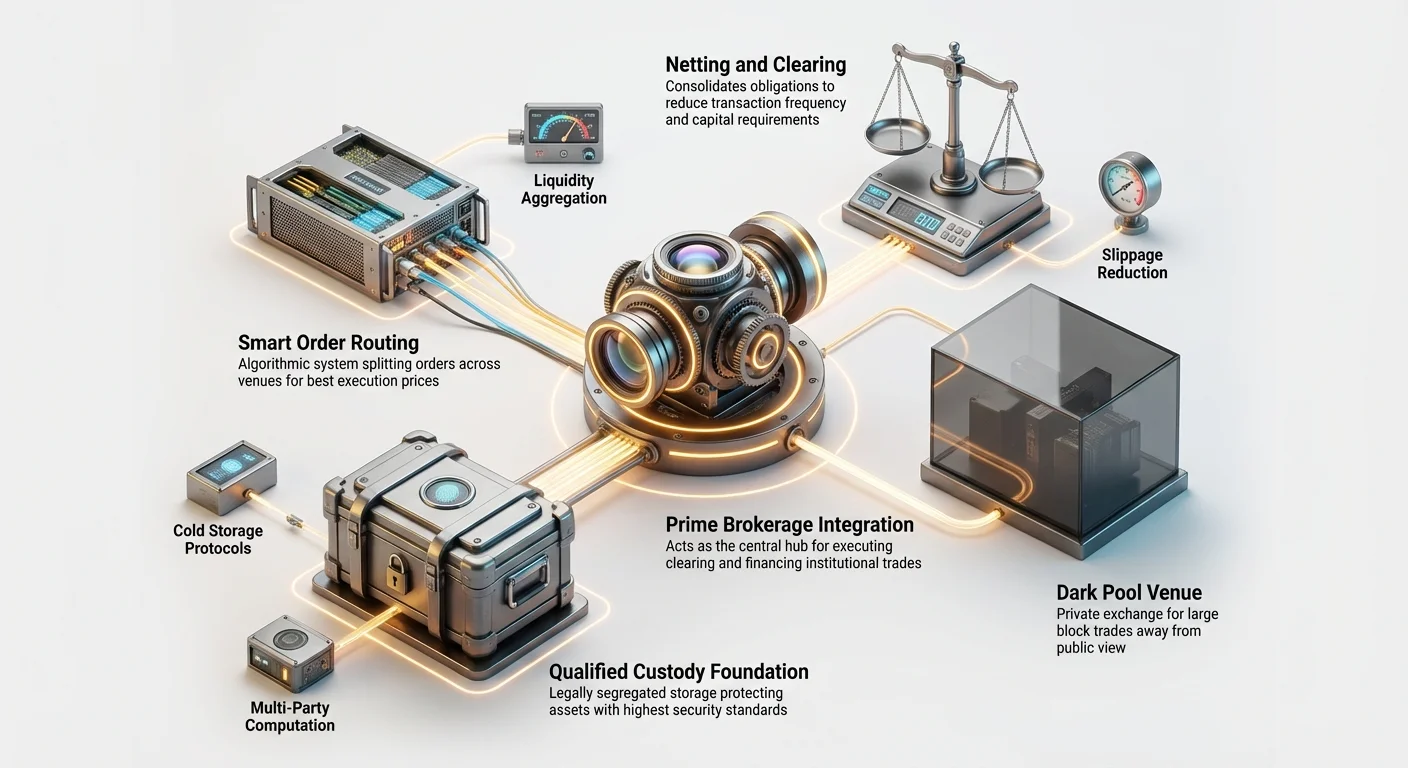
A crypto prime broker acts as an intermediary, centralizing execution, clearing, settlement, custody, and financing. This simplifies operations, enhances security, and, most importantly, provides the efficiency needed to trade massive volumes.
Consolidated Execution and Liquidity Aggregation
The most immediate benefit of a prime broker is access to liquidity aggregation. No single crypto exchange holds all the best prices or all the required depth (volume). To execute a $100 million BTC order efficiently, the trade must be split up and routed to dozens of different venues simultaneously—including centralized exchanges (CEXs), decentralized exchanges (DEXs), and over-the-counter (OTC) desks.
The prime broker provides technology that does this automatically:
- Smart Order Routing (SOR): This algorithmic system constantly scans the order books of all connected venues (e.g., Coinbase, Binance, Gemini, Bitstamp, and OTC desks).
- Execution: When a fund places a large "parent order" (e.g., "Buy $50M BTC"), the SOR system breaks it into many smaller "child orders" (e.g., 50 separate $1M orders).
- Optimization: These child orders are routed to whichever venue currently offers the best combination of price and depth, ensuring the lowest possible average execution price for the client.
This means the fund only needs to interact with the prime broker, who handles the complexity of managing relationships, accounts, and balances across the entire crypto ecosystem.
Credit, Clearing, and Netting
One of the biggest capital hurdles for large funds is collateral management. If a fund wants to execute a complex strategy—for instance, buying Bitcoin spot while simultaneously shorting Bitcoin futures on a derivatives exchange—they would normally have to post separate collateral on each venue. This ties up significant capital.
Prime brokers solve this through netting and cross-margining:
- Clearing and Settlement: The prime broker manages the actual transfer of assets and cash. They sit between the buyer and the seller, ensuring the trade is completed correctly.
- Netting: Instead of settling every single trade instantly, the broker calculates the net financial position of the client. If a client buys $10M BTC on Venue A and sells $9M BTC on Venue B in the same hour, they only need to move $1M worth of BTC plus trading fees, rather than moving $19M back and forth. This drastically reduces transaction costs and blockchain fees.
- Cross-Margining: This allows a fund to use the same capital (or collateral) to support positions across multiple products or venues. If a fund deposits $100 million with the prime broker, that $100 million can be used as margin for trades on any platform accessible through the broker. This increases capital efficiency tremendously.
Integrated Risk Management and Reporting
Regulated funds must adhere to strict internal risk limits and external compliance rules. Prime brokers integrate sophisticated risk management tools:
- Real-time Position Tracking: Funds can see their entire portfolio—spot, futures, margin balances, and collateral—in a single, unified interface, regardless of which exchange the physical assets reside on.
- Pre-Trade Compliance Checks: Before an order is executed, the broker’s system can automatically check if the order violates any internal risk rules (e.g., maximum exposure limits, concentration risk, or regulatory constraints like Know Your Customer/Anti-Money Laundering (KYC/AML)).
- Regulatory Reporting: Prime brokers automate the generation of necessary audit trails, quarterly reports, and tax documents, simplifying the massive compliance burden faced by institutional treasuries.
Institutional Custody Solutions
The security requirement for holding multi-billion dollar crypto portfolios goes far beyond a typical hardware wallet. Institutional custody providers are specialized firms (often trust companies or regulated banks) whose sole mandate is to securely store digital assets on behalf of institutions.
These solutions are governed by strict regulatory frameworks (e.g., the New York Department of Financial Services (NYDFS) requires Qualified Custodians for certain assets).
The Requirement for Qualified Custodians
A Qualified Custodian is an institution legally required to hold assets for a fund or trust. This separation of duty is crucial: the entity responsible for trading (the hedge fund manager) must not be the same entity responsible for holding the assets. This minimizes the risk of misappropriation or security failures.
A typical Qualified Custodian solution provides a layer of legal and technical assurance that a simple retail exchange cannot:
- Segregated Accounts: The client’s assets are held in a separate legal entity, meaning if the custodian itself goes bankrupt, the client’s assets are protected and cannot be seized by the custodian’s creditors.
- Fiduciary Standard: They operate under a legal obligation to protect the assets to the highest standard possible.
Advanced Key Management and Storage
Institutional custody relies on highly complex, layered security architecture to protect private keys. They use a combination of hot, warm, and cold storage, often relying on hardware security modules (HSMs) and advanced cryptography.
1. Air-Gapped Cold Storage
The vast majority of assets are held in cold storage, meaning the private keys are never connected to the internet. This is typically achieved through:
- Physical Segregation: Keys are stored offline, often in underground vaults or specialized high-security facilities (like data centers managed by military-grade security firms).
- Multi-Party Computation (MPC) and Multisignature (Multisig): Instead of a single private key, the key is split into multiple shards or parts. To authorize a transaction, a predetermined number of key shards must be assembled. For example, a "3-of-5" scheme means that out of five total authorized custodians (individuals or machines), at least three must physically approve the transaction before it is broadcast to the network. This eliminates single points of failure.
2. Warm Storage and Withdrawal Policies
A small percentage of assets needed for daily liquidity (trading, settling fees) are held in "warm storage." Warm storage is online but is heavily protected by rigid internal controls and strict withdrawal policies:
- Whitelisting: Funds can only be sent to pre-approved addresses (e.g., the prime broker’s settlement wallet or a regulated exchange).
- Time Delays: Large withdrawals often require multiple human approvals and a cooling-off period (e.g., 24-48 hours) to detect and stop fraudulent transactions.
Insurance and Auditing
Institutional custody providers often carry significant insurance policies to cover theft or loss resulting from internal security failures, employee collusion, or cyberattacks. Furthermore, these providers are subjected to regular, rigorous external audits (such as SOC 1 or SOC 2 reports) that confirm their security controls and operational integrity are up to regulatory standards. This audit trail is essential for the funds that use them to satisfy their own regulators and investors.
Advanced Execution: Dark Pools and Liquidity
Once an institution has secure custody and a prime broker to manage credit, the next challenge is executing the trade without disrupting the public market. This requires accessing unique sources of liquidity that are unavailable to retail traders, primarily through aggregation and the use of private venues known as dark pools.
The Role of Smart Order Routing (Revisited)
We touched on SOR earlier, but its complexity deserves more detail. For an institution, the difference between the best execution price and a mediocre one can represent hundreds of thousands of dollars on a single large trade.
The SOR system is a complex algorithm designed to constantly assess two factors: price and liquidity depth. If Venue A offers a price of $60,000 for Bitcoin but only has 10 BTC for sale, while Venue B offers $60,010 but has 500 BTC for sale, the SOR might prioritize Venue B because the average execution price for a large order will be better there, despite the slightly higher initial price.
The SOR’s job is dynamic: it routes sub-orders in milliseconds to achieve what is known as Volume-Weighted Average Price (VWAP) optimization, aiming for an average price that reflects the market’s true pricing, not just the single best bid/ask.
Dark Pools Crypto Explained
To overcome the problem of market impact (slippage) entirely, institutions use dark pools. A dark pool is a private exchange or trading venue where large blocks of assets are traded away from the public view and public order books.
How Dark Pools Work
Imagine the public crypto exchange order book is a massive, brightly lit trading floor where everyone can see every pending buy and sell order. If a whale posts a massive "Sell 10,000 ETH" order there, every other trader sees it instantly and can front-run them (selling before the whale can finish, or betting the price will fall).
A dark pool is like a private, closed-door negotiation room. The large buy or sell order is posted internally within the pool, visible only to other approved, institutional members who have similar large orders they wish to execute.
- Matching: Orders are matched automatically or through a broker using an internal reference price (often based on the current mid-market price from public exchanges).
- Anonymity: The identity of the institutional buyer and seller is kept anonymous until the trade is executed.
- No Market Impact: Since the large order is never publicly displayed, its size and direction do not influence the visible price of the asset on CEXs.
Use Case: Block Trades
Dark pools are essential for executing block trades—single transactions involving huge amounts of capital.
If Fund A wants to sell $20 million of a mid-cap altcoin and Fund B wants to buy $20 million, they can use a dark pool to execute the trade instantly at a fair price (say, the current CEX mid-point) without pushing the CEX price down and causing chaos. This ensures both parties get the execution they need without revealing their strategy or incurring massive slippage costs.
Over-The-Counter (OTC) Desks and Brokerage
While dark pools are electronic execution venues, Over-The-Counter (OTC) trading desks provide a similar function but with a human element. OTC desks facilitate bilateral (two-way) trades directly between two large parties or between the fund and the desk itself.
- Principal vs. Agency Trading: When dealing with an OTC desk, the fund often trades directly with the desk (the desk acts as the principal). The desk holds a massive inventory of coins and guarantees the price for the large transaction instantly. This is vital when speed and guaranteed price are more important than complex algorithmic execution.
- Customization: OTC brokers can also arrange complex, custom deals or handle highly illiquid tokens that cannot be traded efficiently on standard exchanges.
Prime brokers often bundle OTC access directly into their liquidity aggregation model, offering funds the fastest route to guaranteed execution for block trades.
The Regulated Institutional Platform Ecosystem
The institutional world is fundamentally defined by compliance. Professional traders, especially those managing traditional fiat capital transitioning into crypto, require platforms that operate under clear regulatory mandates.
These platforms are not simply "crypto-friendly"; they are often legally chartered banks, trust companies, or regulated money service businesses that satisfy stringent financial regulations.
Licensing and Regulatory Oversight
For an institutional platform to attract major funds, it must meet jurisdictional regulatory requirements, which often include:
- Securities Licenses: Depending on the asset being traded (e.g., futures, options, or potentially tokens deemed securities), the platform may need to register with bodies like the Securities and Exchange Commission (SEC) or the Commodity Futures Trading Commission (CFTC) in the US, or comparable regulatory bodies globally.
- Money Transmitter Licenses: Necessary for handling fiat currencies and transfers.
- KYC and AML Enforcement: Institutional platforms employ extremely rigorous KYC and AML procedures to verify the source of funds and the identity of the beneficial owners. This is critical for preventing illicit finance, which is a key mandate for regulated funds.
The platform’s willingness to subject itself to auditing and governmental oversight is often the single most important factor for institutions seeking compliance peace of mind.
Advanced Reporting and Audit Trails
A small retail investor needs a year-end tax document. An institutional investor needs an exhaustive, verifiable audit trail for every single millisecond of their trading activity, across every venue.
Regulated platforms must provide:
- Time-Stamped Data: Extremely accurate records of when orders were placed, filled, and settled, often down to the nanosecond, crucial for best execution auditing.
- Transaction Analysis: Tools that demonstrate why the Smart Order Router chose a specific venue for execution (proving that the fund sought the best price as required by fiduciary duty).
- API Integration: Secure, high-speed Application Programming Interfaces (APIs) that allow institutional treasury software, accounting systems, and proprietary trading bots to connect directly for automated reporting and trading.
Platform Segmentation: Spot vs. Derivatives
Institutional platforms often specialize heavily. While retail exchanges often lump all products together, institutional venues clearly separate spot trading (buying/selling the asset itself) from derivatives trading (futures, options, perpetual swaps).
- Spot Trading Platforms: Focus on secure settlement and deep fiat on/off-ramps, ensuring smooth conversion between traditional currencies and crypto. These often partner directly with banks for rapid, high-volume wire transfers.
- Derivatives Exchanges: Require specialized infrastructure for margin calls, liquidation protocols, and risk management. Institutional access to these platforms is usually facilitated via the prime broker who handles collateral management for the fund.
By using these segmented, regulated tools, institutions ensure they are complying with the specific rules governing each asset class while maintaining operational efficiency.
Practical Implications for New Crypto Investors
While most new crypto investors will never use a dark pool or interact with a prime broker, understanding this infrastructure offers crucial insight into the underlying market dynamics.
1. Liquidity Determines Value
The institutional focus on liquidity aggregation and dark pools shows that having the best price matters only if the volume is there. When you research altcoins, always consider the depth of the market—how much money would it take to move the price significantly? Illiquid assets are prone to massive price swings, which is why institutions generally favor highly liquid assets like Bitcoin and Ethereum.
2. Security is an Ecosystem
Institutional custody demonstrates that true security is not just about having a strong password; it’s about establishing protocols, segregation of duties, legal protections, and multi-party sign-off. As a retail investor, this highlights the importance of using multi-factor authentication, cold storage for long-term holdings, and exercising extreme caution when connecting wallets to unfamiliar protocols (the crypto version of "pre-trade compliance").
3. Understanding Trading Efficiency
The tools discussed—prime brokerage, SOR, and netting—are all designed to reduce friction and improve the final execution price. While retail traders worry about small trading fees (0.1% or less), institutions are focused on slippage, which can easily cost 10 or 100 times the explicit fee. For retail traders, this translates to utilizing limit orders instead of market orders whenever possible to guarantee execution price and avoid unnecessary slippage.
Conclusion
The world of institutional crypto trading operates on an entirely different scale than retail investing. It is characterized by specialized services—prime brokerage for operational centralization, Qualified Custodians for bulletproof security, and dark pools for quiet, high-volume execution.
These integrated systems are the backbone that allows the world’s largest funds and financial institutions to participate efficiently in digital asset markets, handling complex regulatory requirements and managing massive amounts of capital. As the crypto ecosystem matures, the continued convergence of these institutional infrastructures with traditional finance standards will lead to greater stability, deeper liquidity, and a higher standard of security for the entire market.