
The world of cryptocurrency moves at a dizzying pace. With thousands of coins and tokens available, achieving effective diversification and long-term stability can feel overwhelming for new investors. Trying to pick individual winners requires massive amounts of research and time, and often leads to portfolios highly concentrated in just a few high-risk assets.
This challenge is precisely why index investing, a strategy popularized in traditional finance by mirroring market performance, has become vital in the digital asset space. A crypto index is essentially a basket of digital currencies designed to track a specific segment of the market—be it the overall market, decentralized finance (DeFi), or Web3 gaming.
This guide provides a comprehensive, beginner-friendly walkthrough on how to identify, build, validate, and deploy robust crypto index strategies using "tokenized baskets." We will move beyond simple buying and holding, focusing on the systematic approach required to validate your investment decisions using historical data, known as backtesting, and mastering the essential maintenance steps of rebalancing and cost management.
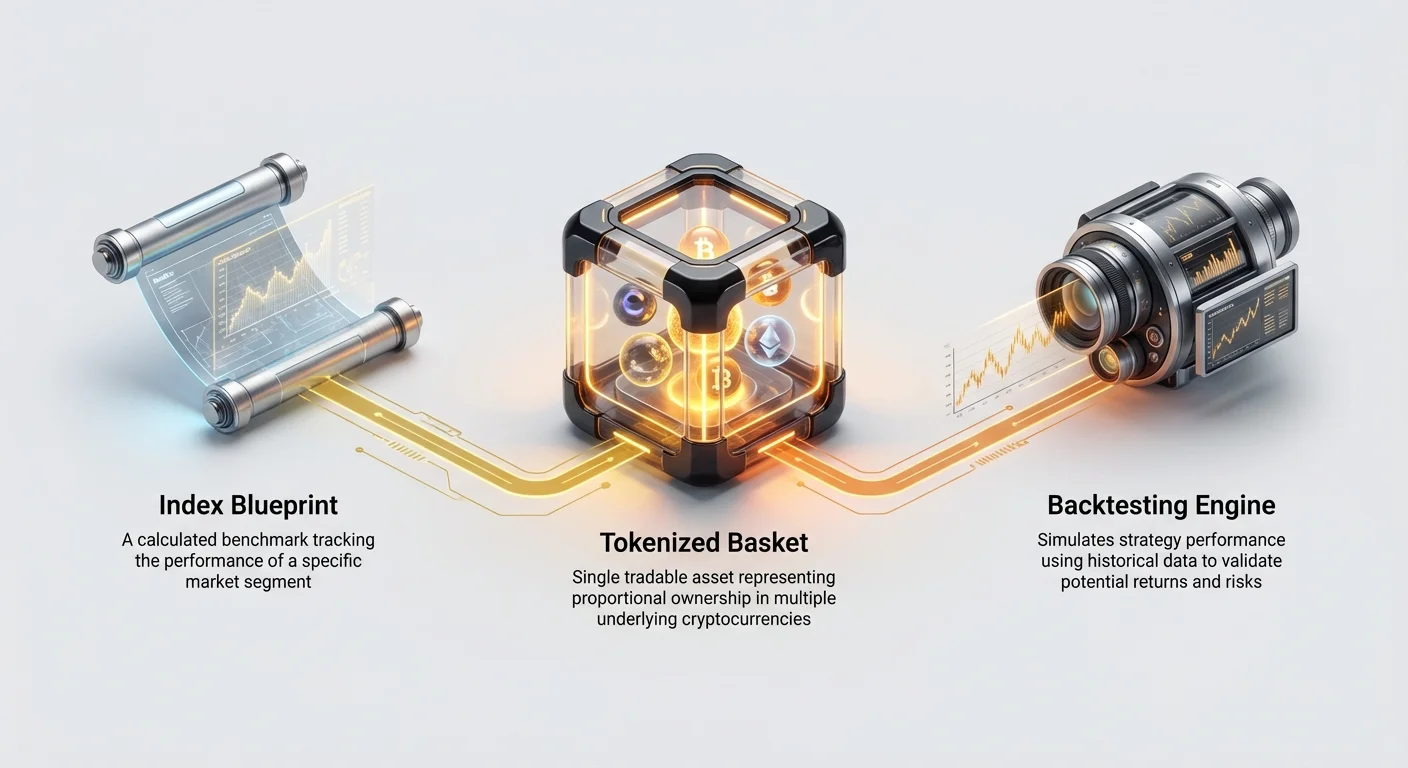
Understanding Crypto Indices and Tokenized Baskets
Before building a strategy, it is critical to grasp the foundational instruments that make index investing possible in the crypto sphere: the index itself and the resulting tokenized basket.
What is a Crypto Index?
In simple terms, a crypto index functions as a benchmark or a market thermometer. It is not an asset you can buy directly, but rather a calculation that tracks the performance of a selected group of cryptocurrencies.
For example, a “Total Market Cap Index” might track the performance of the top 50 cryptocurrencies by size (market capitalization). The index provides a snapshot of how that specific segment is performing as a whole, filtering out the noise of day-to-day volatility in smaller, individual tokens. Its purpose is to represent the health and trend of the underlying market.
The Role of Tokenized Baskets (Synthetic Assets)
If an index is the blueprint, the tokenized basket is the actual product you hold. A tokenized basket is a single, tradable cryptocurrency asset that represents proportional ownership in all the assets defined by the index.
These baskets are often referred to as synthetic assets because they derive their value from the performance of the underlying collection of tokens, rather than possessing intrinsic value themselves. When you buy one unit of a "DeFi Index Token," you are simultaneously getting exposure to the five, ten, or fifty DeFi protocols included in that index, managed under a smart contract. This structure allows investors to gain instant diversification and systematic exposure through a single trade, drastically simplifying portfolio management.
Key Benefits for Systematic Trading
Systematic trading relies on predefined rules and automation, removing emotional decision-making. Index investing provides an ideal framework for this:
- Rule-Based Entry and Exit: You are not timing the market based on news; you are following the rules of the index (e.g., "always hold the top 10 assets").
- Built-in Diversification: Exposure is spread across multiple assets, reducing the impact of any single project failure.
- Passive Management Potential: Once the strategy is designed and the basket is deployed, the maintenance (rebalancing) can often be automated by the basket provider or executed on a fixed schedule.
Index Weighting Methodologies: The Rules of the Game
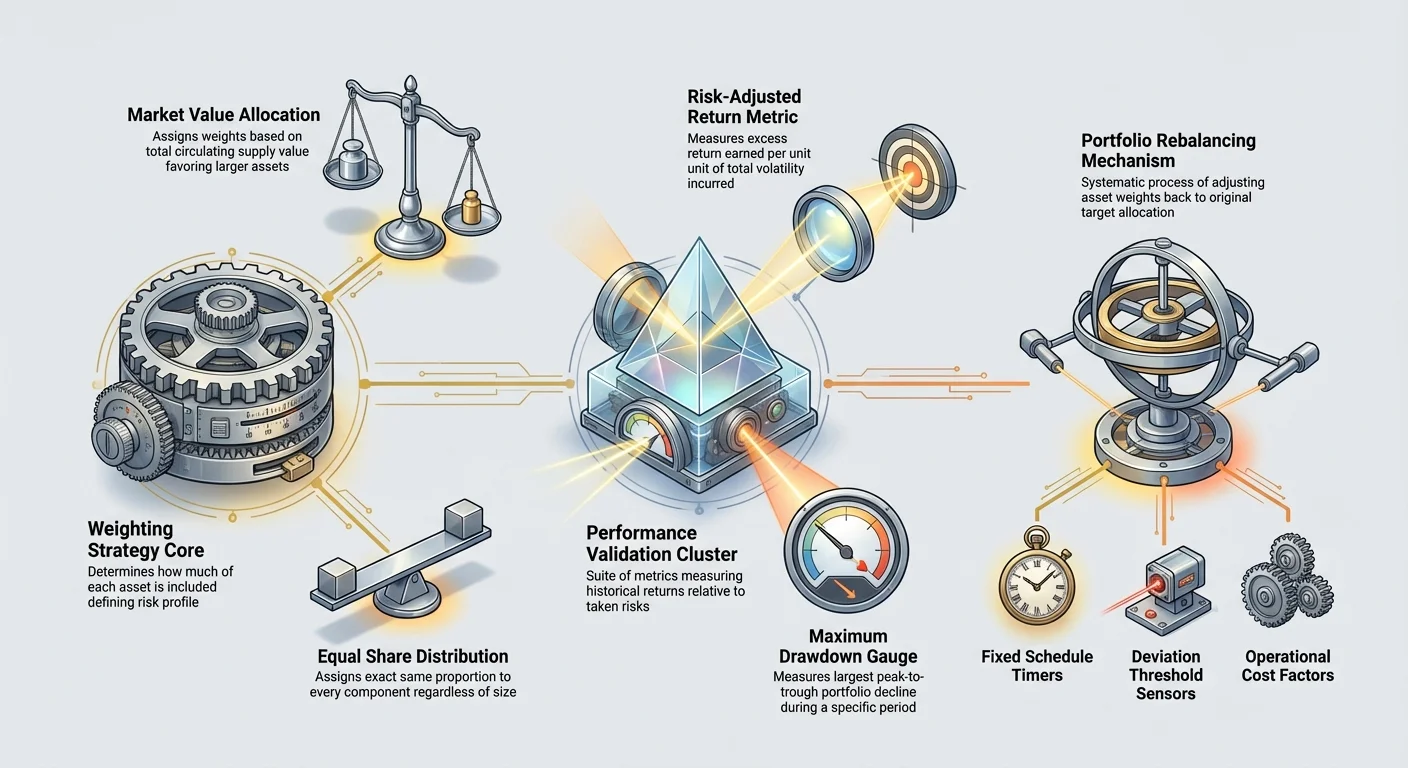
The method used to determine how much of each token to include in the index—the weighting methodology—is arguably the single most important strategic decision. It dictates the index’s risk profile, volatility, and potential performance characteristics.
Market Capitalization Weighting
The most common method, Market Cap Weighting, assigns weight based on the total value (price multiplied by circulating supply) of a cryptocurrency.
- How it works: If Bitcoin has a market cap 10 times larger than Solana, the index will hold 10 times more value in Bitcoin.
- Pros: This methodology naturally favors established, larger, and generally more stable tokens (like BTC and ETH). It requires less frequent rebalancing, as market cap changes gradually.
- Cons: It concentrates risk heavily in the largest assets. If the top coin experiences a major drawdown, the entire index suffers disproportionately. It also means the index reflects the performance of the largest coins, potentially missing out on higher returns from emerging, smaller tokens.
Equally Weighted Methodologies
In contrast, the Equally Weighted methodology assigns the exact same proportion of the index to every component, regardless of its size.
- How it works: If an index tracks 10 tokens, each token accounts for exactly 10% of the basket’s total value at the time of rebalancing.
- Pros: This approach provides equal exposure to smaller, often more volatile, and potentially higher-growth "mid-cap" or "small-cap" assets. It forces a systematic approach to portfolio management—you are automatically buying assets that have underperformed and selling assets that have outperformed to return to the 10% allocation.
- Cons: Equal weighting often results in higher overall volatility. Crucially, it requires very frequent and disciplined rebalancing, which increases transaction costs (fees).
Custom and Thematic Weighting
Advanced strategies involve creating custom weighting schemes tailored to specific goals, such as risk management or targeting sector growth.
- Risk-Parity Weighting: Instead of focusing on size, this method weights components based on their historical volatility (risk). Lower-volatility assets are given higher weights, aiming to achieve a more consistent and less bumpy return profile.
- Fundamental Weighting: This is less common in crypto but involves weighting based on non-price metrics, such as a protocol’s total value locked (TVL), user activity, or decentralized autonomy scores. This attempts to value assets based on real usage rather than speculative price movement.
Tip: For beginners, start by backtesting both Market Cap and Equally Weighted strategies for the same set of assets. The comparison often reveals a stark difference in risk-adjusted returns.
The Power of Backtesting: Validating Your Strategy
Designing an index strategy based on a methodology is only the first step. Before committing capital, you must validate that strategy against historical data. This process, known as backtesting, simulates how your strategy would have performed had you deployed it over the last one, three, or five years.
Setting Up the Backtesting Environment
Backtesting requires clean, reliable historical price data for all component tokens. While sophisticated tools exist for traditional markets, crypto backtesting often involves spreadsheets or specialized analytical platforms.
The simulation must account for every rule defined in your strategy:
- Selection Criteria: Which coins are included? (e.g., "Top 20 by Market Cap, excluding stablecoins").
- Start and End Date: Defining the period you are testing (e.g., January 2021 to January 2024).
- Initial Capital: The starting investment amount.
- Weighting Method: Market Cap, Equal Weight, etc.
- Rebalancing Schedule: How often (e.g., monthly, quarterly) and how are transaction costs factored in?
Key Backtesting Metrics
A simple total return is insufficient for evaluating a strategy. Sophisticated backtesting provides a suite of metrics that measure performance relative to risk.
1. Compound Annual Growth Rate (CAGR)
This is the annualized rate of return over the specified period, assuming profits were reinvested. It provides a clearer picture of growth than a simple arithmetic average.
2. Maximum Drawdown (Max DD)
The most crucial risk metric. Max Drawdown measures the largest peak-to-trough decline during the period. If your strategy has a 75% Max DD, it means at one point, you would have lost 75% of your portfolio value. A lower Max DD is highly desirable, indicating better capital preservation.
3. Sharpe Ratio and Sortino Ratio
These ratios measure risk-adjusted returns.
- Sharpe Ratio: Measures the excess return earned per unit of total volatility (risk). A higher Sharpe Ratio (ideally above 1.0) means you are generating better returns without taking on unnecessary volatility.
- Sortino Ratio: Similar to the Sharpe Ratio, but only considers "bad" volatility (downside deviation). This is often preferred because upward volatility is generally welcomed by investors.
Avoiding Backtesting Pitfalls
The primary danger in backtesting is curve fitting or over-optimization.
- Curve Fitting: This occurs when you tweak the rules (e.g., adjusting the rebalancing schedule from monthly to 37 days) repeatedly until the backtest looks perfect for the specific historical period tested. This strategy is brittle and highly unlikely to perform well in the future.
- Lookahead Bias: Ensure that the data used for selection during the backtest was actually available at that historical time. For instance, if you test a "Top 10" index for January 2022, you must only include the tokens that were in the Top 10 on January 1, 2022, not tokens that became top performers later in the year.
Best Practice: Always test your strategy across diverse market conditions: a bull market, a bear market, and a consolidating market. If the strategy only performs well in one environment, it is likely too fragile.
Implementing Rebalancing Strategies and Managing Costs
Once an index is established, the weights of its components inevitably "drift" over time due to differing price movements. Rebalancing is the necessary, mechanical process of selling assets that have grown (selling high) and buying assets that have shrunk (buying low) to return the portfolio to its original target weighting.
Scheduled vs. Threshold Rebalancing
The timing of rebalancing significantly impacts portfolio turnover, transaction costs, and exposure.
1. Scheduled Rebalancing
This is the simplest approach. The portfolio is adjusted back to target weights on a fixed schedule (e.g., quarterly, monthly, or weekly).
- Pros: Highly predictable and systematic. Reduces the psychological difficulty of deciding when to trade.
- Cons: Can be inefficient. If the market experiences extreme volatility right before the rebalance date, you may be rebalancing at a suboptimal time, or missing the opportunity to capture significant gains before the scheduled date.
2. Threshold Rebalancing (Tolerance Bands)
This is a more dynamic approach that only triggers a rebalance when a component's weight deviates from its target by a predefined percentage (the tolerance band).
- How it works: If an Equally Weighted index requires 10% allocation for Token A, the tolerance band might be set at ±2%. A rebalance only occurs if Token A’s weight drops below 8% or exceeds 12%.
- Pros: Reduces trading frequency compared to scheduled rebalancing, minimizing transaction costs during quiet periods.
- Cons: Requires constant monitoring and may lead to rebalancing events clustered during periods of extreme market stress.
The Critical Impact of Transaction Costs
In traditional finance, transaction costs (brokerage fees) are relatively minor. In crypto, costs are a far more significant factor, especially when dealing with tokenized baskets and automated derivatives.
Tokenized basket rebalancing involves three primary costs:
- Exchange Fees: The percentage fee charged by the platform for buying and selling assets (maker/taker fees).
- Slippage: The difference between the expected trade price and the actual executed price, common in low-liquidity markets or large orders.
- Network (Gas) Fees: The cost associated with processing the smart contract transactions necessary to update the basket on the blockchain (e.g., Ethereum gas fees). This cost can sometimes overwhelm small-volume trades.
Strategy Tip: When backtesting, you must incorporate a realistic estimation of transaction costs into your simulation. An index strategy that shows fantastic theoretical returns but requires daily rebalancing will likely be unprofitable in a real-world, high-fee environment. For beginners, quarterly scheduled rebalancing often strikes the best balance between maintaining target weights and minimizing costs.
Designing Custom Thematic Indices
Moving beyond standard Top X Market Cap indices allows investors to express specific viewpoints about the future direction of the crypto market. Custom thematic indices use tokenized baskets to target high-conviction narratives or specific risk profiles.
Sector-Specific Baskets
These indices focus on tokens within a specific niche that is expected to outperform the broader market.
- The DeFi Yield Index: Focuses exclusively on assets related to decentralized lending, exchange protocols (DEXs), and yield aggregators (e.g., Maker, Uniswap, Aave). This basket is betting on the continued growth and maturity of decentralized finance infrastructure.
- The Layer-2 Scaling Index: Targets protocols designed to improve the speed and reduce the cost of existing blockchains (e.g., Polygon, Arbitrum, Optimism). This index assumes that scaling solutions will be the key driver of future adoption.
- The Gaming and Metaverse Index: Includes tokens associated with major blockchain games, virtual worlds, and NFT platforms. This targets the intersection of digital entertainment and decentralized ownership.
Creating a Weighted Risk Profile Index
A more advanced approach involves building an index specifically designed to balance the inherent volatility of crypto assets.
Imagine creating an index composed of three tiers:
| Tier | Allocation | Risk Profile | Example Components |
|---|---|---|---|
| Tier 1 (Base) | 50% | Low Volatility | BTC, ETH |
| Tier 2 (Growth) | 35% | Mid Volatility | Layer-1 competitors (Solana, Avalanche) |
| Tier 3 (Alpha) | 15% | High Volatility | Emerging DeFi protocols, highly speculative tokens |
This structure ensures that 50% of the basket remains anchored by the most established assets, providing stability, while the remaining 50% offers high-growth potential. When backtesting this complex custom index, the rebalancing mechanism must strictly enforce these three distinct tier percentages, providing systematic control over the portfolio's overall risk exposure.
Unique Value: The power of tokenized baskets is that they abstract this complexity. Instead of manually buying and managing nine different tokens across three risk tiers, the user interacts with a single token that inherently executes this complex, tiered strategy.
Practical Steps for Building and Deploying a Tokenized Index
How does a new investor actually get exposure to these sophisticated index strategies? The path depends on whether you utilize an existing product or decide to manually replicate the strategy.
Step 1: Strategy Definition and Backtesting
Before deployment, ensure your backtesting confirms the strategy is sound (low Max Drawdown, high Sharpe Ratio) and profitable even after factoring in realistic transaction costs.
- Deliverable: A clear document defining the index components, weighting method, and quarterly rebalancing schedule.
Step 2: Choosing the Deployment Method
Option A: Utilizing Established Tokenized Basket Platforms
The easiest and safest entry point is using existing infrastructure designed specifically for systematic index management.
- How it works: Platforms (often decentralized protocols) allow asset managers or the community to launch public index tokens. These platforms handle the complex smart contract mechanics, automated rebalancing, and liquidity provision.
- Pros: Fully automated rebalancing, high security (audit smart contracts), and deep liquidity.
- Cons: You are limited to the indices and strategies already offered by the platform. They may charge management fees (often a small percentage of the asset value per year).
Option B: Manual Replication (Synthetic Portfolio Building)
If you have designed a truly unique, custom index, you may need to replicate it manually across multiple exchanges.
- How it works: You use centralized exchanges (CEXs) or decentralized exchanges (DEXs) to purchase the exact proportions of the underlying tokens defined by your strategy.
- Pros: Total control over the assets, zero management fees.
- Cons: You must manually execute every rebalance event, requiring discipline and time. This greatly increases the risk of human error and may incur higher costs due to frequent, small trades across various platforms.
Step 3: Deployment and Monitoring
Once the basket is live (whether bought as a single token or manually constructed), the final step is continuous monitoring.
- Set Rebalancing Reminders: If using manual replication, rigorously adhere to your scheduled or threshold-based rebalancing dates. Do not delay due to market fear or greed.
- Monitor Drift: Regularly check the actual weight of each token against its target weight. This metric is the clearest indicator of when action is required.
- Review Performance: On a semi-annual basis, compare your index's performance against a simple benchmark (like holding just BTC or ETH). If your customized, effort-intensive strategy is underperforming the simple benchmark, it’s time to revisit the backtesting and the strategy definition.
Actionable Tip: If you choose manual replication, use a portfolio tracking tool that automatically calculates weighting drift and reminds you precisely which assets need to be bought or sold to return to target allocation. This transforms a chaotic manual process into a structured, rules-based routine.
Conclusion
Building and utilizing crypto index strategies through tokenized baskets represents a significant step up from simple HODLing or reactive trading. This approach shifts the focus from picking winners to designing a systematic, diversified, and risk-managed portfolio tailored to your unique financial goals.
By mastering the concepts of index weighting, rigorous backtesting, and disciplined rebalancing, beginners can deploy strategies that mitigate the extreme volatility inherent in individual crypto assets. Index investing is not a get-rich-quick scheme; it is a systematic methodology for participating in the long-term growth of the digital asset economy while prioritizing capital preservation and consistency. Start by defining simple rules, backtest them relentlessly, and let the systematic discipline of index strategy guide your investment journey.