
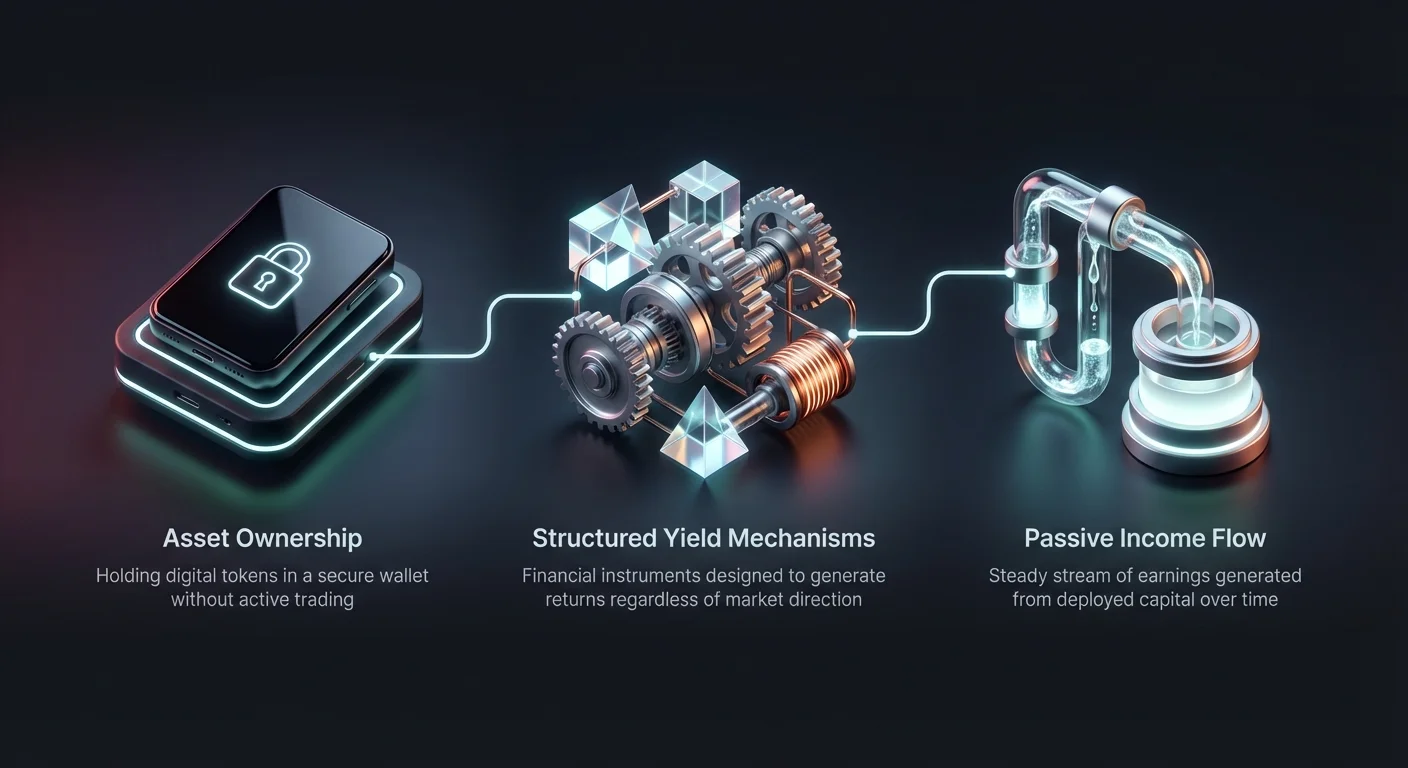
Digital asset markets have evolved significantly beyond simple buy-and-hold strategies. Investors now have access to sophisticated financial instruments designed to generate yield regardless of market direction. These mechanisms, often referred to as structured products, combine various financial derivatives and underlying assets to offer tailored risk-reward profiles. They allow participants to earn interest, capitalize on volatility, or seek protection against downside movements.
The rise of these products marks a maturity in the cryptocurrency ecosystem. In the early days, profit was driven almost exclusively by asset appreciation. Today, platforms offer mechanisms that mimic traditional structured notes found in institutional finance. These include dual investment strategies that monetize market views, range-bound tools that profit from stagnation, and principal-protected accounts that prioritize capital preservation.
Understanding the mechanics behind these offerings is essential for any investor looking to diversify their portfolio. These products often utilize complex derivatives like options and futures in the background to generate returns. By packaging these into user-friendly interfaces, exchanges have democratized access to advanced trading strategies. However, this accessibility requires a deeper understanding of the underlying risks and operational frameworks.
The Mechanics of Yield Generation
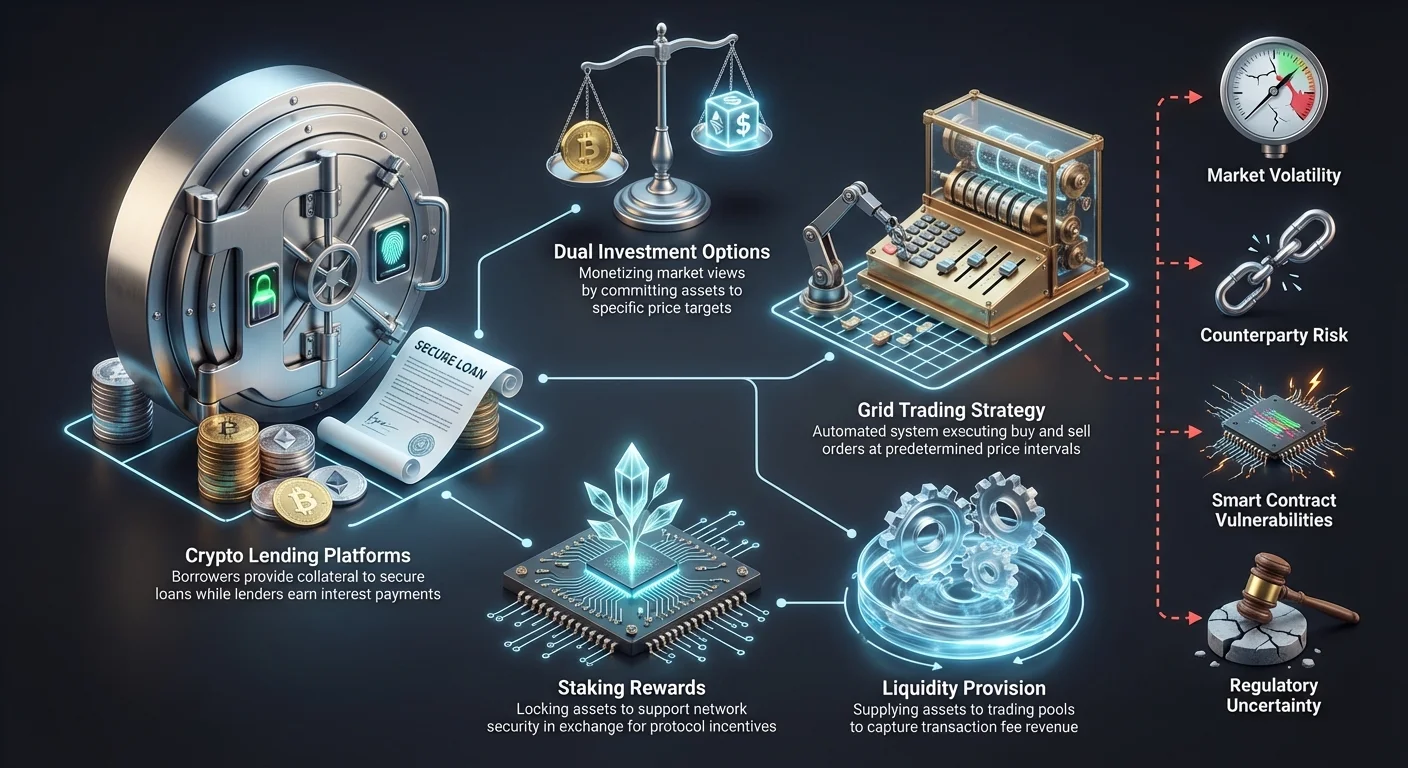
Yield in the cryptocurrency space is generated through several distinct avenues. The most common method involves lending assets to borrowers who need liquidity for trading or operational purposes. Platforms aggregate these deposits and lend them out, often requiring borrowers to provide collateral to secure the loan. The interest paid by borrowers is then shared with the depositors, creating a passive income stream.
Another primary source of yield comes from staking and participation in blockchain validation. While distinct from lending, the user experience is often similar. Investors lock their assets to support network security and receive rewards in return. Structured products may bundle these staking rewards with other derivative strategies to enhance the overall percentage yield, offering a blended product that balances risk and return.
Market making and liquidity provision also play a crucial role. In range-bound or grid trading products, the yield is effectively generated by capturing the spread between buy and sell orders. By automating this process, platforms allow users to profit from market inefficiencies and volatility without needing to actively manage every transaction. This turns market noise into a consistent source of potential profit.
Grid Trading: Capitalizing on Sideways Markets
Grid trading is a systematic strategy that has become a cornerstone of yield generation in non-trending markets. This approach involves placing a series of buy and sell orders at predetermined price intervals. The resulting structure resembles a grid, covering a specific price range. When the market price drops, the system executes buy orders. When the price rises, it triggers sell orders.
This strategy is particularly effective in volatile markets where asset prices fluctuate within a defined channel without establishing a clear long-term trend. In the cryptocurrency sector, assets often spend significant periods moving sideways. Grid trading automates the process of buying low and selling high during these consolidations. It removes the need for constant monitoring and eliminates emotional decision-making from the equation.
The primary advantage of this structured approach is its ability to monetize volatility. Instead of fearing price swings, a grid trader benefits from them. Each small movement up or down within the grid can result in a profitable trade. The frequency of these trades determines the overall yield generated by the strategy.
Setting Parameters for Grid Strategy
Success in grid trading depends heavily on configuring the correct parameters. Traders must define the upper and lower limits of the grid. These limits represent the range within which the investor expects the asset to trade. If the price moves outside this range, the strategy typically pauses or stops, leaving the investor with an open position that requires manual management.
The number of grid lines is another critical variable. A dense grid with many lines will execute trades more frequently on smaller price movements. However, the profit per trade will be lower due to the smaller price gap between buys and sells. Conversely, a grid with fewer lines requires larger price movements to trigger trades but offers higher profit per individual transaction.
Investors must also decide on the investment amount for each grid level. Most platforms allow for uniform distribution of capital across the grid, while others offer arithmetic or geometric spacing options. Arithmetic grids have equal price differences between levels, while geometric grids maintain a constant percentage difference. Choosing the right spacing is vital for optimizing yield based on the specific volatility characteristics of the asset.
Dual Investment and Options-Based Strategies
Dual investment products represent a category of structured yield that utilizes options contracts to generate returns. These products allow investors to commit an asset to a specific strategy that yields a high interest rate. The outcome of the investment depends on the market price of the asset at a predetermined settlement date. It effectively monetizes the investor's willingness to buy low or sell high.
In a typical dual investment scenario, a user might deposit a stablecoin with the target of buying a cryptocurrency at a lower price. If the market price drops to that target, the stablecoin is converted into the cryptocurrency, effectively executing a "buy the dip" strategy while earning interest. If the price stays above the target, the user keeps their original stablecoin principal plus the accrued interest.
Conversely, a user holding a cryptocurrency can use dual investment to sell at a higher target price. If the market rises to that level, the asset is sold, and the user receives stablecoins plus interest. If the price fails to reach the target, the user retains their cryptocurrency and still earns the high yield. This structure allows investors to earn returns while waiting for their target entry or exit prices to trigger.
The Role of Derivatives
The high yields associated with dual investment products are derived from the options market. When a user subscribes to a dual investment product, they are essentially selling an option to the platform or a third-party counterparty. The "interest" paid to the user is, in financial terms, the premium received for selling this option.
By engaging in this strategy, the investor gives up the potential for unlimited upside in exchange for a guaranteed yield. For example, if an investor agrees to sell Bitcoin at $50,000 and the price shoots to $60,000, they are obligated to sell at $50,000. They miss out on the additional $10,000 profit but retain the yield generated by the product.
Understanding this trade-off is crucial. These are not risk-free savings accounts. The risk involves opportunity cost and the potential of holding a depreciating asset if the market moves against the strike price. Users must be comfortable with both potential outcomes: holding the cryptocurrency or holding the stablecoin, depending on how the market moves relative to the strike price.
Principal Protection and Savings Accounts
For investors prioritizing capital preservation, crypto savings accounts and principal-protected products offer a lower-risk alternative. These platforms function similarly to traditional bank savings accounts but operate within the digital asset ecosystem. Users deposit their idle assets and earn interest over time. The interest is typically generated through lending activities or low-risk arbitrage strategies employed by the platform.
Principal protection in crypto often focuses on stablecoins. Since these assets are pegged to fiat currencies like the US Dollar, they do not suffer from the extreme price volatility associated with Bitcoin or Ethereum. By depositing stablecoins into a savings account, investors can earn yield while maintaining a relatively stable portfolio value. This makes them an attractive option for conservative investors entering the space.
It is important to note that "principal protection" in crypto is rarely absolute in the same way as government-insured bank deposits. The protection refers to the stability of the asset value and the platform's commitment to returning the initial deposit. However, systemic risks, smart contract failures, or platform insolvency remain potential threats that investors must consider.
| Feature | Flexible Savings | Fixed-Term Savings |
|---|---|---|
| Liquidity | High (Withdraw anytime) | Low (Locked for duration) |
| Interest Rate | Generally Lower | Generally Higher |
| Suitability | Short-term holding | Long-term investment |
Flexible vs. Fixed-Term Accounts
Crypto savings platforms typically offer two main types of accounts: flexible and fixed-term. Flexible accounts allow users to withdraw their funds at any time without penalty. This liquidity is ideal for funds that may be needed for trading opportunities or daily expenses. The trade-off is that flexible accounts usually offer lower interest rates compared to their fixed counterparts.
Fixed-term accounts require users to lock their assets for a specific period, such as 30, 60, or 90 days. In exchange for this commitment, platforms offer higher annual percentage yields (APY). This structure allows the platform to lend out the funds for longer durations with more certainty, generating higher returns that are passed on to the depositor.
Choosing between flexible and fixed options depends on the investor's time horizon and liquidity needs. Some investors use a "laddering" strategy, dividing their capital across multiple fixed-term accounts with different maturity dates. This ensures that a portion of their capital becomes liquid at regular intervals while still capturing the higher rates associated with locked terms.
Lending Platforms and Collateralization
Crypto lending platforms are the backbone of the yield ecosystem. They facilitate the borrowing and lending of digital assets, creating a market for liquidity. Lenders deposit their crypto into liquidity pools or directly to borrowers, earning interest in return. This interest is often significantly higher than traditional banking rates due to the high demand for leverage and liquidity in the crypto market.
Borrowers on these platforms are often traders looking to leverage their positions or investors seeking liquidity without triggering a taxable event by selling their assets. To mitigate the risk of default, crypto loans are almost always over-collateralized. This means borrowers must deposit assets worth more than the loan amount.
For example, a borrower might need to deposit $10,000 worth of Bitcoin to secure a $5,000 loan in stablecoins. This provides a safety buffer for the lender. If the value of the Bitcoin collateral drops significantly, the platform can liquidate the collateral to repay the loan, ensuring the lender's principal is protected.
Loan-to-Value (LTV) Ratios
The Loan-to-Value (LTV) ratio is a critical metric in crypto lending. It represents the percentage of the collateral's value that is being borrowed. In the example above, a $5,000 loan secured by $10,000 in collateral results in an LTV of 50%. Lower LTV ratios generally qualify for lower interest rates because they present less risk to the lender.
Platforms actively monitor LTV ratios in real-time. If the value of the collateral drops due to market volatility, the LTV rises. If it breaches a specific threshold, the borrower receives a margin call, requiring them to add more collateral or repay part of the loan. If they fail to do so, the system automatically liquidates the assets.
For investors using lending platforms to generate yield, understanding LTV is vital. It explains how the platform manages risk. Platforms with conservative LTV requirements are generally safer for lenders, as they have a larger buffer against market crashes. Conversely, platforms allowing high LTV ratios carry higher default risks but may offer higher interest rates to compensate.
Evaluating Exchange Types for Structured Products
The market for structured yield products is split between centralized exchanges (CEX), decentralized exchanges (DEX), and hybrid platforms. Centralized exchanges act as intermediaries, managing the technical aspects of yield generation. They offer user-friendly interfaces, customer support, and often perform identity verification (KYC). For beginners, CEXs provide the easiest entry point into complex products like dual investment or grid trading.
Centralized platforms often function as custodians, holding the user's private keys. This introduces counterparty risk—the risk that the exchange itself could fail or be mismanaged. However, reputable CEXs employ robust security measures, including cold storage and insurance funds, to protect user assets. They also offer high liquidity, ensuring that structured products can be entered and exited efficiently.
Decentralized exchanges operate on code and smart contracts, removing the central intermediary. Yield on DEXs is often generated through liquidity provision or lending pools governed by algorithms. Users retain control of their private keys, reducing custodial risk. However, DEXs introduce smart contract risk, where bugs in the code could lead to loss of funds. They also require a higher level of technical proficiency to navigate.
Hybrid and Specialized Platforms
Hybrid exchanges attempt to combine the best features of both centralized and decentralized models. They may offer the high performance and liquidity of a CEX while settling transactions on-chain for transparency. These platforms are increasingly popular for traders who want the speed of a centralized order book with the security of non-custodial settlement.
Specialized platforms also exist that focus exclusively on specific types of yield. For instance, some platforms are dedicated entirely to algorithmic grid trading, offering advanced tools and analytics that generalist exchanges may lack. Others focus solely on lending, providing detailed data on LTV ratios and collateral health.
When selecting a platform for structured products, investors should consider the specific tools available. A generalist exchange might offer a basic dual investment product, but a specialized derivatives platform might offer more strike prices and maturity dates. Assessing the depth of the product suite is just as important as evaluating the platform's security.
Risks Associated with Structured Yield
While structured products offer attractive avenues for income, they are not without significant risks. Market volatility is the primary factor affecting returns. In products like dual investment, extreme price movements can lead to the conversion of assets at unfavorable rates. Even in principal-protected accounts, the underlying value of the asset (if not a stablecoin) can fluctuate against fiat currency.
Liquidity risk is another concern. During periods of extreme market stress, platforms may pause withdrawals or lock funds to maintain stability. This is particularly relevant for fixed-term products where capital is contractually inaccessible for a set period. In decentralized finance, liquidity pools can dry up, making it difficult to exit positions without significant slippage.
Regulatory risk also looms over the sector. The legal status of certain yield-bearing products is still being defined in many jurisdictions. Changes in regulation could lead to the sudden suspension of specific services or changes in how returns are calculated and taxed. Investors must stay informed about the regulatory environment in their specific region.
Counterparty and Smart Contract Risk
For users of centralized platforms, counterparty risk is a major consideration. The user is essentially an unsecured creditor to the platform. If the exchange becomes insolvent, recovering assets can be a lengthy and uncertain process. This highlights the importance of using reputable, well-capitalized platforms with a history of clean operations.
In the decentralized space, smart contract risk takes precedence. Yield farming and automated strategies rely on complex code. If this code contains vulnerabilities, malicious actors can exploit them to drain funds. Audits by reputable security firms reduce this risk but do not eliminate it entirely.
Operational security is also the user's responsibility. Regardless of the platform type, securing account access with two-factor authentication (2FA) and using distinct, strong passwords is non-negotiable. For large amounts, diversifying capital across multiple platforms can mitigate the catastrophic impact of a single failure point.
Fee Structures and Net Returns
The advertised yield on structured products is rarely the net return an investor receives. Platforms charge various fees that can eat into profits. Trading fees are the most common, applied whenever an automated strategy like grid trading executes a buy or sell order. In high-frequency strategies, these small fees accumulate quickly and can turn a profitable strategy into a losing one.
Management fees or performance fees may also apply to certain managed products. Some platforms take a percentage of the profit generated by a strategy, while others charge a flat fee for accessing advanced tools. Withdrawal fees are another cost to consider, especially for users who plan to move profits off the platform frequently.
Investors should carefully review the fee schedule of any platform before committing funds. Some exchanges offer zero-fee trading promotions or fee discounts for holding the platform's native token. Utilizing these incentives can significantly improve the net yield of high-frequency strategies like grid trading.
Tokenized Stocks and Diversification
Diversification is a key strategy for managing risk in any investment portfolio. Tokenized stocks offer a unique way to apply yield strategies to traditional assets within the crypto ecosystem. These are digital tokens that represent shares of publicly traded companies. They allow crypto investors to gain exposure to equity markets without leaving the crypto exchange environment.
Trading tokenized stocks offers several advantages, including fractional ownership. Investors can buy a fraction of a high-priced stock, making it accessible to those with smaller capital bases. Furthermore, these assets can often be traded 24/7, unlike traditional stock markets which have rigid opening and closing hours.
From a yield perspective, tokenized stocks can sometimes be used as collateral in lending protocols or included in liquidity pools. This allows investors to earn yield on traditional equity exposure in ways that are not possible in the legacy financial system. However, users must verify if the tokenized stock is fully backed by the actual underlying share to ensure the value remains pegged to the real-world asset.
Regulatory Considerations for Tokenized Assets
Tokenized stocks sit at the intersection of securities regulation and cryptocurrency technology. Because they track the price of real-world equities, they are often classified as securities by financial regulators. This means platforms offering them must comply with strict licensing requirements.
Traders should be aware that access to these products may be restricted based on their geographic location. Platforms often use geoblocking to prevent users from certain jurisdictions, such as the United States, from accessing tokenized stock markets due to regulatory constraints.
Ensuring the platform is compliant with relevant regulations is crucial. Trading on unregulated platforms carries the risk of the service being shut down by authorities, potentially freezing assets. Investors should verify the regulatory status of the exchange and the specific tokenized product before investing.
Tax Implications of Crypto Yield
Earning yield on cryptocurrency triggers tax events in many jurisdictions. Unlike simple buy-and-hold strategies where tax is typically due only upon sale, yield is often treated as income. This means that every interest payment, staking reward, or grid trading profit is a taxable event at the time it is received.
The value of the income is generally calculated based on the fair market value of the asset at the time of receipt. For high-frequency strategies like grid trading, which can generate hundreds of transactions, this creates a complex record-keeping burden. Accurately tracking the cost basis and gain/loss for every micro-transaction is essential for compliance.
Different types of yield may be taxed differently. For instance, interest from lending might be taxed as ordinary income, while profits from dual investment options might be treated as capital gains depending on local laws. The lack of uniform global standards means investors must consult with tax professionals familiar with crypto regulations in their specific country.
Selecting the Best Platform for Yield
Choosing the right platform involves balancing yield potential with security and usability. High interest rates are attractive, but they should not be the only factor. A platform offering 20% APY on a stablecoin savings account warrants scrutiny regarding how that yield is generated and the risks involved. Transparency regarding the source of yield is a hallmark of a trustworthy exchange.
User interface plays a significant role, especially for complex products like grid trading. A clean, intuitive dashboard allows traders to monitor their positions and adjust parameters easily. Advanced charting tools, real-time data feeds, and reliable mobile apps are essential features for active management of yield strategies.
Customer support is another critical differentiator. When dealing with structured financial products, questions and technical issues are inevitable. Platforms with 24/7 support through live chat or email provide a safety net for users. Checking user reviews and community feedback can provide insights into the responsiveness and quality of a platform's support team.
| Criteria | Importance | What to Look For |
|---|---|---|
| Security | Critical | Cold storage, 2FA, Insurance funds |
| Reputation | High | Years in business, Regulatory compliance |
| Usability | Medium | Intuitive interface, Mobile app quality |
Examining Security Protocols
Security acts as the foundation for any crypto investment platform. Before depositing funds, users should investigate the exchange's security history. Has the platform ever been hacked? If so, how did they respond, and were users reimbursed? A clean track record is a strong indicator of robust internal controls.
Two-factor authentication (2FA) should be mandatory for all account logins and withdrawals. The best platforms support hardware keys or authenticator apps rather than relying solely on SMS, which is susceptible to SIM-swapping attacks. Additionally, look for platforms that utilize cold storage, keeping the majority of user funds offline and inaccessible to internet-based threats.
Insurance funds are another layer of protection offered by some top-tier exchanges. These funds are set aside to cover potential losses from hacks or system failures. While not a guarantee of full reimbursement, the existence of such a fund demonstrates a platform's commitment to user protection and financial stability.
Conclusion
Structured products have transformed the cryptocurrency landscape, offering investors sophisticated tools to generate yield beyond simple asset appreciation. From the automated precision of grid trading in range-bound markets to the strategic deployment of options in dual investment products, these instruments allow for tailored financial planning. Lending platforms and savings accounts provide further avenues for passive income, catering to those who prioritize principal protection and steady growth over aggressive speculation.
However, the complexity of these products demands a cautious and informed approach. The integration of derivatives, the nuances of collateralization, and the varying risk profiles of different platforms require investors to conduct thorough due diligence. Security remains paramount, with the choice of exchange often being as critical as the choice of strategy. Balancing the pursuit of high yields with the necessity of risk management is the key to long-term success in this evolving sector.
Successful yield generation requires understanding the mechanics of the product as deeply as the potential return.