
The Ethereum network represents one of the most significant experiments in distributed computing history. Since its inception, it has aimed to serve as a world computer that is open to all. However, achieving this vision requires overcoming substantial technical hurdles. The roadmap for Ethereum is not a simple straight line but a series of interconnected upgrades designed to improve specific aspects of the system.
These upgrades are often categorized into distinct phases that rhyme: The Merge, The Surge, The Scourge, The Verge, The Purge, and The Splurge. Each phase addresses a critical component of the network's architecture. The goal is to solve the complex problems associated with decentralized networks while maintaining security.
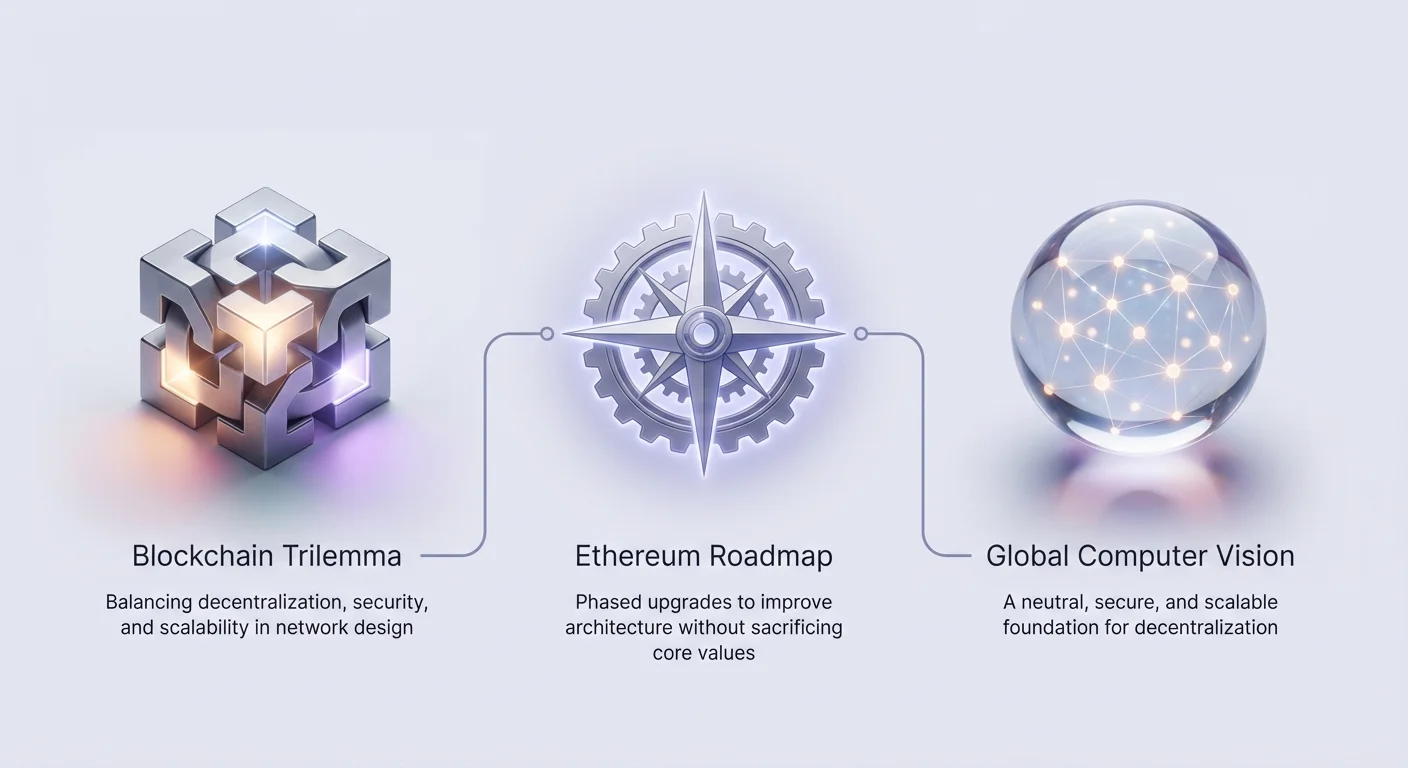
Central to this evolution is the concept of the "blockchain trilemma." This theory suggests that a decentralized network can only optimize for two of three primary features: decentralization, security, and scalability. Ethereum originally prioritized security and decentralization, which often resulted in network congestion and high fees during periods of high demand.
The roadmap is an attempt to solve this trilemma. By implementing these upgrades, the network aims to become scalable enough to handle global demand without sacrificing its core values. The transition involves fundamental changes to both the economic and technical structure of the blockchain.
Pagrindai: Supratimas apie Susijungimą
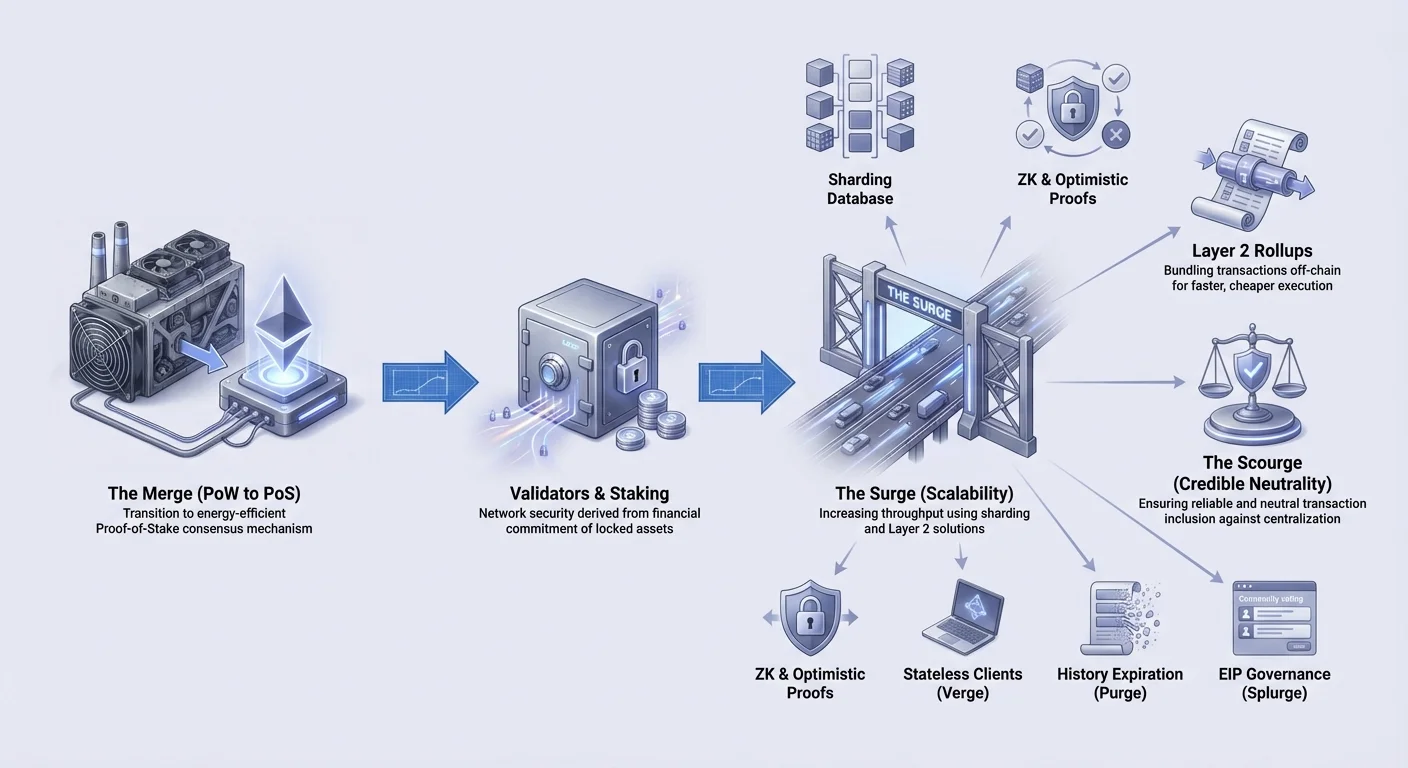
Svarbiausias Ethereum istorijoje atnaujinimas buvo žinomas kaip Susijungimas. Baigtas 2022 m. rugsėjo mėnesį, šis įvykis pažymėjo perėjimą nuo pradinio Darbo įrodymo (PoW) sutarimo mechanizmo prie Iždo įrodymo (PoS). Šis pokytis buvo būtinas siekiant sumažinti tinklo energijos suvartojimą ir padėti pagrindą būsimiems mastelio didinimo atnaujinimams.
Prieš Susijungimą Ethereum remėsi kalnakasiais, kad apsaugotų tinklą. Šie dalyviai valdė energiją intensyviai naudojančią įrangą, kad išspręstų sudėtingas matematines užduotis. Ši sistema, nors ir saugi, suvartodavo didžiulius kiekius elektros energijos. Perėjimas prie Iždo įrodymo pakeitė kalnakasius validatorių, kurie apsaugo tinklą užrakindami kapitalą, o ne degindami energiją.
Iždo įrodymo mechanika
Iždo įrodymo sistemoje tinklo saugumas kyla iš finansinio įsipareigojimo, o ne iš skaičiavimo galios. Dalyviai, vadinami validatoriumi, įšaldo savo kriptovaliutą siųsdami ją į specialią išmaniąją sutartį. Šis įšaldytas turtas veikia kaip užstatas ar garantinis indėlis, garantuojantis jų sąžiningą elgesį.
Protokolas atsitiktinai atrenka validatorių, kad pasiūlytų naujus blokus. Kai validorius pasiūlo bloką, kiti validoriai patikrina duomenis, kad įsitikintų, jog jie atitinka tinklo taisykles. Jei blokas yra galiojantis, jis pridedamas prie grandinės, o validoriai apdovanojami naujai išleista kriptovaliuta ir transakcijų mokesčiais. Ši sistema suderina operatorių finansinius paskatinimus su tinklo sveikata.
Privalumai ir saugumo patobulinimai
Pagrindinis šio perėjimo privalumas buvo dramatiškas energijos vartojimo sumažėjimas. Vertinimai rodo, kad perėjimas prie Iždo įrodymo sumažino Ethereum energijos suvartojimą daugiau nei 99 procentais. Tai pašalino pagrindinę kliūtį instituciniam priėmimui ir aplinkos tvarumui.
Be energijos efektyvumo, nauja sistema įvedė išskirtines saugumo savybes. Darbo įrodymo sistemoje tinklo užpuolimas reikalauja 51 procento maišos galios. Iždo įrodyme užpuolikui reikėtų įsigyti daugumą įšaldyto turto. Tai sukuria aukštą ekonominę kliūtį piktybiškam elgesiui. Be to, protokole yra mechanizmas, vadinamas baudomis (slashing). Jei validorius elgiasi piktybiškai ar pažeidžia protokolo taisykles, jų įšaldytas turtas gali būti konfiskuotas visiškai arba iš dalies.
The Surge: Achieving Massive Scalability
With the consensus mechanism updated, the focus shifts to "The Surge." This phase targets scalability. The objective is to increase the transaction throughput of the network to support thousands of transactions per second. The primary technologies driving this phase are sharding and Layer 2 scaling solutions.
Scalability is critical because the main network, or Layer 1, has a limited capacity. It can typically process only a specific number of transactions per day. When demand exceeds this capacity, users compete to have their transactions included in the next block. This competition drives up gas fees, pricing out smaller users and limiting the utility of decentralized applications.
The Role of Sharding
Sharding is a technique designed to partition the network's database into smaller, more manageable pieces called shards. In a traditional blockchain, every node must process and store every transaction. This requirement ensures security but severely limits speed. Sharding changes this dynamic by distributing the data processing responsibility.
Under a sharded system, validators are assigned to specific shards. Each shard operates somewhat like a separate blockchain with its own state and transaction history. However, unlike independent blockchains, shards communicate and coordinate through the main chain. This allows the network to process many blocks simultaneously rather than consecutively. The initial implementation of sharding focuses on data availability, which enhances the efficiency of Layer 2 rollups.
Layer 2 Solutions and Rollups
Layer 2 solutions are protocols built on top of the Ethereum mainnet. They handle transaction execution off-chain while relying on the main network for security and final settlement. By moving the heavy lifting away from Layer 1, these solutions offer faster speeds and significantly lower costs.
Rollups are currently the most promising Layer 2 technology. They work by bundling hundreds of transactions into a single batch. This batch is processed on the second layer, and only the compressed data is posted back to the main Ethereum blockchain. There are two primary types of rollups: Optimistic rollups and Zero-Knowledge (ZK) rollups.
| Rollup Type | Validation Method | Pros | Cons |
|---|---|---|---|
| Optimistic | Assumes validity by default | EVM compatible, easier to build | Long withdrawal times (7 days) |
| ZK Rollup | Mathematical validity proof | Instant finality, high security | High computational cost, complex |
Optimistic Versus Zero-Knowledge
Optimistic rollups assume that transactions are valid by default. They do not perform computation on the main chain unless someone challenges a transaction. If a challenge occurs, the network verifies the data. This method is compatible with existing Ethereum smart contracts but requires a withdrawal delay to allow time for challenges.
Zero-Knowledge rollups take a different approach. They generate a cryptographic proof that verifies the validity of the transaction batch. This proof is submitted to the main chain. Since the validity is mathematically proven upfront, there is no need for a challenge period. This allows for faster withdrawals. However, the technology is more complex to implement and requires significant computational resources to generate the proofs.
Šėja: Patikimo neutralumo užtikrinimas
Tinklui plečiantis, atsiranda naujų rizikų, susijusių su centralizacija ir cenzūra. „Šėja“ reiškia maršruto punktus, skirtus užtikrinti patikimą ir neutralų sandorių įtraukimą. Šis etapas sprendžia susirūpinimą, kad sudėtingi subjektai gali įgyti per daug kontrolės tinkle.
Ethereum valdymo pagrindinis principas yra „patikimas neutralumas“. Tai reiškia, kad mechanizmas neturėtų diskriminuoti už ar prieš bet kokius konkrečius asmenis. Dizainas turi elgtis su visais sąžiningai. Tačiau ekonominės jėgos Įrodymo pagal akcijas sistemoje gali vesti prie centralizacijos. Kritikai teigia, kad kadangi didesni dalininkai gauna daugiau atlygių, „turtingieji turtėja“. Šis turto susitelkimas teoriškai galėtų vesti prie galios susitelkimo.
Validatoriaus centralizacijos sprendimas
Įėjimo barjeras tapti validatoriumi gali paveikti tinklo decentralizaciją. Jei paleisti validatoriaus mazgą reikia brangios įrangos ar didžiulio kiekio ETH, dalyvauti gali tik turtingos institucijos. Tai sumažina tinklo įvairovę.
Be to, specializuotų paslaugų, tokių kaip skystosios statymo baseinai, kilimas lėmė, kad dideli statymo kiekiai kontroliuojami kelių subjektų. Nors šios paslaugos daro statymą prieinamą vartotojams su mažesniu kapitalu, jos įveda galimą gedimo tašką. Jei vienas subjektas kontroliuoja didelę tinklo statymo dalį, jis galėtų potencialiai paveikti valdymą ar sandorių eilę.
Kovai su tuo maršrutas apima atnaujinimus, užtikrinančius, kad blokų kūrimas liktų paskirstytas. Tikslas – atskirti blokų kūrimo vaidmenį nuo jų siūlymo vaidmens. Šis atskyrimas padeda užkirsti kelią bet kuriam vienam validatoriui cenzūruoti sandorius ar ištraukti pernelyg didelę vertę iš vartotojų.
The Verge and The Purge: Managing Data and History
The long-term health of the blockchain depends on its ability to remain accessible to independent operators. "The Verge" and "The Purge" focus on efficiency, specifically regarding node operation and historical data management.
For a blockchain to be truly decentralized, individuals must be able to verify the ledger themselves. This is done by running a "node." A node is a computer that runs the Ethereum software and validates transactions. If the hardware requirements for running a node become too high, fewer people will do it. This leads to reliance on centralized service providers like Infura, which creates vulnerability.
The Verge: Reducing Verification Costs
The Verge aims to introduce "stateless clients" or Verkle trees. Currently, verifying a block requires access to a large portion of the blockchain's state. As the network grows, this state becomes larger, requiring more RAM and faster SSDs.
The upgrades in this phase will allow nodes to verify blocks without storing the entire state of the network on their hard drives. By reducing the data requirements, it becomes feasible for users to run nodes on consumer-grade hardware, such as mobile phones or basic laptops. This lowers the barrier to entry and increases the resilience of the network.
The Purge: Eliminating Historical Bloat
The Ethereum blockchain carries the weight of its entire history. The Purge involves cleaning up old network history to simplify the protocol. Currently, running a full archival node requires downloading terabytes of data. This history includes every transaction ever executed since the genesis block.
While maintaining a complete history is important for auditing, it is not strictly necessary for validating new transactions. The Purge seeks to implement mechanisms where nodes can expire old history. This means nodes would stop storing data that is older than a certain timeframe, such as one year.
This reduction in storage requirements prevents the network from becoming too heavy. It ensures that new nodes can sync with the network quickly. By managing the accumulation of technical debt, the protocol remains agile and easier to maintain for developers and users alike.
The Splurge: Governance and Future Polish
The final category, "The Splurge," acts as a catch-all for necessary but miscellaneous upgrades. These are the improvements that fix minor issues, improve the user experience, and refine the economic model. It also encompasses the ongoing evolution of Ethereum's governance.
Ethereum is not a static protocol. It requires constant changes to fix bugs and respond to market conditions. This evolution is managed through Ethereum Improvement Proposals (EIPs). Individuals or teams draft proposals, which are then debated by the community. This process relies on "rough consensus" among stakeholders, including miners, node operators, and developers.
Economic Improvements and EIP-1559
One major example of an economic upgrade that fits this category is EIP-1559. Implemented before The Merge, this upgrade overhauled the fee market. It introduced a base fee that is burned (destroyed) with every transaction. This change made transaction fees more predictable for users.
Upgrades like these are crucial for the long-term sustainability of the asset. By burning ETH, the protocol introduces a deflationary pressure that counters the issuance of new tokens to validators. Future "Splurge" upgrades may focus on Account Abstraction, which would make managing crypto wallets as easy as using a traditional banking app.
The Challenge of Decentralized Governance
Governance in a decentralized system is inherently political. Unlike a private company, there is no CEO to make unilateral decisions. Changes must be adopted voluntarily by the thousands of independent nodes running the software.
This process can be slow and contentious. For example, the community must balance progressivism (making rapid changes to improve the network) with conservatism (maintaining stability and minimizing risk). The Ethereum culture has generally favored a progressive approach to solve the trilemma. However, ensuring that these changes reflect the values of the broader community requires constant vigilance and active participation from all stakeholders.
Išvada
Kelio žemėlapis nuo The Merge iki The Splurge yra visapusiškas planas Ethereum tinklui subrandinti. Perėjusi prie Proof-of-Stake, protokolas išsprendė energijos suvartojimo problemas. Per šardinimą ir 2 sluoksnio rollup, jis siekia išspręsti išplečiamumo krizę, kuri istoriškai kankino didelės paklausos blockchainus.
Lygiagrečiai dėmesys mazgų efektyvumui ir istorinių duomenų valdymui užtikrina, kad tinklas liktų decentralizuotas. Mažindami aparatinės įrangos barjerus validatorių ir mazgų operatorių, apsaugoma sistema nuo centralizuotos kontrolės. Nors technologija sudėtinga, galutinis tikslas paprastas: sukurti neutralų, saugų ir išplečiamą pagrindą skaitmeninei ateičiai.
Ethereum atnaujinimai siekia sukurti greitą, saugų pasaulinį kompiuterį, kurį bet kas gali naudoti ir efektyviai patikrinti.