
Decentralizuotos skaitmeninės valiutos architektūra grindžiama saugumo, skaidrumo ir negalimo pakeisti sutarimo pagrindu. Jos šerdyje Bitcoin tinklas veikia per sudėtingą kriptografinių įrodymų, ekonominių paskatų ir išdalytos verifikacijos sąveiką. Šie pagrindiniai mechanizmai — kasyba, darbo įrodymas ir grandinės transakcijos — užtikrina, kad sistema lieka be pasitikėjimo ir atspari cenzūrai. Tačiau pačios savybės, suteikiančios šį tvirtą saugumą, taip pat įveda įgimtas greičio ir pralaidumo ribas. Kai skaitmeninių aktyvų įsisavinimas auga, pokalbis neišvengiamai persikelia nuo to, kaip veikia bazinis sluoksnis, prie to, kaip jį galima mastelinti, kad patenkintų globalią paklausą.
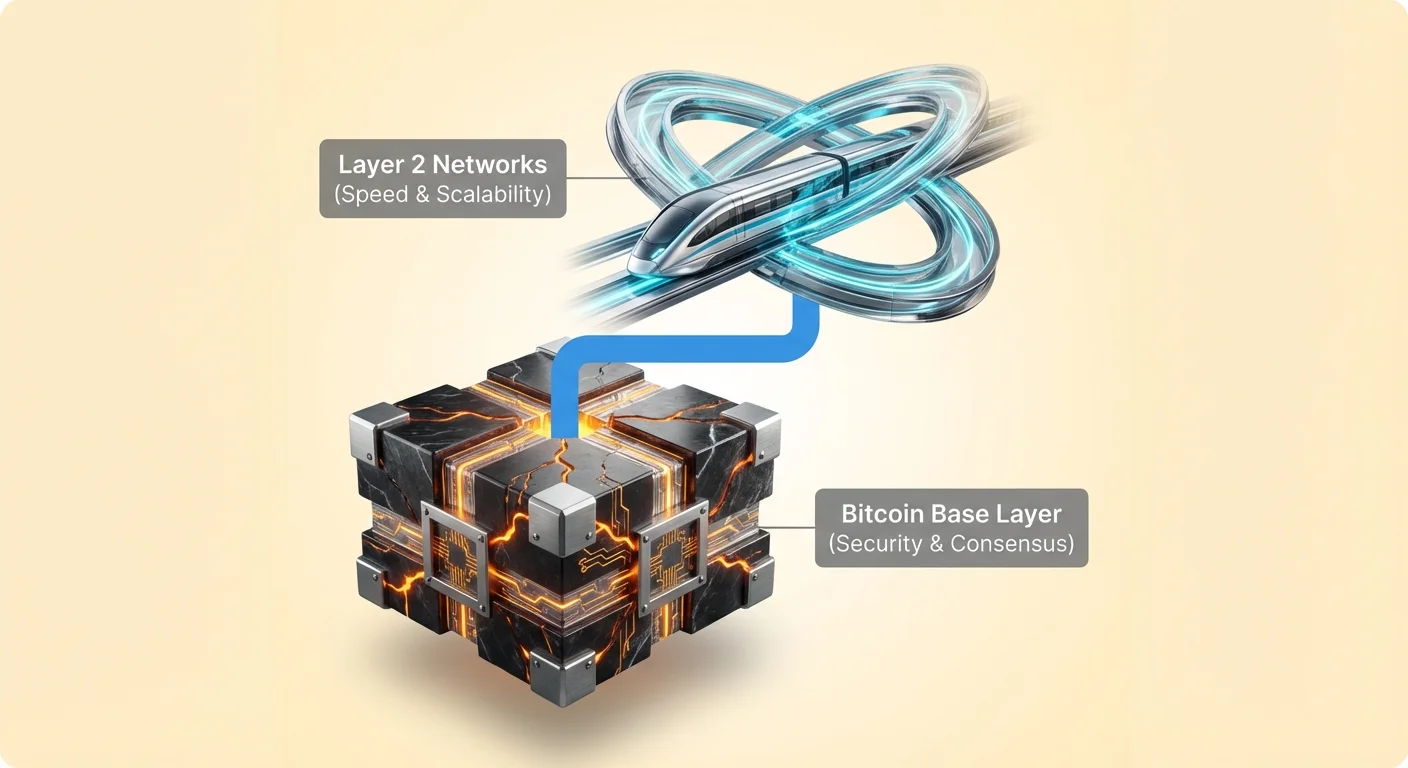
Norint suprasti sprendimus, kurie egzistuoja už pagrindinių mechanizmų ribų, tokius kaip 2 sluoksnio tinklai ir šoninės grandinės, pirmiausia reikia giliai suprasti pagrindinio tinklo apribojimus. Bitcoin dizainas teikia pirmenybę decentralizacijai prieš efektyvumą, tai sąmoningas pasirinkimas, reikalaujantis, kad kiekvienas pilnas mazgas patvirtintų kiekvieną transakciją. Šis perteklinis dubliavimas sukuria neįtikėtinai saugų tinklą, bet sukelia spūstį, kur transakcijų erdvė tampa retu ištekliu. Ekosistemos evoliucija todėl nukreipta į papildomų sluoksnių kūrimą ant šio saugaus pagrindo.
Šis kelių sluoksnių požiūris leidžia pagrindinei blokų grandinei veikti kaip galutiniam atsiskaitymo sluoksniui, o ne grandinės sprendimai tvarko didelės apimties transakcijas. Perkeliant mažesnius pervedimus nuo pagrindinės grandinės, tinklas pasiekia didesnį mastelį neprarandant bazinio sluoksnio saugumo. Ši pažanga nuo pagrindinių protokolų prie pažangių mastelio sprendimų rodo technologijos subrendimą į universalesnę finansinę sistemą.
The Foundation of Consensus: Proof of Work
The security of the Bitcoin network relies on a consensus mechanism known as Proof of Work (PoW). This system requires network participants, known as miners, to expend computational energy to solve complex mathematical puzzles. The solution to these puzzles is difficult to find but easy to verify, creating a barrier to entry that prevents malicious actors from spamming or overtaking the network. This process is not merely about processing transactions but is the fundamental way the network agrees on the state of the ledger.
Miners compete to solve these cryptographic puzzles, and the winner earns the right to add the next block of transactions to the blockchain. This competition ensures that the history of transactions is computationally impractical to reverse. To alter a past record, an attacker would need to redo all the work for that block and every subsequent block, a feat that requires controlling more than half of the total network's processing power. This immutability is the cornerstone of digital value preservation.
The specific algorithm used is the Secure Hash Algorithm 2 (SHA2). Miners run this hashing algorithm repeatedly to find a random number, known as a nonce, that meets a specific difficulty target set by the network. The difficulty adjusts approximately every two weeks to ensure that new blocks are produced roughly every ten minutes, regardless of how much total computing power is active on the network. This self-regulating mechanism maintains the steady heartbeat of the blockchain.
Hashrate and Network Security
Hashrate serves as a critical metric for assessing the health and security of the network. It represents the total computational power being contributed by miners at any given moment. A higher hashrate implies that more resources are dedicated to securing the ledger, making it increasingly difficult for any single entity to disrupt operations. It is a direct measure of the energy and hardware invested in maintaining the system's integrity.
As the hashrate increases, the network automatically raises the difficulty of the mining puzzles. This ensures that the rate of new coin issuance remains predictable, adhering to the protocol's monetary policy. The relationship between hashrate and difficulty creates a competitive environment where miners must constantly upgrade their hardware to maintain profitability. This arms race for efficiency ultimately benefits the security of the entire ecosystem.
The Economic Incentive Structure
The mining process is driven by economic incentives designed to align the interests of miners with the health of the network. Miners are rewarded in two ways: newly minted coins and transaction fees. The block reward acts as a subsidy to encourage participation, especially in the early stages of the network's life. This reward is halved approximately every four years in an event known as the Halving, which introduces a deflationary pressure on the supply.
As the block reward decreases over time, transaction fees are expected to become the primary source of revenue for miners. This shift emphasizes the importance of a fee market where users bid for block space. When the network is congested, fees rise, incentivizing miners to prioritize transactions with higher payouts. This economic model ensures that the network remains self-sustaining even after the minting of new coins eventually ceases.
The Mechanics of On-Chain Transactions
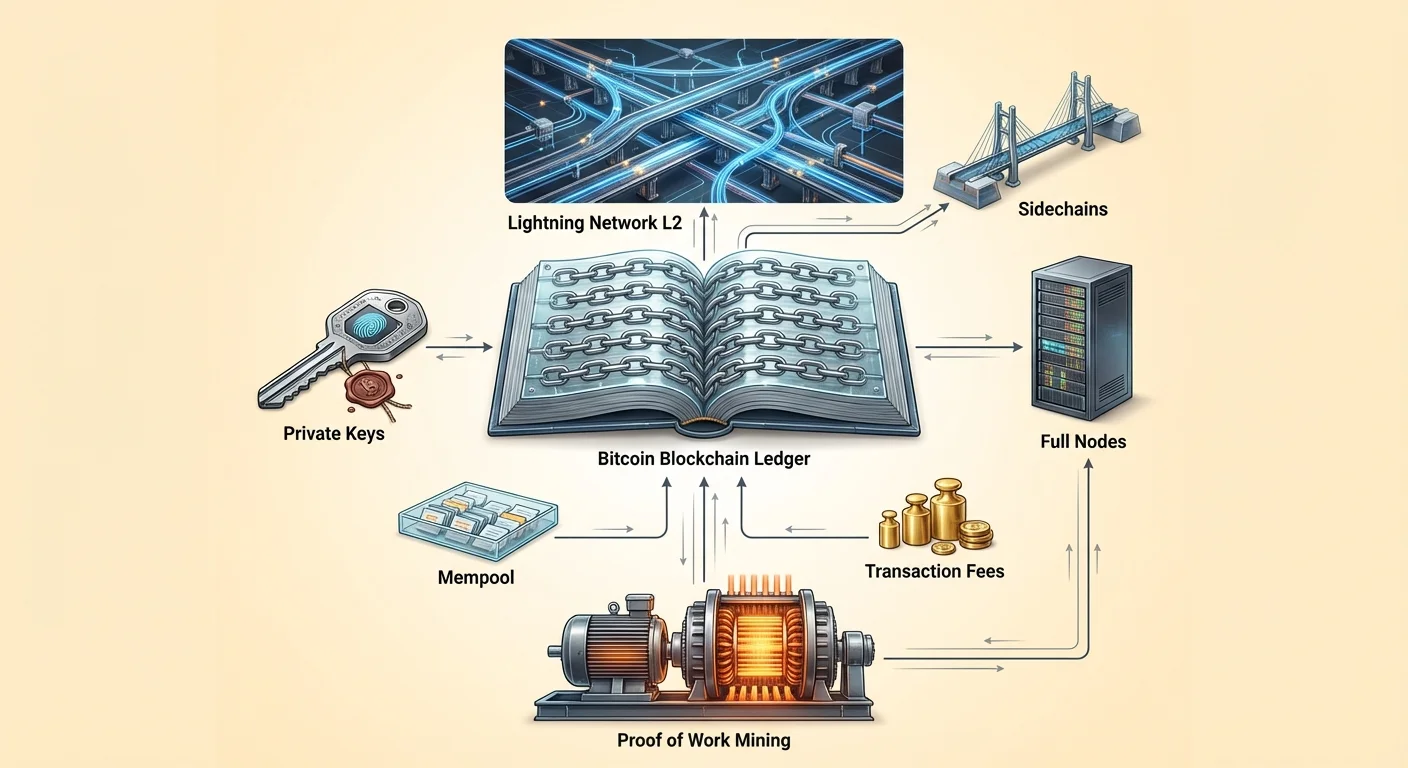
A Bitcoin transaction is fundamentally a message that transfers value from one address to another. These messages are digitally signed using cryptography to prove ownership and authorization. Unlike a bank account that holds a balance, the blockchain uses a model based on Unspent Transaction Outputs (UTXO). In this system, your "balance" is simply the sum of all unspent outputs that your private key can unlock.
When a user initiates a transaction, they are essentially gathering these unspent outputs as inputs and creating new outputs for the recipient. Any difference between the input amount and the amount sent (plus fees) is returned to the sender as change in the form of a new unspent output. This process is similar to paying with cash, where you hand over a larger bill and receive coins back.
The security of these transfers relies on public and private key pairs. The public key acts as the address that others can see and send funds to, similar to an email address. The private key is a secret alphanumeric password that signs the transaction, proving that the sender has the authority to move the funds. This digital signature is verifiable by anyone on the network without revealing the private key itself.
The Role of the Mempool
Before a transaction is permanently recorded on the blockchain, it enters a waiting area known as the mempool (memory pool). The mempool is a collection of unconfirmed transactions held by nodes across the network. It acts as a staging ground where transactions wait to be picked up by miners. Since block space is limited to 1MB, not every transaction in the mempool can be included in the next block immediately.
The mempool is dynamic and fluctuates based on network activity. During periods of high demand, the mempool can become congested, leading to a backlog of unconfirmed transactions. In this environment, a fee market emerges. Miners, looking to maximize their profits, will select transactions with the highest fees per byte of data. Users who need fast confirmation must pay a premium to jump the queue.
Transactions with low fees may sit in the mempool for hours or even days if the network remains busy. In extreme cases, they may eventually be dropped from the mempool if they never get picked up, essentially cancelling the transfer. This mechanism highlights the scarcity of block space and the inherent scalability limits of the base layer.
Transaction Confirmation and Finality
Once a miner includes a transaction in a valid block and broadcasts it to the network, the transaction is considered to have one confirmation. Each subsequent block added to the chain increases the confirmation count, adding layers of security. For example, a transaction with six confirmations is generally considered irreversible because an attacker would need to reverse six blocks of proof-of-work to alter it.
This confirmation process is the solution to the double-spend problem. In digital cash systems, there is a risk that a user could send the same digital token to two different recipients simultaneously. The blockchain prevents this by maintaining a timestamped, public history. If a user tries to spend the same UTXO twice, nodes will reject the second transaction because the inputs have already been spent in the first confirmed transaction.
Bitcoin Script Language
The rules for spending bitcoin are defined by a scripting system known as Bitcoin Script. It is a stack-based language that dictates the conditions under which funds can be moved. Each transaction output contains a locking script, which essentially says, "To spend these funds, you must provide a signature that matches this public key." The transaction input provides the unlocking script to satisfy this condition.
Bitcoin Script is intentionally not Turing-complete, meaning it cannot perform complex loops or recursive logic. This design choice prevents infinite loops that could crash nodes and ensures that transaction verification is fast and deterministic. Despite its limitations, Script allows for advanced features like multi-signature wallets, where multiple parties must sign a transaction to release funds. This programmability is the foundation for more complex scaling solutions like payment channels.
Tinklo mazgai: Knygos sargai
Kol kalnakasiai saugo tinklą energijos sąnaudomis, mazgai yra auditoriai, užtikrinantys taisyklių laikymąsi. Mazgas yra bet koks kompiuteris, vykdantis Bitcoin programinę įrangą, dalyvaujantis tinkle. Jie gauna naujas transakcijas ir blokus, patikrina juos pagal protokolo taisykles ir transliuoja kitiems bendražygiams. Jei kalnakasis sukuria negaliojantį bloką, mazgai jį atmeta, užtikrindami, kad kalnakasiai negali apgauti ar pakeisti sutarimo taisyklių.
Yra skirtingi mazgų tipai, kiekvienas atliekantis specifinę funkciją ekosistemoje. Pilni mazgai palaiko pilną blokų grandinės kopiją ir nepriklausomai patikrina kiekvieną transakcijų istoriją nuo pat pirmo bloko. Jie yra galutinė tinklo būsenos autoritetas, nes nesiremia trečiosiomis šalimis duomenims. Ši nepriklausomybė yra kritiška decentralizacijai palaikyti.
| Mazgų tipas | Funkcionalumas | Išteklių reikalavimai |
|---|---|---|
| Pilnas mazgas | Patikrina visas taisykles, saugo pilną istoriją | Dideli saugojimo ir pralaidumo reikalavimai |
| Apgenėtas mazgas | Patikrina visas taisykles, ištrina senus duomenis | Vidutiniai saugojimo, dideli pralaidumo reikalavimai |
| Lengvas mazgas (SPV) | Patikrina antraštes, pasitiki pilnais mazgais | Minimalūs saugojimo ir ištekliai |
Lengvi mazgai, arba Supaprastinto mokėjimo patvirtinimo (SPV) klientai, nesaugo pilnos blokų grandinės. Vietoj to, jie atsisiunčia tik blokų antraštes ir remiasi pilnais mazgais, teikiančiais transakcijų duomenis. Nors juos daug lengviau vykdyti mobiliesiems įrenginiams, jie siūlo mažesnį saugumą ir privatumą nei pilni mazgai. Mazgų tipų įvairovė užtikrina, kad tinklas lieka prieinamas vartotojams su skirtingais techniniais ištekliais.
Decentralizacija ir atsparumas
Mazgų pasiskirstymas po visą pasaulį daro tinklą atsparią cenzūrai ir vieno gedimo taškams. Kadangi kiekvienas pilnas mazgas turi knygos kopiją, nėra centrinio serverio, kurį galima būtų išjungti ar manipuliuoti. Net jei didelė tinklo dalis išeitų neprisijungusi, likę mazgai toliau veiktų, išsaugodami blokų grandinės vientisumą.
Vykdant mazgą prisidedama prie ekosistemos sveikatos didinant nepriklausomų patikrinančiųjų skaičių. Tai leidžia vartotojams tiesiogiai bendrauti su tinklu, užtikrinant, kad jų transakcijos būtų transliuojamos ir patikrinamos be tarpininkų. Ši savarankiškumas yra kriptovaliutos filosofijos esmė, suteikianti individams būti savo banku.
Mastelio iššūkis
Aprašyti pagrindiniai mechanizmai sukuria saugią ir decentralizuotą sistemą, bet įgimtai ribotą pralaidumo požiūriu. Bloko dydžio riba ir dešimties minučių bloko laikas reiškia, kad tinklas gali apdoroti tik saują transakcijų per sekundę. Kai globalus įsisavinimas didėja, šis talpos apribojimas sukelia tinklo spūstis ir kylančius mokesčius.
Ši situacija sukuria „mokesčių rinką“, kur tik didelės vertės transakcijos yra ekonomiškai naudingos pagrindinėje grandinėje. Mikrotransakcijos, tokios kaip kava, tampa nepraktiškos, jei transakcijos mokestis viršija perkamų prekių vertę. Šis apribojimas paskatino mastelio sprendimų, veikiančių ant ar šalia pagrindinės blokų grandinės, kūrimą.
Šie sprendimai siekia padidinti transakcijų pralaidumą neprarandant bazinio sluoksnio saugumo. Perkeliant didžiąją veiklos dalį nuo pagrindinės grandinės, jie mažina spūstis ir leidžia naujus naudojimo atvejus, reikalaujančius momentinio atsiskaitymo ir beveik nuliniais mokesčiais. Šis sluoksniuotas požiūris panašus į interneto protokolų rinkinį, kur skirtingi sluoksniai tvarko skirtingas funkcijas.
Layer 2 Networks and Payment Channels
Layer 2 networks are protocols built on top of the base blockchain (Layer 1) to improve scalability and efficiency. The most prominent example in the Bitcoin ecosystem is the Lightning Network. This solution utilizes the programmability of Bitcoin Script to create bi-directional payment channels between users.
In a payment channel, two parties commit funds to a multi-signature address on the main blockchain. This initial transaction is the only one recorded on-chain. Once the channel is open, the two parties can exchange unlimited transactions back and forth instantly by updating their local balance sheets. These updates are signed and valid but are not broadcast to the main network until the channel is closed.
Because these intermediate transactions do not hit the blockchain, they do not consume block space or incur mining fees. This allows for instant, high-volume micropayments. When the parties are finished transacting, they close the channel, and the final balance is settled on the main blockchain in a single transaction.
Network of Channels
The true power of the Lightning Network lies in its ability to route payments across a web of interconnected channels. You do not need a direct channel with a merchant to pay them. If you have a channel with User A, and User A has a channel with the merchant, the network can route your payment through User A securely. This routing is trustless, ensuring that intermediaries cannot steal the funds.
Lightning Network nodes facilitate these off-chain transactions. Like base layer nodes, they run software to manage channels and route payments. This creates a secondary peer-to-peer network that operates in parallel with the main blockchain. It effectively creates a high-speed rail system on top of the secure foundation of the base layer.
Script and Smart Contracts in Layer 2
The functionality of Layer 2 solutions relies heavily on the capabilities of Bitcoin Script. Specifically, features like time-locks and multi-signature requirements are essential. Time-locks ensure that if one party tries to cheat by broadcasting an old balance state, the other party has a window of time to challenge it and claim the funds. This "justice transaction" mechanism incentivizes honest behavior within the channel.
While Bitcoin Script is not Turing-complete, it is powerful enough to support these types of smart contracts. This demonstrates that complex functionality can be built without complex base-layer logic. By keeping the base layer simple and secure, complex applications can be engineered on higher layers, minimizing the risk of bugs or exploits affecting the main ledger.
Benefits of Off-Chain Scaling
The primary benefit of Layer 2 solutions is the dramatic increase in throughput. While the base layer may process fewer than ten transactions per second, Layer 2 networks can potentially handle millions. This scalability is essential for Bitcoin to function as a medium of exchange for daily commerce rather than just a store of value.
Additionally, Layer 2 networks offer improved privacy. Since intermediate transactions are not recorded on the public blockchain, they are not visible to the entire network. Only the opening and closing of channels leave a permanent public footprint. This adds a layer of confidentiality to financial activities that is often lacking in completely transparent public ledgers.
Šoninės grandinės ir federacija
Kitas mastelio požiūris apima šoninių grandinių naudojimą. Šoninė grandinė yra atskira blokų grandinė, prijungta prie pagrindinės tėvinės grandinės naudojant dvikryptį kaištį. Šis kaištis leidžia aktyvams judėti tarp pagrindinės grandinės ir šoninės grandinės. Kai aktyvai šoninėje grandinėje, jie gali būti transakcinami pagal tos konkrečios grandinės taisykles, kurios gali skirtis nuo pagrindinio tinklo.
Šoninės grandinės gali būti optimizuotos greičiui, mažesniems mokesčiams ar pažangioms funkcijoms, kaip sudėtingos išmaniosios sutartys, neįmanomos pagrindinėje grandinėje. Pavyzdžiui, šoninė grandinė gali naudoti kitą sutarimo mechanizmą, leidžiantį greitesnius blokų laikus. Vartotojai gali perkelti savo bitcoin į šoninę grandinę šių funkcijų naudojimui ir tada grąžinti į pagrindinę grandinę saugumui ir atsiskaitymui.
Federacijos vaidmuo
Dvikryptį kaištį tarp grandinių dažnai valdo federacija. Federacija yra serverių ar mazgų grupė, veikianti kaip tarpininkai aktyvų perkėlimui tarp grandinių patvirtinti. Skirtingai nuo visiškai be pasitikėjimo pagrindinio tinklo prigimties, šoninės grandinės dažnai apima tam tikrą pasitikėjimą federacija saugiam kaiščio valdymui.
Nepaisant šio kompromiso, šoninės grandinės siūlo vertingą smėlio dėžę inovacijoms. Kūrėjai gali eksperimentuoti su naujomis funkcijomis ir mastelio technikomis neprarandant pagrindinio tinklo stabilumo. Jei šoninė grandinė sugenda ar yra pažeista, žala apribota toje grandinėje, paliekant pagrindinę blokų grandinę nepaliestą.
Bazinio sluoksnio optimizavimas
Kol 2 sluoksniai ir šoninės grandinės teikia reikšmingą mastelį, patobulinimai taip pat daromi tiesiogiai baziniame sluoksnyje efektyvumui gerinti. Protokolo atnaujinimai vaidina lemiamą vaidmenį maksimaliai išnaudojant ribotą bloko vietą. Pavyzdžiui, Atskirto liudytojo (SegWit) atnaujinimas pakeitė duomenų saugojimą bloke, efektyviai padidindamas transakcijų talpą.
Naujesnės inovacijos kaip Taproot ir Schnorr parašai dar labiau optimizuoja transakcijų duomenis. Schnorr parašai leidžia kelis skaitmeninius parašus agreguoti į vieną. Tai ypač naudinga kelių parašų transakcijoms ir sudėtingoms išmaniosioms sutartims. Mažindami reikalingų duomenų kiekį, šios transakcijos užima mažiau vietos bloke ir patiria mažesnius mokesčius.
Šie atnaujinimai ne tik gerina mastelį, bet ir pagerina privatumą. Sudėtingos Taproot naudojančios transakcijos blokų grandinėje atrodo nep skirtamos nuo standartinių transakcijų. Ši fungiškumas užtikrina, kad visos monetos traktuojamos lygiavertiškai, nepaisant jų transakcijų istorijos ar naudojamos piniginės tipo.
Transakcijų pagreitintuvai
Situacijose, kai tinklas užkimštas ir mastelio sprendimai nenaudojami, vartotojai gali susidurti su užstrigusiomis transakcijomis. Bitcoin transakcijų pagreitintuvai atsirado kaip paslauga šiai problemai spręsti. Šios paslaugos koordinuoja su kasybos baseinais specifinėms transakcijoms prioritetizuoti.
Kai vartotojas pateikia transakcijos ID pagreitintuvui, paslauga moka priedą kalnakasiams įtraukti tą transakciją į kitą bloką, aplenkiant standartinę mokesčių rinkos eilę. Tai praktiškas, nors dažnai mokamas, sprendimas skubai bazinio sluoksnio apribojimuose. Tai pabrėžia nuolatinę bloko vietos retos realybę ir ekonominius mechanizmus, reguliuojančius patvirtinimo prioritetą.
Išvada
Bitcoin ekosistemos evoliucija demonstruoja sudėtingą pusiausvyrą tarp saugumo ir mastelio. Pagrindiniai mechanizmai — darbo įrodymas, kasyba ir grandinės sutarimas — suteikia nepalenkiamą pasitikėjimo ir decentralizacijos pagrindą. Šie elementai užtikrina, kad tinklas lieka saugus ir atsparus cenzūrai, įvykdydamas pagrindinį vaidmenį kaip skaitmeninės vertės saugykla. Tačiau šio dizaino įgimti apribojimai reikalauja kelių sluoksnių požiūrio globaliems transakcijų kiekiams tvarkyti.
Mastelio sprendimai kaip Lightning Network ir šoninės grandinės reprezentuoja kitą šios technologinės kelionės fazę. Naudodami pagrindinės grandinės saugumą, perkeldami veiklą į efektyvesnius sluoksnius, šie protokolai išsprendžia įtampą tarp decentralizacijos ir greičio. Jie paverčia tinklą iš paprastos knygos į visapusišką finansinę sistemą, gebančią palaikyti viską nuo didelių atsiskaitymų iki momentinių mikro mokėjimų. Kai šios technologijos bręsta, jos toliau stiprina visos kriptovaliutų kraštovaizdžio naudingumą ir atsparumą.
Inovacijos mastelio sluoksniuose paverčia bazinio protokolo apribojimus globalios finansinės sistemos pagrindu.