암호화폐 여정에 처음 발을 들일 때는 간단한 모바일 지갑으로 충분할 수 있습니다. 하지만 포트폴리오가 성장함에 따라 위험도 증가하며, 보안은 편의에서 필수로 변합니다. 상당한 자본을 보유한 사용자에게 데스크톱에 키를 보관하거나 기본 단일 키 소프트웨어 지갑 같은 표준 보안 조치는 받아들일 수 없는 취약점이 됩니다. 은행 금고의 디지털 등가물이 필요합니다.
이 가이드는 기본 자체 보관을 넘어 기관급 보안의 두 기둥인 Hardware Wallets이 제공하는 물리적 방어와 Multi-Signature (Multisig) Schemes가 제공하는 분산 제어를 탐구합니다. 우리는 트레이드오프를 비교하고, 이러한 시스템 구현 방법을 상세히 설명하며, 키 분배와 복구 계획을 위한 정교한 전략을 개요하여 자산이 도난, 손실, 단일 실패 지점으로부터 보호되도록 합니다.
고가치 포트폴리오를 위한 보안 필수성
고액 자산가, 회사 또는 분산 자율 조직(DAO)의 경우, 주요 목표는 작은 금액 보호에서 세대 부의 지속적이고 안전한 접근을 보장하는 것으로 전환됩니다. 작은 포트폴리오를 위해 구축된 보안 모델은 표적 공격이나 치명적인 개인 실패를 견딜 수 없습니다.
표준 지갑의 한계
대부분의 초보자 지갑은 한 사람과 한 기기에서 제어되는 단일 개인 키에 의존합니다. 이는 단일 서명자 지갑으로 알려져 있습니다. 작은 금액에는 효과적이지만, 이 설정은 파괴적인 단일 실패 지점을 만듭니다:
- 물리적 도난/손실: 개인 키가 포함된 물리적 기기가 분실, 도난 또는 손상되면 자금에 접근할 수 없습니다(시드 구문을 복구하지 않는 한).
- 해킹/맬웨어: 기기가 인터넷에 연결되어 맬웨어 또는 피싱 공격으로 손상되면 공격자가 거래에 서명하여 지갑 전체를 즉시 비울 수 있습니다.
- 강제/오류: 단일 서명자 설정에서 한 개인이 치명적인 실수를 하거나 거래 서명에 강제될 수 있으며, 어떠한 견제나 균형 없이 총 손실로 이어집니다.
"기관급" 보안 정의
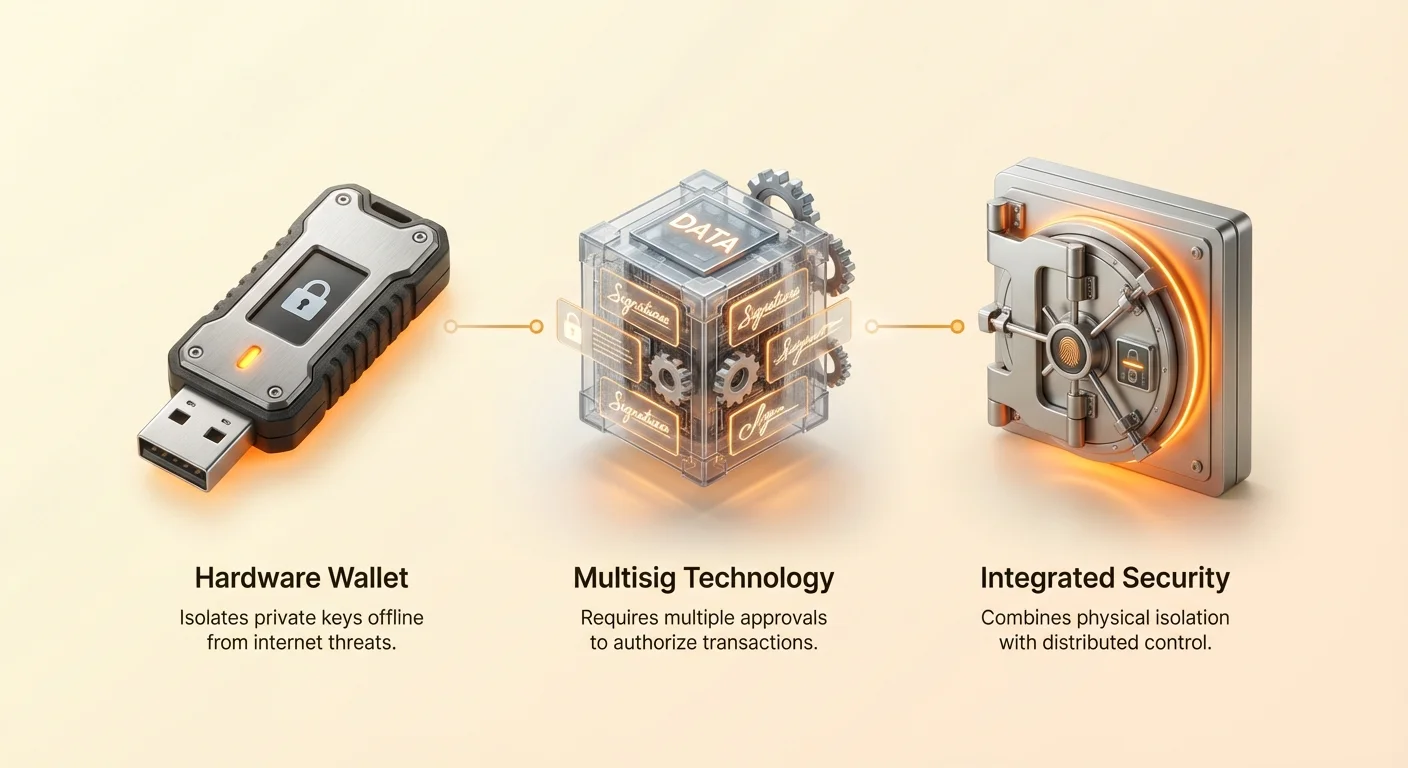
기관급 보안은 격리와 중복성이라는 두 핵심 개념을 통해 손실 위험을 최소화합니다.
- 격리 (하드웨어 지갑): 자금을 제어하는 실제 비밀인 개인 키가 인터넷이나 악성 코드를 실행할 수 있는 운영 체제에 절대 노출되지 않도록 보장합니다.
- 중복성 (멀티시그): 모든 거래를 검증하기 위해 여러 독립적인 승인(키)이 필요하여 단일 실패 지점을 제거합니다. 이는 한 키를 잃거나 한 서명자가 손상되어도 총 손실로 이어지지 않음을 의미합니다.
하드웨어 지갑: 자체 보관의 기초
하드웨어 지갑은 개인 키를 오프라인으로 안전하게 저장하고 거래에 서명하는 한 가지 일만 수행하도록 설계된 전용 특수 기기(종종 USB 스틱처럼 보임)입니다. 이 오프라인 저장은 종종 "콜드 스토리지"라고 불립니다.
하드웨어 지갑이 개인 키를 보호하는 방법
하드웨어 지갑의 핵심 혁신은 Secure Element입니다. 이는 변조 방지로 특별히 설계된 칩으로, 맬웨어, 바이러스 또는 물리적 공격자가 내부에 저장된 개인 키를 추출하는 것이 사실상 불가능합니다.
암호화폐를 보낼 때:
- 거래 세부 정보는 컴퓨터(온라인)에서 생성됩니다.
- 이 세부 정보는 하드웨어 지갑(오프라인)으로 전송됩니다.
- 기기의 작은 화면에서 거래를 물리적으로 확인하고 승인합니다.
- 보안 요소는(기기를 절대 떠나지 않는) 개인 키를 사용하여 거래에 디지털 서명합니다.
- 서명된 거래는 블록체인에 브로드캐스트하기 위해 컴퓨터로 다시 전송됩니다.
개인 키가 격리된 환경을 절대 떠나지 않기 때문에 컴퓨터가 완전히 맬웨어에 감염되어도 자금은 안전합니다.
중요한 하드웨어 지갑 복구 계획
하드웨어 지갑 자체는 견고하지만, 궁극적인 보안은 일반적으로 12개 또는 24개 단어 목록인 Seed Phrase(또는 Recovery Phrase)에 의존합니다. 이 구문은 자금에 대한 마스터 키입니다. 기기가 파괴되면 이 구문을 새롭고 호환되는 기기에 입력하여 지갑에 접근할 수 있습니다.
모범 사례: 계층화된 물리적 보안
- 재료: 시드 구문을 디지털로 저장하지 마세요(사진, 클라우드 저장소, 이메일). 내구성 있고 내화 및 방수 재료(예: 강철 판)에 적어 두세요.
- 위치: 구문은 기기 자체와 물리적으로 분리된 위치에 보관하세요. 기기가 집에 있다면 구문은 이상적으로 다른 고보안 위치(예: 내화 금고 예금 상자 또는 별도의 보안 위치)에 있어야 합니다.
- 분할 (Shamir 백업): 진정한 극한 보안을 위해 Shamir의 비밀 공유(또는 간단한 변형) 같은 고급 기법으로 시드 구문을 분할하는 것을 고려하세요. 이는 구성 요소 일부(예: 5개 중 3개 필요)의 특정 수만 있으면 전체 시드 구문을 재구성할 수 있게 합니다.
하드웨어 지갑 트레이드오프
| 장점 | 단점 |
|---|---|
| 완전한 격리 | 단일 물리적 객체에 의존. |
| 해킹 장벽 높음 | 설정 또는 복구 중 사용자 오류 가능성. |
| 사용 간단 | 시드 구문 손실 시 자금 영구 손실. |
Understanding Multi-Signature (Multisig) Technology
If hardware wallets solve the problem of isolation, multisig solves the problem of redundancy and governance. Multisig wallets are not physical devices; they are special smart contracts deployed on a blockchain (most commonly Ethereum, but also available on Bitcoin and other chains) that require multiple keys to authorize any outgoing transaction.
How Multisig Works: The N-of-M Scheme
Multisig uses an N-of-M scheme, where:
- M is the total number of private keys (signers) associated with the wallet.
- N is the minimum number of keys required to approve a transaction.
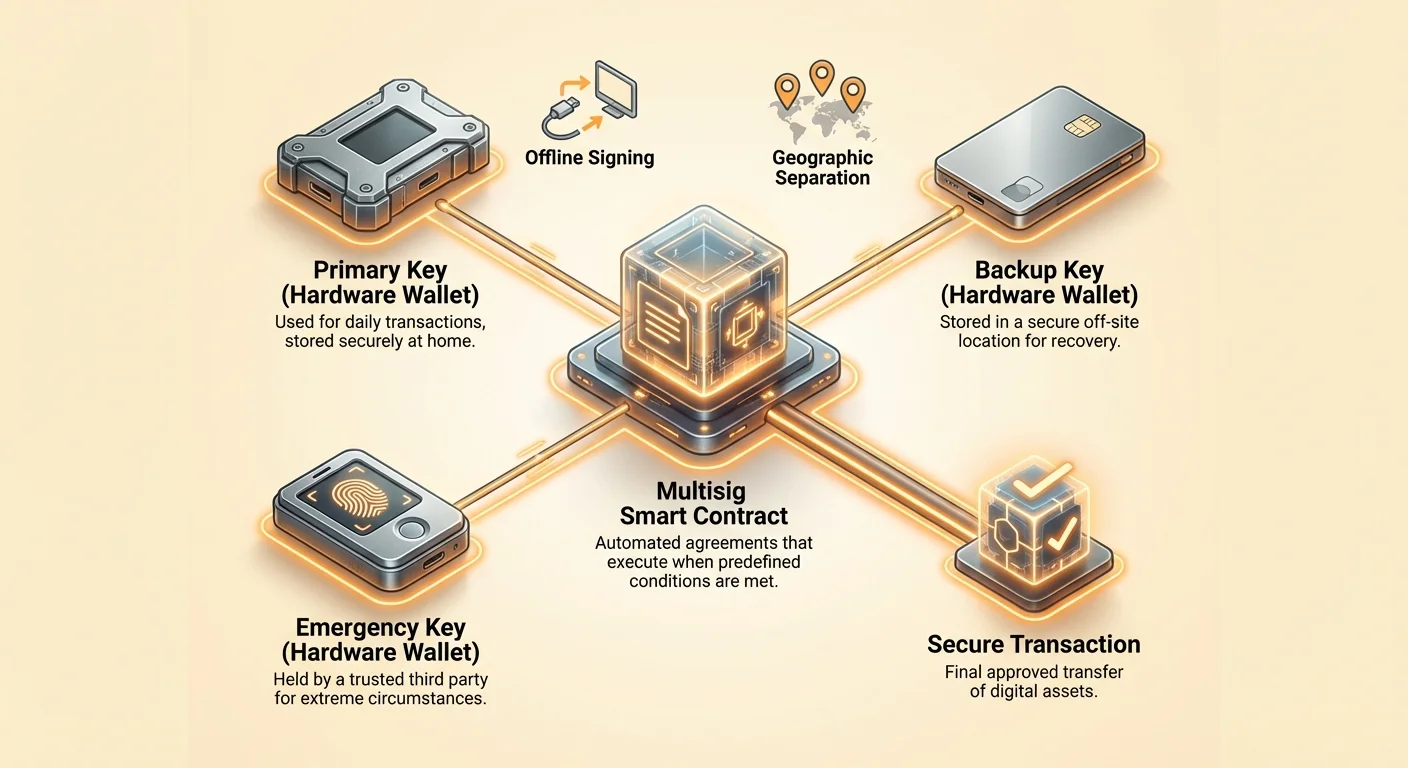
A common setup for an individual holding significant wealth might be a 2-of-3 scheme: three keys exist, but only two of them are needed to send funds.
Scenario Example (2-of-3):
- Key 1: Held by the individual on Hardware Wallet A (Primary).
- Key 2: Held by the individual on Hardware Wallet B (Backup/Remote Location).
- Key 3: Held by a trusted family member or lawyer (Emergency Key).
If Key 1 is lost or compromised, the individual can still use Key 2 and Key 3 together to approve a transaction to a new, secure wallet, ensuring no single point of failure.
Ideal Use Cases for Multisig
Multisig is the standard security choice for any setup where control must be distributed or errors must be mitigated:
- Corporate Treasury Management: Requires multiple board members or executives to approve large expenditures, preventing rogue employees or simple internal theft.
- Decentralized Autonomous Organizations (DAOs): Used to govern community funds, requiring a majority of elected signers to approve proposals.
- Inheritance Planning/Estate Management: Allows an estate planner or designated trustee to act as one of the required signers, providing access to assets after a triggering event (such as the death or incapacitation of the primary holder).
- Advanced Personal Security: Protects the individual from loss of a single key, physical coercion, or temporary unavailability.
Multisig vs. Standard Single-Key Wallets
| Feature | Single-Key Wallet | Multisig Wallet |
|---|---|---|
| Control | Single individual/device | Distributed among multiple parties |
| Transaction Approval | One signature required | N-of-M signatures required |
| Security Type | Isolation (hardware) | Redundancy & Governance (software/contract) |
| Recovery | Dependent on one seed phrase | Dependent on having N out of M keys |
| Cost | Minimal (gas fees only) | Higher setup costs (deploying the smart contract) |
Practical Multisig Setup: A Gnosis Safe Guide
While various multisig solutions exist, Gnosis Safe (now known as Safe) is the industry standard for creating smart contract wallets on Ethereum and many L2 networks. It provides a highly audited, user-friendly interface for managing complex signing requirements.
Initial Setup and Configuration
Setting up a multisig safe involves deploying a specialized smart contract to the blockchain.
Step 1: Define Your Strategy (N-of-M) Before deployment, you must determine how many signers (M) you need and the threshold (N). For major personal portfolios, a 2-of-3 or 3-of-5 setup is common.
Step 2: Key Preparation Each signer address in the multisig should be derived from an independent, secure source. Crucially, every key involved in your multisig scheme should ideally be backed by its own, separate hardware wallet.
- Anti-Pattern: Using the same seed phrase or device for multiple keys in the multisig defeats the purpose of redundancy.
Step 3: Deploy the Safe Using the Safe interface, you designate the list of owner addresses and set the required confirmation threshold (N). Once deployed, this smart contract address is your permanent wallet address.
Step 4: Initial Funding and Test Transaction Fund the newly created Safe. Before moving significant capital, execute a small test transaction. This validates two things: 1) all designated signers can successfully connect and propose transactions, and 2) the N-of-M threshold works as expected.
Multisig Key Distribution Strategies
The effectiveness of a multisig setup hinges on the independence and security of the M keys. Sophisticated users must employ a strategy that minimizes the risk of a coordinated failure (e.g., a physical attack in one location).
1. Geographic Separation
Keys should be stored in physically disparate locations to mitigate against localized disasters (fire, flood, burglary).
- Example: Key 1 (Primary) in a home safe; Key 2 (Backup) in a secure bank vault 50 miles away; Key 3 (Emergency) with a trusted estate lawyer across the country.
2. Device and Vendor Independence
If possible, use hardware wallets from different manufacturers for different keys. If one manufacturer has a zero-day vulnerability, only one key is potentially compromised.
- Example: Key 1 on a Ledger; Key 2 on a Trezor; Key 3 on a specialized air-gapped computer running signing software.
3. Temporal Distribution (Use Cases)
Keys should only be brought out when necessary.
- Primary Key (Daily): Used for common transactions.
- Backup Key (Periodic): Stored cold and only used if the Primary Key is lost or compromised.
- Emergency Key (Rare): Held by a trusted third party, used only in extreme circumstances or as part of a death/incapacitation plan.
Key Management and Regular Audit
Multisig is not a "set-it-and-forget-it" solution. Regular, scheduled audits are essential:
- Verification: Ensure all owner addresses listed on the contract still correspond to the intended key holders and devices.
- Transaction Logs: Review all approved and pending transactions to catch unauthorized proposals quickly.
- Signer Health Check: Periodically require all signers to successfully approve a minor transaction (like a low-value self-transfer) to confirm they still possess access and understand the signing process.
보안 모델 병합: 멀티시그 서명자로서의 하드웨어 지갑
가장 견고한 보안 아키텍처는 두 기술의 강점을 결합합니다. 각 필수 서명이 자체 하드웨어 지원 키에서 오도록 함으로써 물리적 격리 와 분산 중복성을 달성합니다.
궁극의 조합: 하드웨어 지원 멀티시그
이 설정에서 하드웨어 지갑은 N-of-M 방식의 키 중 하나의 암호화 기기로 작용합니다.
보호 스택:
- 1계층 (물리적): 각 키는 하드웨어 지갑의 Secure Element 내에 안전하게 저장됩니다. 키는 인터넷에 노출되지 않습니다.
- 2계층 (중복성): 멀티시그 스마트 계약은 모든 자금 이동을 승인하기 위해 이러한 하드웨어 보안 키 2개 이상을 요구합니다.
이 설정은 공격자가 지리적으로 분리된 여러 하드웨어 지갑을 물리적으로 손상 하고 해당 서명 승인을 성공적으로 획득해야 하며, 공격을 기하급수적으로 복잡하고 비용이 많이 들게 만듭니다.
사회적 복구 메커니즘 구현
암호화폐 보유자의 주요 우려는 무력화되거나 사망할 경우입니다. 멀티시그는 이를 위해 강력한 솔루션인 Social Recovery를 제공합니다.
복구 구문을 하나의 가족 구성원이 보관하는 데 의존하는 대신(상속인에게 실패 지점 생성), 신뢰할 수 있는 개인을 멀티시그 구조 자체에 통합할 수 있습니다.
사회적 복구 예시 (3-of-5 멀티시그):
- 키 1 & 2: 개인이 보유 (기본 및 백업 하드웨어 지갑).
- 키 3: 신뢰할 수 있는 유산 변호사가 보유.
- 키 4: 배우자 또는 주요 수혜자가 보유.
- 키 5: 독립적인 재무 계획자가 보유.
개인이 살아 있고 활동 중이라면 자금을 이동하는 데 키 1과 2만 필요합니다(2-of-5 임계값). 개인이 무력화되면 키 3, 4, 5가 결합하여 거래를 실행하고 유산 지침에 따라 자산을 이동할 수 있으며, 안전하고 신뢰 최소화된 상속 경로를 제공합니다.
Determining Your Advanced Security Strategy
Choosing the right security strategy depends entirely on the size of your portfolio, your personal tolerance for complexity, and the specific risks you are trying to mitigate.
The Security-Complexity Trade-Off
| Strategy | Risk Mitigation Focus | Complexity | Cost/Time Investment | Best For |
|---|---|---|---|---|
| Single Hardware Wallet | Hacking, Malware, Simple Loss | Low | Low | Mid-level portfolios, high risk of online attack. |
| Multisig (2-of-3) | Coercion, Single-Key Loss, Error | Medium | Medium | Large personal portfolios, requiring key redundancy. |
| Hardware-Backed Multisig (3-of-5) | Targeted Attacks, Geographic Disaster, Inheritance | High | High | Corporate treasuries, generational wealth, DAOs. |
Risk Matrix: When to Choose 2-of-3 vs. 3-of-5
Choosing 2-of-3:
- Focus: Simplicity and swift recovery.
- Benefit: Requires fewer signers to act, meaning fewer people need to coordinate to make a transaction. Ideal for a primary holder and one secure backup key, plus one emergency key.
- Risk: If two keys are lost or compromised, the wallet is locked forever.
Choosing 3-of-5:
- Focus: Extreme resilience and robust governance.
- Benefit: Allows two signers to be lost or unavailable without jeopardizing access (you still have three remaining keys). This setup is significantly more resilient to loss and coercion.
- Risk: Coordination is harder. If you need to make a fast transaction, getting three people or three devices ready takes time. This is best suited for long-term storage and treasury management, not active trading.
Actionable Tip: Prioritize Key Independence
Regardless of the N-of-M configuration you choose, the most important element is the independence of the keys. Each signer must be geographically, digitally, and often temporally independent from the others to prevent a single event (physical break-in, computer virus) from leading to total asset loss.
결론
암호화폐 신규 사용자에게 주요 보안 교훈은 자체 보관입니다. 상당한 포트폴리오를 관리하는 고급 사용자에게 교훈은 분산 자체 보관으로 전환됩니다. 기본 격리를 위해 하드웨어 지갑을 전략적으로 사용하고 Gnosis Safe 같은 견고한 멀티시그 프레임워크에 통합함으로써 희망과 간단한 비밀번호에 의존하는 것을 넘어섭니다. 중복성, 분산 거버넌스, 검증 가능한 분산 제어에 기반한 기관급 보안 프레임워크를 구축하여 디지털 자산에 대한 진정한 자체 주권을 달성합니다.