
Receiving cryptocurrency seems like the most passive action in the digital asset ecosystem. On the surface, it appears as simple as copying a string of characters or showing a QR code to a sender. However, the mechanics behind receiving digital assets involve complex considerations regarding privacy, security, and future transaction costs. When you accept Bitcoin or other cryptocurrencies, you are interacting with a public ledger that permanently records every movement of funds.
Understanding how to receive assets safely requires more than just knowing where to find your wallet address. It involves recognizing the implications of that public record. Every transaction leaves a digital footprint. Without proper hygiene, such as avoiding address reuse, you may inadvertently expose your entire financial history to anyone with an internet connection.
Furthermore, the way you receive funds today directly impacts how much you will pay to spend them tomorrow. This concept, often overlooked by beginners, is rooted in the technical structure of blockchain transactions. By ignoring these details, users often find themselves paying exorbitant fees or compromising their long-term security. Mastering the art of receiving is the first step toward true financial sovereignty.
The Mechanics of a Digital Address
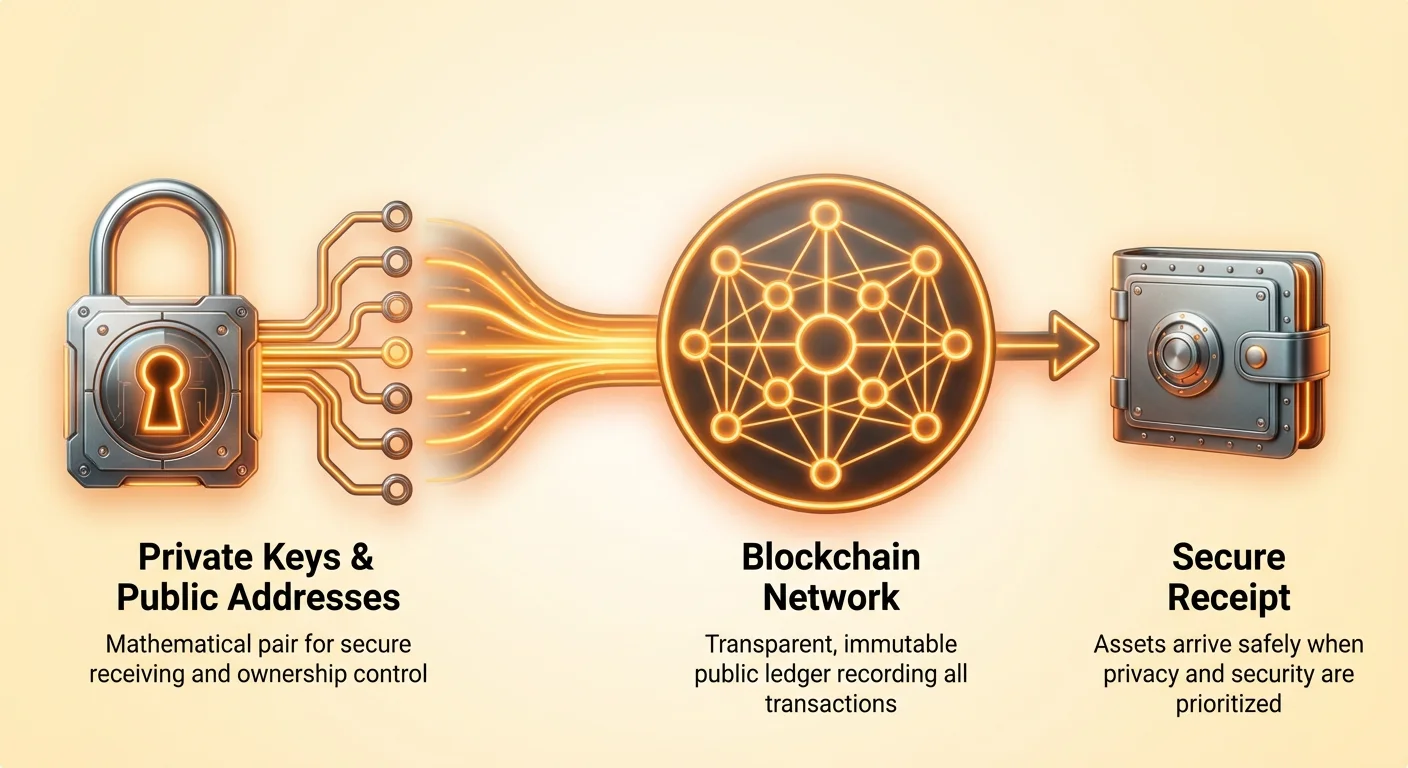
A Bitcoin address functions similarly to a bank account number, acting as a destination for funds. However, unlike a bank account, this address is not a static vault. It is a cryptographic identifier derived from your public key. When you create a wallet, the software generates a private key, which is a secret alphanumeric password. From this private key, the wallet calculates a public key, which is then hashed to create your receiving address.
This relationship is mathematical and one-way. You can generate a public address from a private key, but no one can reverse-engineer your private key from the address. This allows you to share your address safely with friends, family, or business associates. You can display it on a website or send it via messaging apps without fear that someone can use it to steal your funds.
The theft of assets requires the private key. As long as you keep your private key (often represented as a recovery phrase) offline and secure, the public address remains a safe entry point for funds. However, just because an address is safe from theft does not mean it is safe from scrutiny. The public nature of the address introduces significant privacy concerns that every user must navigate.
Privacy Implications of the Public Ledger
The Bitcoin network and many other blockchains are radically transparent. Every transaction is broadcast to a global network of computers and permanently etched onto the blockchain. Block explorers are free websites that allow anyone to view this data. If someone knows your Bitcoin address, they can plug it into a block explorer and see exactly how much money you hold.
They can also view every transaction that has ever entered or left that address. If you use a single address for all your activity, you build a comprehensive financial dossier that is publicly viewable. A friend sending you $20 for dinner could potentially see that you are holding a significant amount of savings in that same address.
This transparency is a feature, not a bug, designed to allow verification of the money supply without a central authority. However, for an individual seeking financial privacy, it presents a challenge. The link between your identity and your blockchain address is the weak point. Once that link is established, your financial privacy evaporates.
The Critical Error of Address Reuse
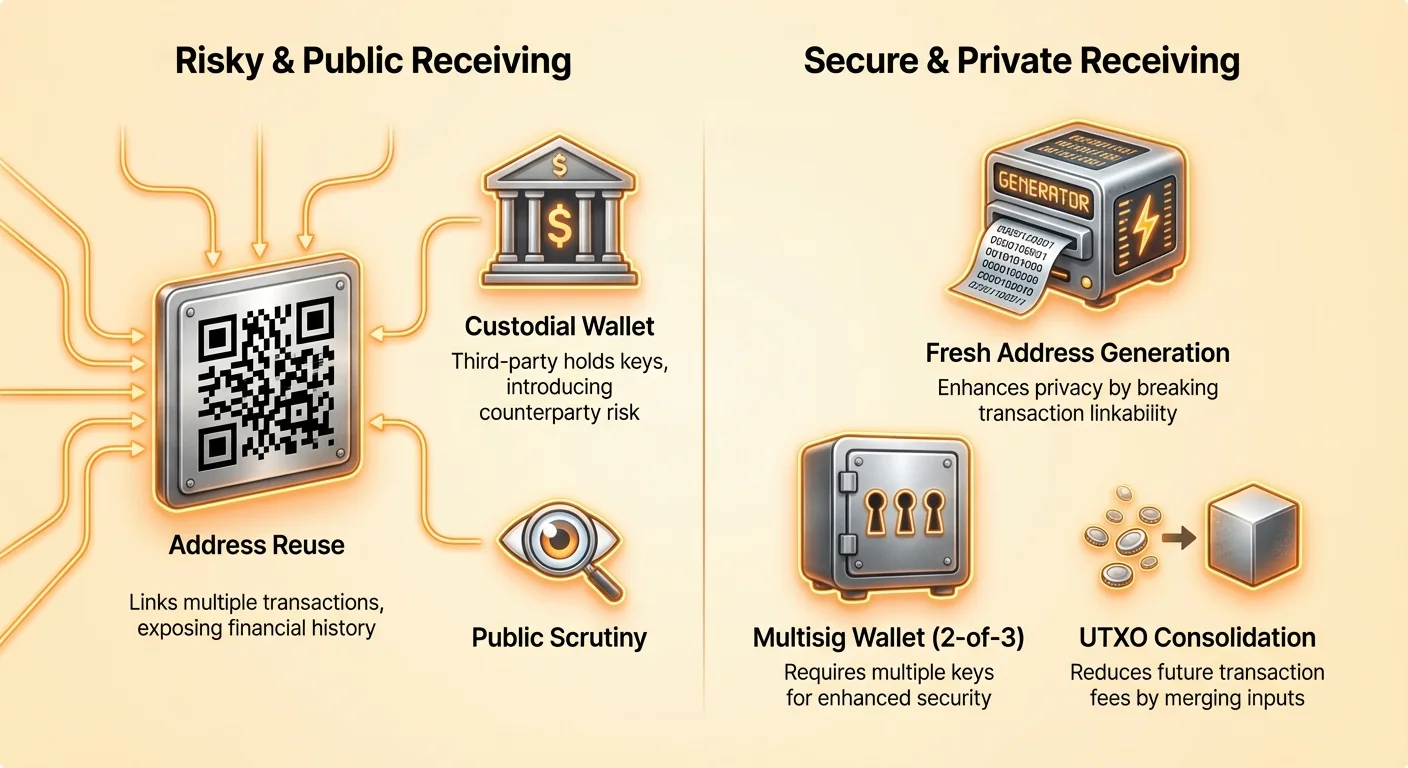
One of the most common mistakes new users make is reusing the same address for multiple transactions. It is convenient to memorize the first few characters of an address or save a static QR code image. However, address reuse is a primary cause of privacy leakage. When you receive multiple payments to the same address, you cryptographically link all those senders together on the chain.
Consider a scenario where you receive a salary payment and a payment from a friend into the same address. An observer on the blockchain can see that these two sources of funds are now controlled by the same entity. If you then spend from that address, the transaction history becomes a singular, easy-to-trace thread.
To combat this, modern hierarchical deterministic (HD) wallets are designed to generate a fresh address for every single transaction. When you click "Receive" in a competent wallet app, it should display a new string of characters. Behind the scenes, all these addresses are linked to your single master private key.
This means your balance is the sum of all these addresses, but to an outside observer, the funds appear scattered across unconnected locations. Using a fresh address for every incoming transaction breaks the chain of continuity. It makes it exponentially harder for third parties, data analytics firms, or nosey acquaintances to determine your total net worth or map your spending habits.
Handling Large Inflows and UTXO Management
Receiving funds has a direct cost implication for the future. This is due to the Unspent Transaction Output (UTXO) model used by Bitcoin and similar networks. When you receive a transaction, you are not just adding a number to a database balance. You are receiving a distinct digital "chunk" of bitcoin, similar to receiving a specific bill or coin in cash.
If you receive ten separate payments of 0.1 BTC, you have ten separate UTXOs in your wallet. Your wallet displays a total balance of 1 BTC, but under the hood, it holds ten distinct pieces of data. When you eventually decide to spend that 1 BTC, your wallet must gather all ten of those inputs to construct the transaction.
The Hidden Cost of Dust
Data size determines transaction fees, not the dollar value sent. A transaction that combines ten inputs takes up significantly more digital space (bytes) on the blockchain than a transaction that uses a single input. Therefore, receiving many small payments (often called "dust") can be dangerous. You might find that the cost to send those funds in the future exceeds the value of the funds themselves during periods of network congestion.
Strategies for Consolidation
If you plan to receive large inflows or accumulate funds over time, you should be mindful of your UTXO set. If you receive frequent small payments, consider performing a consolidation transaction during times when network fees are low. This involves sending your entire balance to yourself at a new address.
This action takes all those small scattered chips and merges them into one large UTXO. When you later need to spend or move that large amount, you will only need to sign for one input. This significantly reduces the data size of the future transaction, potentially saving you a vast amount in mining fees.
Security Verification When Receiving
The moment of receiving is also a critical security checkpoint. Malware known as "clipboard hijackers" poses a persistent threat. This malicious software runs in the background of a computer or mobile device, monitoring the clipboard for strings of text that look like crypto addresses.
When you copy a legitimate address to send to a counterparty, the malware instantly swaps it for an address controlled by the attacker. If you paste the address into an email or message without checking, you instruct the sender to pay the thief instead of you.
Visual Verification Techniques
Always verify the address visually. Checking the first and last four characters is a common habit, but sophisticated malware can generate addresses that match these distinct characters. A safer practice is to check a few characters in the middle of the string as well.
When using QR codes, the risk is lower, but verification is still necessary. Ensure the device scanning the code reads the same characters as the device displaying it. If you are receiving a large amount, send a small test transaction first. Once the test arrives safely, you can proceed with the rest of the transfer.
Custodial vs. Self-Custodial Inflows
Where you receive your funds defines who actually owns them. Receiving funds directly into an exchange account (custodial wallet) is convenient for trading, but it carries third-party risk. When funds land in an exchange wallet, you do not control the private keys. You essentially hold an IOU from the exchange.
The Risks of Third-Party Control
Exchanges can freeze accounts, halt withdrawals, or suffer insolvency. If you are receiving a significant inflow of value, relying on a custodian exposes you to their operational risks. Furthermore, receiving directly to an exchange often requires that the sender interacts with a known entity, which may require compliance checks or delays.
The Self-Custody Advantage
Receiving into a self-custodial wallet puts you in full control. No one can block the incoming transaction, and no one can prevent you from moving it afterward. For large inflows, hardware wallets (cold storage) are the gold standard. These devices keep the private keys offline, ensuring that even if your computer is compromised, the keys needed to spend the received funds remain unreachable to hackers.
Advanced Security: Shared Multisig Wallets
For individuals or organizations handling substantial amounts of cryptocurrency, a single private key represents a single point of failure. If that key is lost or stolen, the wealth is gone. To mitigate this, advanced users often employ multisignature (multisig) wallets for receiving large inflows.
How Shared Wallets Work
A multisig wallet requires multiple private keys to authorize a transaction. A common configuration is "2-of-3." In this setup, three separate keys are generated. One might be held on a hardware wallet at home, another in a bank safety deposit box, and a third by a trusted family member or business partner.
To move funds out of this wallet, two of the three keys must sign the transaction. This structure offers immense security benefits for receiving. You can confidently receive millions of dollars into a multisig address knowing that a thief would need to compromise multiple distinct physical locations to steal the funds.
Redundancy and Safety
This setup also protects against loss. If you lose one of your keys, you can still access your funds using the remaining two. This redundancy makes multisig an ideal destination for long-term storage of large inflows. It removes the anxiety of relying on a single piece of paper or a single hardware device.
Address Formats and Efficiency
Not all Bitcoin addresses are created equal. Over time, the Bitcoin network has upgraded to allow for more efficient transaction types. The type of address you generate affects the fees you and your senders will pay. Using modern address formats is a simple way to contribute to network efficiency and save money.
Legacy vs. Modern Formats
Legacy addresses, which start with the number "1", are the oldest and least efficient. Transactions involving these addresses take up the most space in a block. Segregated Witness (SegWit) addresses, starting with "3" or "bc1", introduced a way to separate signature data from transaction data. This effectively makes the transaction smaller and cheaper.
Taproot and Future-Proofing
The newest upgrade, Taproot, uses addresses starting with "bc1p". Taproot offers potential privacy improvements and efficiency gains for complex transactions, such as those involving multisig. While not every wallet supports sending to Taproot addresses yet, using Native SegWit (starting with "bc1q") is widely considered the best practice for general use today.
| Address Type | Prefix | Efficiency | Recommendation |
|---|---|---|---|
| Legacy | 1... | Low | Avoid if possible |
| Nested SegWit | 3... | Medium | Good compatibility |
| Native SegWit | bc1q... | High | Best for most users |
| Taproot | bc1p... | Very High | Best for future-proofing |
Avoiding Social Engineering and Scams
The technical security of blockchain is robust, so attackers often target the human element instead. When you are expecting to receive funds, be wary of unsolicited messages offering to "double your money" or fix a stuck transaction. These are hallmarks of social engineering scams.
The Impersonation Threat
Scammers frequently monitor social media for users asking questions about wallets or transactions. They may contact you posing as "Support Staff" and ask for your recovery phrase or ask you to connect your wallet to a specific website to "release" your incoming funds.
The Golden Rule of Receiving
Remember that receiving crypto is passive. You never need to provide your private key, password, or recovery phrase to receive funds. You never need to "synchronize" your wallet on a third-party site to accept a transaction. If someone claims you must pay a fee to receive funds, it is a scam. The sender pays the network fee, not the receiver.
Conclusion
Receiving cryptocurrency safely requires a shift in mindset from traditional banking. You are not merely providing a routing number; you are managing a cryptographic key set that interacts with a transparent, immutable ledger. The choices you make regarding address formats, wallet types, and custody models dictate the security of your assets.
Prioritizing privacy through fresh addresses and understanding the technical weight of UTXOs ensures that your wealth remains both secure and usable. By adopting rigorous verification habits and leveraging tools like hardware wallets or multisig setups, you insulate yourself from the majority of threats in the digital asset space.
Treat every receive address as a sensitive data point, verify every character, and never let convenience override security.