
暗号資産の世界に初めて足を踏み入れると、最も重要なルールをすぐに学びます:「Not your keys, not your crypto.」(自分の鍵でないなら、自分の暗号資産ではない)。このルールは、資金の所有権を証明し、取引を承認する暗号学的秘密である秘密鍵を所有し、保護する必要性を強調しています。
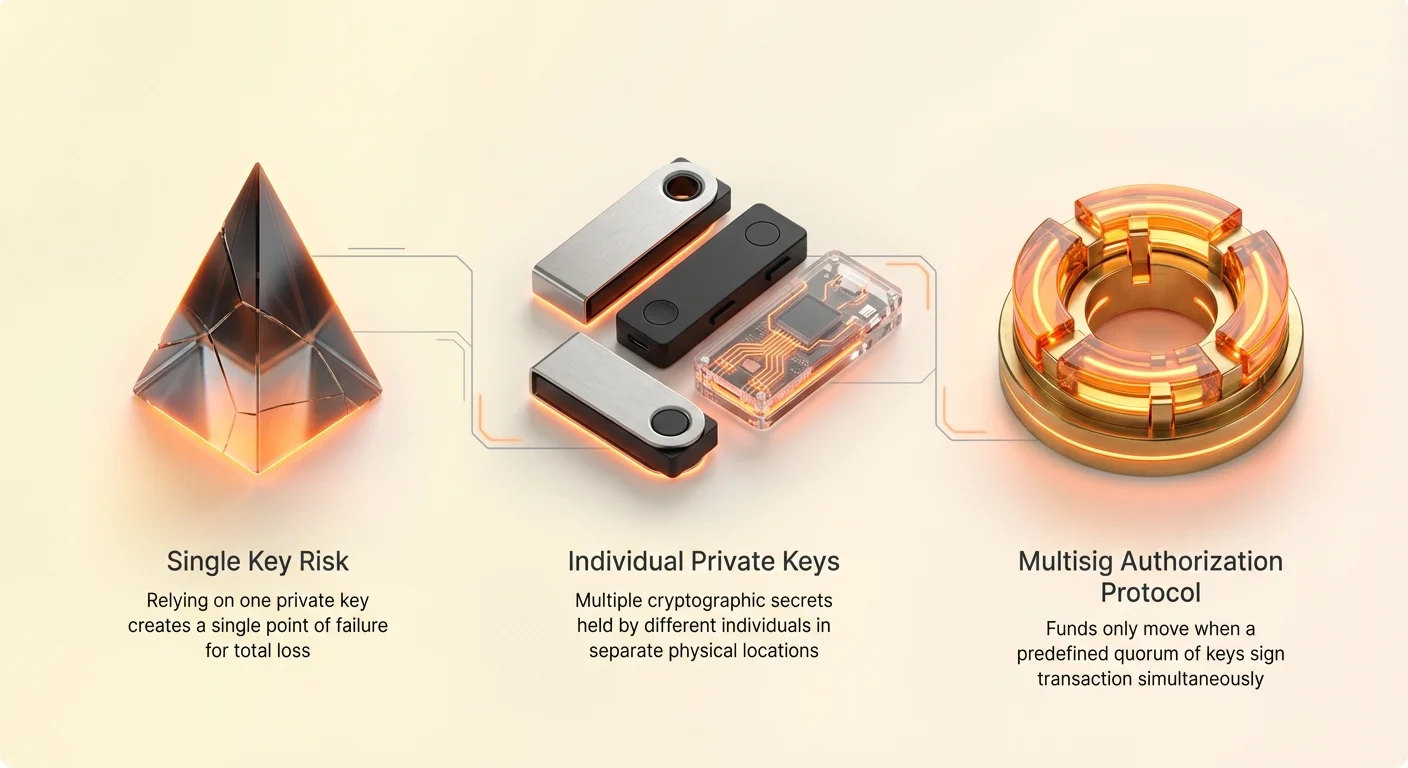
個人にとっては、この単一の鍵を保護することは、ハードウェアウォレットを使用することを意味します。これはコールドストレージとして知られる非常に効果的なセキュリティ対策です。しかし、ビジネス、グループ、大規模な資金庫、または将来を見据えた洗練された個人にとっては、単一の場所に保存された単一の鍵に依存することは受け入れがたいリスクです。その鍵が紛失、盗難、または侵害された場合、資金全体が即座に失われます。
ここで、マルチシグネチャ(マルチシグ)ウォレットの概念が登場します。マルチシグは、標準(シングルシグネチャ)ウォレットに固有の単一障害点を排除するために設計された先進的なセキュリティメカニズムです。それは、金庫を開くために1つの鍵を必要とするパラダイムを、別々の個人によって保持される組み合わせの鍵を必要とするものにシフトします。このガイドは、マルチシグ技術の決定的で包括的な概要を提供し、その技術的セットアップ、戦略的適用、およびデジタル資産に対する真の自己主権と共有制御を達成する上で重要な役割をカバーします。
マルチシグネチャウォレットの基礎
マルチシグネチャウォレットとは、取引を承認するために複数の秘密鍵を必要とする暗号通貨アドレスの一種です。1つの鍵ではなく、2人の異なる人が持つ2つの別々の鍵を必要とする銀行の貸金庫のように考えてください。
秘密鍵、公開鍵、そして単一障害点
マルチシグに深く入る前に、標準的なウォレットの仕組みを復習することが重要です:
- 秘密鍵: これは究極の秘密です。長い文字列(通常12語または24語のシードフレーズで表される)で、あなたの暗号通貨を支出するための数学的権限を与えます。この鍵を誰かが手に入れれば、あなたの資金をコントロールできます。
- 公開鍵/アドレス: これは誰もが見る受信アドレス(口座番号のようなもの)です。秘密鍵から数学的に派生しますが、資金を支出することはできません。
標準的な設定では、ハッカーがあなたの秘密鍵(単一署名)にアクセスすれば、即座にウォレットを空にできます。これがマルチシグが排除するために設計された単一障害点です。
マルチシグが損失と盗難の問題をどのように解決するか
マルチシグは支出要件を根本的に変更します。所有権を証明する1つの署名ではなく、ブロックチェーンは例えば3つの承認署名のうち2つを含む取引のみを受け入れるようプログラムされています。
盗難からの保護(外部脅威): 悪意ある攻撃者が1つの鍵保有者のコンピューターやハードウェアウォレットを侵害した場合でも、他の鍵保有者からの必要な2番目(または3番目)の署名がないため、資金を移動できません。
損失からの保護(内部脅威): 1つの鍵保有者がハードウェアデバイスを紛失したりシードフレーズを忘れたりした場合でも、グループは残りの鍵を使って資金を回復または移動できます。
マルチシグは、単一の人物(または単一の侵害されたデバイス)が一方的な制御を持たないことを保証し、協力と信頼の分散を要求します。
マルチシグ vs. MPC (Multi-Party Computation)
セキュリティソリューションが進化するにつれ、多人数計算(MPC)と呼ばれる関連概念がマルチシグと並んでしばしば登場します。両者は共有制御を目指しますが、達成方法が異なります:
| 特徴 | Multisig (M-of-N) | MPC (閾値署名) |
|---|---|---|
| 技術 | 鍵保有者からの別個の完全な署名を必要とするオンチェーンプロトコル。 | 共有された「鍵のシャード」から単一の署名を作成するオフチェーン暗号プロセス。 |
| 透明性 | ウォレットアドレスはブロックチェーン上で明らかにマルチシグです。 | 結果の取引はブロックチェーン上で標準的な単一署名取引のように見えます。 |
| 鍵の状態 | 各鍵保有者は完全で独立した秘密鍵を保有します。 | 鍵保有者は鍵の断片または「シャード」を保有します;単一のパーティが完全な鍵を保有しません。 |
| 複雑さ | 一般的にシンプルで、確立されており、広くサポートされています。 | より複雑な暗号実装で、企業保管ソリューションでしばしば必要です。 |
MPCが機関投資家向けに急速に成長している一方で、マルチシグはその相対的なシンプルさと長い実績により、堅牢で透明性が高く、自己保管型のグループガバナンスと財務管理のゴールドスタンダードであり続けています。
Understanding M-of-N Security Schemes
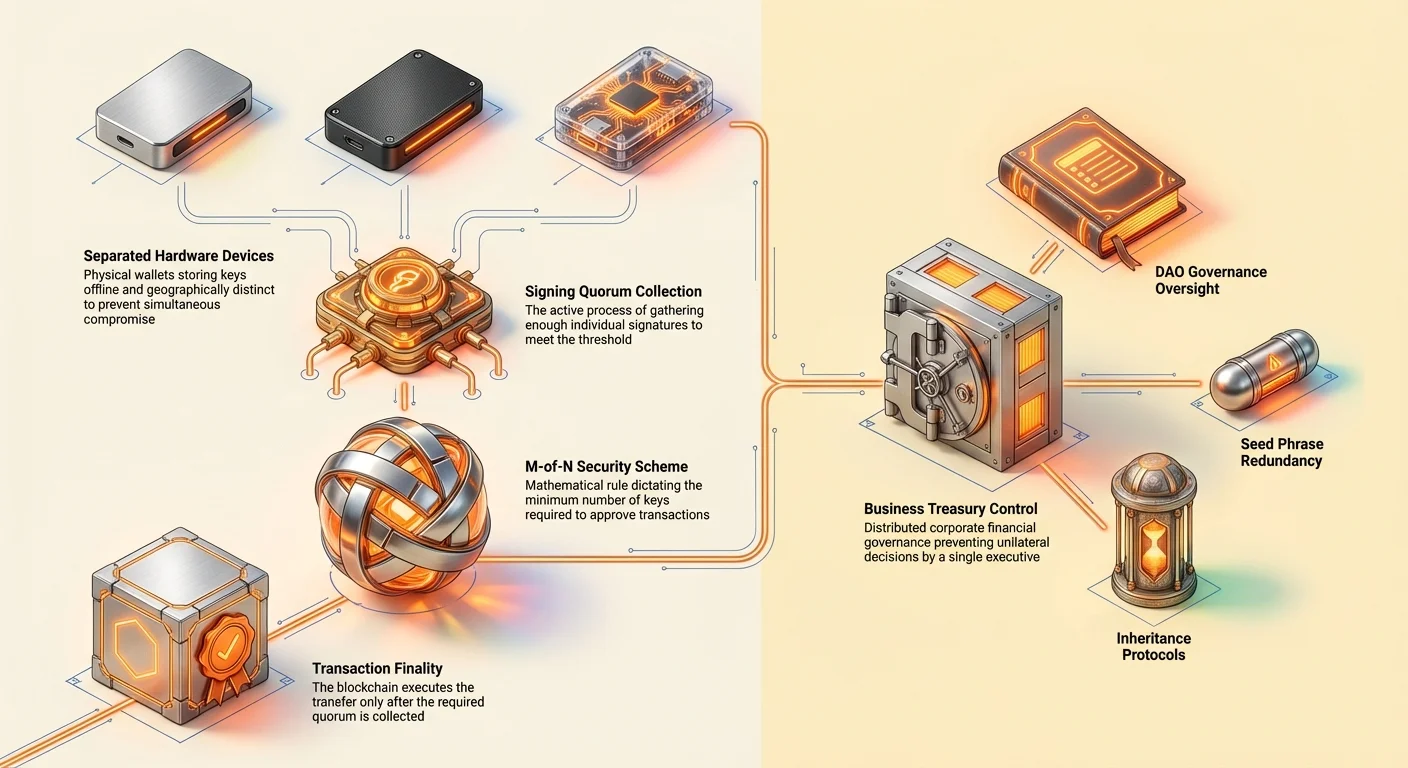
The core mechanic of any multisig wallet is the M-of-N scheme. This is the mathematical formula that dictates how many keys are required out of the total number of keys created to approve a transaction.
Defining M and N (Quorum and Key Holders)
- N (Total Key Holders): This is the total number of private keys associated with the multisig address. This determines the maximum possible security backup.
- M (The Quorum): This is the minimum number of keys required to sign and execute a transaction. This is the threshold for action.
The relationship between M and N is critical because it defines the wallet’s vulnerability profile and operational efficiency. The required signatures (M) must be collected before the transaction is broadcast to the network.
Common Configurations and Their Applications
Choosing the right M-of-N scheme depends entirely on the purpose, the level of trust among participants, and the need for operational speed.
1. The 2-of-3 Setup (High Security, High Reliability)
- Configuration: Requires 2 signatures out of 3 total keys.
- Use Cases: Small business treasuries, couples managing joint funds, or enhanced personal security.
- Why it works:
- Security: One key (or one key holder) can be compromised without losing funds.
- Reliability: One key can be lost without rendering the funds inaccessible.
In a 2-of-3 setup for a small business, Key 1 might be held by the CEO, Key 2 by the CFO, and Key 3 might be held by a corporate lawyer or stored securely off-site as a backup (an "emergency key"). Any two can authorize spending.
2. The 3-of-5 Setup (Shared Governance, Robust Backup)
- Configuration: Requires 3 signatures out of 5 total keys.
- Use Cases: Medium-to-large business treasuries, board management, or Decentralized Autonomous Organizations (DAOs).
- Why it works: This setup offers much greater resilience against collusion. If 1 or 2 keys are compromised, the funds are safe. If 1 or 2 key holders become unavailable (vacation, illness, death), the remaining 3 can still operate.
3. The 1-of-2 Setup (Dangerous but Necessary)
- Configuration: Requires 1 signature out of 2 total keys.
- Use Cases: Generally discouraged for security, but sometimes used in contracts where two parties are fighting over funds (Escrow).
- Why it works (in limited scenarios): It provides a way for either party to unilaterally release the funds. This is a low-security, high-flexibility option, not suitable for treasury management.
4. The N-of-N Setup (The Ultimate Trust Model)
- Configuration: Requires ALL signatures out of the total keys (e.g., 3-of-3).
- Use Cases: Highly specialized, high-trust scenarios where every single participant must approve every single transaction.
- Why it works: Provides absolute security against non-consensus spending. However, if any single key holder is unavailable, the funds are locked forever—making this scheme extremely difficult to manage operationally.
Risk Assessment and Scheme Selection
When deciding on M and N, you must balance two competing risks:
| Risk Profile | Description | Recommended M-of-N |
|---|---|---|
| Operational Risk (The Locking Risk): | The risk that you cannot gather enough signatures (M) because keys are lost or key holders are unavailable. | Choose a lower M (e.g., 2-of-5). |
| Collusion Risk (The Theft Risk): | The risk that the minimum number of key holders (M) conspire to steal the funds. | Choose a higher M (e.g., 4-of-5). |
Rule of Thumb: Always ensure $M$ is high enough to prevent a conspiracy among a small faction, but low enough to allow for continued operations even if one or two key holders are incapacitated or lose their keys. For most groups, a 2-of-3 or 3-of-5 scheme offers the optimal balance.
Step-by-Step Guide: Setting Up a Multisig Wallet
Setting up a multisig wallet requires careful planning, often involving multiple hardware devices and software interfaces. This process is complex by design, as its security relies on redundancy and separation of keys.
Prerequisites and Key Preparation
Before creating the multisig contract on the blockchain, you must generate the underlying keys.
1. Acquiring Hardware Wallets
Every key in the M-of-N scheme should be generated and stored on a separate, dedicated hardware wallet (e.g., Trezor, Ledger). This provides true cold storage security, meaning the private key never touches an internet-connected device.
- Action: Purchase $N$ separate hardware wallets (e.g., three wallets for a 2-of-3 setup).
2. Generating and Separating Seed Phrases
Each hardware wallet must be set up independently to generate its own unique seed phrase.
- Action: Write down each seed phrase meticulously. Crucially, these seed phrases must be stored in physically separate, geographically distinct locations. If two keys are required, ensure their recovery phrases are not kept in the same safe.
3. Assigning Key Responsibility
Formally assign each private key (and its corresponding hardware device) to a specific key holder. This assignment should be documented and agreed upon by the group.
Choosing and Interacting with a Software Interface
The multisig wallet itself is not a physical device; it is a smart contract address on the blockchain that understands the M-of-N rule. To interact with this contract, you need specialized software.
For Bitcoin, common desktop interfaces include Sparrow Wallet or Electrum. For Ethereum and related chains (which often manage business treasuries and DeFi), Gnosis Safe (now Safe) is the industry standard.
Setup Phase: Creating the Contract
- Input Public Keys: The designated setup interface (e.g., Gnosis Safe web app) will prompt the key holders to input the public key or address derived from their hardware wallet.
- Define M and N: The user specifies the total number of owners (N) and the required confirmations (M).
- Deploy the Contract: The software deploys the multisig smart contract to the blockchain. This contract now is your multisig wallet address.
Once deployed, the funds must be sent to this new, unique multisig address. Only when funds arrive at this address are they protected by the M-of-N rules.
The Signing and Execution Process
When the group decides to make a transaction (e.g., sending 5 BTC to a vendor), the process follows a strict flow:
1. Proposal and Initiation
One key holder initiates the transaction proposal using the software interface. The proposal specifies the amount, the recipient address, and the network fee. The transaction is generated but remains unsigned.
2. Review and Signing
The proposal is visible to all N key holders. Each key holder connects their hardware wallet to their interface (which is connected to the multisig software) and reviews the proposed transaction details.
- If the transaction is approved, the key holder uses their hardware wallet to generate their unique cryptographic signature for that specific transaction and broadcasts the signature to the multisig contract.
3. Quorum Reached (Execution)
The multisig contract monitors the incoming signatures. As soon as the number of signatures reaches M (the quorum), the contract automatically bundles those signatures together and broadcasts the finalized, authorized transaction to the blockchain for immediate execution.
4. Failure to Reach Quorum
If the transaction fails to reach M signatures within a set time, the proposal expires or remains pending indefinitely. The funds remain locked in the multisig address until the required number of signatures is collected.
Strategic Use Cases for Multisignature Technology
Multisig is not just a high-tech way to secure funds; it is a powerful tool for governance, risk mitigation, and systematic control. Its primary applications lie in managing large assets where distributed responsibility is mandatory.
1. Secure Business Treasury Management (The Primary Use Case)
For any company holding significant crypto reserves, security means removing unilateral control.
Centralized Control vs. Distributed Control
In a traditional company structure, the CEO or CFO might have access to the single wallet key. This creates "key-person risk"—the risk of the funds being lost due to one person’s error, malice, or unavailability.
A multisig wallet ensures that financial decisions are always collaborative:
- Expense Approval: For example, a 3-of-5 setup might involve the CEO, CFO, COO, Head of Legal, and an External Auditor. Any transaction requires consensus from three senior leaders, preventing any one person from making unauthorized transfers.
- Operational Continuity: If the CEO is traveling or incapacitated, the business can continue to pay bills and manage funds without interruption, provided the quorum (M) can still be met by the available signers.
Handling Employee Turnover and Separation
Multisig provides a clean framework for managing key access during personnel changes. When a key holder leaves the company, the remaining key holders can initiate a transaction to migrate all funds from the old M-of-N contract to a new M-of-N contract that excludes the departing employee’s public key. This procedure ensures a clean cut-off of access without relying on the integrity of the former employee.
2. Decentralized Autonomous Organizations (DAOs) and Governance
DAOs use smart contracts to automate governance, but large treasury movements often require human oversight. Multisig wallets, particularly those implemented via platforms like Gnosis Safe, are the foundational infrastructure for DAO treasury management.
- Community Oversight: While proposals might be voted on by thousands of token holders, the actual execution of spending funds (e.g., funding a new development team) is typically handled by a core group of elected multisig signers (often 5-of-7 or 7-of-9).
- Trustless Execution: This ensures that even if the DAO is attacked by a governance-manipulation scheme, the treasury funds cannot be moved without the explicit, secure, and physically separated signatures of the elected core team.
3. Advanced Personal Security and Inheritance Planning
For high-net-worth individuals, multisig is an unparalleled tool for managing personal security risks and ensuring smooth wealth transfer after death.
Reducing Personal Kidnapping Risk
In rare but serious situations, an attacker might attempt to coerce a single key holder into signing a large transaction. With multisig, this becomes impossible. The attacker would need to coerce multiple, geographically separated key holders simultaneously, dramatically increasing the operational difficulty and risk of the attack.
Secure Inheritance Planning (The "Dead Man's Switch")
One of the greatest challenges of self-custody is ensuring loved ones can access funds upon the owner's death without risking early access or theft. Multisig provides a structured solution:
The Setup (e.g., 2-of-3):
- Key 1: Held by the owner (kept in secure cold storage).
- Key 2: Held by a trusted third party, such as an estate lawyer or specialized fiduciary custodian.
- Key 3: Held by the primary heir (stored in a safe or separate location).
During Life: The owner and the lawyer/fiduciary (Keys 1 and 2) can easily transact 2-of-3, keeping the heir’s key dormant and safe.
After Death: Upon presentation of a death certificate, the lawyer/fiduciary (Key 2) and the heir (Key 3) can now coordinate the 2-of-3 signatures to unlock the funds and transfer them to the heir’s new address.
This setup prevents the heir from accessing the funds prematurely while the owner is alive, but guarantees access when the owner is deceased, fulfilling the inheritance plan without compromising the security of the funds during the owner's lifetime.
セキュリティのベストプラクティスと管理のヒント
マルチシグの実装は最初のステップに過ぎません。正しい管理、キーの衛生管理、災害復旧計画が、時間の経過とともにM-of-Nスキームの完全性を維持するために不可欠です。
地理的なキー分散
マルチシグの基本的な目的はキーを分離することです。この分離は物理的かつ地理的でなければなりません。
- 集中化を避ける: 複数のシードフレーズを同じ物理的な場所に決して保管しないでください(例: 2つのシードフレーズを1つの金庫に)。その場所が侵害された場合(火災、洪水、盗難)、マルチシグのセキュリティの利点は即座に失われます。
- 国際的な分散: 非常に大規模なトレジャリーや高額の個人資産の場合、キーを異なる国や大陸に分散することを検討してください。これにより、地域的な政治的リスクや物理的な災害から保護されます。
ウォレットのテスト: 「火災訓練」
多くの組織が複雑なマルチシグウォレットを設定しますが、危機が発生するまで復旧手順をテストしません。これは致命的なミスです。すべてのキー保有者が正常に署名して資金を移動できることを定期的に検証する必要があります。
- 年次テスト: 少なくとも年1回、小規模で象徴的なトランザクションを開始してください(例: 指定のテストアドレスに10ドル相当の暗号通貨を送金)。
- 参加の義務化: すべてのキー保有者(M)がテストトランザクションの署名に参加することを要求してください。これにより、ハードウェアウォレット、ソフトウェア設定、キーアクセス方法が依然として機能していることを検証します。
- キー紛失シミュレーション: 1つのキーが紛失したと仮定した内部シナリオを実行してください。残りのN-1キー保有者がMのクォーラムに達し、新しいアドレスへの復旧トランザクションを実行できますか? 必要な手順を文書化してください。
キー回転と監査
キー署名に関わる個人、使用されるハードウェアデバイス、基盤となるソフトウェアインターフェースは、定期的な監査の対象とするべきです。
- 署名者監査: すべてのキー保有者に対して定期的なバックグラウンドチェックを実施するか、信頼レベルを再評価してください。キー保有者の役割や状況が大幅に変更された場合、その個人を除外した新しいマルチシグコントラクトへ資金を移行することを検討してください。
- ハードウェア監査: ハードウェアウォレットデバイスが物理的なリスクにさらされた場合(例: 飛行機に持ち込む、押収される、グループ外の人物に扱われる)、侵害されたものとみなされ、関連する公開キーを新しいマルチシグコントラクトで置き換えるべきです。
- 定期的なシードフレーズ確認: シードフレーズは決してデジタル化すべきではありませんが、物理的な保管コンテナの完全性(水損、セキュリティシールの状態)を定期的に確認してください。
「ダスト攻撃」とフィッシングの防止
すべてのキー保有者がトランザクションを確認して署名する必要があるため、確認プロセスは綿密でなければなりません。ハッカーは時折「ダスト攻撃」やフィッシング攻撃を行います。
- 検証は必須: トランザクションプロポーザルを確認する際、キー保有者はすべての詳細を検証する必要があります: 金額、网络手数料、そして最も重要ですが、宛先アドレス。インターフェースが正確であると仮定せず、常に二次的な信頼できる通信チャネル(例: 受信者と口頭でアドレスを確認)で宛先アドレスを検証してください。
- ホワイトリストの使用: 多くのマルチシグプラットフォームでは「ホワイトリスト」—事前承認されたアドレス(既知の取引所出金アドレスやベンダーアドレスなど)—の設定が可能です。これにより、一般的なトランザクションを迅速化し、偶発的な誤送金のリスクを低減します。
マルチシグソリューション提供者の選択
Bitcoinマルチシグ(P2SH)の基盤となる暗号技術は標準化されていますが、選択するソフトウェアプラットフォームやサービスによってユーザーエクスペリエンスと機能セットは大きく異なります。
プラットフォーム機能比較
提供者の選択は、使用するブロックチェーン(Bitcoin対EVMチェーン)と必要な運用制御のレベルに通常帰着します。
| プラットフォームタイプ | 主なブロックチェーン | 主な機能 | 最適な用途 |
|---|---|---|---|
| Gnosis Safe (Safe) | Ethereum、Polygon、Avalancheなど(EVMチェーン) | 高度にプログラマブル、NFT対応、DeFiインタラクション、カスタマイズ可能なアクセス制御。 | DAO、DeFiトレジャリー、複雑なインタラクションを必要とするWeb3ビジネス。 |
| Sparrow Wallet | Bitcoin | デスクトップアプリケーション、さまざまなハードウェアウォレットとの優れた統合(PSBT標準)、高い透明性でBitcoinセキュリティに純粋に焦点。 | Bitcoinマキシマリスト、個人の長期Bitcoin保管、高セキュリティBitcoinビジネス。 |
| Electrum | Bitcoin | 軽量、Bitcoinマルチシグの古い標準、多用途でユーザー友好なデスクトップクライアント。 | シンプルさとBitcoinでの確立された歴史を求めるユーザー。 |
| カストディアンサービス | マルチチェーン | 管理サービス、しばしばMPC、保険、規制遵守を含む。 | 金融機関、規制された企業体、複雑なコンプライアンスを必要とする企業。 |
オープンソース対プロプライエタリソリューション
暗号通貨コミュニティは一般にセキュリティインフラとしてオープンソースソリューションを好み、特にマルチシグではその傾向が強いです。
オープンソースの利点
Gnosis SafeやSparrow Walletのようなプラットフォームはオープンソースで、コードが公開され監査可能です。
- 検証による信頼:誰でもコードを検査してバックドア、隠れた手数料、脆弱性がないことを確認できます。この透明性は、スマートコントラクトやソフトウェアクライアントに多額の資金を預ける際に重要です。
- コミュニティサポート:バグやセキュリティ問題はグローバルな開発者コミュニティによって迅速に発見・修正されます。
プロプライエタリの考慮事項
いくつかの企業向けマルチシグおよびカストディソリューションはプロプライエタリ(クローズドソース)ですが、企業責任保険、規制報告、レガシー銀行システムとのシームレスな統合などの機能を提供します。
プロプライエタリソリューションを選択する場合、組織はベンダーのセキュリティ認証、保険ポリシー、サードパーティ監査レポートについて厳格なデューデリジェンスを実施する必要があります。ソースコードを直接レビューできないためです。自保管と最大の自己主権のためには、オープンソースが強く推奨されます。
結論
マルチシグネチャ技術は、デジタル資産のセキュリティにおいて画期的な進歩を表しており、リスクプロファイルを単一の高ステークスな標的から分散型ガバナンスシステムへと変革します。これは、個人の自己保管と機関責任の間の不可欠な架け橋です。
適切に設計された M-of-N スキームを実装し、鍵を別々の場所に分散したコールドストレージで保護し、署名とリカバリーのための明確な運用手順を確立することで、グループは盗難、鍵の侵害、または鍵保有者の利用不能による壊滅的な損失のリスクをほぼ完全に排除できます。
高価値資産を管理する企業や洗練されたユーザーにとって、マルチシグはもはやオプションの機能ではなく、非中央集権型経済におけるレジリエンスと信頼を構築するための基本的な要件です。マルチシグウォレットのセットアップと戦略的使用を習得することは、真のデジタル自己主権へのロードマップにおける重要なステップです。