
ビットコインネットワークは、堅牢なセキュリティと最大限の分散化の原則に基づいて構築されており、取引を慎重かつ安全に処理します。しかし、このセキュリティへの献身は、ピーク時の速度低下と高い取引手数料という代償を伴います。これはLayer 1 (L1) 決済レイヤーにとって必要なトレードオフです。
ライトニングネットワーク (LN) は、Bitcoin のコアを置き換えるのではなく、日常の商取引におけるその有用性を高めることを目的とした Layer 2 (L2) ソリューションとして導入されました。Bitcoin ブロックチェーンの上に動作することで、LN はメインチェーンでは実用的でない即時、低コストのマイクロペイメントを可能にします。
このガイドは、ライトニングネットワークの理論的な定義を超えて、その実践的な運用実態を探求します。ノードを運用したい人、LN をビジネスに統合したい人、または単にモバイルウォレットが時々支払いを完了できない理由を理解したい人にとって、ルーティング、チャネル管理、流動性のニュアンスを把握することが不可欠です。LN は驚異的な速度を提供しますが、新しいセキュリティのトレードオフとアーキテクチャの複雑さを導入し、積極的な管理を必要とします。
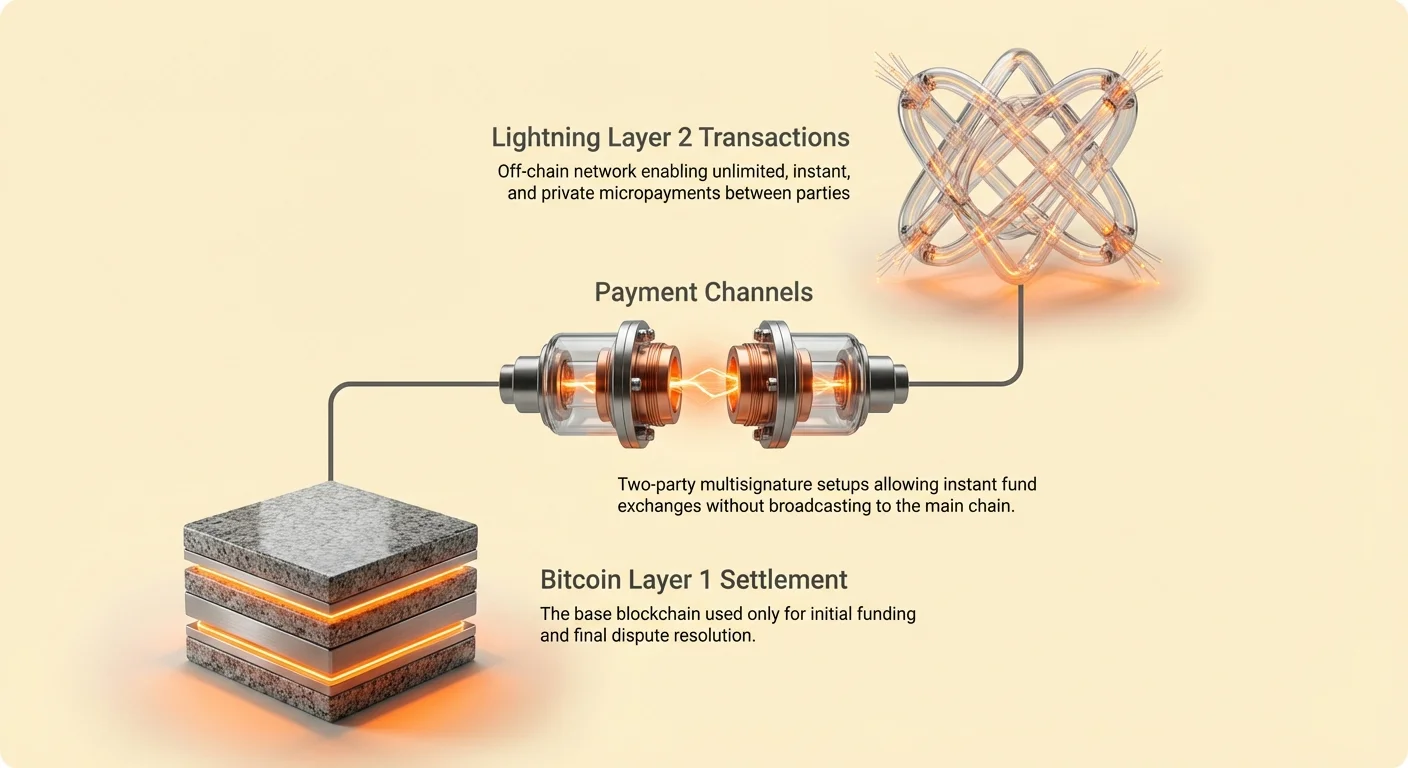
コアメカニクス:Lightningが速度を実現する方法
Lightning Networkの基本的な革新は、膨大な数のトランザクションの大部分をオフチェーンで処理し、初期チャネル開設と最終紛争解決のみにLayer 1ブロックチェーン(Bitcoin)を使用することです。このアーキテクチャにより、2者はすべての個別のトランザクションをグローバルネットワークにブロードキャストする必要なく、無制限の数のトランザクションをプライベートかつ即時に実行できます。
ペイメントチャネル:実践的なアナロジー
ペイメントチャネルとは、ビットコインのブロックチェーン上に確立された、2者間のマルチシグネチャウォレットのことです。友人とバーでセキュリティ付きの勘定を開くようなものだと考えてください:
- チャネルの開設(資金供与): AliceとBobは、一定額のビットコイン(チャネル容量)をメインチェーンの共同アドレスにロックすることに同意します。これがL1確認を必要とする唯一のトランザクションです。
- トランザクション(オフチェーン): チャネルが開設されると、AliceとBobはそのチャネル容量内で即時に資金を交換できます。彼らはブロックチェーンを更新せず、相互に合意した最新の残高表を単に更新するだけです。これらの更新をコミットメントトランザクションと呼びます。
- チャネルの閉鎖(決済): トランザクションが完了したら、彼らは最終的な最新コミットメントトランザクションをビットコインL1チェーンにブロードキャストします。この単一のトランザクションが、潜在的に数千のオフチェーントランザクションの純結果を反映します。
主要なセキュリティメカニズムは、どちらの当事者もいつでも最新の合意された状態をブロードキャストすることで一方的にチャネルを閉鎖できる点です。一方の当事者が古い有利な状態をブロードキャストして不正を試みた場合、もう一方の当事者は限定された時間窓(「取り消し期間」)内に不正当事者を罰し、チャネル内の全資金を請求できます。
ハッシュタイムロックコントラクト(HTLC):信頼不要な経路保証
チャネルはAliceとBobが直接トランザクションできるようにしますが、LNの本当の力は、AliceとCarolの間に直接チャネルがなくても、チャネルのチェーン経由で支払いをルーティングできる点にあります。AliceがBobに接続され、BobがCarolに接続されていれば、AliceはBob経由でCarolに支払えます。
このプロセスはハッシュタイムロックコントラクト(HTLC)を使用して保護されます。HTLCは、多段支払いのためのセキュアで条件付きエスクローとして機能する重要な暗号メカニズムです。
HTLCの実践的な動作(アトミックスワップ):
- 秘密の作成: Carol(受信者)は暗号学的秘密(プレイメージ)を生成し、それをハッシュ化します。彼女はAliceにハッシュ(鍵のロック)のみを提供します。
- 条件付き支払い: AliceはBobへの支払いを開始し、「このハッシュに対応する秘密を提供できるなら(または支払いが48時間後にタイムアウトしたら)あなた(Bob)に支払います」というHTLCを設定します。
- 秘密のルーティング: Bobは支払いと条件をCarolに渡し、少し短いタイムロック(例:46時間)を設定します。
- 完了: Carolが条件付き支払いを受け取ると、彼女の秘密(プレイメージ)を使用してアンロックします。秘密をBobに公開することで資金を請求します。
- 後方解決: Bobは今秘密を持っています。彼はそれを使用してAliceが彼のためにエスクローした資金を請求します。支払いは経路に沿って即時に後方解決します。
重要なのは、タイムロック条件によりBobが単に資金を持って逃げることはできない点です。支払いが解決しなかった場合、タイムロック期限後に資金は送信者に戻ります。これにより、多段支払いは「アトミック」になります—完全に成功するか完全に失敗する—中間ルーティングノード(Bobなど)を信頼する必要がありません。
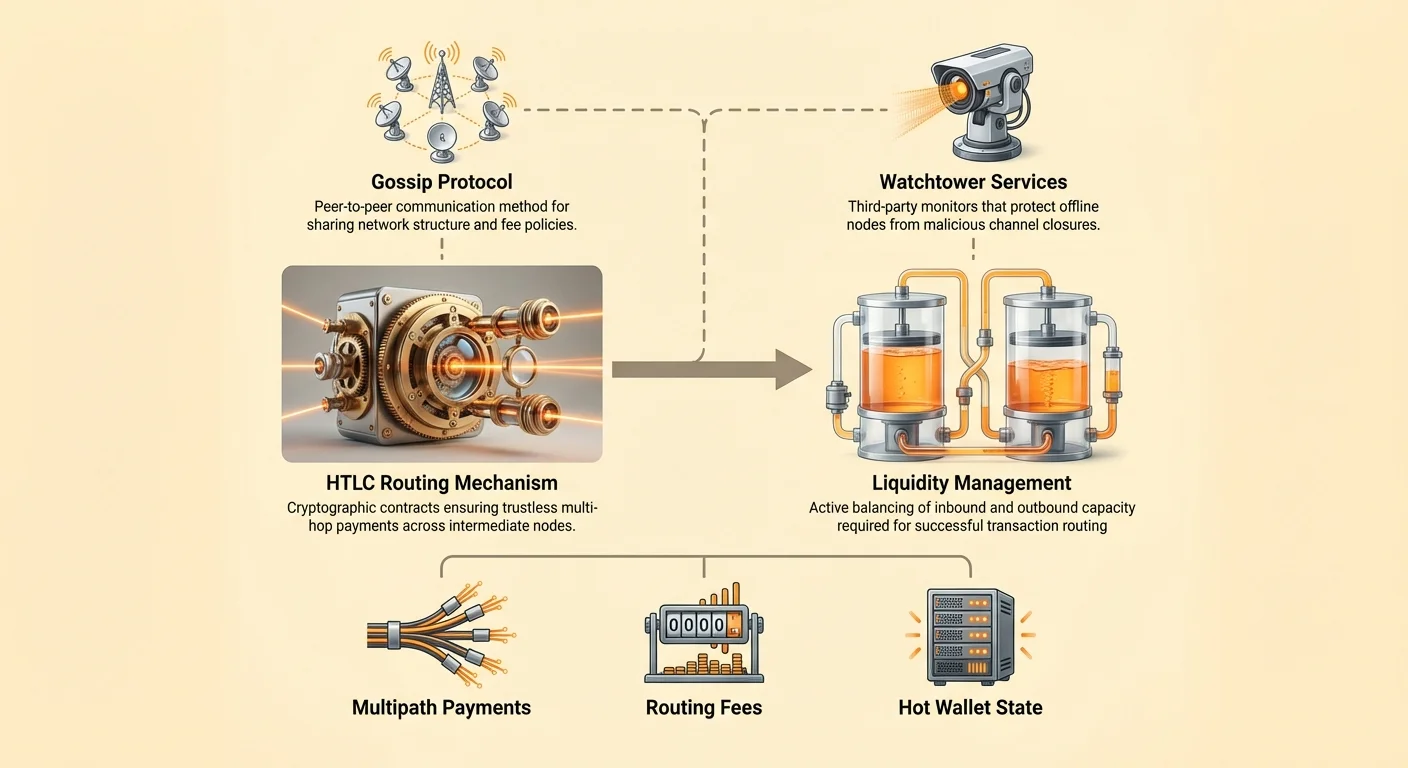
ネットワークのバックボーン:ルーティングとゴシッププロトコル
Lightning Networkは、メッシュネットワークであり、ノードが双方向の支払いチャネルで相互接続されています。支払いが成功するためには、送信者と受信者の間で、すべてのセグメントに十分な容量を持つ経路、つまりルートを見つけなければなりません。
ネットワークのマッピング:ゴシッププロトコルの仕組み
すべてのノードがすべてのトランザクションを保存する必要があるBitcoinメインチェーンとは異なり、LNのトポロジー(接続の地図)はすべての参加者によってグローバルに知られたり保存されたりしていません。代わりに、ノードはネットワークの構造に関する情報を共有するためにゴシッププロトコルを使用します。
ゴシッププロトコルは、本質的に連続的で低帯域幅の通信方法であり、ノードは次のことを発表します:
- 新しいチャネル:ノードが新しいチャネルを開設すると、そのチャネルの容量とL1資金調達トランザクションIDを発表します。
- チャネル更新:ノードは、ピアに対して手数料ポリシー(経由するコスト)やチャネルが現在アクティブかクローズされているかを継続的に更新します。
実践的な影響:この分散型情報共有は高速ですが、しばしば不完全です。ノードのネットワークマップのビューは、ゴシップを通じて受信した情報次第です。これにより、ルーティングノードのマップが少し古く、チャネルが利用可能と表示されているのに実際にはダウンしているために、ルーティング試行が失敗する可能性があります。
ルーティング効率の実践的な課題
LN支払いの経路を正常に見つけることは、今日の最大の運用課題です。支払いを送信するには、ネットワークトポロジー、容量、コストをリアルタイムで組み合わせた複雑な物流パズルを解く必要があります。
ルーティング失敗の主な3つの原因:
- 流動性の不足:最も一般的な失敗です。チャネルが存在していても、不均衡になっている可能性があります。AliceがBob経由でCarolに1 BTCを送る場合、BobはCarolに向けたアウトバウンド容量として1 BTCを、Aliceからのインバウンド容量として1 BTCを保有していなければなりません。チェーン内の任意のリンクがチャネルの正しい側に必要な資金を欠いている場合、支払い全体が失敗します。
- 古い情報:ルーティングノードはゴシップされたマップに基づいて経路を試みますが、その経路上のチャネルが最近閉鎖されたり、一時的に応答不能(オフライン)になったりする可能性があります。
- 最大ホップ制限:LN支払いはレイテンシ問題と複雑なタイムロック管理を防ぐためにホップ数(通常20前後)に制限されています。長距離ルーティングには、主要ハブ間の高効率で直接的な接続が必要です。
これらの問題を克服するために、現代のLNソフトウェアは確率的ルーティングを使用します。1つの経路だけを試すのではなく、送信者は支払いを複数の小さなチャンクに分割(Multipath Payments、またはMPP)し、異なる経路に同時に送信します。これにより成功確率が大幅に向上し、レイテンシが低下し、ネットワークの耐障害性が向上します。
ルーティング手数料:速度のコスト
Lightning Networkはしばしば「無料」と形容されますが、それは不正確です。ルーティング手数料は、中間ノードがリスクを負う資本(流動性)と、HTLCの検証・転送に費やす計算リソースに対する補償として存在します。
ルーティング手数料は、実践的な2つの理由で重要です:
- ノード運営者のインセンティブ:手数料は、個人や企業が高可用性で良好に接続されたノードを運用し、チャネルを適切にバランスさせることを奨励し、エコシステムに重要な流動性を提供します。
- ネットワークスパムの防止:少額の手数料は、悪意あるアクターが経済的価値を提供せずに帯域幅を消費する失敗した小さなHTLCでネットワークをスパムするのを防ぎます。
手数料構造:
ノードのルーティング手数料は通常、2つの部分で構成されます:
- ベース手数料:転送支払いごとに適用される固定のフラット手数料で、金額に関係なく(例:1 satoshi)。
- 比例手数料:総支払い金額のパーセンテージ(例:転送金額の0.001%)。
エンドユーザーにとっては、これらの手数料は極めて低く、大規模トランザクションでも数セント程度で、L1手数料に比べて無視できるほどです。ただし、ノード運営者は市場需要とバランス調整の労力を基にこれらの手数料を常に調整し、ノードを小さなアクティブな金融ビジネスとして扱わなければなりません。
The Crucial Factor: Managing Liquidity and Capacity
For L1 Bitcoin, simply holding the coins (custody) is enough. For L2 Lightning, holding coins is only half the battle; managing their availability and direction (liquidity) is the greater operational challenge. Liquidity management is the biggest barrier to entry for businesses adopting LN and the reason why simple non-custodial wallets can sometimes struggle to receive funds.
Defining Liquidity in Lightning Terms
Liquidity on the Lightning Network refers to the distribution of funds within a payment channel. It determines how much a node can send or receive.
- Outbound Capacity (Sending): This is the amount of funds the local node has on its side of the channel. If Alice has a channel with Bob with 1 BTC, and all 1 BTC is currently on her side, she has 1 BTC of outbound capacity to Bob.
- Inbound Capacity (Receiving): This is the amount of funds the remote peer has on their side of the channel, which Alice can receive. If Bob holds 1 BTC on his side, Alice has 1 BTC of inbound capacity (she can receive 1 BTC from anyone who can route through Bob).
The Operational Catch: Unlike L1 where receiving is passive, receiving on LN is an active requirement. If you have a brand-new node and have just opened several channels, all the funds are on your side. You have excellent outbound capacity, but zero inbound capacity. You can send easily, but you cannot receive any Bitcoin until you spend some funds or acquire inbound liquidity.
Strategies for Acquiring Inbound Liquidity
For a business that primarily wants to accept payments via LN (e.g., an e-commerce store), maximizing inbound capacity is critical.
1. Spending Funds to Balance Channels
The most natural way to gain inbound liquidity is by using your node’s existing outbound capacity. When you send 0.1 BTC to a merchant, your side of the channel decreases by 0.1 BTC, and the merchant’s side increases by 0.1 BTC (on the final hop). This shift creates 0.1 BTC of new inbound capacity for your node.
- Practical Tip: If your node is new, making a few small, genuine purchases (e.g., buying a gift card or paying for a VPN) can effectively "push" the funds away from your side and create room to receive future payments.
2. Paying for Inbound Capacity (Liquidity Providers)
For major nodes or businesses that cannot rely on organic spending, they can explicitly pay a major routing node to open a channel to them.
- Liquidity Providers: Large, well-established nodes (sometimes called hubs) act as liquidity providers. A smaller business can request that a hub open a 5 BTC channel to them. The hub funds the channel entirely, giving the business 5 BTC of instant inbound capacity. The business often pays a small, upfront fee for this service.
- Benefits: This guarantees high-quality inbound liquidity, usually through a major, high-uptime peer, improving routing reliability.
3. Opening Channels to Major Peers
While not a direct inbound strategy, opening channels to major, well-connected hubs is essential. While opening the channel funds your side (outbound), it connects you efficiently to the wider network. A well-connected node with multiple large, balanced channels is more likely to be used for routing, which helps keep the channels naturally balanced through routing fees.
Balancing Channels: Maintaining a Healthy Node
Channel balancing is the continuous process of adjusting funds within your channels to ensure you maintain adequate inbound and outbound capacity simultaneously.
The Rebalancing Trade-off:
If a channel becomes heavily used in one direction (e.g., you keep sending payments out), you eventually run out of outbound capacity. If you try to receive too much, you run out of inbound capacity.
Rebalancing involves using one channel to push funds into another. If your Channel A (with Bob) is low on funds (low outbound), and your Channel B (with Carol) is full (high outbound), you can execute a loop payment where you send funds from Channel B, through the network, and back to yourself via Channel A.
- Cost: Rebalancing is expensive because it consumes network routing fees without achieving an external goal (it’s a closed-loop transaction).
- Automation: Sophisticated node operators use automated software tools to monitor channel capacities and trigger rebalancing attempts when capacity falls below a certain threshold, minimizing manual intervention.
Operational Security and Node Management
Running a Lightning Node introduces security considerations that differ significantly from simple L1 self-custody. Because LN involves time-sensitive, off-chain state updates, the private keys controlling the funds must be accessible, which fundamentally changes the cold storage paradigm.
Cold Storage vs. Hot Wallet Concerns for L2 Use
The security architecture of L1 Bitcoin strongly favors cold storage (keeping private keys completely offline, typically on a hardware wallet). This provides maximum protection against online theft.
However, the Lightning Network fundamentally requires your keys to be "hot" (online, or easily accessible) for two critical reasons:
- State Monitoring: Your node must constantly monitor the Bitcoin blockchain for any unauthorized or old channel closures initiated by a cheating peer. If a malicious peer broadcasts an old commitment transaction, your node has a limited time window (the dispute period) to broadcast a penalty transaction, claiming all the channel funds. This requires the private keys to sign the justice transaction immediately.
- Routing and Forwarding: A routing node must be online and ready to sign HTLC updates instantly to facilitate multi-hop payments.
The Operational Trade-Off: LN users must accept a trade-off: higher utility (speed, low cost) in exchange for keeping a portion of their funds in an accessible, hot environment.
Best Practices for L2 Security:
- Limit Hot Funds: Never commit all your Bitcoin holdings to the Lightning Network. Only move the funds necessary for active commerce or routing into L2 channels. The vast majority of savings should remain in L1 cold storage.
- Dedicated Hardware: Use a dedicated, air-gapped machine or specialized hardware device (like some modern hardware wallets with LN support) to manage the node's keys, separating them from general-purpose computing devices.
- Robust Network Isolation: Ensure your LN node runs on a stable, secure network that is resilient against DDoS attacks or unauthorized access attempts.
Watchtowers and Disaster Recovery
Since your node must be constantly online to defend your funds, what happens if your internet connection fails or your node server crashes right when a malicious peer tries to cheat?
This is where Watchtowers come in.
A Watchtower is a third-party service (or another node you trust) that monitors the Bitcoin blockchain on your behalf.
- Function: You securely transmit the required penalty transaction data to the Watchtower. If the Watchtower detects that your peer attempts to broadcast an old channel state while your node is offline, the Watchtower steps in, broadcasts the penalty transaction, and protects your funds.
- Trust Model: Watchtowers are typically "trust-minimized." They see the channel breach data, but they cannot steal your funds; they only know how to punish a cheating peer.
Disaster Recovery: A robust LN setup requires regular backups of the channel.backup file (or equivalent) provided by your node software (e.g., LND, c-lightning). This file contains the data needed to force-close your channels and recover your funds back to L1 in a worst-case scenario (e.g., a complete server failure). However, relying on backups alone means waiting for the mandatory timelock period, emphasizing that being online is always the preferred method of channel defense.
Node Implementation: Practical Software Choices
To run a dedicated, feature-rich LN node, operators typically choose between several implementations, each optimized for different needs:
- LND (Lightning Network Daemon): Developed by Lightning Labs, LND is perhaps the most widely used implementation. It is popular for its developer focus, API flexibility, and ease of integration into larger platforms. LND is often favored by businesses and larger routing hubs.
- c-lightning (Core Lightning): Developed by Blockstream, c-lightning is known for being highly modular and resource-efficient. It is often preferred by those running a node on low-power devices (like a Raspberry Pi) and those who value a clean, minimalist approach to the code base.
- Eclair: A Scala-based implementation known for its strong mobile integration and focus on simplicity.
For new users, bundled solutions like Umbrel or RaspiBlitz simplify the process by providing a plug-and-play operating system that includes the Bitcoin Core, an LN implementation (usually LND), and a user-friendly web interface for managing channels and monitoring fees.
現在のユーザーエクスペリエンス (UX) と将来展望
ルーティングと流動性管理はノードオペレーターにとって複雑なアーキテクチャ上の問題ですが、L2の目標はこれらの複雑さをエンドユーザーから抽象化することです。実際のユーザーエクスペリエンス (UX) は急速に改善していますが、根本的なトレードオフは残っています。
ウォレットタイプと使いやすさ
ユーザーエクスペリエンスは、選択したウォレットタイプに依存することが多く、これによりユーザーがチャネルと流動性を積極的に管理するのか、それともカストディアンに依存するのかが決まります。
1. カストディアルウォレット (最も簡単な道)
カストディアルウォレット (例: 大手取引所や専門サービスが提供するウォレット) は秘密鍵を保持し、ユーザーの代わりにすべての複雑なルーティングと流動性を管理します。
- 利点: シームレスなUX。支払いはほぼ常に即時で成功します。チャネルバランスやウォッチタワーを心配する必要はありません。VenmoやPayPalを使うような感覚です。
- 欠点: 主権を犠牲にします。カストディアンが資金を持ち逃げしたり、支出を監視したりしないことを信頼しなければなりません。これはBitcoinが提供する自己主権の核心的目的を損ないます。
2. ノンカストディアルウォレット (主権の道)
ノンカストディアルウォレットは、ユーザーが鍵を制御し、したがってチャネルを制御できるようにします。
- 手間なしノンカストディアル (例: Phoenix, Muun): これらのウォレットは「trampoline routing」やビルトインのサービスノードなどの先進技術を活用してチャネル管理を抽象化します。多くの場合ただ動くだけですが、少し高いルーティングフィーを課したり、あなたの代わりにチャネルを開設する中央集権的なサービスプロバイダに依存したりする場合があります (ただし、鍵はあなたが保持します)。
- フルノードウォレット (例: Zeus, Zap (ホームノード接続)): ユーザーが専用のノードを自分で運用する必要があります。最大のプライバシーと最低のフィーを提供しますが、流動性を管理し、ノードを24/7オンラインに保つ必要があります。献身的な採用者にとって最適な体験です。
実世界のユースケース: マイクロペイメントとストリーミングマネー
LNの実用的利点は、L1 Bitcoinでは到底競争できないユースケースで最も顕著です:
- マイクロペイメント (チップ & コンテンツアクセス): 記事の解禁、クリエイターへのチップ、APIアクセスの支払いに数サトシ (数分の1セント) を支払うのは、LNでなければ経済的に成り立ちません。これにより、従来のペイウォールを回避する新しいビジネスモデルが生まれます。
- ストリーミングマネー (Value 4 Value): LNは「ストリーミングマネー」を可能にし、時間や消費に基づいて資金が連続的に流れるようにします。ポッドキャストリスナーが1秒あたり1サトシを支払うなど、消費者とクリエイターの間で動的で継続的な経済関係を生み出します。
- ゲーム: 即時かつほぼゼロの手数料取引は、インゲーム通貨の交換に最適で、ブロック確認のための10分待機なしに即時入出金が可能です。
痛点の解決: UXソリューションと将来のアップグレード
インバウンド流動性とチャネル管理の複雑さが、大衆採用の最大の実際的な障害です。将来的なプロトコル開発はこれらの問題を簡素化することを目指しています:
1. チャネルジャムとJITチャネル
ネットワークパスが混雑 (「チャネルジャム」) している場合、取引は失敗します。開発者は、よりエキゾチックなパスを自動的に試したり、少し高いフィーのチャネルを一時的に使用したりする賢いルーティングアルゴリズムを開発中です。
"Just-in-Time" (JIT) チャネルは、支払い途中で流動性プロバイダーが一時的なチャネルを開設し、高額取引の成功を保証するものであり、保証サービスに対してプレミアム料金を課します。
2. Splicing
現在、既存チャネルの容量を変更するには、それを閉じて再開設する必要があります (時間と2回のL1手数料を消費します)。Splicing は将来のLN機能で、ノードがL1上で単一のアトミック取引を実行することで、チャネルを完全に閉じることなく、非破壊的に資金を追加または削除できるようにします。Splicingにより、オペレーターは需要の変化に応じて容量を動的に調整できるようになり、流動性管理が劇的に簡素化されます。
3. Taprootの利点
BitcoinメインチェーンへのTaproot実装は、複雑な取引の効率とプライバシーを向上させます。Lightningにとっては、コミットメント取引の構造を簡素化します。これにより、LNチャネルの開設と閉鎖が標準的なシングルシグネチャのL1取引と区別がつかなくなり、プライバシーが向上し、L1ブロックチェーン上の取引ウェイト (コスト) が潜在的に低下します。
結論
ライトニングネットワークは、ビットコインのスケーリング課題に対する画期的な解決策であり、即時決済と超低取引コストを成功裏に実現しています。しかし、レイヤー1の確固たる確実性から、レイヤー2の動的でリアルタイムな環境への移行には、運用焦点のシフトが必要です。
終端ユーザーにとっては、先進的な非保管型ウォレットがルーティングの複雑さを抽象化してくれるおかげで、実用的な体験がますますシームレスになっています。しかし、企業、サービスプロバイダー、専用ノードを運用するすべての人にとって、ライトニングネットワークの運用成功は、流動性の積極的な管理、ホットウォレットとウォッチタワーを通じたセキュリティの慎重な監視、およびルーティング効率の継続的な最適化に完全に依存します。
これらの実用的アーキテクチャのトレードオフ—速度と有用性を、積極的な運用オーバーヘッドとホットキーセキュリティと引き換えに—を理解することが、新しいデジタル経済における自己主権の習得と、ビットコインのL2レイヤーの真の潜在能力の活用の鍵です。