
Bitcoin is often described as digital gold, but its supply mechanics are far more predictable than the extraction of any physical commodity. At the core of this digital monetary system lies a pre-programmed event known as the halving. This mechanism is not controlled by a central bank, a board of directors, or a government committee. It is embedded directly into the protocol’s source code, executing automatically to ensure the currency remains scarce and deflationary.
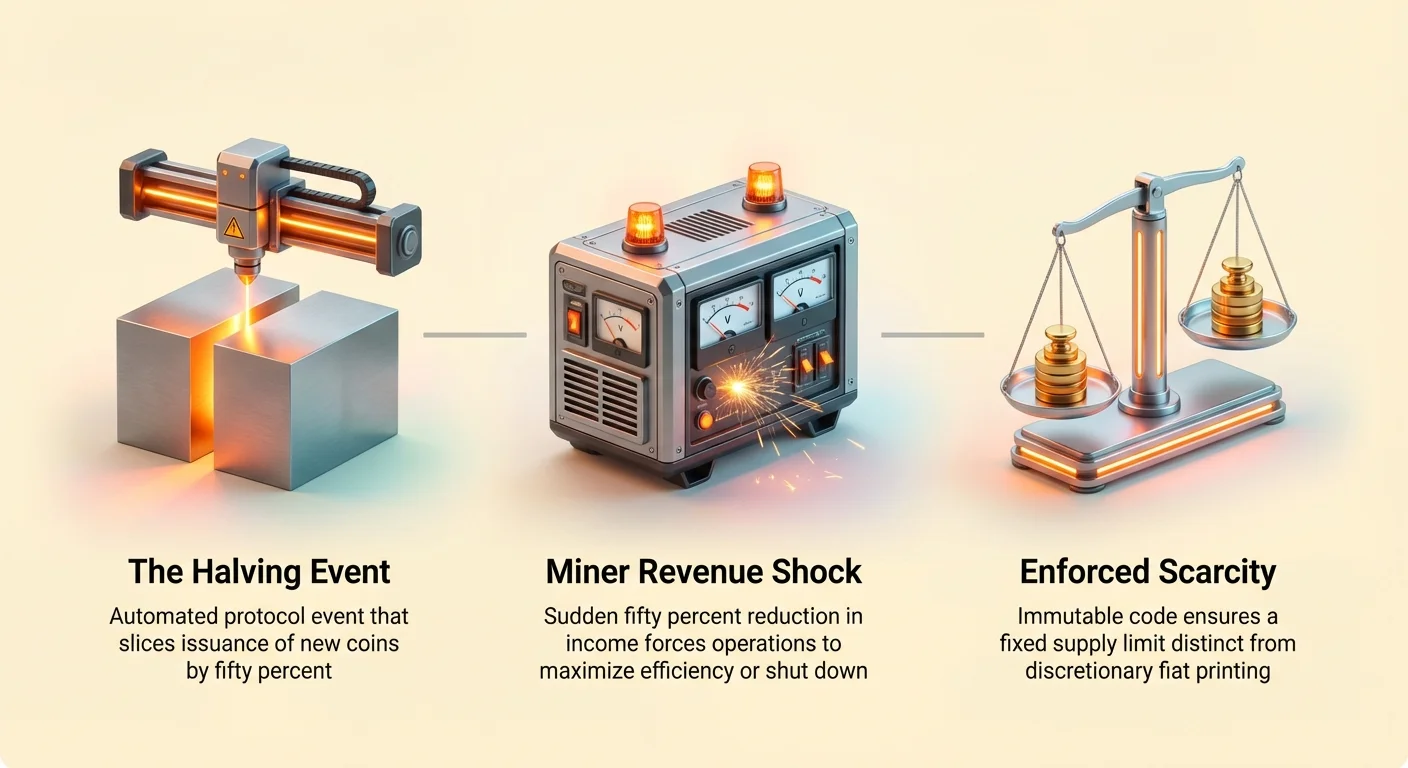
The halving is arguably the most significant economic event in the crypto ecosystem. It occurs approximately every four years and serves as a synthetic supply shock. By slicing the issuance of new coins in half, the protocol enforces a strict limit on inflation. This creates a predictable monetary policy that stands in stark contrast to the discretionary printing of fiat currencies. Understanding the halving requires looking beyond the price charts and examining the intricate technical dance between miners, nodes, and the difficulty adjustment algorithm.
This automated process is the heartbeat of the network. It dictates the security budget, influences miner behavior, and ultimately secures the 21 million supply cap. While the concept is simple—issuance goes down—the ripple effects touch every aspect of the ecosystem, from transaction fees to hardware efficiency. It is a stress test for the network and a reaffirmation of its fundamental rules.
The Architecture of Coded Scarcity
The concept of scarcity in the digital realm was an unsolved problem before the advent of blockchain technology. Digital files are naturally easily copied, leading to the double-spend problem. Bitcoin solved this through the proof-of-work consensus mechanism, but it needed a way to regulate the supply of the currency itself. The solution was a fixed supply schedule that mimics the extraction of precious metals.
The 210,000 Block Interval
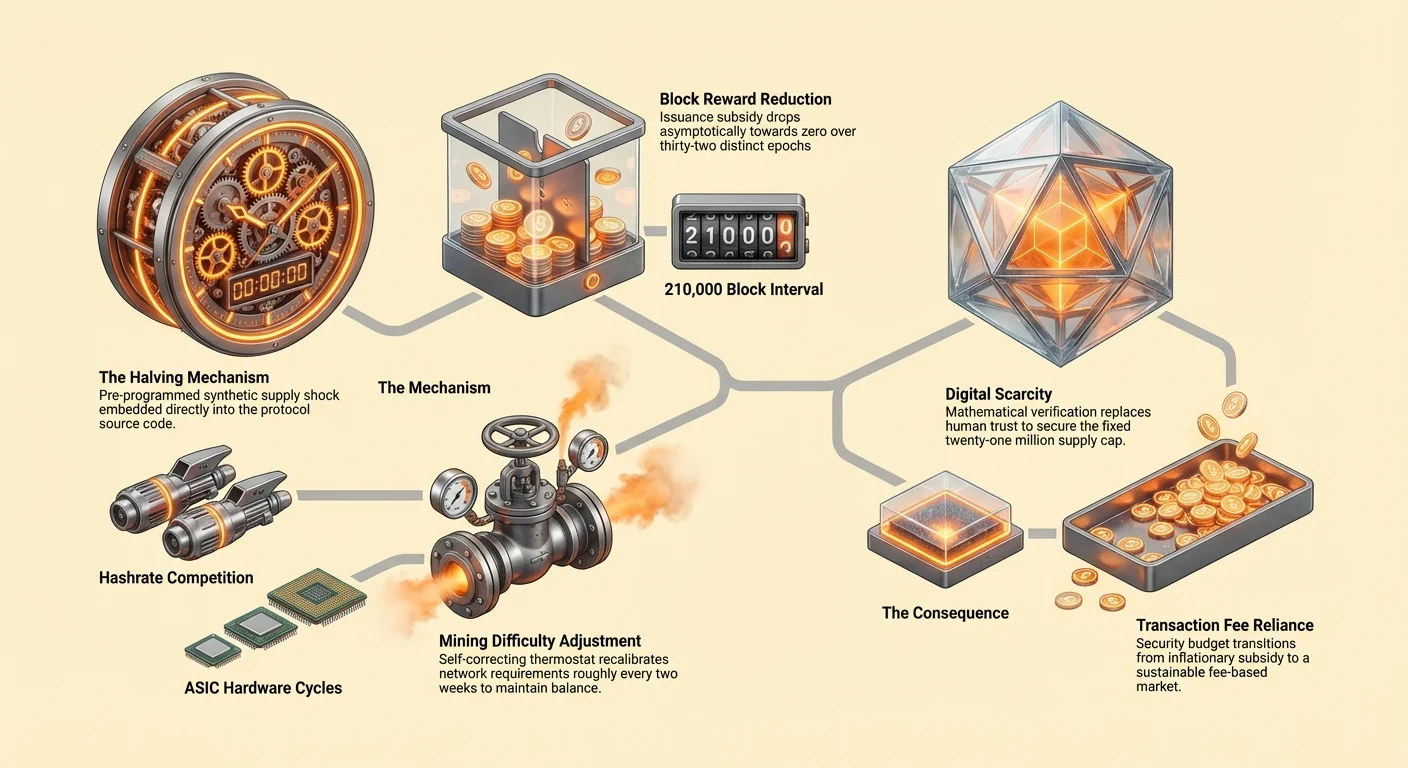
The halving does not operate on a calendar schedule. It operates on block height. The protocol is programmed to cut the block subsidy in half every 210,000 blocks. Since the network targets a ten-minute average for block discovery, this interval translates to roughly four years. However, this is an estimate rather than a guarantee. If more hashrate enters the network and blocks are found faster than ten minutes, the halving will arrive sooner.
This reliance on block height rather than wall-clock time ensures the system remains self-contained. The blockchain acts as its own clock. This internal timekeeping mechanism creates a predictable rhythm for the issuance of new currency. Participants can calculate exactly when the next supply shock will occur by observing the current block height and the average mining speed. This transparency allows the market to price in the event long before it happens.
Hard Coded Monetary Policy
In traditional finance, monetary policy is fluid. Central bankers meet periodically to decide on interest rates and quantitative easing measures based on economic data. These decisions are human, political, and reactive. In contrast, Bitcoin’s monetary policy is absolute. The reduction in supply is immutable. No emergency meeting can increase the block reward, and no economic crisis can pause the halving.
This rigid structure provides certainty to holders and miners. Mathematical verification replaces the need for trust in human decision-making. The code dictates that the reward started at 50 BTC per block. It dropped to 25, then 12.5, and continues to halve until it reaches zero. This process is asymptotic, meaning the supply grows closer and closer to the maximum limit but at an ever-decreasing rate. This design ensures that inflation is high initially to bootstrap the network but drops aggressively as the asset matures.
The Path to Zero Issuance
The halving process is finite. There will be 32 halving events in total. Once the network undergoes its final halving, expected around the year 2140, the block subsidy will drop to zero. At that point, no new bitcoins will ever be created. The incentives for securing the network will shift entirely to transaction fees.
This long-term horizon is critical for understanding the economic model. The system is designed to transition from a subsidized network to a self-sustaining fee-based market. The halving is the mechanism that drives this transition. It slowly weans the security model off of inflation and onto actual utility and demand for block space. This slow progression allows the fee market to develop naturally over more than a century.
Historical Halving Epochs
Analyzing past halving events provides insight into how the network has matured. Each epoch represents a distinct phase in the asset's lifecycle. The reduction in rewards has historically correlated with shifts in market sentiment and miner capitulation cycles, though the magnitude of these effects changes as the market capital grows.
The Early Era of High Inflation
The first epoch began with the genesis block in 2009. Miners received 50 BTC for every block they solved. This was a period of hyper-inflation designed to distribute coins widely while the value was negligible. The first halving in November 2012 reduced this to 25 BTC. This was the first test of Satoshi Nakamoto’s theory. Would miners quit if their revenue was slashed? The network survived, proving that the economic incentives were robust enough to handle a 50% revenue cut.
The second halving in July 2016 dropped the reward to 12.5 BTC. By this time, the asset had gained significant attention. The inflation rate dropped, and the discussion around the asset shifted from a peer-to-peer cash system to a store of value. The reduced supply began to attract institutional interest as the inflation rate became comparable to major fiat currencies.
Recent Cycles and Maturation
The third halving occurred in May 2020, reducing the reward to 6.25 BTC. This event happened amidst global economic uncertainty, highlighting the asset's decoupled nature. The inflation rate dropped below 2%, making it competitive with central bank targets. The fourth halving in April 2024 further reduced the issuance to 3.125 BTC. With this reduction, the inflation rate dropped to approximately 0.85%, making the asset scarcer than gold in terms of annual supply growth.
| Halving Event | Year | Block Reward | Annual Inflation (Approx) |
|---|---|---|---|
| Launch | 2009 | 50 BTC | N/A |
| First | 2012 | 25 BTC | 12% -> 4% |
| Second | 2016 | 12.5 BTC | 4% -> 3% |
| Third | 2020 | 6.25 BTC | 3.5% -> 1.7% |
| Fourth | 2024 | 3.125 BTC | 1.7% -> 0.85% |
| Fifth (Est) | 2028 | 1.5625 BTC | < 0.5% |
The Proof-of-Work Security Model
The halving is inextricably linked to the consensus mechanism known as Proof-of-Work (PoW). PoW is the engine that secures the ledger, and the block reward is the fuel. Miners expend real-world resources in the form of electricity and hardware depreciation to solve cryptographic puzzles. The halving directly impacts their compensation for this service.
Energy and Consensus
Miners compete to find a hash that meets the network's difficulty target. This process is energy-intensive by design. It creates a physical cost to forge the history of the ledger. If an attacker wants to rewrite the blockchain, they must expend an amount of energy equal to the honest miners. This cost provides the security of the network.
When the halving occurs, the "payment" for this security is cut in half. If the price of the asset does not double to compensate, the security budget effectively drops in the short term. This pushes less efficient miners off the network. Only those with the cheapest electricity and the most modern hardware can survive. This constant culling of inefficiency ensures that the mining industry remains highly competitive and industrialized.
The Difficulty Adjustment
The network has a built-in thermostat called the difficulty adjustment. If the halving causes a significant number of miners to shut down their machines, the total hashrate of the network drops. This would normally cause blocks to be found much slower than the ten-minute target. To prevent the network from stalling, the protocol adjusts the mining difficulty every 2,016 blocks, or roughly every two weeks.
If blocks are coming in too slowly, the difficulty decreases, making it easier to mine. This invites miners back into the fold. If blocks are too fast, difficulty increases. This self-correcting mechanism ensures that the halving does not break the network's functionality. Even if 50% of miners quit overnight due to a reward reduction, the network would simply recalibrate two weeks later, and block production would return to normal.
Miner Economics and The Supply Shock
For mining operations, the halving is a known existential threat that requires years of planning. It is a supply shock that specifically targets the producers of the commodity. While investors may cheer for reduced supply, miners face a sudden 50% reduction in revenue while their operational costs remain the same.
Revenue Compression
Mining is a game of margins. Revenue is derived from the block reward plus transaction fees. When the block reward halves, the primary source of income evaporates. If a miner was operating with a 40% profit margin pre-halving, they instantly become unprofitable post-halving unless the market price increases.
This compression forces consolidation. Large-scale operations with economies of scale tend to absorb the market share of smaller, less efficient players. It also drives the geographic migration of hashrate to areas with the absolute lowest energy costs. The halving relentlessly drives the industry toward maximum efficiency, removing waste and redundancy from the sector.
Hardware Efficiency Cycles
The halving cycle dictates the hardware cycle. Manufacturers of Application-Specific Integrated Circuits (ASICs) race to release more efficient machines ahead of halving events. Miners must upgrade their fleets to stay competitive. An older machine, like an Antminer S9, might be profitable when the reward is 12.5 BTC but becomes electronic waste when the reward drops to 6.25 BTC.
This creates a capital-intensive environment where miners must constantly reinvest profits into new technology. They cannot sit on their hands. The coded scarcity forces them to innovate or die. This results in a network that becomes more energy-efficient per hash over time, as the hardware used to secure it becomes orders of magnitude more capable with each epoch.
The Role of Transaction Fees
As the block subsidy diminishes through successive halvings, transaction fees play an increasingly vital role. Eventually, fees will replace the subsidy entirely. This transition changes the security model from one based on inflation to one based on market demand for block space.
Mempool Dynamics
The mempool (memory pool) is the waiting room for unconfirmed transactions. Because blocks have a limited size (1MB data, 4MB weight), there is a hard limit on how many transactions can be confirmed every ten minutes. When users broadcast transactions, they attach a fee. Miners, acting rationally, select the transactions with the highest fees to include in the next block.
During periods of high network usage, the mempool fills up. Users must outbid each other to get their transactions confirmed. This auction mechanism ensures that the most valuable economic activity is prioritized. As the block reward shrinks, miners become more dependent on a full mempool to remain profitable. The halving incentivizes miners to support scaling solutions or larger blocks that might increase total fee revenue, although the protocol rules strictly limit block size to preserve decentralization.
The Fee Market Evolution
In the early days, fees were negligible. Today, during bull markets, fees can exceed the block subsidy in value. This is a glimpse into the future. The halving forces the ecosystem to accept that block space is a scarce resource. If the network is valuable, people will pay to use it.
This shift has implications for users. It encourages the use of batching transactions and Layer-2 solutions like the Lightning Network. By moving smaller, everyday transactions off the main chain, users can avoid high fees while still benefiting from the security of the base layer. The base layer evolves into a settlement network for high-value transfers, where paying a premium fee is acceptable for the finality and security provided.
Network Enforcement and Decentralization
Miners may produce blocks, but they do not rule the network. The true power lies with the nodes. A Bitcoin node is a computer that runs the software, validates transactions, and maintains a full copy of the blockchain. Nodes are the referees that enforce the rules of the halving.
Full Nodes as Gatekeepers
If a powerful group of miners decided to ignore the halving and continue awarding themselves 50 BTC per block, the rest of the network would reject them. Full nodes independently verify every block. If a block contains a transaction that violates the supply schedule, the node marks it as invalid and ignores it. It does not matter how much hashrate the miners have; if they break the rules, they are mining a fork, not Bitcoin.
This system of checks and balances ensures that the scarcity is enforced by the users, not the producers. Running a node allows an individual to verify the total supply without trusting a third party. This decentralization is what makes the 21 million cap credible. It is not just a promise; it is a rule enforced by thousands of independent computers around the world.
Immutable Rules
Changing the halving schedule would require a hard fork, which effectively creates a new currency. The economic majority of the network—exchanges, merchants, and users—would have to agree to switch to this new version. History has shown that the community strongly resists changes to the core monetary policy.
The "block size wars" and other governance disputes have demonstrated that the network is resistant to contentious change. This calcification is a feature, not a bug. It ensures that the deflationary nature of the currency cannot be tampered with by inflationists or corporate interests. The code that dictates the halving is considered sacrosanct by the node operators who secure the network.
Comparing Bitcoin to Traditional Assets
The halving mechanism highlights the fundamental difference between algorithmic money and traditional financial assets. Understanding these distinctions clarifies why the supply shock is unique in the landscape of global finance.
Fiat Inflation vs. Coded Deflation
Fiat currencies are inflationary by design. Central banks target a positive inflation rate, typically around 2%, to encourage spending. They achieve this by expanding the money supply. During crises, this expansion can accelerate rapidly, devaluing the savings of holders. There is no cap on how much fiat can be printed.
Bitcoin operates on the opposite premise. It is disinflationary, meaning the inflation rate decreases over time until it hits zero. The halving is the tool that enforces this. It removes the human element from the equation. There is no governor to lobby for more printing. This predictability creates a store of value proposition similar to gold but with a strictly verifiable supply schedule that cannot be faked or discovered in new large deposits.
Gold and Stock-to-Flow
Gold has been the standard for scarcity for millennia. Its annual supply growth is roughly 1.5% to 2% based on mining output. However, gold has an elastic supply response. If the price of gold triples, miners will invest in new equipment to dig deeper and mine faster, eventually increasing the supply and lowering the price.
Bitcoin has an inelastic supply. If the price triples, the hashrate may triple, but the difficulty adjustment ensures that the issuance rate remains exactly the same. No amount of investment or energy can force the protocol to release more coins than the schedule allows. Following the 2024 halving, the asset's stock-to-flow ratio—a measure of scarcity—surpassed that of gold. This mathematical reality positions it as the hardest money ever discovered or invented.
Conclusion
The Bitcoin Halving is more than a technical reduction in mining rewards; it is the automated enforcement of a monetary philosophy. By systematically reducing the issuance of new supply, the protocol creates a predictable and transparent economic environment that is immune to political interference. This mechanism ensures that the asset remains scarce, distinguishing it sharply from fiat currencies that are subject to unlimited inflation. The interdependence of miners, the difficulty adjustment, and node validators creates a robust system where the rules are enforced by code rather than decree.
As the network progresses through its scheduled epochs, the importance of the halving shifts from defining inflation to testing the sustainability of the fee market. Each event brings the ecosystem closer to its final form: a self-sustaining, decentralized economy secured by the value of the transactions it processes. The halving remains the ultimate demonstration of the network's reliability, executing its function without fail every four years, regardless of market conditions or global events.
The halving guarantees mathematical scarcity, proving that money can exist without a central authority to manage its supply.